
Benefits of Third-Party Advocacy Developers for U.S. Projects

For most contested U.S. land-use, infrastructure, and energy projects, hiring a third-party public affairs firm is the right move. Early, structured advocacy shortens permitting timelines, reduces the risk of costly appeals, and gives project owners narrative control before filings become public record. The three decisive advantages are permitting acceleration, stakeholder risk reduction, and media and digital management. Projects that benefit most from outside advocacy include:
Entitlements facing organized community opposition or politically sensitive siting
Multijurisdictional permitting where no single internal team holds all the agency relationships
Projects with tight financing schedules where delays trigger material cost overruns
Energy and infrastructure developments requiring environmental review coordination with lead agencies
Pro Tip: Engage your public affairs firm before any application hits the public record. Once filings are visible, you are already playing defense.
Table of Contents
What are the core benefits of third-party advocacy developers for permitting?
How do you measure ROI and set milestones executives will accept?
What did the Long Beach Courthouse project teach us about early engagement?
How do you integrate an outside advocacy team with your internal governance?
Why campaign-style advocacy changes the outcome for land-use projects
Amautapublicaffairs: permitting support and community engagement for your project
What are the core benefits of third-party advocacy developers for permitting?
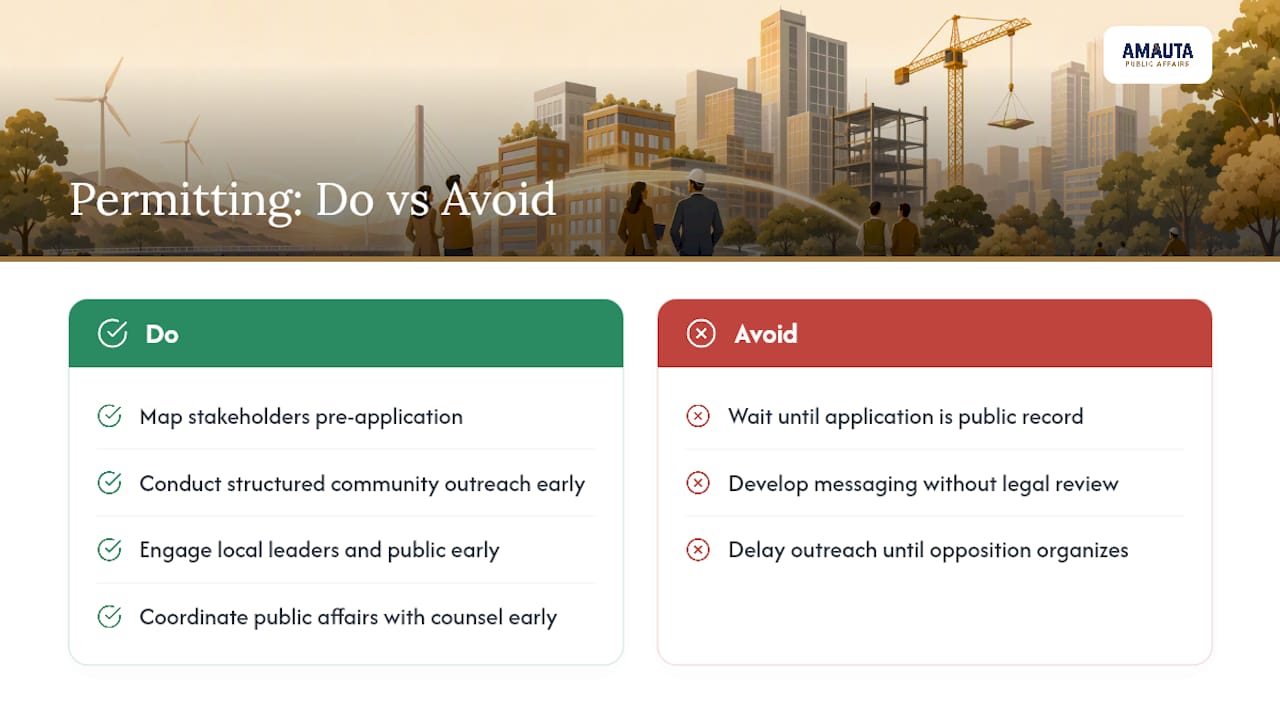
The single most measurable benefit is shorter review cycles, achieved through early narrative control and targeted stakeholder outreach before opposition organizes. When a firm maps the stakeholder landscape at the pre-application stage, it identifies likely objectors and shapes the public record in your favor, rather than reacting to it.
Structured community outreach saves months and reduces costs by avoiding appeals, redesigns, and litigation, particularly in jurisdictions with influential neighborhood councils. The mechanism is straightforward: a stakeholder who has been heard and addressed is far less likely to file an appeal or appear at a hearing with organized opposition.
Early, meaningful engagement with local political leaders and the public reduces controversy and minimizes permitting delays. Meridiam’s Long Beach Courthouse project demonstrated exactly this, succeeding through coordinated outreach with the Administrative Office of the Courts during environmental review.
Media and digital advocacy compound the effect. A well-timed op-ed, a targeted digital campaign reaching residents in the project’s zip code, or a coalition letter from credible community organizations can shift the tone of a public hearing before a single comment card is submitted. The role of community engagement strategy in shaping those outcomes is well documented for projects across real estate, energy, and infrastructure sectors.
Greenspoon Marder LLP advises developers to treat public relations as a prerequisite for entitlements and to coordinate PR strategy with legal counsel while plans are still being drafted. Waiting until an application is public record forces the project team onto the defensive, often at the worst possible moment.
Pro Tip: Coordinate your public affairs engagement with outside counsel from day one. Messaging developed without legal review can create record problems during CEQA or NEPA review.
How do you measure ROI and set milestones executives will accept?
The most defensible KPI approach combines milestone-based reporting with quantitative indicators tied to cost avoidance. Public affairs measurement guidance from PAC recommends aligning metrics with senior management language, specifically the vocabulary of CFOs and general counsel: costs avoided, freedom to operate, and stakeholder engagement trends over time.
Sample KPIs for a typical entitlement stage:
Stakeholder meetings secured (target: X meetings with identified decision-makers by filing date)
Media sentiment shift (baseline negative coverage percentage vs. post-campaign percentage)
Permit milestones met on schedule (number of hearings passed without continuance)
Appeals avoided (zero formal appeals filed within the challenge window)
Days saved vs. baseline schedule (compared to comparable projects without structured outreach)
For CFO reporting, translate those outputs into dollar terms. A single 30-day permitting delay on a $50 million project carries real holding, financing, and labor costs. Avoided appeals eliminate legal fees and months of schedule risk. Aligning research deliverables with ROI-focused reporting dashboards gives finance teams the granular evidence they need to justify the advocacy budget line.
PAC also recommends tracking year-to-year performance to show continuous improvement on long-running projects, not just point-in-time wins.
How do you pick the right third-party advocacy firm?
The three non-negotiable selection criteria are demonstrated permitting experience, verifiable local relationships, and transparent milestone-based reporting. Firms that cannot produce case studies showing specific permitting outcomes, not just general community goodwill, are not ready for contested entitlement work.
Evaluation checklist:
Case studies with named projects, jurisdictions, and permitting outcomes
Team bios showing prior agency relationships in the relevant market
References from project owners, not just community partners
Written compliance protocols for lobbying registration and disclosure
Sample reporting dashboard from a prior engagement
Interview questions worth asking every finalist:
Name a project where you faced organized opposition. What was the outcome and what did you measure?
How do you coordinate messaging with outside legal counsel to protect the administrative record?
What is your reporting cadence during active permitting, and who receives the reports?
How do you select and vet community coalition partners for defensibility?
Red flags to disqualify a firm quickly: no measurable milestones in the proposed scope, vague references to “relationships” with no documented outcomes, coalition partners that cannot withstand scrutiny at a public hearing, and a reporting cadence of monthly or less during active permitting phases.
Developers choose partners that are visible, credible, and defensible under scrutiny, not simply well-connected. That standard applies equally to the advocacy firm itself.
Pro Tip: Ask every finalist for a sample milestone memo from a prior project. The quality of that document tells you more about their reporting discipline than any proposal.
What did the Long Beach Courthouse project teach us about early engagement?
Early, collaborative engagement with public partners and lead agencies produced measurably faster permitting outcomes in the Long Beach Courthouse project. Meridiam, the infrastructure developer, coordinated directly with the Administrative Office of the Courts during environmental review, building a public record that reflected broad stakeholder support rather than contested opposition.
The Long Beach Courthouse project succeeded because engagement was continuous and began before controversy had a chance to form. Coordinating with the Administrative Office of the Courts during environmental review, rather than after, kept the permitting process on a constructive track.
The Bipartisan Policy Center’s analysis of this project identifies three replicable lessons:
Engage public partners, including lead agencies, before the environmental review process opens
Document public benefits explicitly and early so the record supports approval
Maintain continuous outreach through the full permitting cycle, not just at hearing dates
Energy and infrastructure project owners can apply the same framework. Coordinate your advocacy firm’s outreach calendar with your NEPA or CEQA timeline, assign a single point of contact for agency communications, and build the public record proactively.
How do you integrate an outside advocacy team with your internal governance?
Integration should preserve legal control while delegating outreach execution to the outside firm. The most common failure mode is an advocacy team that operates without clear approval gates, creating messaging inconsistencies that surface during administrative hearings.
Onboarding checklist:
Define roles and responsibilities in writing before the first public contact
Establish a single internal approver for all public-facing materials
Set reporting cadence and distribution list at contract signing
Require the advocacy firm to copy outside counsel on all agency communications
Create an escalation path for unplanned media inquiries or opposition activity
Governance template for a typical entitlement project:
Messaging approval: Project manager and outside counsel sign off on all talking points before use
Meeting authorization: Project manager approves all agency and community meetings in advance
Media response: Communications lead handles all press inquiries; advocacy firm provides draft language within four hours
Escalation: Any organized opposition activity triggers a same-day briefing to the project owner and legal team
Advocacy communications strategy works best when the internal team treats the outside firm as an extension of the project team, not a vendor operating independently.
Key Takeaways
Hiring a third-party public affairs firm accelerates permitting, reduces stakeholder risk, and produces measurable ROI when the engagement is structured around milestone-based reporting and early pre-application outreach.
Point | Details |
Engage before filings go public | Pre-application outreach shapes the public record before opposition organizes. |
Measure in cost-avoidance terms | Translate advocacy outputs into dollars saved through avoided appeals and schedule compression. |
Require milestone-based reporting | KPIs tied to stakeholder meetings, media sentiment, and permit milestones give executives defensible evidence. |
Vet for permitting outcomes, not relationships | Case studies with named jurisdictions and documented results are the only reliable selection criterion. |
Amautapublicaffairs delivers campaign-style advocacy | AMAUTA structures community engagement, media relations, and permitting support around measurable milestones for land-use and infrastructure projects. |
Why campaign-style advocacy changes the outcome for land-use projects
The conventional wisdom treats public affairs as a communications function, something you layer on after the real project work is done. That framing is wrong, and it costs project owners months and money. Advocacy is a prerequisite for permitting on any project that touches a politically aware community, and the firms that understand this treat it as a campaign, not a press release.
What that means in practice: a defined strategy before the first public contact, granular stakeholder mapping that identifies the two or three voices who actually move a planning commission, and reporting cadence that keeps the project owner and legal team informed in real time. The Long Beach Courthouse example is instructive not because it was unusual, but because it was disciplined. Meridiam did not wait for opposition to form. The lesson for project owners is that the window for proactive engagement is narrow and closes fast once an application is filed.
Amautapublicaffairs structures its engagements around this reality, using a campaign-style development outreach model that ties every deliverable to a permitting milestone. The differentiators that matter to project owners: tailored strategy built around the specific community landscape, local relationships that hold up under scrutiny, and reporting that speaks the language of CFOs and general counsel.
Amautapublicaffairs: permitting support and community engagement for your project
Amautapublicaffairs delivers the full range of public affairs services that contested U.S. land-use, energy, and infrastructure projects require: community engagement, media relations, digital advocacy, coalition building, and permitting support, all structured around measurable milestones and transparent reporting. The difference from a traditional communications retainer is specificity. Every engagement begins with a stakeholder assessment and a scoped strategy tied to your permitting calendar, not a generic outreach plan.
Project owners can start with a scoping call to map the community landscape, identify the highest-risk stakeholder groups, and define the KPIs that will demonstrate ROI to your board and legal team. Explore the full range of land-use and permitting services or review the firm’s land management advocacy practice to see how the approach applies to your project type. Contact Amautapublicaffairs to schedule that initial scoping conversation.
Sources and further reading
The following sources informed this article. All are U.S.-applicable or explicitly attributed to their jurisdiction. Project owners should confirm current lobbying registration and disclosure requirements with qualified legal counsel in their state, as compliance obligations vary by jurisdiction and activity type.
How to Measure the Value of Public Affairs
Gaining community buy-in for infrastructure projects
The Land Use Lowdown: Why PR is Your Secret Weapon for Project Entitlements
Guide to Community Outreach for Development Projects
Developer risk budgets and nonprofit engagement
This article provides general information about public affairs and advocacy practices. It is not legal advice. Confirm lobbying registration requirements and disclosure obligations with a qualified attorney in your jurisdiction before engaging a public affairs firm.
Recommended
Comments