
How to Build Neighborhood Trust for a New Development Project

The single highest-impact move for any land-use project is to begin with values-clarification before any design decisions are final, then run transparent, tiered engagement tied to measurable outcomes. Starting engagement after design is locked in is the most common failure point — and the hardest to recover from. Here is what your team can do in the next 7–14 days:
Identify three to five neighborhood organizations or faith leaders who hold credibility with residents most affected by the project.
Publish a one-page project overview with a clear timeline and a plain-language FAQ on your project website or a public-facing landing page.
Schedule one listening session — not a presentation — within 14 days, held at a time and location accessible to working residents.
Draft a brief scope-of-work document naming your engagement tier, objectives, and reporting cadence.
Assign an internal community liaison who owns all resident-facing communications.
For teams that want a structured, campaign-style approach from day one, AMAUTA Public Affairs provides the stakeholder mapping, facilitation, and evaluation infrastructure to move faster and with less conflict.
Key Takeaways
Early, values-clarification-led engagement tied to documented tiers, transparent reporting, and real-time evaluation is the most reliable pathway to securing durable neighborhood support for land-use and development projects.
Point | Details |
Start with values-clarification | Begin engagement before design decisions are final; shared goals reduce conflict and shape better outcomes. |
Document your engagement tier | A written scope of work naming tiers, deliverables, and reporting cadence is a concrete trust signal for residents and regulators. |
Map and partner early | Trusted intermediaries — faith leaders, neighborhood associations, equity-focused groups — are credibility bridges no project team can replace. |
Publish “what we heard” reports | Closing the feedback loop in writing, after every major event, is the single most effective transparency tool available. |
Amautapublicaffairs as your partner | AMAUTA Public Affairs provides campaign-style engagement, media relations, digital advocacy, and evaluation infrastructure for land-use projects. |
Table of Contents
Who matters: stakeholder mapping and recruiting trusted local partners
What engagement tactics actually work for complex land-use projects
What to publish, when, and how to keep communications credible
Designing engagement to include historically underrepresented residents
How to measure engagement success and when to change tactics
Who does what: internal team roles, partners, and public commitments
How a campaign-style engagement approach delivers measurable neighborhood trust
Why the conventional wisdom on community engagement is wrong
AMAUTA Public Affairs: campaign-style engagement for land-use projects
How to build neighborhood trust for a new business or development project: define your scope and engagement tier first
Clear objectives are the prerequisite for any credible community engagement plan. Without them, outreach becomes performative, and residents notice. The Nashville Community Engagement Playbook describes a tiered engagement model that scales methods and resources to the stakes and complexity of each project — a useful framework for any project team.
**Engagement tiers at a glance: **
Tier 1 (Inform): One-way communication for low-stakes, low-complexity projects. Newsletters, fact sheets, website updates.
Tier 2 (Consult): Structured feedback collection. Surveys, public comment periods, open houses.
Tier 3 (Involve): Iterative dialogue. Workshops, charrettes, advisory committees, co-design sessions.
Tier 4 (Collaborate/Empower): Shared decision-making. Community-led visioning, joint governance structures, resident-led working groups.
Most land-use and infrastructure projects fall in Tiers 3–4. Your scope-of-work document should name the tier, list specific deliverables, identify decision points where community input directly shapes outcomes, and include a reporting cadence. Budget line-items typically cover staff time, event logistics, translation and interpretation, paid media, and evaluation. A Tier 3 engagement for a mid-size project in a single neighborhood might realistically require several hundred hours of staff time over about a year, plus event and translation costs.
Who matters: stakeholder mapping and recruiting trusted local partners
Stakeholder mapping is not a one-time exercise — it is a living document that shapes every outreach decision. Build a matrix that captures each stakeholder’s level of influence, level of interest, and the trusted intermediaries who can reach them. Categories to include:
Identify decision-influencers: Elected officials, planning commissioners, and agency staff who hold formal authority over permits and approvals.
Identify service-influencers: Neighborhood associations, faith congregations, school PTAs, local business improvement districts, and Tribal governments where applicable.
Identify equity-focused groups: Organizations serving low-income residents, immigrants, seniors, and people with disabilities — groups historically left out of land-use processes.
Map trusted intermediaries: Community health workers, youth organizers, and cultural liaisons who can reach residents your team cannot reach directly.
Approach skeptics early: Request a listening visit before any formal meeting. Acknowledge concerns without deflecting. Offer a small, concrete ask — a co-hosted event, a seat on an advisory committee — to signal genuine partnership.
Early, inclusive outreach that coordinates with permitting timelines reduces protests, appeals, and litigation while producing decisions that hold up over time.
Pro Tip: Use trusted intermediaries as credibility bridges, not messengers. Invite them to co-design the engagement process itself — not just to distribute flyers. When residents see their trusted leaders shaping the process, skepticism drops measurably.
What engagement tactics actually work for complex land-use projects
Choosing the right tactic depends on your engagement tier, project stage, and available resources. The table below maps common methods to their best use.
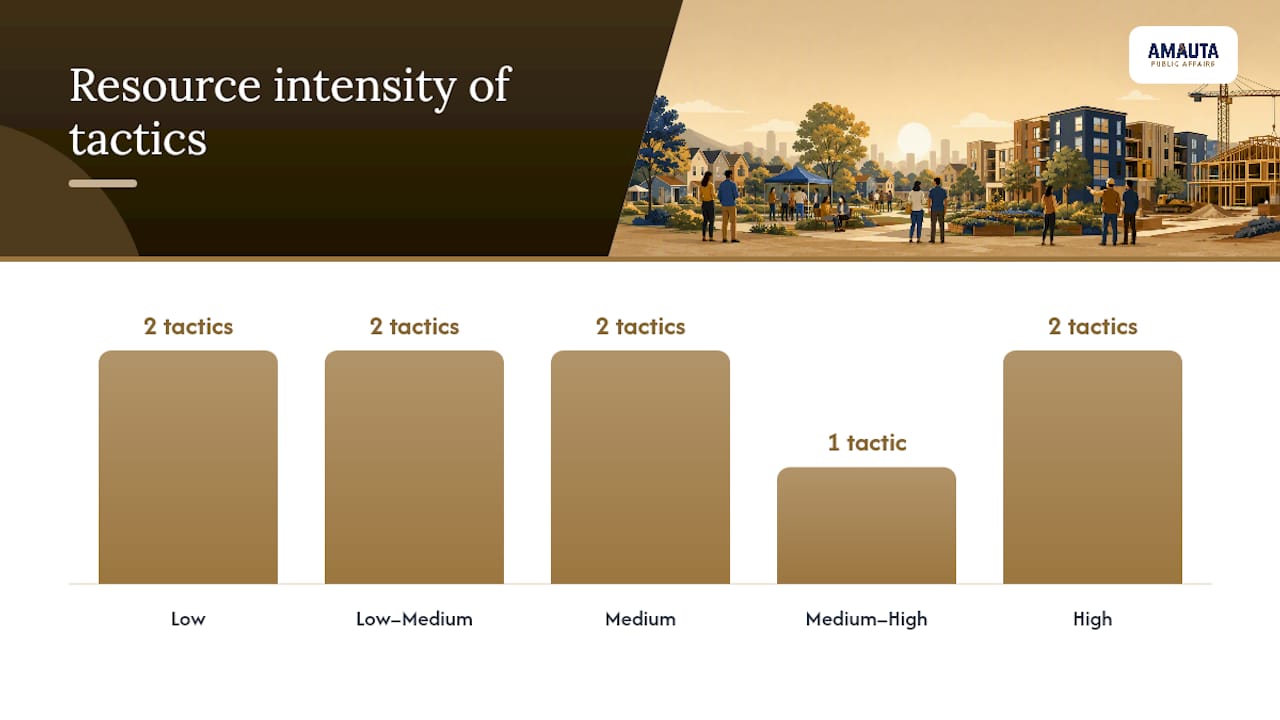
Tactic | Best Project Stage | Resource Intensity |
Values-clarification workshop | Pre-design, planning | Medium |
Design charrette | Schematic design | High |
Pop-up tabling (parks, markets) | Any stage | Low |
Office hours (drop-in) | Permitting, construction | Low |
Walking audit | Pre-design | Low–Medium |
Stakeholder advisory committee | Planning through construction | High |
Targeted roundtables | Permitting, conflict resolution | Medium |
Door-knocking and phone outreach | Pre-design, pre-vote | Medium–High |
Virtual town halls and webinars | Any stage | Low–Medium |
A charrette works best when design options are genuinely open. Pop-up tabling at a farmers market or community event reaches residents who will never attend a formal meeting. Advisory committees provide continuity but require a clear charter and a genuine commitment to act on recommendations. The PACE framework for trust-building — Participation, Accountability, Communication, and community benefits — offers a useful lens for evaluating whether your tactic mix is actually building trust or just generating attendance numbers.

Pro Tip: Sequence tactics to escalate participation gradually. Start with low-barrier formats (pop-ups, surveys) to build familiarity, then move to higher-commitment formats (charrettes, advisory committees) once residents see their input reflected in project updates. Jumping straight to a formal public hearing without prior relationship-building is a reliable path to polarization.
What to publish, when, and how to keep communications credible
Transparency is not a value statement — it is a publishing schedule. Open access to timelines, expected impacts, and safety measures is a foundational trust-building practice for infrastructure projects of any scale.
Publish and maintain the following:
Project timeline: Key milestones, decision points, and permit submission dates — updated when they change.
Process map: A visual showing where community input enters the decision process and what happens to it. Residents need to see that their participation matters.
“What we heard” reports: After every major engagement event, publish a plain-language summary of themes, concerns, and how the project team responded. This single artifact does more to close the feedback loop than any other communication tool.
FAQ: Updated continuously as new questions surface.
Impacts and mitigations: Plain-language descriptions of anticipated disruptions and the specific measures in place to address them.
For channels, use a combination of a project website, email list, social media (Facebook and Nextdoor tend to reach neighborhood audiences most effectively), printed flyers in multiple languages, and in-person contact. All materials must meet ADA accessibility standards and be available in the languages spoken by affected residents. For guidance on transparent communication in development plans, the principles apply across project types.
Designing engagement to include historically underrepresented residents
Equitable engagement is not a compliance checkbox — it is the difference between a process that produces durable community support and one that produces a lawsuit. A community-centric outreach plan with equity built in reaches populations that standard outreach misses and produces more legitimate outcomes.
Equity checklist:
Language access: interpretation at all meetings, translated materials for all written communications.
Childcare: on-site childcare at evening and weekend events.
Transportation: shuttle service or transit passes for residents without vehicles.
Compensation: stipends for resident advisory committee members and focus group participants.
Meeting timing: schedule events outside standard 9-to-5 hours.
Trusted intermediaries: partner with organizations already serving underrepresented residents.
Data privacy: explain clearly how participant information will be used and stored.
Pro Tip: Work with community organizations to co-design accommodations rather than announcing them. Ask directly: “What would make it possible for your members to participate?” The answers are often simpler and cheaper than what project teams assume — and residents trust a process they helped design.
For practical guidance on engaging underserved community residents, co-design principles apply across housing, energy, and infrastructure contexts.
How to measure engagement success and when to change tactics
Evaluation should be built into the engagement plan from day one, not retrofitted after a public hearing goes badly. Key performance indicators worth tracking:
Reach: Number of unique residents contacted, by channel and demographic group.
Representative participation: Whether participants reflect the demographic makeup of the affected area.
Sentiment tracking: Themes from feedback forms, comment cards, and social media monitoring.
Input-to-decision traceability: Can you show, in writing, how community input changed a project decision?
Grievance counts: Number of formal complaints received and resolution time.
Collect data at every event: sign-in sheets with optional demographic fields, brief feedback forms, and facilitator notes on recurring themes.
Publishing evaluation results and quarterly updates — even when the news is mixed — builds the kind of ongoing trust that sustains a project through construction and beyond. Projects that maintain a visible local presence throughout construction prevent misinformation and preserve the relationships built during the planning phase.
Who does what: internal team roles, partners, and public commitments
Engagement without clear accountability collapses under pressure. Every project team needs these roles filled, whether by staff or contracted partners:
Project lead: Owns the overall engagement strategy and budget.
Community liaison: Primary point of contact for residents and partner organizations; attends community events.
Communications lead: Manages all published materials, social media, and media inquiries.
Data lead: Owns sign-in sheets, feedback analysis, and evaluation reporting.
Legal/permitting contact: Tracks how engagement outputs connect to permit conditions and regulatory requirements.
External facilitator: Neutral third party for high-stakes sessions like charrettes and advisory committee meetings.
Grievance handling follows four steps: acknowledge receipt within 48 hours, investigate the concern, respond with a specific answer or action, and publish the outcome in the next “what we heard” report. Commitments made during engagement — design changes, mitigation measures, ongoing communication — belong in the scope-of-work document and should be published publicly. Residents who can point to a written commitment hold the project team accountable in a way that builds, rather than undermines, trust.
Sample 6–18 month engagement timeline and rough cost guide
The table below shows a phased timeline with resource intensity by activity.
Cost bands are illustrative and vary by project scale, geography, and engagement tier. Translation, paid media, and external facilitation are the most variable line-items. Before moving from one phase to the next, confirm that participation is representative, that input has been documented and responded to, and that the advisory committee has reviewed the “what we heard” summary.
For guidance on resident engagement strategy before capital projects, the phasing logic applies across infrastructure types.
How a campaign-style engagement approach delivers measurable neighborhood trust
The most effective engagement programs follow a campaign logic: assess the landscape, clarify shared values, run targeted outreach, evaluate in real time, and maintain a visible presence through project completion. This is the workflow that trust-building campaigns for land-use leaders use to convert skepticism into durable support.
AMAUTA Public Affairs maps its services directly to the outcomes project teams need:
Community engagement and facilitation: Values-clarification workshops, charrettes, advisory committee management, and pop-up outreach designed to surface genuine community priorities.
Media relations and strategic messaging: Proactive local media outreach, spokesperson preparation, and narrative development that keeps the project story accurate and credible.
Digital advocacy: Social media management, targeted digital outreach, and online engagement platforms tailored to the specific neighborhood and demographic.
Coalition building: Recruiting and sustaining partnerships with community-based organizations, faith leaders, and equity-focused groups.
Evaluation and reporting: KPI tracking, “what we heard” reports, quarterly updates, and final engagement evaluations that document outcomes for permitting and public record.
The result: reduced permit delay risk, stronger local relationships, and a documented record of meaningful participation that holds up in regulatory review.
Why the conventional wisdom on community engagement is wrong
Most project teams treat community engagement as a risk-management exercise — something to do enough of to satisfy a permit condition. That framing produces the minimum viable process, and residents can tell. The projects that actually secure durable neighborhood support treat engagement as a co-design process, not a compliance task.
The deeper problem is sequencing. Teams that present a near-final design and then ask for feedback are not engaging the community — they are auditioning for approval. Values-clarification inverts this: start with shared goals (safety, economic opportunity, environmental quality), then shape technical solutions around them. The difference in community response is not marginal. It is the difference between a project that moves through permitting and one that stalls in litigation.
The other underestimated variable is presence. A project team that shows up only for formal meetings and disappears during construction is signaling, loudly, that the engagement was performative. Maintaining a visible, accessible local presence through construction — office hours, construction updates, a named contact residents can actually reach — is what converts a successful engagement process into a lasting community relationship.
AMAUTA Public Affairs: campaign-style engagement for land-use projects
When a land-use project needs more than a public meeting, AMAUTA Public Affairs delivers the full campaign infrastructure: stakeholder mapping, values-clarification facilitation, media relations, digital advocacy, coalition building, and evaluation-driven reporting. The difference from a standard consulting engagement is the campaign-style approach — real-time feedback loops, targeted outreach, and messaging refined continuously based on what is actually working in the field.
Project teams working with AMAUTA get a documented scope of work, a named community liaison, and a public-affairs partner who stays engaged from planning through construction. To discuss your project and scope a community engagement plan, visit AMAUTA’s services page or reach out directly for a project scoping conversation.
Sources
Recommended
Comments