
Community Engagement Plan With 90-Day Starter for Land-Use Teams

A community engagement plan is a documented roadmap naming your objectives, the stakeholders you’ll reach, your timeline, and how you’ll measure whether input actually shaped the outcome. Its primary output is a set of clear goals, defined roles, and a working feedback loop stakeholders can hold you to. If you’re starting today, write one SMART objective for your next milestone, or sketch a basic stakeholder map before adding anything else.
TL;DR:
A community engagement plan should include specific goals, a stakeholder map, engagement methods, a timeline, a budget, roles, and evaluation strategies.
Implementing the plan in four phases—setting the stage, getting started, maintaining activities, and wrapping up—ensures continuous progress and adaptation.
Mapping stakeholders requires identifying those historically excluded and explicitly funding participation supports to increase diversity and influence.
Selecting engagement methods must match the desired involvement level, considering logistics and accessibility for digital and low-tech options.
Using structured tools and a clear 30/60/90-day timeline with assigned ownership supports effective planning and follow-through, especially for complex land use projects.
Table of Contents
What Belongs in a Professional Community Engagement Plan
A plan earns its name only when it covers seven mandatory elements. Skip one, and the document becomes a vague intention rather than a working tool. The ATSDR Community Engagement Playbook frames these as the baseline for any accountable engagement effort, whether the project involves a rezoning fight, a substation, or a mixed-use development.
The core components:
Goals and SMART objectives tied to each project phase, not just a single end state.
A stakeholder map that names priority groups, including those historically left out of the process.
Engagement methods and accessibility accommodations, spanning in-person, digital, and low-tech channels.
A timeline with milestones that anchor activities to real project decision points.
Budget and resource lines covering staff time, materials, translation, and participation supports.
Roles and accountability, specifying who owns each commitment and who approves it.
Evaluation and documentation, so results get reported back rather than filed away.
Each of these functions as a checkpoint. A land use team preparing for a contentious permitting hearing can run this list against its draft plan in twenty minutes and immediately see where the gaps sit, usually in the budget line or the accountability column.
How to Roll Out an Engagement Plan in Four Phases
Engagement rarely succeeds as a single event. The ATSDR playbook frames it as a sequence: defining goals, characterizing the community, selecting activities, and updating the plan based on feedback. That sequence maps cleanly onto four operational phases most land use and infrastructure teams already use, whether they call them that or not.
Setting the stage. Assemble your internal team, build a community profile, and make first contact with anchor organizations. This phase closes when you have named stakeholders and a draft timeline, not a finished plan.
Getting started. Run your first events, co-create priorities with residents, and lock in partner agreements with community-based organizations. First community visits happen here, and they set the tone for everything after.
Keeping it going. Sustain regular activities, adjust tactics based on turnout and feedback, and document every commitment as you make it. Data collection and ongoing analysis typically anchor this phase.
Wrapping up. Deliver a final report, close the loop on outstanding commitments, and decide which relationships need to continue past project completion.
Well-documented milestones at each phase transition, first contact, first visit, data collection, and final reporting, give you natural checkpoints to refresh the plan. Refresh it whenever a milestone passes, a stakeholder group changes, or feedback contradicts your assumptions. A plan that never changes after month one was never really a plan.
Mapping Stakeholders Without Missing the Quiet Voices
Standard stakeholder mapping sorts people by influence and interest, but that grid alone tends to surface only the loudest, most organized groups. The harder and more valuable work is identifying who is structurally missing from the room and asking why before you finalize your list.
Plot stakeholders on influence versus interest, then add a third lens: historical inclusion in past decisions affecting the same area.
Budget explicitly for participation supports, translation, childcare, transportation stipends, rather than treating them as optional add-ons.
Build power-sharing into the structure through co-design sessions, compensated advisory roles, or resident-led working groups.
Document consent and participation records so commitments made in a meeting don’t evaporate by the next one.
Regional equity toolkits note that teams who fund participation supports see higher and more diverse turnout, along with feedback that carries more weight in front of decision makers.
Pro Tip: Ask your stakeholder map who was consulted on the last three projects in the same area. If the same five names keep appearing, you have a mapping problem, not an engagement problem.
Choosing Methods That Match Your Engagement Goal
Method selection should follow the level of engagement you’re actually trying to achieve, not the tools your team happens to already own. The familiar ladder runs from inform to consult to involve to collaborate to empower, and each rung calls for different tactics.
Inform: fact sheets, project websites, mailed notices.
Consult: surveys, comment periods, open houses.
Involve: focus groups, working sessions, structured feedback loops.
Collaborate: co-design workshops, advisory committees with real decision input.
Empower: resident-led steering groups with budget or veto authority over specific decisions.
Logistics decide whether any of this works. Venue accessibility, evening and weekend timing, translated materials, and safe transit routes matter more than the polish of your slide deck. Digital tools like online surveys or mapping platforms extend reach, but low-tech alternatives, printed comment cards, phone lines, still matter for residents without reliable internet. Sequence lighter methods early and heavier co-design methods once trust has had time to build.
Setting Timelines, Roles, and a Realistic Budget
A milestone timeline typically clusters activity around key project decision points: initial scoping, first community visit, data collection windows, and final reporting. Build your calendar around those anchors rather than arbitrary monthly check-ins.
Assigning ownership works best through a RACI structure, naming who is Responsible, Accountable, Consulted, and Informed for each task. A well-built RACI matrix prevents the common failure where three people think someone else is handling stakeholder follow-up.
Typical budget categories include:
Staff time for outreach and facilitation.
Venue rental, materials, and translation services.
Participation stipends and childcare support.
Contingency funds for added meetings when feedback demands them.
Spend in phases rather than committing the full budget upfront, and document every financial commitment made to a partner organization in writing.
Writing SMART Objectives That Close the Feedback Loop
SMART objectives, Specific, Measurable, Achievable, Relevant, and Time-bound, give teams a way to know whether engagement worked, not just whether it happened. An example: “Reach 150 residents across three underrepresented neighborhoods through two workshops by month four.”
Track attendance diversity, not just headcount.
Ask participants directly whether they felt their input influenced the decision.
Count follow-up actions taken as a direct result of feedback.
Schedule a review 60 to 90 days after major activities, then report results back to stakeholders in writing.
Where to Find Fillable Templates and How to Adapt Them
Several free, adaptable tools cut planning time significantly. The ODH community engagement plan template offers a municipal-grade structure with built-in ethical considerations. The Tamarack planning canvas prompts your team to state why you’re engaging and at what level before choosing tactics.
Adapt scope and language to your specific project, not generic boilerplate.
Keep attribution intact when a template comes from a public agency or nonprofit source.
Treat the template as a starting draft, not a finished deliverable.
AMAUTA’s 90-Day Starter for Stakeholder Engagement
AMAUTA built a 90-day stakeholder engagement starter around the same phased logic: days 1 to 30 for community profiling and first contact, days 31 to 60 for co-design and initial events, days 61 to 90 for documentation and adaptive adjustment based on real-time feedback. Tactics get refined continuously rather than locked in at kickoff.
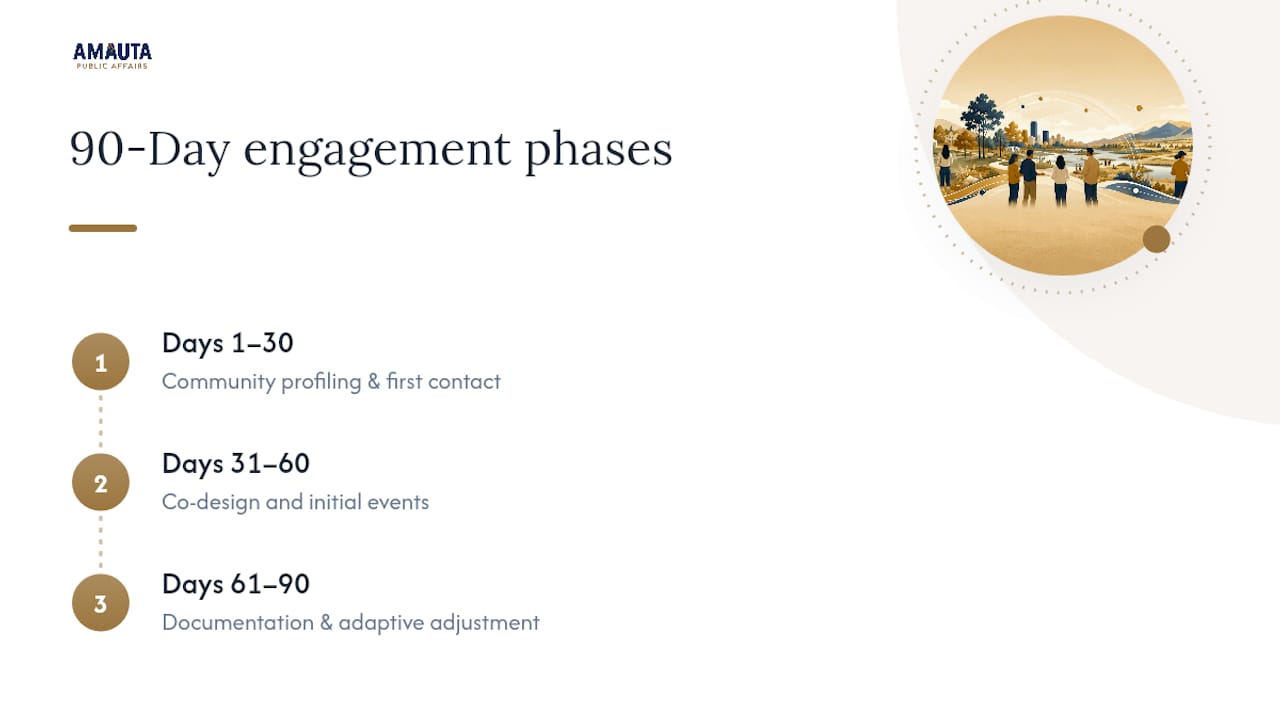
Pro Tip: Copy the 30/60/90 structure directly into your project plan and assign one owner per window. Ambiguous ownership is where most engagement timelines quietly fail.
What Practitioners Get Wrong About Community Trust
The biggest failure I see isn’t a bad plan. It’s a good plan nobody followed through on. Teams promise “we’ll keep you informed” and then vanish for four months, and residents remember exactly that gap. Escalate or pause an engagement effort the moment you can’t honor a stated commitment, rather than letting the silence do the talking.
Treating the plan as an internal accountability tool, a living log of who promised what and when, matters more than any single workshop. That log is what separates genuine engagement from a project checkbox, and it’s usually the first document I ask to see on a stalled project.
— Ignacio
How AMAUTA Builds and Runs Engagement Plans for Land Use Projects
A third-party public affairs firm can be an alternative to building a plan from scratch and hoping your team has bandwidth to run it: such firms design and execute engagement plans while you stay focused on permitting and delivery. Their work may span community engagement, digital advocacy, and stakeholder strategy for land use, energy, and infrastructure projects, with tactics refined continuously against real-time feedback rather than set once and forgotten.
An initial scoping conversation covers your project timeline, likely opposition points, and which stakeholder groups carry the most influence over permitting outcomes. From there, we build a phased plan, staff the outreach, and report results back to you and your stakeholders on a set cadence. If you’re managing a project where community opposition could stall permits or damage your timeline, start with our community engagement and public affairs services and ask about adapting the 90-day starter to your specific site and jurisdiction.
Sources
Recommended
Comments