
Make Community Engagement Scope of Work Enforceable for Land Use

A community engagement scope of work is a deliverable-driven document that ties specific outreach methods to project milestones, spelling out exactly who does what and by when. The single most important inclusion is a paired set of clear deliverables and client responsibilities, since vague language on either side is what causes stalled approvals. Match the engagement tier to the project’s stakes and complexity before drafting a single clause.
TL;DR:
A well-defined scope of work must specify clear deliverables, timelines, and client responsibilities to prevent disputes and delays in project approval.
Engagement tiers should match project stakes, with high-impact projects requiring more intensive methods such as collaboration and standing advisory groups.
For complex or uncertain projects, use hybrid contracts combining time-and-materials for discovery phases and fixed pricing for repeatable, well-defined tasks.
Client responsibilities should include timely access, key contacts, and specific feedback turnaround times, with exclusions clearly listed to avoid scope creep.
Incorporating midpoint re-evaluation sessions in the scope helps adjust expectations and avoid misunderstandings during the engagement process.
Table of Contents
Core Elements Every Community Engagement Scope of Work Needs
A weak scope of work fails for one reason more than any other: it describes intentions instead of deliverables. The Project Management Formula guide makes the case plainly. A well-built SOW names deliverables, sets a timeline, states acceptance criteria, lists exclusions, and defines a change-management process. Skip any one of these and you’ve built a document that invites disputes rather than preventing them.
Start with a short executive summary that states the project’s objective in plain terms. Then build out the following:
Deliverables list with acceptance criteria attached to each item (a stakeholder map isn’t done when submitted; it’s done when the client signs off that contacts and influence levels are accurate).
Timeline and milestones expressed as fixed windows, not “ongoing” language that gives neither party a deadline to hold the other to.
Client responsibilities, including introductions to key contacts, site or data access, and a stated turnaround time for reviewing drafts.
Explicit exclusions and assumptions, so a client doesn’t assume translation services or legal notice postings are bundled in when they aren’t.
Municipal toolkits like Philadelphia’s Equitable Community Engagement Toolkit add one more layer worth borrowing: an alignment check with the project sponsor before fieldwork begins, plus an equity review of who the plan reaches and who it might miss. Building that check into the scope, rather than assuming it happens informally, closes a gap that trips up otherwise solid documents.
How to Choose the Right Engagement Tier
Not every project needs a town hall circuit. The intensity of engagement should scale with stakes and complexity, and the IAP2 spectrum, running from inform to consult, involve, collaborate, and empower, gives a shared vocabulary for setting that expectation in writing.
Roughly:
Tier 1 (high stakes, high complexity, contested land use): collaborate to empower, heavy fieldwork, standing advisory groups.
Tier 2 (moderate stakes, some controversy): involve to collaborate, targeted workshops and structured feedback loops.
Tier 3 (routine approvals, low controversy): consult, surveys and public comment periods.
Tier 4 (administrative or low-impact work): inform, notices and simple digital updates.
Municipal playbooks, including Nashville’s Community Engagement Playbook, often suggest engagement can account for 3 to 15 percent of total project effort depending on tier. Treat that range as a planning benchmark, and revisit the tier if early fieldwork surfaces unexpected opposition.
What Methods and Deliverables Actually Belong in the Scope
Every method named in the SOW should have a one-line purpose statement attached, so bidders and clients alike know why it’s there rather than assuming it’s filler.
Community meetings: gather live feedback and build visible presence in contested projects.
Surveys: capture quantifiable sentiment across a broader population than meetings reach.
Workshops: co-design specific design or siting decisions with affected residents.
Digital outreach: extend reach to residents who can’t attend in-person events.
Accessibility and language access: state required accommodations (captioning, translated materials, ADA-compliant venues) as a line item, not an afterthought.
Recruitment and sampling expectations deserve their own sentence in the SOW, not a vague “diverse outreach” phrase. Data handling matters just as much: state upfront who owns raw survey responses, how consent is documented, and whether the client gets anonymized data only.
Timeline, Milestones, and Touchpoints Tied to Project Phases
Outreach that happens after design decisions are locked isn’t engagement. It’s notification. The scope should map touchpoints to actual project phases:
Planning phase: early listening sessions and stakeholder mapping, four to six weeks before any design work begins.
Design phase: workshops and comment periods scheduled with enough lead time to actually influence drawings, not rubber-stamp them.
Construction or implementation phase: update communications and a complaint or inquiry channel, reported on a set cadence.
Review gates: build in a required client response window, typically five to ten business days, so drafts don’t sit unanswered for a month.
A 90-day stakeholder engagement plan built around these touchpoints keeps fieldwork timed to when it can still shape a decision, rather than documenting one after the fact.
Choosing the Right Contracting Model
Exploratory fieldwork and prescriptive deliverables need different contract structures, and forcing one model onto both creates friction. Applied-practice guidance on engagement scoping recommends:
Time-and-materials for open-ended, ethnographic-style fieldwork where the right questions only emerge once you’re in the community.
Fixed price for repeatable, well-defined deliverables like a survey report or a stakeholder database.
Hybrid or phased contracts that run discovery on T&M, then shift to fixed price once deliverables are known, common on land-use projects with real uncertainty upfront.
Whatever the model, write in a change-control clause naming who approves budget shifts and how quickly.
Pro Tip: Budget synthesis time equal to your fieldwork time. Teams that treat analysis as a rounding error at the end of the schedule are the ones who miss their own deadlines.
Client Responsibilities and Exclusions That Prevent Delays
The client responsibilities section is the one most often left thin, and it’s frequently the reason engagement stalls, as explained in the content/reporting workflows that highlight the importance of specifying deliverables and responsibilities clearly. It needs specific commitments, not a general promise of cooperation.
Introductions to key community contacts and local officials within an agreed window.
Timely access to site information, prior studies, or GIS data the engagement team needs.
A stated feedback turnaround (commonly five to ten business days) on drafts and deliverables.
Recruitment support for hard-to-reach populations where the client has existing relationships.
Pair that with exclusion language: “This scope does not include legal notice publication, translation of materials beyond [X] languages, or media buys.” Add a default clause for missed reviews, such as automatic approval if no response arrives within the stated window, so one missed email doesn’t freeze a milestone. The COMPEL Framework calls this right-sizing: naming what’s out of scope is as much a professional judgment as naming what’s in.
How AMAUTA Frames a Land-Use Engagement Scope
A typical AMAUTA-scoped engagement for a land-use or infrastructure project starts with a one-paragraph objective (build durable community support for a defined entitlement or permitting milestone), then lists deliverables: a stakeholder map, a tiered outreach plan, meeting summaries with acceptance criteria, and a media or messaging brief tied to key decision points.
Client asks are stated up front, introductions to planning staff, access to prior traffic or environmental studies, and a review turnaround on messaging drafts. The timeline runs in parallel with permitting phases rather than as a standalone track.
The balance AMAUTA works to hold is between advocacy-style campaign tactics, built to move opinion and build coalitions, and the transparent, contract-ready terms that keep a client and a community both clear on what was promised.
What Most Scoping Documents Get Wrong
The most common mistake isn’t underspending on engagement. It’s writing a scope so vague that both sides discover mid-project they meant different things by “community input.” Schedule a midpoint reframing session into every engagement, formally, in the contract, so early findings can adjust later deliverables without a fight over change orders. Protect synthesis time as fiercely as fieldwork time.
— Ignacio
Get a Scope Built for Your Project, Not a Template
This firm approaches land-use and infrastructure engagement the way a campaign strategist approaches a race, not the way a generic consultancy fills in a template. That difference shows up directly in the scope of work: tailored tiering, messaging built around your specific opposition and support base, and deliverables tied to your actual permitting calendar instead of a generic 90-day boilerplate.
If you’re drafting a scope for an upcoming project or evaluating one a consultant handed you, this firm offers a review against the checklist above. Explore the firm’s community engagement and public affairs services or look at how the team approaches land-management engagement specifically. From there, get connected to request a scope review or a sample SOW tailored to your project type.
Where to Go Deeper on Engagement Frameworks
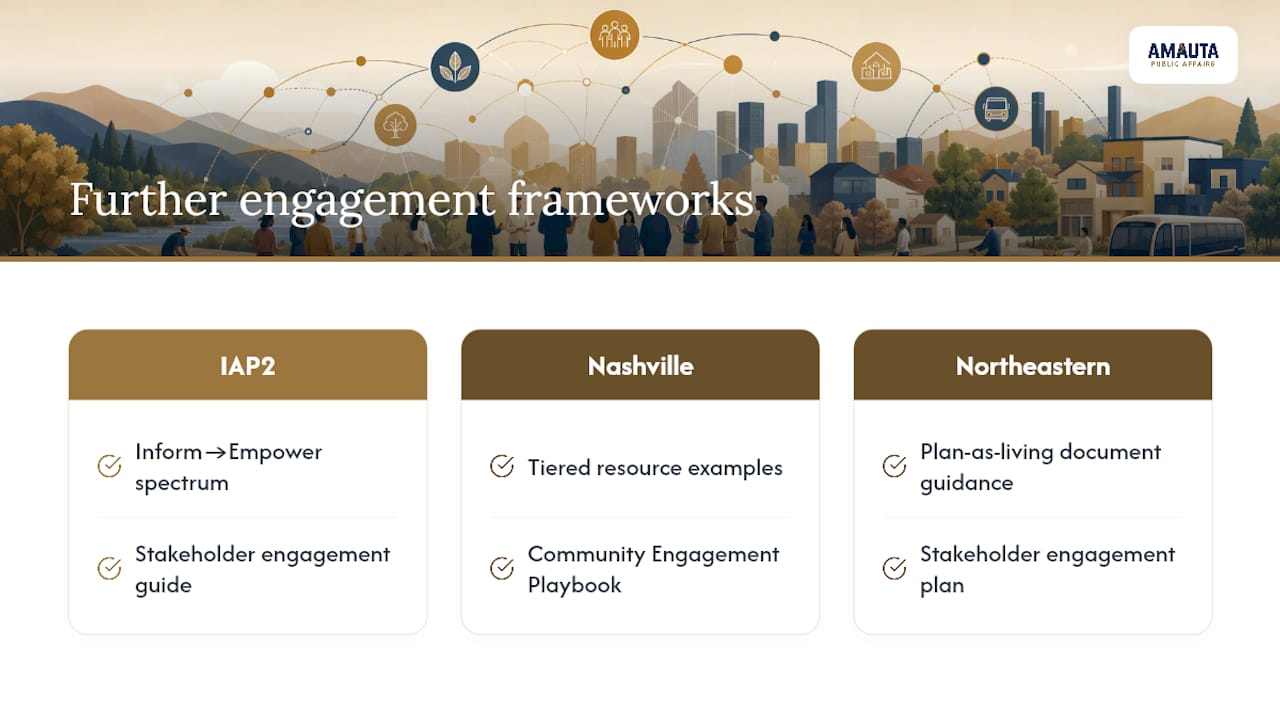
For the underlying frameworks referenced throughout this guide, start with the IAP2 stakeholder engagement practical guide for the inform-to-empower spectrum, Nashville’s Community Engagement Playbook for tiered resource examples, and Northeastern’s stakeholder engagement plan guidance for treating the plan as a living document.
Sources
Recommended
Comments