
Community Impact Assessment: A Practical Guide for Project Teams
A community impact assessment (CIA) is a structured way to find out how a proposed project will change the lives of the people around it, and to use that knowledge before opposition forms. The federal definition is an iterative process that evaluates a project’s effects on a community and its quality of life. It documents the social environment with and without the action. It works best when it is paired with real community engagement, which is the campaign-style approach we use at AMAUTA Public Affairs for land use, energy and infrastructure projects.
TL;DR
A CIA compares the community’s conditions with and without your project, covering mobility, safety, jobs, relocation and isolation.
The federal framework has eight components, and the first is engaging the public, not collecting data.
Residents should help define community characteristics, judge impacts and shape the fixes. A desk study alone misses what they know.
Findings only matter if they are written for decision makers and tied to commitments you monitor.
Teams that treat the assessment and the outreach as one workstream arrive at hearings with fewer surprises.
Table of Contents
What a community impact assessment is for
The CIA grew out of transportation planning, and its purpose there is plain: to inform decisions on planning, alternatives, design and implementation, including things that matter in daily life such as mobility, safety, employment effects, relocation and isolation. The same logic now applies well beyond highways. Solar and wind siting, housing, brownfield cleanup and commercial redevelopment all raise the question of who gains, who bears the cost and who has not yet been asked.
The Federal Highway Administration’s handbook lists the benefits it expects: greater livability, more responsive decisions, smoother delivery that may reduce delays and conflicts, and nondiscrimination, because the assessment alerts decision makers to disproportionately high and adverse effects. It also notes that the effort is low to medium and that the lead can be an elected official, local staff, a planner, an engineer or a community advocate.
That last point matters to most readers of this page. A city planner, a developer, a nonprofit director and a business owner can all run a CIA, because the method is scalable. What changes is the depth.
How it differs from an environmental review or a needs assessment
Three terms get mixed up, and the difference decides who has to do what.
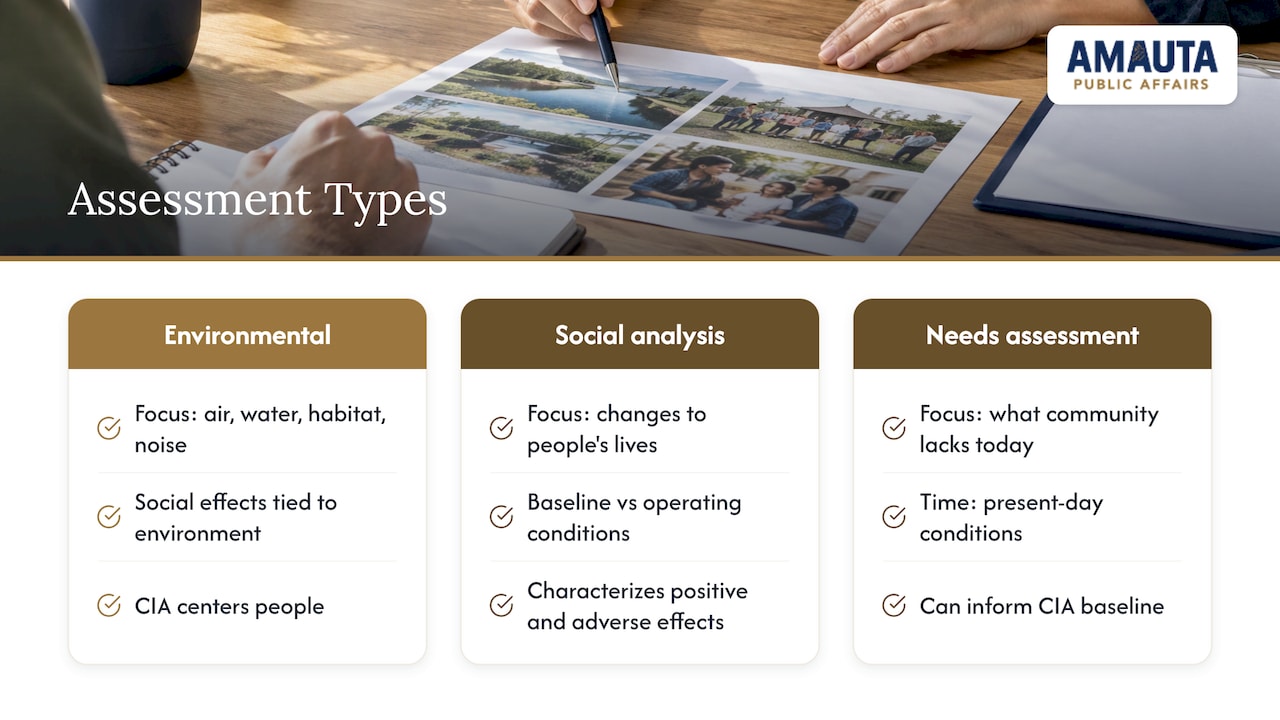
Environmental impact assessment. This looks at effects on air, water, habitat, noise and similar resources, usually under the National Environmental Policy Act (NEPA) for federal actions. Social and economic effects enter that process when they are tied to the physical environment. A NOAA review of social impact assessment in NEPA documents shows how unevenly they are treated, with confidentiality and data limits getting in the way of community-level analysis. A CIA fills that gap by putting people at the center.
Social or socioeconomic analysis. This is the closest relative. The Bureau of Reclamation describes it as a systematic process to determine how projects change people’s lives, comparing baseline conditions with the likely situation once the project operates. The difference is the impact estimate. The Bureau of Land Management’s 2024 guidance says the analysis characterizes positive and adverse social and economic effects of a proposal and its alternatives, and that an environmental impact statement typically uses more rigorous methods than an environmental assessment.
Community needs assessment. This asks what a community lacks today, for example through a community health assessment that identifies key needs through systematic data collection. It looks at the present. A CIA looks at the change a specific project would cause.
In practice, a needs assessment can feed the baseline of a CIA, and a CIA can feed the social section of an environmental document.
The eight components, and where each one goes wrong
The FHWA’s Quick Reference lays out eight components: engage the public, develop a community vision and goals, define the need and action, identify community characteristics, analyze impacts of the proposed action against no action and alternatives, identify solutions, document findings in writing, and implement and monitor. The order is not strict, since the process is iterative. Here is what each stage demands and the usual failure.
1. Engage the public from the first day
Public involvement is listed first for a reason. Residents know which intersection floods, which corner store anchors a block and which street children use to walk to school. No dataset holds that.
The usual failure is treating engagement as a hearing at the end. By then positions have hardened. Our community engagement plan with a 90-day starter shows how to sequence the first three months so listening comes before announcing.
2. Develop community vision and goals
Ask what the community wants to protect and what it wants to gain. A project that advances a stated local goal, such as safer crossings or local hiring, starts from a different place than one that only avoids harm.
The usual failure is importing the developer’s goals and calling them the community’s.
3. Define the need and the action
State plainly what the project is, why it is proposed and what the alternatives are, including doing nothing. Vague descriptions produce rumors. A clear description gives residents something specific to react to.
4. Identify community characteristics and the study area
The study area usually covers communities within and immediately around the project area, identified through scoping, public involvement and agency coordination, while recognizing that consequences can reach further. Each technical topic, such as traffic or noise, may have its own boundary. California’s transportation department tells analysts to compare study-area demographics with regional data so readers can see similarities and differences.
The usual failure is drawing the boundary around the parcel and missing the neighborhood that will absorb the truck traffic.
5. Analyze impacts: action versus no action
This is the core comparison. The FHWA says impacts are analyzed by examining the proposed action versus no action and investigating alternatives. Cumulative effects belong here too. The FHWA’s earlier handbook notes that actions taken individually can have different implications than when considered together, which is the situation of any neighborhood facing several projects at once.
6. Identify solutions
The framework names four families of response: avoidance, minimization, mitigation and enhancement, with the public helping identify which approaches are acceptable. Enhancement is the one teams forget. It is where a project leaves the community better off, and it is often what turns neutral residents into supporters.
7. Document findings in writing
Write for two audiences: decision makers who need a clear recommendation, and interested residents who need to see their input reflected. A short summary up front, a plain-language explanation of method and a table of impacts with proposed responses serve both.
8. Implement and monitor
Commitments made in the assessment need an owner, a schedule and a way to report back. Without monitoring, the document becomes the first thing opponents quote against you.
Choosing data and methods that fit the project
There is no single approach. The BLM guidance is explicit that agencies select methods appropriate to the social context and issues of each action. Its list includes demographic and trend analysis, collaborative scenario development, fiscal analysis, regional economic impact analysis (output, labor income, employment, value added), social values mapping and surveys with formal sampling.
A workable mix for a mid-sized project:
Question | Useful method | Watch for |
Who lives here? | Census and local demographic data, compared with the region | Some groups are undercounted |
What will change economically? | Regional economic and fiscal analysis | Separate construction jobs from lasting ones |
What do residents value? | Surveys, interviews, mapping exercises | Sampling that skips renters or non-English speakers |
What could go wrong? | Scenario sessions with residents | Treating one meeting as representative |
Two cautions from public agencies are worth building in. Sound Transit’s toolkit advises disaggregating population data and using multiple sources, because Census figures under-report some populations and communities of color are not a single group. Oregon’s land use department adds that quantitative data should be augmented with qualitative engagement and ground-truthing, and that data should start conversations rather than be the sole basis for a decision.
If your outreach runs as a series of events across several sites, the logistics of keeping the format consistent matter as much as the questions. Guidance on multi-city roadshow planning covers how to hold one format steady across many stops, which helps when you want comparable feedback from each location.
Reaching the people most likely to be affected
The FHWA is direct that decision makers must actively seek out low-income and minority populations, people with disabilities, people with limited English proficiency and older adults, using clear and timely notice, accessible meeting sites and outreach through community leaders. Florida’s transportation department ties this to environmental justice review: information on minority and low-income populations helps determine whether any alternative would have disproportionate impacts. Washington’s 2025 draft engagement plan goes further and says a demographic analysis of overburdened and underserved populations should shape the engagement strategy.
Practical steps follow from that:
Map who lives within and beyond the study area before you schedule a single meeting.
Offer meetings at varied times and in accessible places, with interpretation where needed. Our guide to accessible public meetings covers the details.
Work through trusted local organizations, not only mailers.
Report back what you heard and what changed as a result.
For projects where equity review is expected, our piece on environmental justice engagement explains why the work has to start before plans are set.
Turning findings into project decisions
An assessment earns its cost when it changes something: a route, a buffer, a construction schedule, a hiring commitment, a community benefit. Three habits help.
Tie each impact to a response. A table pairing every identified effect with an avoidance, minimization, mitigation or enhancement measure is easier to defend than a narrative.
Show your reasoning. When you do not adopt a suggestion, say why. Residents tolerate a “no” with an explanation far better than silence.
Keep the loop open. The framework ends with implementation and monitoring for a reason. Public updates on commitments keep trust intact through construction. For disruption specifically, see our traffic disruption outreach plan.
For permitting, the assessment also strengthens the record. Notices alone rarely satisfy a skeptical board, as we argue in permitting public outreach, while documented engagement and responses give officials a basis to act.
How the assessment and outreach work together
Treat them as one workstream. The assessment tells you what to ask and where to look. Outreach tells you whether your reading of the community is right. Run separately, each repeats the other’s gaps: consultants produce a report residents never see, or meetings happen without a baseline to test claims against.
For local governments, that means a defensible record. For developers, fewer unpleasant surprises at hearings. For environmental organizations and nonprofits, a credible way to bring partners and neighbors into co-design. For business owners, a way to show the neighborhood that its concerns changed the plan. Our framework for infrastructure public outreach and our overview of community engagement strategy in projects show how that integration looks in practice.
Our perspective
Most opposition we see described in land use work is not opposition to change. It is opposition to being the last to know. A community impact assessment is the earliest, cheapest chance to reverse that. We approach every project as a campaign: assess the community landscape, set priorities, then refine tactics from real-time feedback instead of waiting for a final report. That is why we pair the analysis with community engagement, media relations and digital advocacy from the start, so the data you gather and the trust you build reinforce each other. Our view is that the assessment should never sit on a shelf. Its findings should shape the message, the meeting design, the coalition and the permitting record, and the people it describes should be able to see themselves in it. Ignacio
Support from AMAUTA Public Affairs
We provide community engagement, stakeholder relations, coalition building, media relations, digital advocacy, permitting support and campaign management for land use, energy, infrastructure and commercial development projects. Our approach is tailored to each project and evaluates the community landscape before strategy is set, so your assessment translates into a plan.
If you are scoping an assessment or facing community questions about a project, see our services or get connected with our team.
FAQ
What is the purpose of a community impact assessment?
Its purpose is to inform decisions about a project by documenting how it would affect a community’s quality of life, compared with no action. It covers items such as mobility, safety, employment, relocation and isolation. Done early, it also helps teams spot and address problems before they become conflicts.
Who can lead a community impact assessment?
The FHWA handbook says it can be led by elected officials, local or tribal staff, planners, engineers or community advocates. The effort is scalable, so a small project can use a lighter version than a major corridor. What matters is that technical specialists, knowledgeable community members and public involvement staff coordinate.
Is a community impact assessment required by law?
Requirements depend on the project, the funding and the jurisdiction. Federal actions trigger NEPA, which can include social and economic effects, and environmental justice review often applies. Confirm your obligations with the permitting agency and your counsel, then treat the assessment as good practice even where it is not mandated.
How long does it take?
There is no standard duration. It scales with project size, the number of alternatives and how much community engagement is planned, which the FHWA’s earlier handbook says may range from minimal to extensive. Build the schedule backward from your first public decision point.
Sources
Analytical Tools and Planning Frameworks - Community Connections Handbook
Community Impact Assessment: A Quick Reference for Transportation
Community Impact Assessment: A Handbook for Transportation Professionals
Desk Guide: Socioeconomic Aspects of Planning and NEPA (BLM, 2024)
Review of Social Impact Assessment in NEPA documents (NOAA Fisheries)
Recommended
Comments