
How Business Reputation Management Works for Owners

Business reputation management is the ongoing process of shaping and protecting how your company is perceived by customers, partners, and the public. Nearly half of customers post reviews, and more than 90% consult them before making a purchase. That single data point explains why reputation is no longer a marketing concern alone. It is a core business function that directly affects revenue, hiring, valuation, and regulatory standing. Understanding how business reputation management works gives you the foundation to act before problems surface, not after.
What are the fundamental components of reputation management?
Online reputation management (ORM) is the recognized industry term for the structured practice of monitoring, shaping, and defending your company’s public image across digital channels. Business reputation management is the broader strategic frame that includes ORM plus internal alignment, governance, and long-term trust building. Both terms describe the same underlying goal: controlling the narrative before someone else does.
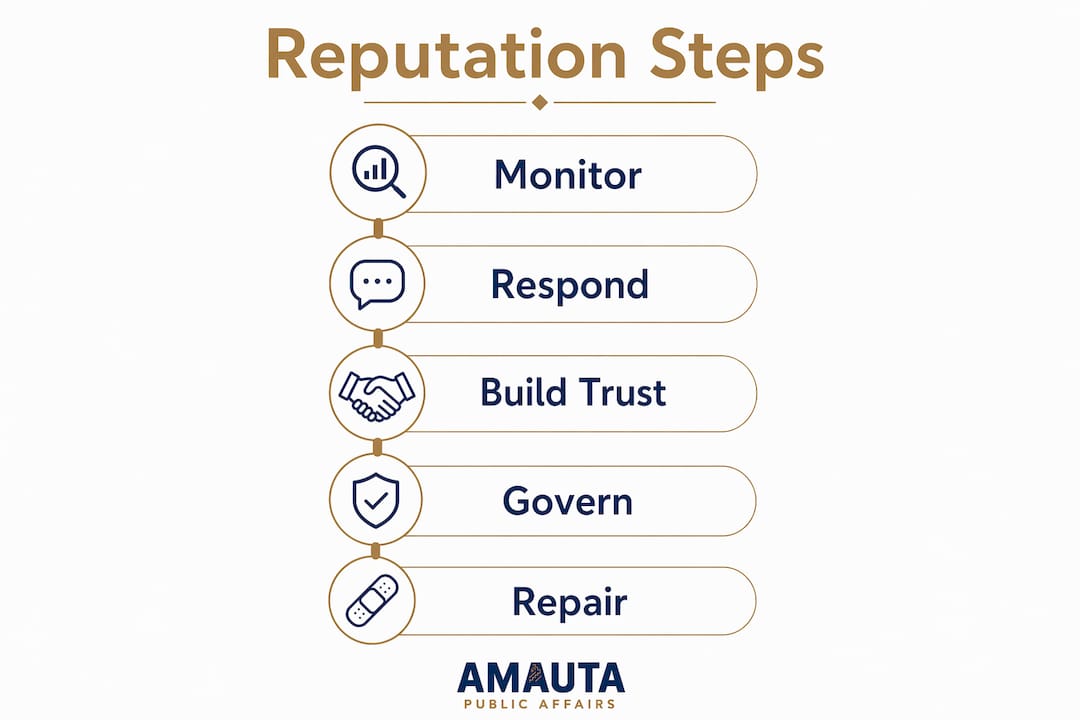
The core process follows a clear sequence:
Audit your current standing. Search your business name, read your reviews, and identify what content ranks on the first page of Google. This baseline tells you what the public sees before they ever contact you.
Build reputation assets. Publish authoritative content, earn credible third-party endorsements, and collect verified customer reviews. These assets do the heavy lifting when a crisis hits.
Engage consistently. Respond to reviews, answer social comments, and participate in community conversations. Silence reads as indifference.
Correct or suppress harmful content. Create genuinely helpful, high-authority content that search engines prioritize for utility. This pushes damaging results down the page.
Reduce ongoing risk. Establish governance protocols, assign ownership, and build escalation paths so your team knows exactly who handles what.
Recover when damage occurs. Follow a structured repair plan with measurable milestones, not just a public apology.
AI-driven search systems synthesize public information to generate summaries and chatbot responses. That means your reputation now shapes what AI says about you, not just what humans read. Consistent, authoritative data across all platforms is the prerequisite for favorable AI visibility.
Pro Tip: Assign a named internal owner for reputation management. Without clear ownership, monitoring lapses and response times slow down exactly when speed matters most.

How do businesses monitor and respond to online feedback?
Monitoring is the early-warning system of any reputation program. Without it, you are reacting to crises you could have caught early. A layered approach works best:
Google Alerts provides free, keyword-based monitoring for your brand name, key executives, and product names. Set it up in under five minutes and receive email digests when new content appears.
Mention and Brand24 offer paid, multi-platform tracking with sentiment analysis, volume metrics, and real-time alerts. These tools are worth the investment once your brand generates significant online conversation.
Native platform tools such as Google Business Profile notifications and social media inbox monitoring catch platform-specific feedback that broader tools sometimes miss.
Review aggregation dashboards pull ratings from Google, Yelp, and industry-specific directories into one view, making it easier to spot trends across locations or product lines.
Treating reviews like support tickets and aiming for same-day responses on key platforms demonstrates attentiveness and builds trust. Speed signals that you take customer experience seriously. Negative reviews, when handled with speed and empathy, can actually improve your reputation by showing accountability. A well-crafted public response to a one-star review often matters more to future customers than the review itself.
Response frameworks that define posture, escalation triggers, and pre-approved templates improve consistency and reduce the risk of an off-message reply going viral. Your customer service team should not be improvising responses to sensitive complaints in real time.
Pro Tip: Create three response templates: one for positive reviews, one for neutral feedback, and one for negative complaints. Customize each before posting, but start from a tested framework to stay consistent and on-brand.
What strategies build a stronger reputation before problems arise?
Proactive reputation building is the difference between businesses that weather crises and those that collapse under them. Building trust assets such as verified content, certifications, and credible third-party endorsements creates resilience that protects you when negative content appears.
Here is how to build those assets systematically:
Solicit reviews at peak satisfaction moments. Ask for a review immediately after a successful delivery, project completion, or positive support interaction. Timing matters. A customer who just received great service is far more likely to write a review than one you contact three weeks later.
Publish long-form, authoritative content. Case studies, detailed guides, and original research demonstrate expertise and give search engines high-quality material to index. This content also serves as the foundation for suppressing negative results over time.
Earn credible endorsements. Industry certifications, media coverage, and verified partnerships carry more weight than self-published claims. 54% of consumers trust online reviews more than direct company statements, which means third-party voices are your most credible asset.
Align your marketing with your actual operations. Over-promising in marketing creates a perception gap that erodes trust faster than any competitor attack. If your service cannot consistently deliver on a claim, remove the claim.
Trust asset type | Primary benefit | Example |
Customer reviews | Social proof at point of decision | Google Business Profile ratings |
Industry certifications | Third-party credibility | ISO standards, trade association badges |
Media coverage | Authority and reach | Feature articles in trade publications |
Case studies | Proof of results | Documented client outcomes with data |
For a deeper look at how public perception connects to project outcomes, Amautapublicaffairs has published practical guidance on improving public perception that applies directly to businesses managing complex community relationships.
You can also find a detailed walkthrough of managing online reputation for small and medium businesses that covers platform-by-platform tactics worth reviewing.
How do businesses repair their reputation after a crisis?
Reputation repair is not a single action. It is a structured sequence executed over weeks and months. The most effective repair process follows four steps: acknowledge the issue, fix the root cause, provide proof of the fix, and follow through consistently over time.
Each step matters for a specific reason:
Acknowledge the issue publicly and specifically. Vague apologies read as deflection. Name the problem, accept responsibility where appropriate, and communicate what happened clearly.
Fix the root cause. An apology without operational change is a liability. Customers and journalists will return to the story if the same problem recurs.
Provide tangible proof of the fix. Share updated policies, third-party audits, or documented process changes. Evidence converts skeptics more reliably than statements alone.
Sustain consistency over 30, 60, and 90 days. Trust rebuilds through repeated positive experiences, not a single press release.
The businesses that recover fastest from reputational damage are not those with the best PR teams. They are the ones with the clearest internal processes. When everyone knows their role, the public response is faster, more consistent, and more credible.
Coordinated internal efforts between marketing, legal, customer service, and leadership are non-negotiable during complex reputation challenges. Legal counsel should review any public statement that touches on liability before it goes out. Customer service needs talking points that match the executive message exactly. Without that coordination, conflicting signals reach the public and compound the damage.
For defamatory or factually inaccurate content, escalation paths matter. Document the content, preserve screenshots, and consult legal counsel before responding publicly. Some inaccurate content qualifies for formal removal requests through platform policies or legal channels.
Key Takeaways
Effective business reputation management requires continuous monitoring, proactive trust building, and coordinated internal governance to protect revenue and sustain customer confidence.
Point | Details |
Monitor across layers | Use Google Alerts for free coverage and paid tools like Brand24 for multi-platform, real-time tracking. |
Respond fast and on record | Aim for same-day replies on Google and Yelp; a well-handled negative review builds more trust than silence. |
Build trust assets early | Certifications, case studies, and verified reviews create resilience before a crisis arrives. |
Align promises with operations | Over-promising erodes trust faster than competitor attacks; match marketing claims to actual delivery. |
Follow a structured repair plan | Acknowledge, fix, prove, and sustain. Apologies without operational change do not rebuild trust. |
Why reputation management is a governance issue, not a marketing task
I have watched businesses treat reputation management as a campaign. They run a review-generation push, respond to a few complaints, and then move on. That approach fails because reputation is not a project with a finish line. It is a continuous operational function.
The businesses I have seen handle crises well share one trait: they built governance structures before they needed them. Clear ownership, escalation paths, and response playbooks are not bureaucratic overhead. They are the infrastructure that lets you move fast when a story breaks at 9 PM on a Friday.
The AI dimension adds urgency to this. Reputation engines powered by AI accelerate how quickly public information gets synthesized and surfaced. If your entity data is inconsistent across platforms, an AI summary may misrepresent your business to thousands of potential customers before you even know the problem exists. Entity hygiene, meaning consistent name, address, category, and description data across every platform, is now a prerequisite for accurate AI representation.
The common pitfall I see most often is the reactive-only posture. Businesses wait for a bad review or a news story before engaging. By then, the narrative has already formed. The businesses that win on reputation are the ones publishing authoritative content, collecting reviews systematically, and monitoring mentions every week, not just when something goes wrong.
Reputation management deserves a budget line, a named owner, and a quarterly review. Treat it like any other business function that directly affects revenue, because customer feedback and reviews define the micro-moments that determine whether a prospect becomes a customer or walks away.
— Ignacio
How Amautapublicaffairs supports your reputation goals
Amautapublicaffairs brings a campaign-style discipline to reputation and public affairs management that most businesses cannot build internally. The team specializes in community engagement, media relations, and digital advocacy, with a track record of building public trust for complex projects in competitive environments.
Whether you are managing a land use project, a community-facing development, or a business facing reputational headwinds, Amautapublicaffairs builds the messaging frameworks and stakeholder engagement programs that move public perception in the right direction. The approach is data-informed, results-tracked, and refined continuously based on real-time feedback. You can review the full range of public affairs services and identify where professional support fits your current needs.
FAQ
What is the difference between ORM and reputation management?
Online reputation management (ORM) focuses specifically on digital channels such as reviews, search results, and social media. Business reputation management is the broader practice that includes ORM plus internal governance, stakeholder relations, and long-term trust strategy.
How quickly should a business respond to a negative review?
Same-day responses on platforms like Google and Yelp are the recommended standard. Speed signals accountability, and a well-handled public response often matters more to future customers than the original complaint.
Can negative reviews actually help a business?
Yes. Negative reviews handled with speed and empathy demonstrate accountability and responsiveness. A business with a mix of reviews and thoughtful responses appears more credible than one with only perfect ratings and no engagement.
How does AI affect business reputation management?
AI-driven search systems synthesize public data to generate summaries and answers. Inconsistent or inaccurate entity data across platforms can lead to AI misrepresenting your business. Maintaining consistent, authoritative information everywhere is now a core reputation management requirement.
What is the first step in repairing a damaged reputation?
The first step is a public, specific acknowledgment of the issue. Vague apologies signal deflection. Name the problem, accept appropriate responsibility, and communicate clearly what happened before moving to operational fixes.
Recommended
Comments