
How Local Government Relations Work: A 2026 Guide

Local government relations is the process by which individuals and organizations engage with elected officials, appointed administrators, and community stakeholders to influence policies, land use decisions, and public services at the municipal level. Understanding how local government relations work is the prerequisite for any effective community advocacy or land use strategy. The council-manager and mayor-council models define who holds real administrative power in most American cities. Municipal election turnout averages about 27%, which means a relatively small, organized group of engaged stakeholders can carry outsized influence. That reality makes early, informed participation not just useful but decisive.
How local government relations work: structures and power
Local government structure determines who you need to talk to, when to talk to them, and how much authority they actually hold. Getting this wrong wastes time and goodwill.
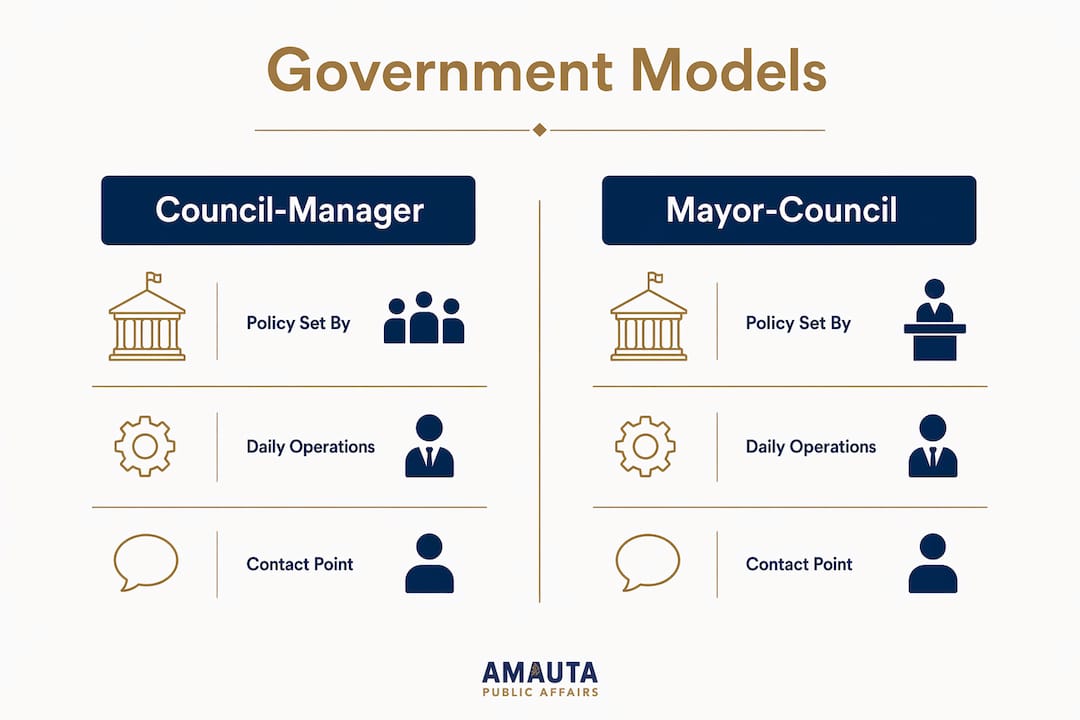
48% of American cities use the council-manager system, where a professional city manager runs daily operations and a city council sets policy. The mayor in this model is largely ceremonial. The mayor-council system, common in larger cities like New York and Chicago, gives the mayor direct executive authority over departments and budgets. A third model, the commission system, merges legislative and executive functions into a single elected board, though this structure is far less common today.

Council-manager vs. mayor-council: who holds real power
In a council-manager city, the city manager is the most influential administrative official for operational and land use matters. Contacting the mayor’s office for a zoning complaint or permit issue in this model produces little result. The city manager controls staff, budgets, and implementation. In a mayor-council city, the opposite is true. The mayor’s office drives policy execution, and council members hold legislative authority over ordinances and approvals.
Government model | Who sets policy | Who runs operations | Best contact for land use |
Council-manager | City council | City manager | City manager’s office |
Mayor-council | Mayor + council | Mayor’s departments | Mayor’s office or council member |
Commission | Elected commissioners | Same commissioners | Relevant commissioner |
Pro Tip: Before any engagement campaign, look up your city’s charter online. It takes 10 minutes and tells you exactly which model governs your municipality, saving weeks of misdirected outreach.
Who are the key players in local government decisions?
Local government decisions involve more actors than most people realize. City council members vote on ordinances, budgets, and major approvals. Planning commissions review land use applications and make recommendations before council votes. City managers and department directors shape staff reports that frame how council members understand an issue. Advisory boards, neighborhood councils, and community development committees add further layers of input.
Zoning issues are the most frequent cause of local political conflict and litigation, far surpassing higher-level policy debates in community impact. A proposed housing development, a commercial rezoning, or a variance request can mobilize entire neighborhoods. Understanding which body reviews a zoning application first, and which official writes the staff recommendation, is the difference between influencing an outcome and reacting to one.
City council members: Vote on final approvals, ordinances, and budgets. Elected and directly accountable to constituents.
City manager or administrator: Oversees daily operations, directs staff, and prepares budget recommendations in council-manager cities.
Planning commission: Reviews land use applications, conducts public hearings, and forwards recommendations to council.
Department directors: Control permitting, public works, and code enforcement at the staff level.
Advisory boards: Provide community input on specific topics like parks, transportation, or historic preservation.
Pro Tip: Read every staff report published before a planning commission or council meeting. Most key decisions are effectively finalized in those documents before the public meeting begins. Engaging staff during the report-writing phase is where real influence happens.
What are the most effective strategies for local government engagement?
Direct, persistent communication with local officials living in the community yields more success than contacting state or federal representatives. Local officials are accessible in ways that state legislators and federal representatives simply are not. A city council member attends the same community events you do. A planning commissioner may live two streets away. That proximity creates real opportunity for relationship-building.
Effective engagement follows a clear sequence. Starting early, before a project is filed or a vote is scheduled, gives you the ability to shape the conversation rather than respond to it.
Map the decision-making process. Identify which body holds approval authority and which officials write the staff recommendation.
Engage staff before public hearings. Request meetings with planning staff, city managers, or department directors during the application or report-drafting phase.
Attend public meetings consistently. Speak during public comment periods at planning commission and city council meetings. Consistent presence builds credibility.
Submit written comments on the record. Written comments become part of the official record and carry weight in appeals and litigation.
Mobilize community advocates. Organized coalitions of residents, business owners, and civic groups amplify individual voices and signal broad public support.
Track the legislative calendar. Monitor agendas, staff reports, and meeting schedules through your city’s official website or tools like Granicus, which many municipalities use for public notice distribution.
Follow up after every meeting. Send a brief summary of your position to the relevant official within 48 hours of any meeting or public hearing.
Community outreach before a project launches consistently produces better outcomes than reactive advocacy after opposition forms. The organizations that win at the local level are those that build relationships during quiet periods, not just when a vote is imminent.
Pro Tip: Personalize every communication. Reference a specific agenda item, a local neighborhood concern, or a recent council decision. Generic form letters get filed. Specific, informed letters get read.
How do intergovernmental dynamics affect local government relations?
Local government does not operate in isolation. Intergovernmental bargaining requires local officials to negotiate funding, policy design, and enforcement across government levels, complicating local relations and strategies. A city’s ability to approve a housing development may depend on state environmental review requirements. A transit project may require federal funding that comes with its own conditions and timelines.
Effective land use governance requires interplay between top-down policy coherence and bottom-up input from diverse local stakeholders. Exclusive top-down models fail to capture the local nuances that make policies legitimate and workable. This means local advocates must understand not just city hall but also the state agencies, federal programs, and funding streams that shape what local officials can and cannot do.
Government level | Influence on local decisions | Common mechanisms |
Federal | Funding conditions, environmental review, civil rights compliance | Grants, mandates, preemption |
State | Zoning preemption, budget allocations, permitting authority | Legislation, agency rules, court decisions |
Regional | Infrastructure coordination, land use planning | Councils of governments, special districts |
Local | Direct approval authority, ordinances, permits | Council votes, staff decisions, public hearings |
Public affairs strategy for land use projects must account for all four levels simultaneously. A project that clears city council can still stall at the state environmental review stage. Advocates who understand the full intergovernmental picture avoid costly surprises.
Key Takeaways
Effective local government relations depend on understanding structure, engaging early, and building relationships across all levels of government before a critical vote arrives.
Point | Details |
Know your government model | Identify whether your city uses council-manager or mayor-council structure before any outreach. |
Engage before public meetings | Staff reports shape decisions before votes occur; influence them during the drafting phase. |
Zoning drives conflict | Zoning issues generate more local political conflict and litigation than any other policy area. |
Intergovernmental context matters | Federal and state policies directly constrain what local officials can approve or fund. |
Persistence and presence win | Consistent attendance, written comments, and follow-up communication build the credibility that moves decisions. |
What I have learned from years of working in local government relations
Local government is the most accessible level of government, and also the most underestimated. People spend enormous energy trying to influence Congress while ignoring the planning commission that will decide whether their project gets built. That is a strategic error.
The single most common mistake I see is showing up at a public hearing for the first time the night of the vote. By then, the staff report is written, the council members have formed their views, and the outcome is largely set. The organizations that consistently succeed engage months earlier, during the staff review phase, when the framing of an issue is still open.
City managers deserve far more attention than they typically receive. In a council-manager city, the city manager controls the staff, the budget process, and the agenda. A council member who supports your project but whose city manager is skeptical will often defer to staff. Building a working relationship with the city manager’s office is not optional. It is the work.
Zoning and land use are where local government relations become genuinely high-stakes. The zoning code is dense, technical, and rarely read by the public. That creates a real advantage for advocates who do the work of understanding it. Know the specific code sections that apply to your project. Reference them in your comments. That level of preparation signals seriousness and earns credibility with staff and commissioners alike.
Local officials are people. They live in the community, shop at the same stores, and attend the same events. Respectful, informed, and consistent engagement works. Pressure campaigns and adversarial tactics tend to harden opposition. The goal is a working relationship, not a confrontation.
— Ignacio
Work with experts who know how local government operates
Amautapublicaffairs brings a campaign-style approach to the unique demands of land use and community engagement. The firm evaluates the full community context before any outreach begins, identifies the right decision-makers at every government level, and builds messaging that earns genuine public support. Whether you are managing a complex land management challenge or need to build credibility with a planning commission, Amautapublicaffairs designs the engagement process from the ground up. If you are ready to move from reactive to proactive in your local government work, get connected with the Amautapublicaffairs team today.
FAQ
What is the difference between council-manager and mayor-council government?
In a council-manager system, an appointed city manager runs daily operations while the council sets policy. In a mayor-council system, the elected mayor holds direct executive authority over city departments.
Who should I contact for a zoning or land use issue?
In a council-manager city, contact the city manager’s office and the planning department directly. In a mayor-council city, the mayor’s office and the relevant council member are the primary points of contact.
Why do most local government decisions happen before public meetings?
Staff reports prepared by city planners and administrators frame the options and recommendations that council members rely on. Engaging staff during the report-drafting phase gives advocates the best opportunity to shape the outcome.
How does state government affect local land use decisions?
State governments set zoning preemption rules, environmental review requirements, and funding conditions that directly limit or expand what local officials can approve. Local advocates must track state-level policy changes that affect their projects.
How do I build effective relationships with local officials?
Attend meetings consistently, submit written comments on the record, and follow up after every interaction. Local officials respond to direct, respectful, and persistent communication from informed community members far more readily than to form letters or one-time appearances.
Recommended
Comments