
How Public Affairs Strategy Works for Policy Professionals

A public affairs strategy is the deliberate, ethical orchestration of stakeholder relationships, advocacy efforts, and strategic communication to influence public policy and opinion in alignment with organizational goals. This discipline operates across government relations, community engagement, and media outreach, drawing on frameworks like GOST (Goals, Objectives, Strategies, Tactics) and principles of responsible public affairs to build credible, lasting influence. Understanding how public affairs strategy works means recognizing it as a long-term investment in trust and reputation, not a short-term pressure campaign. Professionals who master this approach gain the ability to shape policy environments before decisions are made, not after.
How public affairs strategy works: the core definition
Public affairs strategy is defined as a long-term strategic discipline that integrates ethical advocacy, stakeholder engagement, and strategic intelligence to align an organization’s interests with broader public and policy outcomes. This distinguishes it from narrower activities like lobbying, which targets specific legislative or regulatory results within shorter time frames. The distinction matters because organizations that treat public affairs as lobbying alone consistently underinvest in the relationship infrastructure that makes any single advocacy effort credible.
Responsible public affairs is built on transparency, ethics, and trust, which enhance credibility and long-term influence. Without trust, arguments lose impact regardless of their technical merit. With it, organizations earn inclusion in meaningful policy discussions before formal consultation processes even begin.
The three foundational pillars of any public affairs strategy are stakeholder alignment, strategic messaging, and ongoing intelligence gathering. Each pillar reinforces the others. Stakeholder alignment without clear messaging produces goodwill that never converts to support. Messaging without intelligence produces campaigns that miss the policy moment entirely.

What separates public affairs from lobbying and government relations
The confusion between public affairs, lobbying, and government relations is common, and it costs organizations real strategic clarity. Here is how each function operates and where they overlap:
Public affairs focuses on long-term reputation building, community trust, and shaping the broader environment in which policy decisions are made. It operates across multiple audiences simultaneously, including media, civil society, regulators, and the general public.
Lobbying targets specific legislative or regulatory outcomes, typically within a defined time frame tied to a bill, rulemaking, or budget cycle. It is outcome-focused and often involves direct contact with decision-makers.
Government relations manages the ongoing relationship between an organization and government bodies at all levels. It is a component of public affairs but concentrates specifically on institutional access and dialogue.
Effective organizations integrate both public affairs and lobbying to build trust and alignment while securing policy wins. This integration is the key insight most organizations miss. Lobbying without the reputational foundation that public affairs builds is transactional and fragile. Public affairs without the targeted precision of lobbying can drift into activity without outcomes.
Public affairs also secures what practitioners call the “social license,” the broader community and stakeholder permission that allows a project or policy position to advance despite short-term political friction. Government relations handles the institutional access; public affairs builds the social permission that makes that access productive. Understanding how public affairs complements government relations is a prerequisite for any professional designing an integrated influence strategy.
What are the core frameworks used in public affairs strategy?
The most widely applied planning framework in public affairs is GOST, which structures strategy across four levels:
Goals define the broad, long-term outcomes an organization seeks to achieve, such as securing regulatory approval for a land use project or building community acceptance for a new development.
Objectives are specific, measurable results that indicate progress toward goals. They must be time-bound and assigned to named stakeholder groups or policy milestones.
Strategies explain the approach for achieving each objective, such as building a coalition of local business leaders or generating earned media coverage in regional outlets.
Tactics are the concrete actions assigned with dates and responsibilities, including stakeholder meetings, op-ed placements, digital outreach campaigns, and public comment submissions.
The GOST framework structures strategic planning clearly and effectively for public affairs campaigns. Its value lies in forcing practitioners to distinguish between what they want to achieve and how they plan to achieve it. Many campaigns fail because tactics are selected before objectives are defined.
Alongside GOST, effective public affairs strategy uses stakeholder mapping through interest-influence matrices. These tools plot stakeholders on two axes: how much they care about the issue and how much power they hold over the outcome. This analysis determines where to invest relationship-building resources and which voices to mobilize in support.
The awareness-acceptance-action ladder helps target objectives to the needed level of stakeholder engagement for different licenses to operate. A regulator who is unaware of your project requires a different objective than a community leader who is aware but skeptical. Collapsing these distinctions into a single “engagement” objective is one of the most common planning errors in the field.
Pro Tip: When setting objectives, identify which rung of the awareness-acceptance-action ladder each key stakeholder currently occupies. Write one measurable objective per stakeholder group per campaign phase, and assign a named team member to each. This prevents the common failure of treating all stakeholders as if they need the same message at the same moment.
How does public affairs mobilize stakeholders for credible influence?
Influence is most effective when built by mobilizing credible third parties to expand legitimacy beyond solo advocacy. This is one of the most underused mechanisms in public affairs practice, particularly among organizations new to the discipline.
The logic is straightforward. A developer advocating for its own project carries inherent self-interest. A coalition of local employers, environmental groups, and neighborhood associations advocating for the same project carries social proof. The message is identical; the credibility is categorically different.
Effective third-party mobilization draws from several actor categories:
Civil society organizations lend grassroots credibility and demonstrate community support that elected officials and regulators cannot ignore.
Industry bodies and trade associations signal sector-wide consensus rather than individual organizational interest.
Academic and research institutions provide independent technical validation that strengthens the evidentiary basis of policy arguments.
Community leaders and local officials translate abstract policy positions into tangible local impact, which is the language most relevant to decision-makers in land use and infrastructure contexts.
“Influence is rarely built by a single voice; broad coalitions increase persuasive power and policy impact.” — Responsible Public Affairs: A Practical Guide
Building these coalitions requires early investment in relationship development, well before any specific policy campaign begins. Organizations that wait until they need support to build relationships consistently find that credible third parties are unavailable, skeptical, or already aligned with opposing interests. The community outreach process before a project launches is precisely where this coalition infrastructure gets built.
Practical steps to develop and implement a public affairs strategy
Developing a public affairs strategy follows a defined planning sequence. The steps below reflect how practitioners at organizations like Amautapublicaffairs approach campaign design for complex land use and infrastructure projects.
Phase 1: Goal setting and situation analysis. Define the policy or community outcome you need to achieve. Conduct a landscape assessment that identifies current stakeholder positions, regulatory timelines, and political dynamics. This analysis is the prerequisite for every subsequent decision.
Phase 2: Stakeholder mapping. Use an interest-influence matrix to identify who holds power over your outcome and who cares most about the issue. Segment stakeholders into tiers: primary decision-makers, secondary influencers, and broader public audiences. Each tier requires a different engagement approach and message.
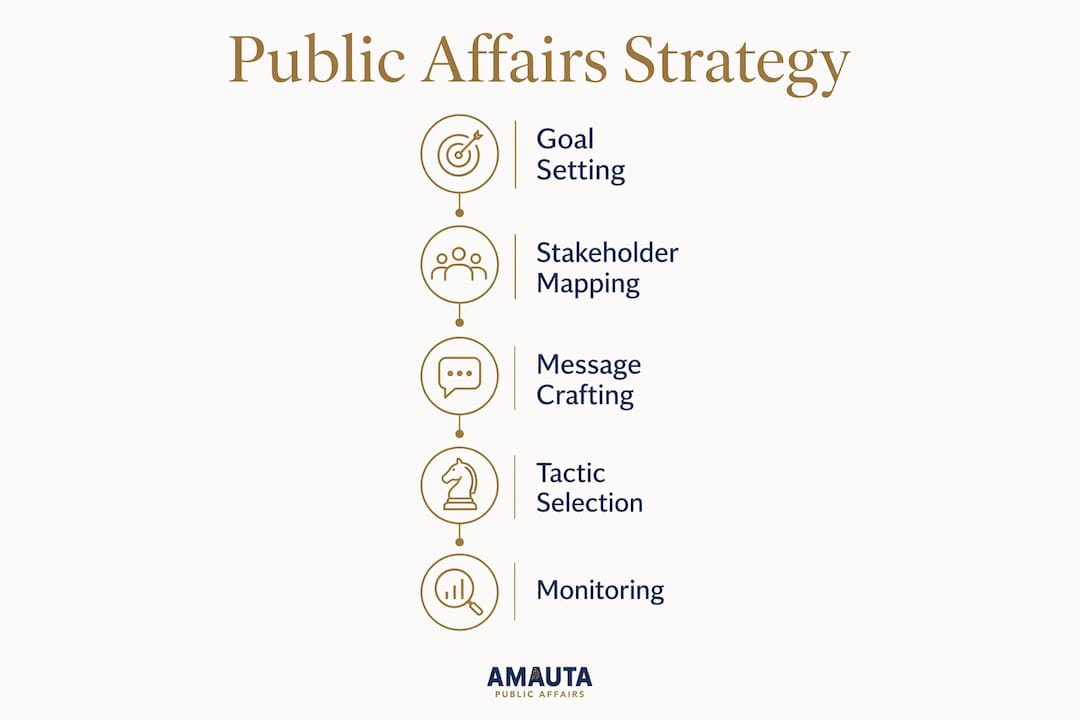
Phase 3: Messaging development. Craft messages that address the specific concerns of each stakeholder tier. Ethical advocacy allows organizations to present expert positions and contribute to policy without undermining trust or credibility. Messaging that overstates benefits or ignores legitimate concerns destroys the trust that makes long-term influence possible.
Phase 4: Tactic selection and channel mix. Common public affairs tactics include earned media outreach, face-to-face stakeholder meetings, digital engagement, and event organizing. Combining multiple channels allows for reinforced messaging and broader audience reach. A well-designed media relations strategy amplifies earned media placement and extends the reach of direct stakeholder engagement.
Phase 5: Monitoring and adaptation. Strategic intelligence helps organizations track policy trends, monitor sentiment, assess risks, and spot opportunities to influence effectively. It provides early warnings and data-driven insights that enable proactive rather than reactive public affairs. Build a monitoring cadence into the campaign calendar, not as an afterthought but as a core operational function.
Tactic type | Best application |
Earned media outreach | Building public awareness and framing the narrative before formal comment periods |
Face-to-face stakeholder meetings | Deepening relationships with decision-makers and addressing concerns directly |
Digital advocacy and social media | Mobilizing supporter networks and demonstrating broad-based community engagement |
Coalition and event organizing | Demonstrating third-party credibility and creating visible public support moments |
Pro Tip: The most common implementation failure is launching tactics before completing stakeholder mapping. Tactics selected without a clear picture of who holds influence and what they care about produce activity without traction. Map first, then build your channel mix.
Key takeaways
A public affairs strategy works because it integrates long-term trust building, ethical advocacy, and multi-stakeholder mobilization into a coherent framework that creates credible, durable influence over policy outcomes.
Point | Details |
Public affairs vs. lobbying | Public affairs builds long-term reputation; lobbying targets specific outcomes. Both are needed for sustained influence. |
GOST framework | Goals, Objectives, Strategies, and Tactics provide a clear planning structure that prevents tactics from driving strategy. |
Stakeholder mapping | Interest-influence matrices identify where to invest relationship resources and which voices to mobilize. |
Third-party mobilization | Credible civil society, academic, and community voices expand legitimacy beyond what solo advocacy can achieve. |
Strategic intelligence | Ongoing monitoring of policy trends and stakeholder sentiment enables proactive adaptation rather than reactive response. |
What I’ve learned about public affairs that most guides won’t tell you
After working across land use, infrastructure, and community engagement campaigns, the pattern I see most often is organizations that confuse activity with strategy. They schedule stakeholder meetings, issue press releases, and build social media presence, then wonder why the policy outcome didn’t move. The problem is almost never the tactics. It’s the absence of a clear theory of change connecting those tactics to a specific decision-maker’s calculus.
The most durable public affairs work I’ve observed shares one characteristic: it starts before the campaign. The organizations that win on complex land use approvals or environmental permits are the ones that spent 18 months building relationships with community leaders, local officials, and civil society groups before a single permit application was filed. By the time the formal process begins, the social license is already in place.
I’ve also seen the cost of treating ethics as a compliance checkbox rather than a strategic asset. Transparency and honesty in stakeholder engagement are not just the right approach. They are the mechanism by which trust is built, and trust is the only currency that survives a policy setback. Organizations that cut corners on transparency consistently find that their influence evaporates precisely when they need it most.
The integration of digital and traditional methods is now non-negotiable. Digital outreach extends reach and demonstrates scale; face-to-face engagement builds the depth of relationship that converts a neutral stakeholder into an active supporter. Neither works as well alone. The advocacy communications framework that combines both channels consistently outperforms single-channel approaches in my experience.
— Ignacio
How Amautapublicaffairs supports your public affairs strategy
Amautapublicaffairs brings a campaign-style approach to public affairs consulting, with deep expertise in land use, community engagement, and government relations. Every engagement begins with a granular assessment of the community landscape, stakeholder positions, and regulatory environment, producing a strategy tailored to the specific project and policy context.
Services span stakeholder mapping, earned media and digital advocacy, coalition building, and ongoing strategic intelligence. The approach is results-driven and ethics-grounded, with tactics continuously refined based on real-time feedback to maximize impact. Whether you are preparing for a complex land use approval or building long-term community trust for a development project, Amautapublicaffairs delivers the integrated strategy and execution that moves outcomes. Connect with the team to discuss your public affairs goals.
FAQ
What does public affairs strategy mean?
A public affairs strategy is a structured, long-term plan for building stakeholder relationships, shaping public opinion, and influencing policy outcomes through ethical advocacy and strategic communication. It integrates tools like stakeholder mapping, coalition building, and earned media to create credible influence over time.
How is public affairs different from lobbying?
Public affairs is a broader, long-term discipline focused on reputation, trust, and stakeholder alignment, while lobbying targets specific legislative or regulatory outcomes within defined time frames. Effective organizations use both in an integrated approach to secure policy wins while building durable social license.
What is the GOST framework in public affairs?
GOST stands for Goals, Objectives, Strategies, and Tactics. It structures public affairs planning by separating broad desired outcomes from specific measurable results, the approach to achieve them, and the concrete actions assigned with dates and responsibilities.
Why does third-party mobilization matter in public affairs?
Credible third parties such as civil society groups, academics, and community leaders expand the legitimacy and persuasive power of a public affairs position beyond what any single organization can achieve alone. Broad coalitions signal consensus rather than self-interest, which is more persuasive to policy decision-makers.
How do you measure public affairs effectiveness?
Effectiveness is measured by tracking progress against specific, time-bound objectives set during the planning phase, including shifts in stakeholder positions, media coverage quality, regulatory milestones reached, and community support indicators. Strategic intelligence tools provide ongoing data to assess whether tactics are moving stakeholders along the awareness-acceptance-action ladder.
Recommended
Comments