
How Public Meeting Participation Works: A 2026 Guide

Public meeting participation is the structured process by which individuals attend, speak at, and submit comments during official governmental or community meetings. At its core, it gives you a direct pathway into decisions that affect your neighborhood, your land, and your community’s future. The process typically involves four elements: advance notice of the meeting, a published agenda, designated opportunities to speak or submit written comments, and the right to observe proceedings. Participation methods vary by jurisdiction but generally fall into three categories:
In-person attendance at a physical meeting venue
Remote or virtual participation via platforms like Zoom, telephone dial-in, or live-streamed webinars
Written comment submission through webforms, email, or postal mail
Laws like California’s Bagley-Keene Act require state bodies to give the public an opportunity to both attend and speak at meetings. New York’s Open Meetings Law similarly mandates that all public body meetings remain open to the general public, including media access. These legal frameworks exist to protect transparency and ensure that government deliberation does not happen behind closed doors.
Why public participation in meetings matters and where it gets complicated
Public participation strengthens government accountability by putting community voices on the official record before a vote is cast. When residents speak at a city council meeting, their testimony becomes part of the documented process, creating a paper trail that elected officials cannot easily ignore. North Carolina statutes mandate at least one public comment period per month for city councils, county boards, and local school boards, reflecting a legislative recognition that regular public input is a prerequisite for legitimate governance.
The challenges are real, though. Common obstacles include:
Time limits that restrict speakers to a few minutes, compressing complex concerns into brief remarks
Registration deadlines that can close hours or days before the meeting, catching unprepared attendees off guard
Technological barriers for remote participants, including connectivity issues or unfamiliarity with virtual hand-raising features
Limited speaking slots when demand exceeds capacity, sometimes resolved by random lottery rather than first-come-first-served registration
Decorum rules that can restrict how and when you may speak, particularly on off-agenda topics
Group size also shapes the experience. A small planning board meeting may allow open dialogue, while a large city council session with dozens of registered speakers compresses each voice into a tightly managed queue.
Principles that make public meetings effective and orderly
Well-run public meetings share a consistent set of practices that protect both the body’s efficiency and the public’s right to be heard.
Scheduling and notice come first. The Bagley-Keene Act mandates advance public notice well ahead of California state body meetings. New York’s Open Meetings Law requires notice of the time, date, and location before every meeting. Agendas published in advance allow participants to prepare targeted, relevant comments rather than arriving uninformed.
Agenda setting is the governing body’s responsibility, and it directly shapes what the public may address. State bodies generally cannot deliberate on items not listed on the agenda, which means your comment must align with a posted item to carry procedural weight.
Public comment periods follow defined rules. The chair enforces time limits, manages speaking order, and may remove disruptive speakers. When a state body limits speaking time, California law requires it to allow twice the time for non-English speakers using a translator.
Technology and hybrid formats have expanded access considerably. The City of San Diego runs hybrid meetings where participants join in person, by phone, or through Zoom Webinar, with virtual attendees pressing ★9 to raise their hand. Effective virtual meeting strategies are increasingly central to inclusive public engagement.
Pro Tip: Keep your public comment to one clear problem statement, one specific policy request, and one supporting reason. Boards respond to concise asks, not extended narratives.
What types of public meetings exist and how participation differs
Not all public meetings work the same way. The format determines your role and the procedural rules that apply.
Legislative hearings gather formal public input on proposed laws or policy changes. Rules are strict, testimony is often sworn, and comments must stay on the specific matter before the body.
Regulatory hearings are legal proceedings where agencies collect testimony on proposed rules. Participants typically have defined roles, and the record created carries legal weight in subsequent challenges.
Work sessions are informal discussions among board members, usually with limited or no public speaking time. Attendance is generally permitted for observation, but the public rarely addresses the body directly.
General public meetings are the broadest format, designed for community feedback on a range of agenda items. These offer the most accessible participation, including non-agenda public comment periods.
San Antonio’s City Council, for example, holds dedicated Wednesday public comment sessions separate from its Thursday agenda-item meetings, each with distinct registration requirements and speaking rules. San Diego’s City Council distinguishes between agenda items, consent agenda items, and non-agenda public comment, each carrying different time allocations.
How to conduct yourself effectively during public comment
The chair holds authority over the meeting room, and understanding that authority is the first step toward being heard rather than dismissed.
Stay on topic. Comments that stray from the agenda item or the body’s jurisdiction give the chair grounds to cut you off.
Respect time limits. Speakers who run over their allotted time lose credibility with board members and slow the meeting for everyone else.
Register early. Some jurisdictions use randomized lotteries when speaker demand exceeds capacity, so early registration does not always guarantee a slot.
Follow remote etiquette. Virtual participants should mute themselves until called, use the platform’s hand-raise feature, and speak from a quiet location with stable connectivity.
Know your recording rights. Members of the public may generally make audio or video recordings of public meetings, provided they do not disrupt proceedings. Tripods and floor equipment may be restricted.
Keep anecdotes relevant. Speakers who stay concise and on-point maintain board engagement far better than those who wander beyond their time limits.
First Amendment protections apply in public comment forums, but government bodies may impose viewpoint-neutral restrictions for orderly conduct. That means a board can limit your time but cannot silence you because of your position on an issue.
Pro Tip: Austin permits a speaker to receive donated time from up to two other registered speakers on the same agenda item. Coordinate with allies before the meeting to consolidate your message into a longer, more impactful statement.
Resources and costs involved in public meeting participation
Attending a public meeting is generally free. Agendas, minutes, and meeting recordings are public records, typically posted on the governing body’s official website at no cost. Where costs do arise, they tend to involve preparation: hiring a land use attorney to draft formal testimony, commissioning technical reports, or producing visual materials. For complex land use or regulatory proceedings, 3D visuals have become a practical tool for making technical arguments accessible to board members and the public alike. Translation services, document copying, and travel to in-person venues represent additional expenses for some participants.
Typical timeline from notice to decision
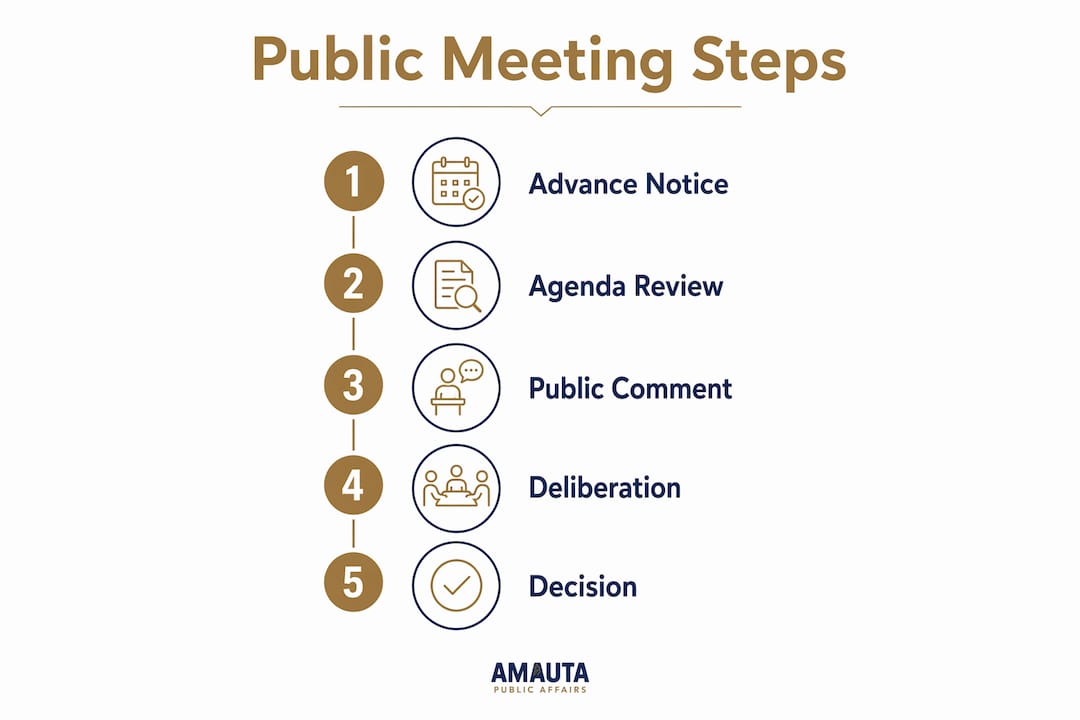
The public meeting process follows a predictable sequence, though exact deadlines vary by jurisdiction and meeting type.
Notice issued (10+ days before the meeting for many state bodies under laws like the Bagley-Keene Act)
Agenda published (typically 72 hours to one week before the meeting)
Speaker registration opens (often 7–21 days before, closing anywhere from the night before to 45 minutes before the meeting)
Written comment deadline (San Antonio accepts written comments until one hour before meeting start; San Diego distributes comments received by 8:00 AM on the meeting day)
Meeting convenes, chair calls roll, quorum confirmed
Public comment period conducted per agenda item before the body votes
Vote or decision recorded in official minutes
Meeting record posted online, typically within 24–48 hours for video archives
How to submit comments or questions before and during a meeting
Written comment submission follows a defined process that varies by body but shares common steps. San Antonio’s SASpeakUp platform allows residents to select a meeting, choose an agenda item, and type a comment directly into the system, with email confirmation sent upon submission. San Diego’s public comment webform accepts submissions up to 500 words and allows attachments, with a distribution deadline of 8:00 AM on the day of the meeting. For in-person submission, completing a speaker slip with the city clerk at the meeting is the standard procedure. Handouts for council members typically must be submitted by email the day before the meeting.
Ways the public can provide input beyond speaking at the podium
Oral testimony at the podium is the most visible form of participation, but it is far from the only one. The full range of input methods available to the public includes:
Oral testimony during designated comment periods, in person or by phone
Written statements submitted via webform, email, or postal mail before or during the meeting
Online forums and portals like SASpeakUp or city-specific engagement platforms
Organized presentations where two or more people pool their time to present collectively, with San Diego allowing up to 15 minutes for group presentations
Non-agenda public comment periods, which let speakers address topics within the body’s jurisdiction even when those topics are not on that day’s agenda
Video and audio recordings submitted as supplemental materials, subject to advance notice requirements
The role of public comment campaigns in civic advocacy has grown substantially as digital tools lower the barrier to written participation. Coordinated written comment campaigns, in particular, can generate a volume of input that carries weight even when individual speakers cannot attend in person.
How governing bodies make decisions during and after public meetings
Once public comment closes on an agenda item, the governing body moves to deliberation and action. A council member makes a motion, another seconds it, and the body votes. The motion passes when it receives the required number of votes, which varies by body and item type. If no one seconds a motion, or it fails to reach the threshold, the body either moves on or considers an alternate motion. The City of San Diego uses roll call votes for teleconference meetings, ensuring each member’s position is individually recorded. Consent agenda items, which cover routine or non-controversial matters, are approved in a single collective vote rather than item by item. Official minutes capture motions, seconds, and votes, not a transcript of discussion. Video archives serve as the record of what was actually said, and they are typically posted online within 24–48 hours of the meeting.
Navigating public meetings with confidence requires preparation, procedural knowledge, and a clear message. Amautapublicaffairs brings a campaign-style approach to community engagement, helping clients build public support, manage complex administrative processes, and communicate effectively at every stage of the public meeting process. Explore our engagement services to see how tailored advocacy strategies can make your voice count.
Key Takeaways
Effective public meeting participation requires advance preparation, procedural knowledge, and a concise message delivered within the body’s established rules.
Point | Details |
Notice and agenda come first | Most state bodies must publish meeting notice at least 10 calendar days in advance; review the agenda before registering to speak. |
Registration deadlines are strict | Speaker registration can close as early as 45 minutes before the meeting or as late as the night before; confirm local rules early. |
Time limits are enforced | Speakers typically receive a few minutes; Austin allows donated time from other registered speakers on the same item. |
Written comments are always an option | San Diego accepts webform comments up to 500 words; San Antonio accepts written input until one hour before meeting start. |
Decisions are recorded, not transcribed | Official minutes capture motions and votes; video archives, posted within 24–48 hours, preserve the full discussion. |
Recommended
Comments