
How to Improve Public Perception of a Commercial Project

Public perception management is the practice of shaping how communities, officials, and stakeholders view a commercial project before, during, and after construction. Projects that fail to manage perception early face opposition, delays, and regulatory setbacks that cost far more than any engagement program. The most effective way to improve public perception of a commercial project is to combine transparent communication, structured community engagement, and enforceable accountability mechanisms from day one. This guide gives developers, government officials, and business leaders a clear framework for building genuine community support.
What prerequisites are needed to improve public perception of a commercial project?
Effective perception management begins before the first public meeting. Community engagement strategies must define clear purposes, target audiences, and measurable objectives. Without this foundation, outreach becomes reactive and unfocused.
The right team and tools matter as much as the strategy itself. A multidisciplinary team should include communications specialists, digital engagement managers, and data analysts who can track sentiment and adjust messaging in real time. No single channel reaches every stakeholder group, so the approach must combine digital and offline methods.
Core prerequisites for any commercial project engagement program:
A written engagement strategy with defined goals, audiences, and success metrics
Digital platforms such as consultation websites, online surveys, and social media channels
Offline methods including town halls, printed materials, and direct mail for populations with limited internet access
A communications plan that aligns with project milestones and approval timelines
Data analysis tools to collect, categorize, and act on public feedback
A designated engagement lead who coordinates across legal, communications, and project delivery teams
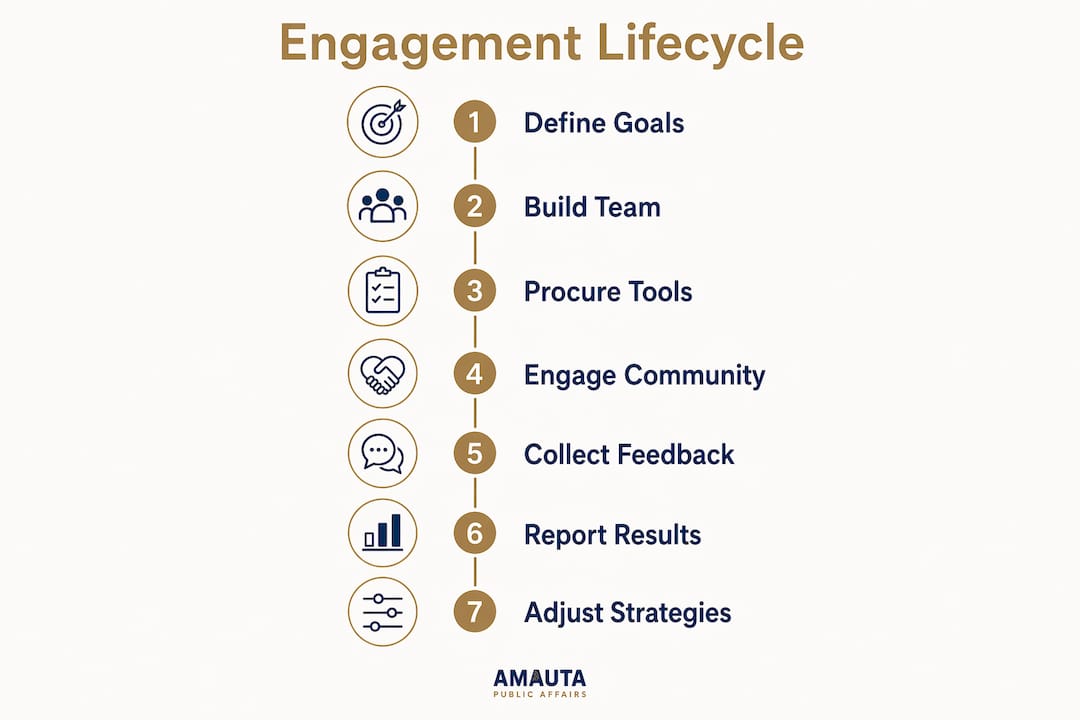
GOV.UK’s digital engagement toolkit recommends a structured 7-step lifecycle: define outcomes, build the team, procure tools, plan the engagement, launch, monitor, and review. This lifecycle prevents the common mistake of treating engagement as a single event rather than a continuous process.
The table below maps each prerequisite to its primary function:
Prerequisite | Primary function |
Written engagement strategy | Aligns team on goals and prevents ad hoc decisions |
Digital consultation platform | Reaches broader audiences and captures structured feedback |
Offline outreach methods | Includes residents without reliable internet access |
Communications plan | Coordinates messaging across all channels and project phases |
Data and sentiment analysis | Identifies emerging concerns before they escalate |
Dedicated engagement lead | Maintains consistency and accountability across departments |
How to execute effective stakeholder engagement to boost community image
Execution separates projects that earn community support from those that generate opposition. The sequence and quality of engagement activities determine whether stakeholders feel heard or managed.
Start with community listening sessions. Hold structured listening events before any design is finalized. These sessions capture concerns, local priorities, and existing tensions that desk research will miss. Document every concern and publish a summary publicly.
Embed engagement specialists within the delivery team. Mace Group’s approach demonstrates that embedding engagement specialists within project delivery teams improves trust and identifies issues early. Specialists who sit alongside engineers and planners catch communication gaps before they become public conflicts.
Maintain a consistent update schedule. Send newsletters, post project updates on a dedicated website, and share progress on social media at regular intervals. Transparency about delays is as important as celebrating milestones. Communities that receive honest updates are far less likely to assume the worst.
Use interactive digital tools. Map-based visualizations, online polls, and virtual open houses give residents a concrete way to engage with project designs. These tools also generate structured data that teams can use to demonstrate responsiveness.
Connect stakeholder input to real decisions. Meaningful engagement requires linking community feedback to actual design changes or policy adjustments. When residents see their input reflected in project outcomes, trust compounds over time.
Address concerns proactively. Monitor local social media groups, neighborhood forums, and news outlets for emerging concerns. Respond publicly and factually before misinformation takes hold.
Combine digital and in-person outreach. Digital tools expand reach, but in-person meetings build the relational trust that sustains support through difficult project phases. Neither channel alone is sufficient.
Pro Tip: Publish a feedback report after every major engagement phase. Showing the community what you heard and what you changed based on their input is the single most credible signal that engagement is genuine, not performative.
What role do community benefits and accountability play in enhancing project reputation?

Community benefits are the most durable tool for building lasting public support. They shift the project’s relationship with the community from transactional to reciprocal.
Community benefit agreements (CBAs) are legally binding, negotiated documents that clarify costs, benefits, and enforceable commitments to local communities. Brookings highlights their role in addressing public concerns before and during construction. The binding nature of CBAs matters because informal promises erode trust when circumstances change. Legally binding commitments reduce perceptions of opportunism and support sustainable local partnerships across the full project lifecycle.
Voluntary community benefit designs offer additional flexibility. Local investment funds, infrastructure upgrades, local hiring commitments, and educational partnerships all signal long-term commitment to the community’s wellbeing. These measures work best when they are co-designed with community representatives rather than announced unilaterally.
The table below compares formal and voluntary community benefit mechanisms:
Mechanism | Binding? | Best use case |
Community benefit agreement (CBA) | Yes | Large-scale projects with significant community impact |
Local hiring commitment | Negotiable | Projects in areas with high unemployment |
Community investment fund | No | Supplementary goodwill building alongside a CBA |
Infrastructure investment pledge | Negotiable | Projects requiring road, utility, or park improvements |
Social license to operate (SLO) is the concept that captures what community benefits are ultimately building. SLO is earned through ongoing local acceptance based on trust, transparency, and accessible grievance mechanisms, not just regulatory approvals. A single broken commitment can quickly erode hard-earned goodwill. This is why practitioners distinguish between measuring activity, such as meetings held, and measuring relationship outcomes, such as whether the community believes it is being heard.
A well-maintained grievance mechanism must be accessible, transparent, responsive, and perceived as fair. Projects in the energy and infrastructure sectors that have implemented formal grievance channels consistently report fewer escalations and shorter approval timelines than those relying on informal complaint processes.
Pro Tip: Frame community benefit agreements as a co-design process, not a negotiation. Invite community representatives to help shape the benefit package from the start. This approach produces commitments that communities actually value and are more likely to defend publicly.
How to manage reputation risk and coordinate messaging throughout the project lifecycle
Reputation risk management is not a crisis communications function. Greenspoon Marder LLP calls public relations a mechanical necessity from day one of project planning. Projects that treat reputation management as an afterthought pay for it in schedule delays and opposition costs.
Agility PR Solutions recommends starting reputation management at the site acquisition and due diligence stages. This means conducting structured community listening before any public announcement and using those findings to shape the project’s initial narrative. Early engagement shapes the story before opponents do.
Messaging consistency is the most frequently overlooked risk factor. Inconsistencies between legal filings, press releases, social media posts, and community communications undermine trust and cause reputational damage. Every channel must carry the same core message, even when the language is adapted for different audiences.
Key reputation risk management practices:
Audit all public-facing documents at each project phase to confirm messaging alignment
Assign one communications lead who reviews all external content before release
Monitor social media and local news daily for misinformation and respond within 24 hours
Share bad news proactively rather than waiting for it to surface through other channels
Maintain a media relations strategy that coordinates earned media with community communications
Avoid common developer PR mistakes such as inconsistent statements across legal and public channels
Reputational work is fundamentally about managing schedule risk. Opposition that could have been addressed in a listening session becomes a formal objection, then a legal challenge, then a delay measured in months and millions. The cost of early engagement is always lower than the cost of late-stage opposition.
Key Takeaways
Improving public perception of a commercial project requires structured engagement, enforceable community commitments, and consistent messaging across every channel from the earliest project stage.
Point | Details |
Start engagement before design | Community listening sessions held before plans are finalized capture concerns early and prevent costly redesigns. |
Use legally binding commitments | Community benefit agreements reduce skepticism and create enforceable accountability that informal promises cannot provide. |
Coordinate all messaging channels | Legal filings, press releases, and social media must carry consistent messages to prevent trust erosion. |
Embed engagement specialists | Specialists within delivery teams identify communication gaps before they escalate into public opposition. |
Measure relationship outcomes | Track whether communities feel heard, not just how many meetings were held, to assess real engagement quality. |
What I have learned about public perception from working commercial projects
The most persistent mistake I see in commercial project development is treating public engagement as a box to check rather than a governance function. Teams spend months on engineering and weeks on community relations. The ratio should be closer to equal, especially in the first six months of a project.
Embedding engagement specialists within delivery teams is not a luxury for large infrastructure projects. It is a baseline requirement for any commercial development that touches a neighborhood. When engagement sits outside the delivery team, it becomes reactive. Specialists inside the team catch the issues that engineers and planners do not know to flag.
The projects that earn genuine community support share one characteristic: they publish what they hear. Openly sharing feedback results demonstrates transparency in a way that no press release can replicate. Communities that see their concerns documented and addressed become advocates. Communities that feel ignored become opponents.
Trust is not built through more messaging. Trust is built through credible relationships and delivered commitments. The developers and officials who understand this distinction consistently achieve faster approvals, lower opposition costs, and stronger long-term community relationships. The ones who do not learn it the expensive way.
— Ignacio
How Amautapublicaffairs helps commercial projects build community support
Amautapublicaffairs works with developers, government officials, and business leaders who need more than a communications plan. The firm applies a campaign-style approach to land management engagement, assessing the community landscape, identifying key stakeholders, and building the messaging architecture that sustains public support through every project phase.
Services include community engagement planning, media relations, digital advocacy, and benefit agreement facilitation. Each program is built around the specific needs of the project and refined based on real-time feedback from the community and stakeholders. If you are preparing for a commercial development and need a structured path to community support, connect with the team at Amautapublicaffairs to discuss your project’s specific challenges and goals.
FAQ
What is the fastest way to improve public perception of a project?
Start with structured community listening sessions before any public announcement. Early engagement shapes the narrative and reduces the opposition that causes the most costly delays.
What is a community benefit agreement and why does it matter?
A community benefit agreement is a legally binding document that commits a developer to specific local benefits such as hiring, infrastructure, or investment funds. Binding commitments are more effective than informal promises at building community trust.
What is social license to operate?
Social license to operate is the ongoing acceptance of a project by the local community, earned through trust, transparency, and accessible grievance mechanisms. It exists independently of regulatory approvals and can be lost if commitments are broken.
How do you prevent messaging inconsistencies from damaging a project’s reputation?
Assign one communications lead to review all external content before release and audit legal filings, press releases, and social media posts at each project phase to confirm alignment. Inconsistencies between channels are a leading cause of trust erosion in commercial developments.
When should reputation management begin on a commercial project?
Reputation management should begin at the site acquisition and due diligence stage, before any public announcement. Projects that engage communities early consistently achieve faster approvals and face less organized opposition than those that wait until formal filings.
Recommended
Comments