
How to Respond to Media Criticism Development Effectively

Responding to media criticism development is defined as the structured process of assessing, correcting, and communicating in response to negative press coverage to protect organizational reputation. PR professionals and communication strategists who treat this process as a discipline, rather than a reaction, consistently achieve better outcomes. The dual clock of modern media response runs simultaneously: the immediate news cycle and the long-term AI search narrative. Both require deliberate management. This guide covers the critical steps, from private verification through sustained content campaigns, using research-backed practices current through 2026.
What are the critical initial steps in responding to media criticism?
The first 24–48 hours after negative coverage appears are the highest-stakes window in any media response process. The instinct to respond publicly is almost always wrong. 90% of PR professionals advise reserving this period for private assessment and correction requests rather than public rebuttal. Acting publicly before facts are verified creates additional news cycles and hands journalists a second story.
The correct sequence follows four steps:
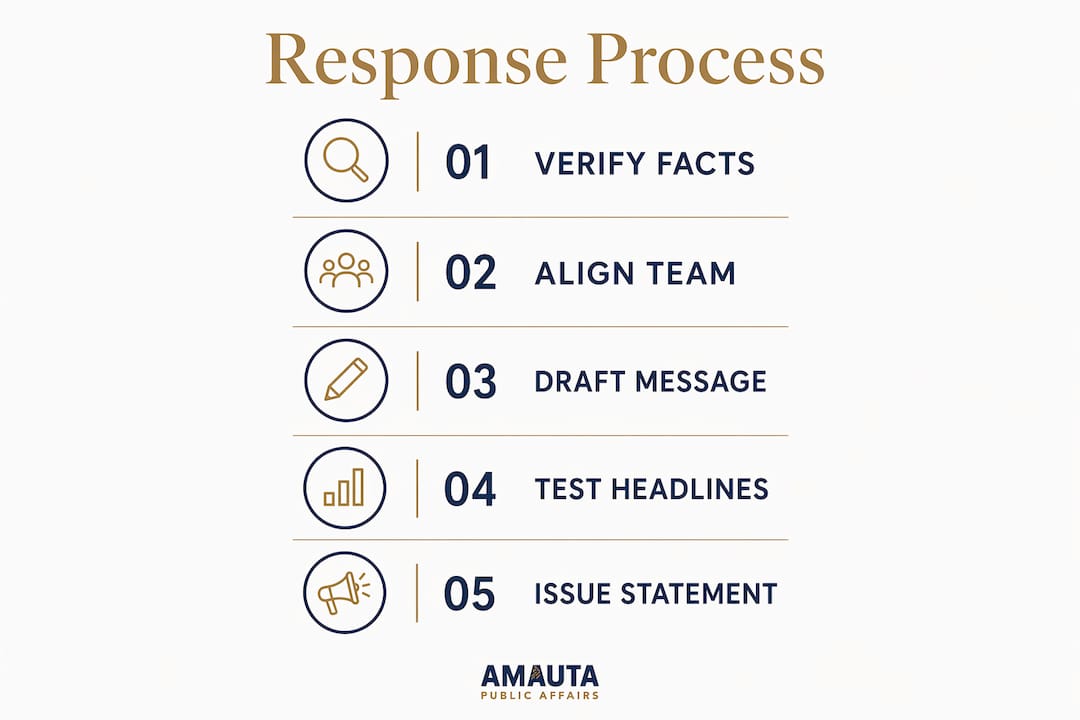
Assess the coverage privately. Read the full piece. Identify every factual claim. Separate verified facts from errors and from matters of opinion. Document each category in writing before anyone drafts a response.
Align the internal team. Bring together the executive lead, legal counsel, and communications lead within hours of the coverage appearing. Each team member must agree on the facts before any message leaves the building. Early alignment between legal and communications prevents contradictory messaging and reduces reputational damage.
Submit a private correction request. Where factual errors exist, corrections requests citing verifiable evidence are often granted and carry better reputational impact than public fights. Send a documented, sourced request to the editor or journalist directly. This is an active reputation management tool, not passive silence.
Draft a cold response. Write a factual, accountability-focused statement for internal review only. Do not publish it yet. This draft serves as the foundation for any public statement if one becomes necessary.
Emotional or reactive public responses in the first hours significantly prolong and worsen negative media impact. Most crises worsen precisely because organizations react before they think.
Pro Tip: Run your draft response through a “second-day headline” test. Ask: if a journalist wrote a follow-up story based solely on this statement, what would the headline say? If the answer is unflattering, revise before sending.

When and how to issue a public response to media criticism
Not every piece of negative coverage requires a public statement. The decision to respond publicly depends on three criteria: the scale of the audience reached, whether factual errors are uncorrected and spreading, and whether silence will be interpreted as admission.
When a public response is unavoidable, the following principles apply:
Lead with empathy, then facts. Acknowledge the concern before defending the organization. Audiences read defensiveness as guilt.
Stay narrow. Address only the specific claim at issue. Broad denials invite broader scrutiny.
Choose the right channel. The company blog or an owned press release page is the preferred venue. Responding on the same platform as the criticism risks amplifying the original story.
Time it carefully. An empathetic, factual statement issued within 4 hours of report publication, when coordinated internally beforehand, helps retain narrative control. Without internal coordination, 4 hours is too fast.
Avoid attacking the journalist or outlet. This tactic consistently backfires and shifts the story from the original criticism to the organization’s conduct.
The media relations strategy that works best treats the public statement as a single, narrow document. It states what happened, what the organization is doing about it, and what the next communication will be. Nothing more.
Pro Tip: Avoid committee-written statements. Narrow, pressure-tested messages that remain defensible over time outperform broad, consensus-driven language every time. Assign one writer, then review with the team.
Understanding why media criticism is now mainstream behavior also matters here. Audiences are more media-literate than ever. They notice when a statement sounds like it was written by a committee trying to avoid accountability.
How do long-term content strategies shift search and AI narratives?
Handling negative media coverage in the short term is only half the problem. The longer-term challenge is what search engines and AI systems surface when someone queries the organization’s name months or years later. Negative coverage does not disappear from search results on its own.
Structural reform content requires 12–24 months of consistent primary-source publication to influence search and AI weighting effectively. That timeline surprises most PR teams. It means the content campaign must begin within weeks of the crisis, not after the news cycle ends.
Content type | Primary function | Timeline to impact |
Owned blog posts and press releases | Build primary-source corpus under the named principal | 3–6 months |
Earned media placements | Third-party credibility signals for search algorithms | 6–12 months |
Executive bylines and op-eds | Establish named authority in AI retrieval systems | 6–18 months |
Community engagement reports | Demonstrate operational accountability publicly | 12–24 months |
Same-day operational compensation and clear public communication compound favorably in AI engine retrieval as response substance. This means that concrete actions, documented publicly and promptly, carry more weight in AI-generated summaries than carefully worded statements alone.
Reputation repair depends heavily on building a primary-source corpus over this extended period. Organizations that publish consistently under the named principal, whether a founder, CEO, or institutional brand, create a body of authoritative content that search engines and AI systems draw from when forming narrative summaries.
Monitoring is not optional. Track search results and AI-generated responses for the organization’s name at least monthly. When negative coverage still dominates at the 6-month mark, accelerate earned media outreach and increase publication frequency on owned channels.
Best practices for coordinating internal teams during media backlash
Internal coordination failures cause more reputational damage than the original coverage in many cases. The most common failure point is paralysis between legal and communications teams, each waiting for the other to approve a message.
The following practices prevent that paralysis:
Name one spokesperson immediately. Naming a single spokesperson to route all communications prevents mixed messages and reduces perceived confusion. Every journalist inquiry, every social media comment, every internal question routes through one person.
Set a decision deadline. Legal and communications must reach a defensible position within a fixed window, typically 6–12 hours from the first internal meeting. Open-ended review cycles create delays that the media fills with speculation.
Separate legal risk from reputational risk. Legal counsel protects the organization from liability. Communications counsel protects the organization from perception damage. These goals sometimes conflict. Resolve the tension explicitly, not by letting one team veto the other indefinitely.
Avoid hollow messaging. Statements that acknowledge nothing, promise nothing, and explain nothing satisfy no one. Factual corrections citing precise public records shape perception better than broad denials.
The rapid response communications framework that Amautapublicaffairs applies in practice treats internal alignment as a prerequisite, not a parallel process. The public statement cannot be finalized until the internal position is settled.
Pro Tip: Run a tabletop exercise before a crisis happens. Simulate a negative front-page story about your organization and walk through the first 48 hours. Teams that have practiced the process move faster and make fewer errors when the real event occurs.
Early clear communication led by founders under pressure is a documented factor in crisis reputation recovery. The organizations that recover fastest are those where leadership speaks first and speaks clearly, not those where communications are managed entirely by committee.
Key Takeaways
The most effective approach to media criticism response combines private verification, coordinated internal alignment, and a sustained 12–24 month content campaign to shape both immediate and long-term narratives.
Point | Details |
Delay public response | Use the first 24–48 hours for private fact verification and correction requests, not public statements. |
Align legal and communications early | Resolve the legal-communications tension within hours to prevent contradictory messaging. |
Name one spokesperson | A single communications lead prevents mixed messages and reduces perceived organizational confusion. |
Publish consistently for 12–24 months | Sustained primary-source content is required to shift search and AI narratives after negative coverage. |
Choose owned channels for statements | The company blog or press release page reduces the risk of amplifying the original critical story. |
The 48-hour window is where most organizations lose the narrative
The pattern I see most often is not organizations that respond badly. It is organizations that respond too fast. The first 48 hours feel urgent because the story is moving and silence feels like surrender. That instinct is understandable. It is also the most reliable path to making the situation worse.
What I have found, working through media criticism events across different sectors, is that the organizations that recover fastest are almost never the ones that responded first. They are the ones that responded right. They verified the facts. They aligned their teams. They sent a private correction request before they said a word publicly. And when they did speak, they said something narrow, factual, and defensible.
The AI dimension of this problem is genuinely new and underestimated. When someone asks an AI assistant about your organization six months after a crisis, the system draws from whatever primary-source content exists. If your organization published nothing substantive during that period, the AI retrieves the critical coverage. That is the long game that most PR teams are not yet playing.
My recommendation: treat the 12–24 month content campaign as a non-negotiable part of the crisis response plan, not an optional follow-on. The business reputation management work that matters most happens long after the news cycle ends.
— Ignacio
How Amautapublicaffairs supports organizations through media criticism
Organizations facing negative media coverage need more than a statement. They need a coordinated process that covers immediate response, internal alignment, and the long-term content work that shapes how search engines and AI systems represent them over time.
Amautapublicaffairs provides media relations and crisis response services built for exactly this kind of pressure. From the first 48 hours of private assessment through the sustained publication campaigns that rebuild search and AI narratives, the team applies a campaign-style approach grounded in real-time feedback and measurable outcomes. Organizations working through complex public affairs challenges, including land use, community opposition, and regulatory scrutiny, benefit from a process that is both disciplined and adaptable.
FAQ
What is the best time to respond publicly to media criticism?
The best public response, when one is necessary, comes after internal alignment is complete and within 4 hours of the report’s publication. Responding before facts are verified almost always extends the negative news cycle.
Should you always issue a public statement after negative coverage?
Not always. A public statement is warranted when factual errors are spreading uncorrected, when the audience reached is large, or when silence will be interpreted as admission. Private correction requests to editors are often the better first move.
How long does it take to repair a reputation after negative media coverage?
Sustained content campaigns require 12–24 months of consistent primary-source publication to shift search engine and AI narratives away from negative coverage. Short-term statements alone do not produce lasting reputation recovery.
Who should speak for an organization during a media criticism event?
One named spokesperson should handle all external communications. Routing all journalist inquiries and public statements through a single person prevents mixed messages and reduces the appearance of organizational confusion.
How do private correction requests work?
A private correction request is a documented, sourced communication sent directly to the editor or journalist identifying specific factual errors with verifiable evidence. These requests are frequently granted and carry stronger reputational impact than public disputes.
Recommended
Comments