
How Trust-Building Campaigns Work for Land Use Leaders

Trust-building campaigns are strategic, continuous efforts designed to create and sustain genuine credibility between organizations and communities. In land use contexts, where public skepticism runs deep and approval timelines are long, understanding how trust-building campaigns work is not optional. It is the prerequisite for any successful project. Research from SMG shows that 87% of consumers will pay more for brands they trust, but 40% will never return once that trust is broken. That asymmetry defines the stakes for every local government official, community leader, and activist working to advance land use initiatives. Fluent Support data confirms that trust now outranks price as a primary competitive differentiator, a shift that applies directly to public sector credibility.
How trust-building campaigns work: the core mechanics
The standard industry term for this discipline is trust architecture, a framework that treats credibility as a designed, measurable system rather than a byproduct of good intentions. Trust-building campaigns, as the SEO phrase describes them, are the execution layer of that architecture.
The most important structural distinction is between a campaign and a trust loop. A campaign is a scheduled, finite burst of messaging. A trust loop, as defined by TrustMedia.io, is a behavior-driven cycle where each community interaction triggers a calibrated response that deepens the relationship. For local officials managing a rezoning proposal or a renewable energy siting process, this distinction is decisive. One-off town halls generate attendance data. Trust loops generate behavioral signals, such as repeat participation, public comment quality, and sentiment shifts, that tell you whether your credibility is actually growing.
The mechanics of a trust loop in a land use context operate through four stages. First, you initiate contact through a community touchpoint, whether a public meeting, a digital survey, or a neighborhood newsletter. Second, you capture behavioral signals: who responded, what they asked, what concerns surfaced. Third, you deliver a personalized, relevant follow-up that directly addresses those signals. Fourth, you measure the shift in engagement depth before repeating the cycle. Zendesk research confirms that emotional connections drive loyalty 1.5 times more powerfully than rational evaluations, which means your follow-up must address how residents feel about a project, not just what they know about it.

Pro Tip: Never treat a public meeting as a trust event in itself. It is only the first trigger in a loop. The trust is built in what you do with the feedback afterward.
Real-world examples that illustrate effective trust campaigns
The most instructive case studies come from organizations that faced the same credibility gap local officials encounter: an audience that is skeptical, informed, and watching for inconsistency.
Thomson Reuters and the AI credibility problem. When Thomson Reuters needed to win over cautious legal professionals on AI adoption, it did not lead with technology features. It anchored the campaign in the expertise of trusted legal authorities, using established voices to validate the new tool. For land use leaders, the parallel is direct: when proposing a controversial infrastructure project, lead with the voices your community already trusts, such as local engineers, longtime residents, or respected civic organizations, rather than with agency branding.
Starling Bank’s crowd-sourced tips campaign. Starling Bank converted abstract brand trust into measurable growth by using authentic customer content segmented by specific financial moments in people’s lives. The campaign worked because it replaced polished marketing language with real voices addressing real situations. Community leaders can replicate this by collecting and amplifying resident stories about how a proposed project would affect daily life, both positively and negatively.
Public complaint responses as trust touchpoints. Research from FiveReviews confirms that small public moments like responding to a complaint at a city council meeting or addressing a critical social media comment carry more trust weight than large advertising campaigns. A local official who publicly acknowledges a legitimate concern and commits to a specific follow-up action builds more credibility in that single exchange than a month of press releases.
Consistency across micro-moments. Trust is not the sum of your best messaging. It is the sum of every public interaction your organization has, including the ones you did not plan. When a resident posts a question on a neighborhood forum and receives no response, that silence registers as a trust signal. When a project website goes three months without an update during a permitting delay, that gap communicates something. Effective trust campaign strategies account for these low-visibility touchpoints with the same rigor applied to formal communications.
The common thread across these examples is alignment: the promise made in the campaign must match the experience delivered in every channel. When those two diverge, the trust gap that opens is far harder to close than the skepticism you started with.
What frameworks and tools can local officials use?
Designing a trust campaign without a measurement framework is the equivalent of running a construction project without a site survey. The trust architecture framework identifies five layers that every credible campaign must address: visual credibility, narrative credibility, social credibility, experiential credibility, and values credibility. Each layer contributes to the cumulative trust decision your community makes about your initiative.
The table below maps each layer to a practical application in land use contexts.
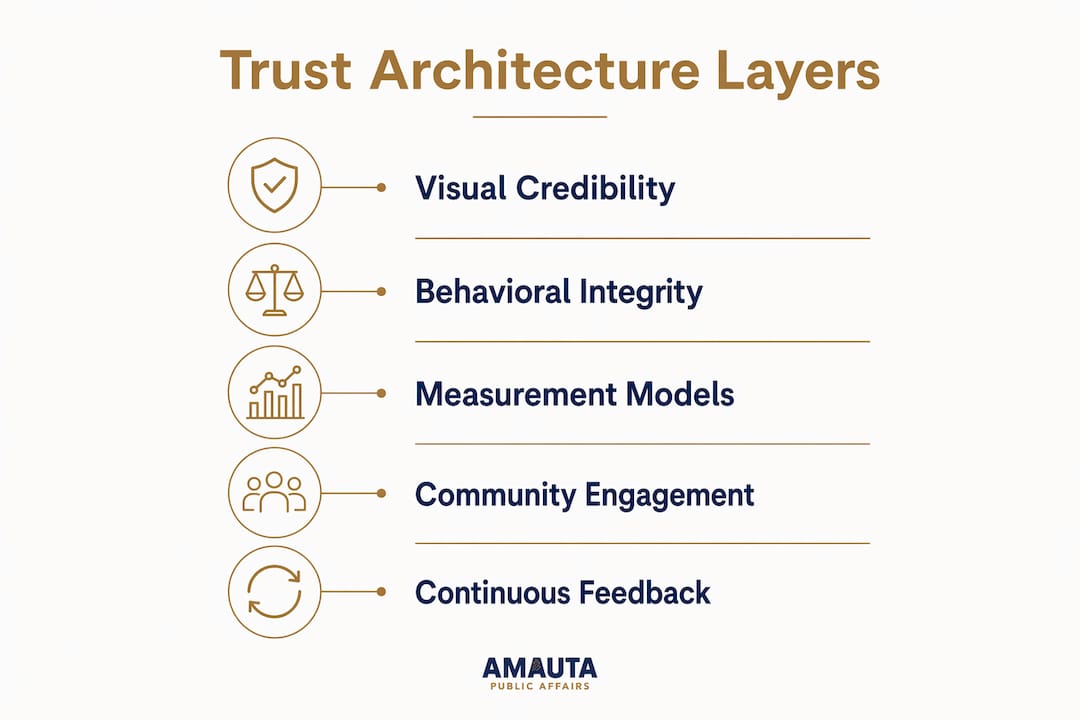
Trust architecture layer | Land use application |
Visual credibility | Consistent, professional design across all public materials signals organizational competence |
Narrative credibility | Project messaging that uses plain language and acknowledges tradeoffs builds believability |
Social credibility | Endorsements from recognized community figures lower skepticism faster than agency statements |
Experiential credibility | Delivering on small commitments, like publishing meeting minutes on time, compounds over months |
Values credibility | Demonstrating that project decisions reflect stated community priorities, not just regulatory minimums |
Beyond architecture, trust campaigns require measurement models that go beyond impressions. Starling Bank’s campaign demonstrated that trust metrics must include survey scores, engagement depth, and funnel conversions, not just reach. For land use campaigns, the equivalent metrics are public comment sentiment, meeting attendance trends, petition signature rates, and the ratio of supportive to opposing testimony at hearings.
Amautapublicaffairs uses trust analytics to assess these perception shifts at a granular level, identifying which community segments are moving toward support and which remain skeptical. That segmentation allows for targeted messaging that addresses specific concerns rather than broadcasting generic reassurance.
Pro Tip: Run a baseline trust audit before launching any public campaign. Survey a representative sample of community members on their current perception of your organization. Without a baseline, you cannot measure whether your campaign is working.
Common pitfalls that undermine trust campaigns
The most damaging trust campaign mistakes are not dramatic failures. They are quiet, cumulative erosions that compound over time.
Treating trust as a campaign rather than a relationship. The single most common error is designing a trust initiative with a start date and an end date. Trust campaigns fail when frequency and messaging ignore community behavior and relationship pacing. A community that feels engaged during a project’s approval phase and then ignored during implementation will register that shift as a broken promise.
Ignoring low-level friction points. Unanswered emails, outdated project websites, and unacknowledged public complaints are not minor administrative oversights. They are trust signals. Public transparency in addressing mistakes strengthens trust more than hiding errors, which means your response to a critical comment on a community Facebook group matters as much as your formal public record.
Polished messaging that outpaces delivery. When a campaign promises community co-design but the actual process offers only comment periods, residents notice the gap immediately. The trust architecture collapses not because the messaging was wrong, but because the experience contradicted it. For advocacy communications designed for civic leaders, the principle is consistent: promise only what the process can actually deliver.
Siloed communication teams. Trust is not the sum of brand behaviors over time in the communications department alone. It is the sum of every public interaction across every department. A planning department that communicates well but a permitting office that is unresponsive creates a fragmented experience that residents correctly interpret as organizational dysfunction.
Skipping segmentation. A message designed for longtime residents who fear displacement lands very differently with new business owners who see economic opportunity. Generic trust messaging that tries to speak to everyone typically resonates with no one.
Pro Tip: Integrate community representatives directly into your campaign review process. They will identify friction points and tone mismatches that internal teams consistently miss.
Key takeaways
Trust-building campaigns work by designing continuous, behavior-responsive systems that align every public interaction with stated community values, measured through engagement depth, sentiment shifts, and delivery on commitments.
Point | Details |
Trust loops over campaigns | Design ongoing behavior-triggered cycles, not scheduled messaging bursts, to build sustained credibility. |
Small moments carry the most weight | Public complaint responses and micro-interactions build more trust than large-scale messaging campaigns. |
Measure beyond impressions | Track sentiment analysis, engagement depth, and public comment quality to assess real trust shifts. |
Align promise with experience | Every gap between campaign messaging and actual project delivery creates a trust deficit that compounds. |
Segment your community | Targeted messaging by community concern type outperforms generic reassurance in every trust metric. |
Why the pathway to trust is longer than most leaders expect
I have worked with local officials who launched well-designed trust campaigns and were genuinely surprised when community skepticism persisted three months in. The instinct is to conclude the campaign is not working. The reality is almost always the opposite: the campaign is working, but trust accumulates on a timeline that does not match a project approval schedule.
What I have found, consistently, is that the organizations that build the most durable community trust are not the ones with the best messaging. They are the ones that show up in the small moments. The planning director who responds personally to a resident’s email. The project team that posts an update during a permitting delay, even when there is nothing positive to report. The community meeting where the facilitator acknowledges a legitimate concern rather than deflecting it. These micro-moments are the actual infrastructure of trust. The campaign is just the scaffolding that makes them visible.
The uncomfortable truth for land use leaders is that you cannot shortcut this timeline with better creative or a larger media budget. What you can do is design your organization’s behavior so that every touchpoint, planned or unplanned, reinforces the same message: we are here, we are listening, and we will follow through. That is the pathway to implementation that actually works. For infrastructure projects specifically, winning community support requires exactly this kind of sustained, co-designed engagement rather than top-down communication.
— Ignacio
How Amautapublicaffairs supports your trust-building strategy
Amautapublicaffairs specializes in designing and implementing trust-building campaigns tailored to the specific demands of land use and community engagement. The firm’s approach combines trust analytics, strategic messaging, and community outreach to move public perception from skepticism to active support.
For local government officials and community leaders managing complex land management initiatives, Amautapublicaffairs provides the measurement tools, segmentation frameworks, and cross-functional communication support that transform a good-faith effort into a credible, measurable campaign. The team’s experience across community engagement, media relations, and digital advocacy means every touchpoint in your trust loop is designed with the same rigor. To explore how a tailored trust campaign strategy can support your next initiative, connect with the team for a personalized consultation.
FAQ
What is the difference between a trust campaign and a trust loop?
A trust campaign is a finite, scheduled messaging effort. A trust loop is an ongoing, behavior-driven cycle where each community interaction triggers a calibrated response that deepens the relationship over time.
How do you measure whether a trust-building campaign is working?
Effective measurement goes beyond impressions to include public comment sentiment, meeting attendance trends, survey scores, and engagement depth. Holdout tests and segmented surveys provide the most reliable attribution data.
Why do small public moments matter more than large campaigns?
Research confirms that responses to public complaints and low-visibility interactions carry more trust weight than large advertising efforts. Communities judge credibility by how organizations behave when no one is watching, not just during formal communications.
How long does it take for a trust-building campaign to show results?
Trust accumulates over months, not weeks, particularly in land use contexts where community skepticism is grounded in historical experience. Baseline audits conducted before launch allow leaders to track incremental shifts rather than waiting for dramatic changes.
What is the biggest mistake local officials make in trust campaigns?
The most common error is treating trust as a campaign with a defined end date rather than an ongoing relationship system. When community engagement stops after project approval, residents interpret the silence as confirmation that their participation was transactional.
Recommended
Comments