
How Developers Should Vet Agencies for Letter to the Editor Campaigns

Yes, a professionally managed letter-to-the-editor campaign is worth commissioning when it operates as one component of a coordinated media and community strategy, not as a substitute for one. Letters correct the public record, surface credible local voices, and move fast when opposition messaging threatens a hearing timeline. Success looks like verified placements in the right outlets at the right moment, not a stack of letters nobody in the decision chain ever reads.
TL;DR:
Letters should be timed within 24 to 48 hours of a damaging article or opposition piece to be effective in shaping public opinion and influencing hearings.
Campaign success relies on verified local signatories and tailored messaging, not just on the number of placements or volume of letters sent.
A coordinated approach involving media briefings and stakeholder outreach enhances the credibility and impact of letter campaigns in land-use fights.
Monitoring local coverage and opposition messaging helps determine when a letter response is necessary, based on specific triggers like hearings or permit filings.
A professional public affairs firm manages the entire process, from local customization to verification, publication tracking, and timing, to maximize influence on decision-makers.
Table of Contents
Why an Editorial Campaign for Letters Works in Land-Use Fights
Editors keep a standing appetite for reader-submitted commentary because it is short, timely, and gives a paper local flavor without newsroom labor. A well-drafted letter has a real editorial advantage over generic advocacy outreach precisely because it looks and reads like something a neighbor wrote, not a client memo.
For a developer or local government facing an entitlement fight, a letter-to-the-editor campaign serves three strategic goals at once:
Correcting the record when a news article or opponent flyer misstates traffic counts, density figures, or environmental review status.
Elevating supporters who already back a project but have no natural platform, such as a small-business owner near the site or a longtime resident.
Educating decisionmakers who read local papers closely, including planning commissioners and city council staff, even when they never say so publicly.
None of this happens in isolation. Public relations works best as part of an entitlement strategy from the start, which means letters get commissioned alongside media briefings and stakeholder outreach, not after a project is already in trouble.
When to Launch a Letter-Writing Campaign in the Project Timeline
Timing separates a letter campaign that shapes a hearing from one that arrives too late to matter, as explained in a helpful local organizer’s guide to press releases for events which emphasizes coordination and timing.
Pre-submission window. Before an application enters public record, letters build a baseline narrative. This is the cheapest window to operate in because there is no active controversy to fight through, only an absence of coverage to fill.
Reactive response window. When a damaging article or opposition op-ed runs, the firm needs a signed, verified letter in an editor’s inbox within 24 to 48 hours to stay relevant to that news cycle. Editorial teams recommend exactly this kind of rapid drafting and submission turnaround because a letter about last week’s story rarely gets printed.
Sustained-pressure window. During a multi-month approval process, a slower cadence of letters keeps supportive voices visible without flooding the opinion page and triggering editor fatigue.
At every stage, letters amplify other tactics rather than replace them. Op-eds carry more argument, media briefings shape reporter framing, and stakeholder communication plans build the relationships that produce willing signatories in the first place. A letter campaign running alone, with no briefed reporters and no stakeholder outreach behind it, tends to look exactly like what it is: a paid push with no organic backing.
How a Public-Affairs Firm Runs a Letter-to-the-Editor Campaign
A competent firm treats an LTE campaign as a repeatable operation, not a one-off writing assignment. Here is the workflow a buyer should expect to see in a proposal.
Monitoring and triggers. The firm tracks local coverage, competitor and opposition messaging, hearing calendars, and permit filings, then scores each development against a simple question: does this moment justify a letter, or does it need a bigger response like a press briefing? A city council vote gets a different trigger threshold than a routine zoning notice.
Message architecture. Every campaign starts with one core message, two or three proof points (jobs created, tax revenue, traffic mitigation commitments), and a bank of local details that make a letter sound like it came from someone who actually lives near the project.
Local customization. A letter destined for a 40,000 circulation regional daily reads differently than one destined for a weekly community paper. Practitioner guidance consistently favors naming specific streets, landmarks, and neighborhood benefits over generic project language, since hyper-local detail is what makes an editor believe a letter is genuine.
Submission workflow. Firms track each outlet’s word limit, submission portal or email address, and typical turnaround time, then submit through the correct channel with the byline and contact information the paper requires. Local PR playbooks recommend building this asset library before a campaign launches, not while a deadline is bearing down.
Signatory verification. Before any letter goes out, the firm confirms the signer’s residency or professional affiliation and discloses any client relationship where a paper’s policy requires it. Newspapers routinely verify byline and contact details before publishing, and a firm that skips this step risks a rejected letter or a retraction that damages the client’s credibility.
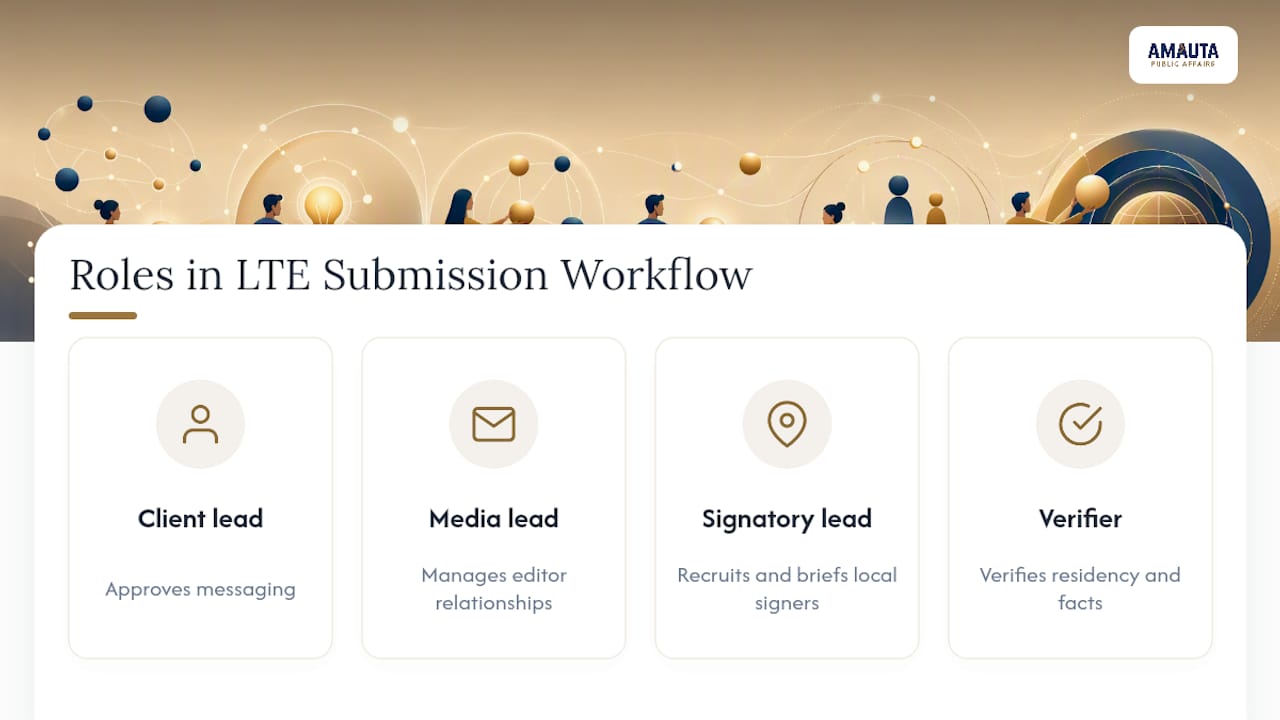
Operational roles. A clean campaign assigns a client lead who approves messaging, a firm media lead who manages editor relationships, a local signatory coordinator who recruits and briefs community voices, and a verification owner who checks every fact before submission.
Pro Tip: Ask any firm you’re evaluating whether they maintain a standing pool of verified local signatories. A firm scrambling to find a resident willing to sign a letter after a story breaks has already lost the 48-hour window that makes a reactive letter worth running.
What to Measure When You Run Letters to the Editor
Placement counts are the obvious metric, but they are not the only one that matters, and a firm that reports only a placement tally is giving you half the picture.
Primary indicators worth tracking:
Number of placements across the campaign window.
Publication tier, since a letter in the paper of record carries more weight with commissioners than one in a small weekly.
Timing relative to the trigger event, because a letter published two weeks after a hearing has already passed has limited value regardless of where it ran.
Estimated reach or circulation, used as a rough proxy for how many local readers, including officials, likely saw it.
Secondary signals matter too: did a reporter follow up on a letter for a story, did another community leader submit a supportive letter without being asked, did a commissioner reference the coverage at a hearing. These are harder to quantify but often more predictive of real influence than raw placement counts.
A grounded measurement principle: firms should combine placement data with qualitative outcomes rather than claiming direct causation between a letter and a permit decision. The strongest public-relations playbooks for development treat correlation with hearing outcomes as supporting evidence, not proof, and any firm promising a guaranteed approval outcome from a letter campaign is overselling what the tactic can do. Expect a reporting cadence tied to project milestones, not just a monthly count.
AMAUTA’s Perspective on Letters as a Campaign Tool
Letter-to-the-editor work is best treated as one instrument inside a campaign-style approach built around land-use challenges, where community engagement, media relations, and digital advocacy are sequenced against a project’s entitlement calendar rather than run on a generic template. That sequencing depends on a close read of the community landscape and the administrative process a given jurisdiction runs on, since a letter strategy that works in one county’s approval process can misfire in another.
There are moments when an LTE push might not be recommended, such as in media markets too thin to sustain an active opinion page, volatile controversies where visible advocacy invites backlash, or situations where residents need direct, in-room engagement rather than published opinions. Reading how opposition campaigns typically operate helps explain why that judgment call matters as much as the execution itself.
What This Playbook Gets Right That Most Advice Misses
Most content on this topic treats letters to the editor as a grassroots writing exercise, complete with tips on word count and tone. That framing misses what actually determines whether a campaign moves a project forward: sequencing, verification, and honest measurement.
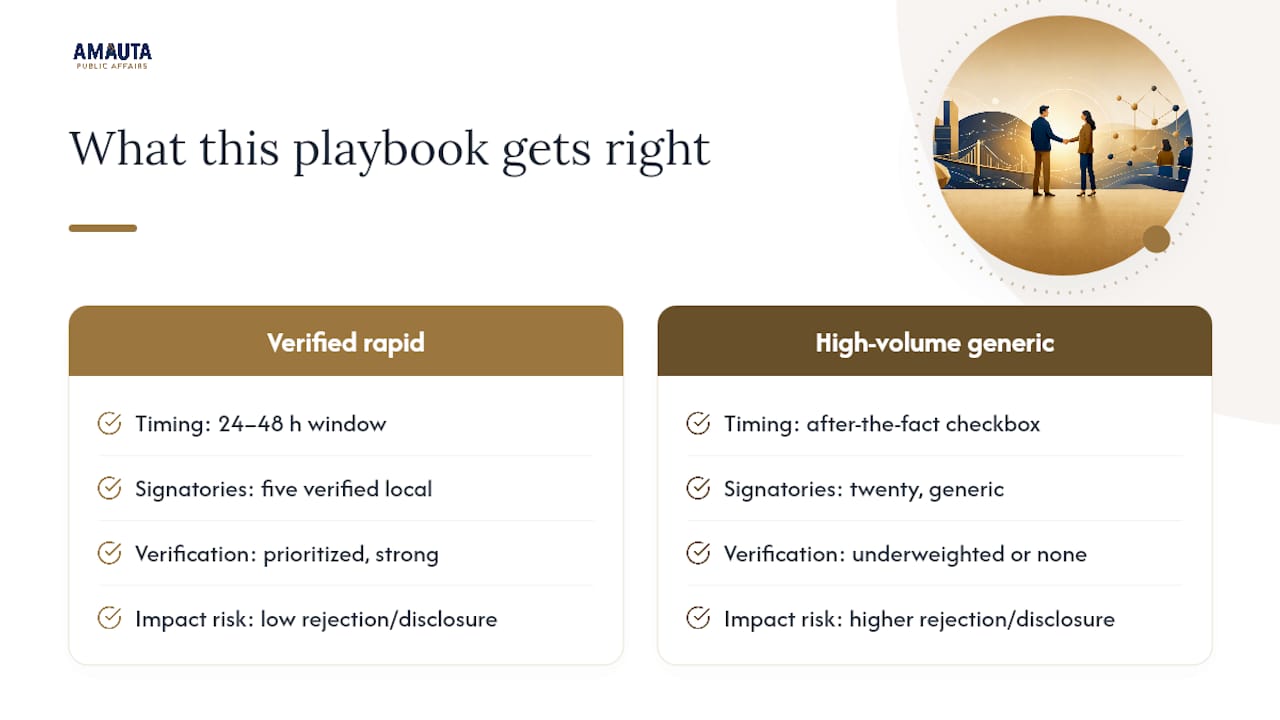
The research behind this piece supports a specific judgment. Letters work when they arrive inside a 24 to 48 hour reactive window or a deliberate pre-submission phase, and they fail when a firm treats them as a checkbox deliverable disconnected from the hearing calendar. Conventional advocacy advice underweights verification, and that is where campaigns actually break: a rejected letter or a disclosed client relationship discovered after publication does more damage than no letter at all.
If you are briefing a vendor, prioritize their signatory pool and verification process before you ask about placement volume. A firm with five verified local voices ready to move in 48 hours beats one promising twenty generic letters with no one lined up to sign them.
— Ignacio
Hire AMAUTA to Plan and Run Your Letter-to-the-Editor Campaign
Hiring a public affairs firm that specializes in letter campaigns tailored to specific hearing calendars and administrative processes provides an alternative to assembling general media outreach efforts or hiring a generalist agency without entitlement timeline expertise.
A typical engagement with a public affairs firm starts with a media landscape brief, sample letters tailored to target outlets, a submission and verification plan, and a timeline synced to key project dates. From there, the firm handles monitoring, drafting, local customization, submission tracking, and signatory verification work to maintain campaign credibility. If your project touches infrastructure or utility approvals specifically, the firm’s digital infrastructure advocacy work applies the same campaign discipline to that sector. Review the full range of services on the AMAUTA Public Affairs services page and request a briefing before your next hearing date locks in.
Sources
FAQ
How Fast Does a Reactive Letter Need to Go Out?
A letter responding to a damaging article or opposition op-ed should reach an editor within 24 to 48 hours to remain relevant to that news cycle.
Do Newspapers Verify Who Signs a Letter?
Yes, most papers confirm a signer’s identity, residency, or professional affiliation and require valid contact information before publishing.
Can a Letter Campaign Run Without Other Media Tactics?
It can, but it performs far better paired with op-eds, media briefings, and stakeholder outreach, since letters amplify a broader narrative rather than build one alone.
What Should a Firm Report Besides Placement Counts?
Expect reporting on publication tier, timing relative to the triggering event, estimated reach, and qualitative signals like reporter follow-up or referenced coverage at hearings.
Does the firm handle signatory recruitment and verification?
Yes, signatory recruitment and verification can be coordinated as part of a campaign-style approach to land-use advocacy, alongside broader media relations and digital advocacy work.
Recommended
Comments