
Local Business Public Relations Strategy: 2026 Guide

A local business public relations strategy is a planned, goal-driven approach to shaping your brand’s story within the community through targeted media outreach, relationship-building, and structured engagement. The standard industry term for this discipline is earned media relations, and it sits at the core of every effective small business PR plan. When executed consistently, it builds the kind of community trust that paid advertising cannot replicate. Salesforce recommends starting with SMART goals, core foundational assets, and at least three newsworthy angles before any outreach begins. This guide walks you through each step, from planning through measurement, using 2026 best practices.
What does a local business public relations strategy require to launch?
The prerequisite for any effective PR effort is a clear plan. Without defined goals, you are sending press releases into a void and hoping something sticks. Salesforce’s 2026 PR guide recommends building your strategy around SMART goals tied directly to local business outcomes, such as securing two media placements per quarter or increasing foot traffic by 15% after a community event.
Before you pitch a single journalist, build these foundational assets:
Brand boilerplate: A 100-word description of your business that stays consistent across all materials
Press kit: Includes your boilerplate, high-resolution logo, founder bio, product or service overview, and recent coverage
Media list: A curated spreadsheet of local reporters, editors, and bloggers organized by beat and outlet
Visuals: Professional photos of your storefront, team, and products ready for immediate use
Your brand narrative is the thread that connects all of these assets. It answers one question: why does your business matter to this community? A neighborhood bakery that sources from local farms has a different story than one that does not. That specificity is what makes pitches land.
Pro Tip: Use a CRM tool like Salesforce or a simple Google Sheet to track every media contact, pitch date, and response. Disorganized outreach is the fastest way to burn journalist relationships before they start.

Asset | Purpose | Priority |
Brand boilerplate | Consistent identity across all media materials | High |
Press kit | One-stop resource for journalists covering your business | High |
Media list | Organized outreach targeting by beat and geography | High |
Professional visuals | Reduces friction for editors who need ready-to-publish images | Medium |
SMART goal document | Keeps outreach accountable and measurable | High |
Which channels build the strongest local PR visibility?
Local media remains the highest-leverage channel for small business PR. Shopify’s 2026 PR guide identifies community events and earned media as the two most effective outreach components for local businesses. A placement in a regional business journal or neighborhood blog carries more trust with local customers than a national feature that has no geographic relevance.
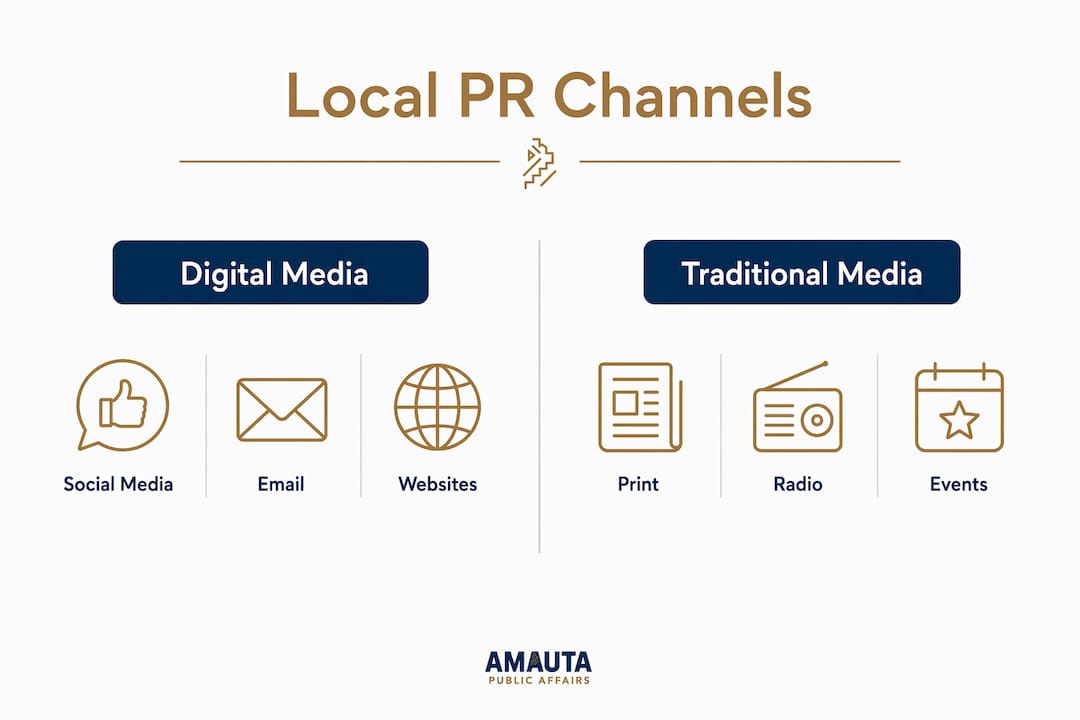
The most productive channels for local PR visibility include:
Local newspapers and business journals: The Austin Business Journal, Chicago Reader, and similar city-specific outlets actively seek local business stories
Neighborhood blogs and hyperlocal news sites: Platforms like Patch.com cover community events and business openings that larger outlets ignore
Local podcasts: A 20-minute interview on a city-focused podcast reaches a highly engaged, geographically concentrated audience
Community events: Hosting or sponsoring events generates media interest, photo opportunities, and word-of-mouth simultaneously
Social media micro-influencers: Local influencers with 5,000–25,000 followers in your city often deliver higher engagement rates than national accounts
Event content is particularly valuable because it generates multiple assets from a single investment. One well-documented community event produces photos for your press kit, a recap blog post, social media content, and a follow-up pitch angle for local media.
Pro Tip: After every event, write a 300-word keyword-rich recap and post it on your website within 48 hours. This creates a citable, searchable record that local journalists and bloggers can reference when covering your business.
How do you execute media pitching and build journalist relationships?
Effective pitching is a process, not a one-time action. Shopify’s PR guidance stresses that journalists prefer tailored pitches with a clear local relevance rationale. A generic press release sent to 200 contacts produces far fewer results than 10 personalized emails sent to reporters who cover your specific beat.
Follow this sequence for every media outreach campaign:
Research your targets. Use tools like Muck Rack or Cision to identify reporters who cover local business, food, retail, or whatever beat fits your story. Read their last five articles before writing a single word.
Write a subject line under 10 words. “Local bakery partners with three city farms” outperforms “Press Release: New Partnership Announcement” every time.
Open with the local hook. Your first sentence should answer why this story matters to the journalist’s specific audience, not to you.
Keep the pitch under 200 words. Attach your press kit as a PDF or link to a media page on your website.
Send on Tuesday, Wednesday, or Thursday morning. Monday inboxes are overloaded. Friday pitches get buried.
Follow up once, 3–5 business days later. App Launch Partners’ 2026 playbook is explicit: one follow-up is professional, two is annoying, three ends the relationship.
Approach | Result | Recommended |
Generic mass email blast | Low open rates, journalist fatigue | No |
Personalized pitch by beat | Higher reply rates, relationship potential | Yes |
Multiple follow-ups | Damages credibility with reporters | No |
Single follow-up at 3–5 days | Respects journalist workflow | Yes |
Building relationships before you need coverage is the most underused tactic in local media relations. Follow reporters on LinkedIn, share their articles, and comment thoughtfully. When your pitch arrives, your name is already familiar.
How does community engagement translate into PR and SEO results?
Community involvement generates more than goodwill. CFM Growth explains that structuring community involvement into shareable, citable content directly boosts local search visibility through citations and backlinks. A business that sponsors a neighborhood cleanup and documents it properly earns links from the local news outlet covering the event, the nonprofit’s website, and the city’s community calendar.
The conversion from engagement to measurable results requires deliberate documentation:
Photograph every event with a professional or high-quality smartphone camera
Write keyword-rich recaps using phrases like “downtown [city] business event” or “[neighborhood] community partnership”
Request backlinks from event partners, sponsors, and local publications that covered the activity
Submit event recaps to local directories like Yelp, Google Business Profile, and neighborhood association websites
Button Block’s 2026 authority playbook recommends allocating 20–30% of your PR and SEO time to earned media focused on local and regional outlets. That allocation compounds over time. Each backlink from a local news site increases your domain authority, which improves your ranking in local search results, which drives more organic traffic without additional ad spend.
Track these outcomes monthly: media-referred website traffic in Google Analytics, brand mentions via Google Alerts, new backlinks via Ahrefs or Moz, and review volume on Google Business Profile. These four metrics give you a clear picture of whether your community relations strategy is producing real results or just activity.
What are the most common mistakes in local business PR?
The most damaging mistake in small business PR plans is treating outreach as a one-time campaign rather than an ongoing pipeline. Cerebral Ops’ research frames PR as a multi-month numbers game where consistent relationship-building and multi-angle pitching determine long-term credibility. Businesses that send one press release and wait for the phone to ring consistently underperform those that pitch multiple angles to multiple outlets every month.
Avoid these specific pitfalls:
Sending generic blasts: A press release addressed to “Dear Editor” signals that you did not research the outlet. Personalize every pitch.
Skipping operational readiness: Dowhatmatter’s 2026 checklist identifies internal unpreparedness as a top reason coverage opportunities are lost. Before distributing any press release, prepare an internal FAQ, confirm spokesperson availability, and get all approvals in place.
Over-following up: Three or more follow-up emails to the same journalist on the same story will get you blocked.
Pitching only one outlet: If your story is genuinely newsworthy, pitch it to five or six local outlets simultaneously with customized angles for each.
Ignoring post-coverage work: Securing a placement is not the finish line. Repurpose the coverage on your website, share it on social media, and use it as social proof in future pitches.
“Operational readiness before press release distribution is not optional. A journalist who calls for comment and gets no response will not call again.” — Dowhatmatter, 2026 Press Release Distribution Checklist
Pro Tip: Create a one-page internal media FAQ before every press release. List the five most likely journalist questions and your approved answers. This cuts response time from days to minutes.
Key takeaways
A local business public relations strategy succeeds when it combines clear goals, personalized media outreach, documented community engagement, and consistent follow-through over multiple months.
Point | Details |
Build foundational assets first | Create a press kit, media list, and brand boilerplate before any outreach begins. |
Personalize every pitch | Tailor each message to the journalist’s beat and audience for measurably higher response rates. |
Follow up once, then stop | Send one follow-up 3–5 business days after the initial pitch to protect journalist relationships. |
Document community engagement | Write keyword-rich recaps and request backlinks to convert events into SEO and PR value. |
Treat PR as a pipeline | Pitch multiple angles to multiple outlets monthly and track responses to refine your approach over time. |
Why most local PR efforts stall after the first month
I have seen this pattern more times than I can count. A business owner invests two weeks building a press kit, sends a well-crafted pitch to eight local outlets, gets one placement, and then stops. They treat that single feature as the destination rather than the first data point in a longer experiment.
The businesses that build lasting community credibility treat PR the way a good sales team treats prospecting. They pitch consistently, track what resonates, and adjust their angles based on what journalists actually respond to. A story that gets ignored in January might land perfectly in March when a local publication runs a seasonal feature that fits your narrative.
Authentic storytelling is the other variable that separates durable PR from forgettable press releases. Readers and journalists alike can detect when a pitch is manufactured for coverage versus when it reflects something genuinely meaningful to the community. A local hardware store that teaches free home repair workshops has a real story. That story, told consistently across earned media, owned content, and community events, compounds into the kind of brand recognition that no single ad campaign can buy.
My honest advice: commit to a 90-day PR calendar before you evaluate results. Define three distinct story angles, identify 10 local media targets, and pitch one angle per month. By month three, you will have enough response data to know which outlets, formats, and narratives work for your specific market.
— Ignacio
How Amautapublicaffairs supports your local PR goals
Building a credible local PR presence takes more than a good press release. It requires a clear strategy, the right media relationships, and the discipline to execute consistently over time.
Amautapublicaffairs brings a campaign-style approach to community engagement and media relations for local businesses and organizations navigating complex public environments. From crafting strategic messaging to managing media outreach and documenting community involvement, the team builds the infrastructure that turns local visibility into lasting trust. If you are ready to move from reactive press releases to a structured, results-driven PR program, connect with the team for a consultation tailored to your market and goals.
FAQ
What is a local business public relations strategy?
A local business public relations strategy is a planned approach to building community trust and media visibility through targeted outreach, storytelling, and relationship management. It differs from advertising because coverage is earned, not purchased.
How do i create a PR strategy for a small business?
Start by defining SMART goals, identifying your core audience, and building foundational assets like a press kit and media list. Then identify three newsworthy angles and begin pitching local outlets with personalized messages.
How often should a local business pitch the media?
Pitch at least one new angle to multiple local outlets each month. Cerebral Ops recommends treating PR as a multi-month pipeline where consistent outreach and relationship-building determine long-term results.
What is the best follow-up cadence after a media pitch?
Send one follow-up email 3–5 business days after your initial pitch. App Launch Partners’ 2026 playbook confirms that a single, well-timed follow-up is the professional standard. Additional follow-ups damage your credibility with journalists.
How does community engagement help local SEO?
Documenting events with keyword-rich recaps and securing backlinks from local publications and event partners directly improves local search rankings. Each citation from a regional news site or community directory signals geographic relevance to search engines.
Recommended
Comments