
How to Manage Social Media Project Backlash

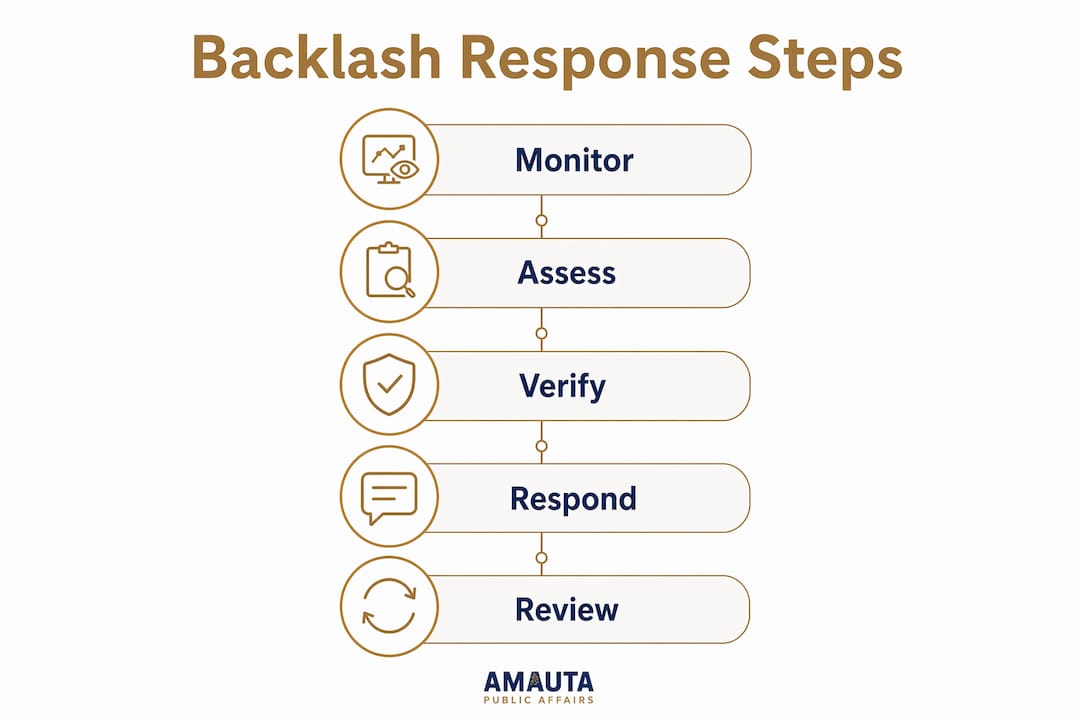
Immediately triage the signal, acknowledge publicly within 60 minutes, and trigger a tiered response calibrated to the incident’s heat. For land-use and infrastructure projects, 96 percent of brand crises reach international audiences within 24 hours, which means the window to shape the narrative is narrow. The first action is not a full statement. It is a holding acknowledgment that stops the “are they even paying attention?” commentary while your team verifies facts.
Notify these roles within the first 15–60 minutes:
Monitor lead: confirms volume, velocity, and actor authenticity
Decider: authorizes the holding statement and escalation tier
Legal counsel: flags permitting or public-record sensitivities
Community engagement lead: identifies affected stakeholder groups
Amautapublicaffairs recommends treating every incident as a potential permitting risk until triage proves otherwise. The playbook below gives your team the decision thresholds, checklists, and message templates to move from reactive to controlled within 72 hours.
Table of Contents
Why land-use backlash is different from ordinary brand criticism
How to tell whether you have routine feedback or a real crisis
A Level 1–4 response framework that scales with the incident
How to convert opposition into participation through coalition-building
Approval workflows and legal checks before any public statement
What practitioners consistently get wrong about backlash management
Why land-use backlash is different from ordinary brand criticism
Social-media backlash to a land-use or infrastructure project threatens permitting timelines, not just brand sentiment. That distinction changes everything about how you respond.
Three features make these incidents uniquely dangerous. First, local journalists monitor neighborhood Facebook groups and Nextdoor threads as primary beats, so a community thread can become a news story within hours. Second, stakeholder networks are concentrated: the same 40 people who comment online often attend public hearings, submit formal comments to the EPA or Federal Highway Administration review process, and know their city council member personally. Third, regulatory windows are unforgiving. A public comment period closes on a fixed date, and a spike in organized opposition during that window can delay or derail an approval.
Pro Tip: The single fastest way to make a manageable incident worse is to leave automated promotional posts running while the community is upset. Trigger a global pause on scheduled content as the very first protocol, before any statement is drafted.
How to tell whether you have routine feedback or a real crisis
Not every spike warrants a Tier 3 response. Treating minor friction as a full emergency burns out your team and signals panic to the public. The three outcome buckets are:
Routine feedback: isolated complaints, no media pickup, sentiment negative but stable
Active fire: accelerating volume, one or more journalist inquiries, reshares crossing into adjacent networks
Total meltdown: coordinated amplification, elected official statements, permit-period overlap, or proof-based allegations circulating with screenshots
Capture these signals in the first 15–60 minutes: mention volume per hour, sentiment trajectory, share velocity, number of unique journalist pickups, and the ratio of human to suspicious accounts. The table below maps thresholds to required actions.
Metric | Routine | Active Fire | Total Meltdown |
Journalist pickups | 0 | 1–2 | 3 or more |
Reshare velocity | Flat | Doubling every 2h | Doubling every 30 min |
Suspicious account share | Under 30% | 30–60% | Over 60% |
Required action | Monitor + log | Notify Decider, draft holding statement | Full team activation, legal on call |
Automated authenticity scoring tools combine account age, follower ratio, content duplication, and AI-phrasing signals into a Human / Suspicious / Spam tier, so your team focuses attention on real constituents rather than noise.
A Level 1–4 response framework that scales with the incident
Match response intensity to the tier. Never treat every spike as a Tier 3 emergency, and never treat a Tier 3 as a Tier 1.
Level | Trigger | Immediate Actions | Decision Authority | Public Posture |
1 | Routine feedback | Monitor, log, standard reply | Community lead | Acknowledge, inform |
2 | Active fire, no media | Notify Decider, draft holding statement | Decider + Comms lead | Acknowledge, investigate |
3 | Media pickup or permit overlap | Full team, legal review, One Source of Truth page live | Decider + Legal | Holding statement, no speculation |
4 | Coordinated attack or elected official involvement | Executive visibility, legal on call, coalition activation | CEO/Executive Director | Formal statement, direct stakeholder outreach |
Levels 1 and 2 can be handled by the community engagement lead with pre-approved message templates. Levels 3 and 4 require the Decider’s explicit sign-off before anything goes public.
Pro Tip: Pre-approve two holding statements before any project launches: one for “we are aware and investigating” and one for “we have identified an error and are correcting it.” Having these cleared by legal in advance cuts approval time from hours to minutes when pressure is highest.
The operational playbook for the first 24–72 hours
A structured 24–72 hour checklist stabilizes the narrative and protects project timelines. Here is the hour-by-hour sequence.
0–1 hour
Trigger global pause on all scheduled social content
Capture screenshots and log the first data points (volume, sentiment, actor authenticity)
Notify the Decider and community engagement lead
Publish a holding statement within 60 minutes
1–6 hours
Verify the underlying claim before any substantive response
Activate the One Source of Truth landing page and pin it across channels
Route high-priority DMs to designated case handlers, not the general inbox
Brief legal counsel on permitting-period status
6–24 hours
Publish a verified, factual update on the One Source of Truth page
Begin direct outreach to key stakeholders (community leaders, local officials)
Resume non-promotional content only if sentiment is stabilizing
24–72 hours
Convene a small-group listening session with affected stakeholders
Issue a corrective or progress statement if the original claim had merit
Begin postmortem documentation
Sample holding statement (allegation without verified proof):“We are aware of concerns being raised about [project name] and are actively reviewing the information. We are committed to transparent communication with this community and will share a full update by [specific time]. Questions can be directed to [contact].”
Sample reply for a mistake with proof:“You are right to raise this. We made an error in [specific action] and are correcting it by [specific fix]. We will post a full update at [link] by [time].”
Pro Tip: Avoid common PR mistakes like issuing a full apology before verification. Being fast and wrong creates a second crisis that is harder to recover from than the first.
How to convert opposition into participation through coalition-building
Coalition-building reduces amplification risk and converts resistant stakeholders into project messengers. Opposition to infrastructure projects often stems from people feeling that change is being done to them rather than with them, and addressing that dynamic directly is the fastest path to de-escalation.

Start with a stakeholder map that identifies four groups: vocal opponents, persuadable skeptics, quiet supporters, and trusted community intermediaries. The intermediaries are the highest-leverage group. A respected pastor, school principal, or neighborhood association president who speaks positively about the project carries more credibility than any paid advertisement.
Engagement tactics that consistently move skeptics:
Targeted briefings for local officials before public announcements
Small-group listening sessions (8–15 people) where concerns are documented and addressed by name
Peer-to-peer outreach through trusted intermediaries, not project staff
Paid local information campaigns on community-specific platforms where ethically appropriate
Measure coalition impact by tracking the ratio of supportive to critical public comments over time, attendance at listening sessions, and the number of stakeholders willing to speak publicly on the project’s behalf. Detailed stakeholder communication strategies for land-use contexts can accelerate this mapping process.
How to detect and respond to bot-driven pile-ons
Not all volume is equal. Use authenticity signals to decide response type before committing resources to a manufactured wave of criticism.
Detection checklist for each account flagged:
Account age under 30 days
Follower-to-following ratio below 0.1
Identical or near-identical phrasing across multiple accounts
Posting cadence exceeding 50 posts per hour
AI-phrasing markers (unnatural sentence rhythm, no personal context)
Score each account as Human, Suspicious, or Spam. Respond substantively only to Human-scored accounts. For Suspicious clusters, document the pattern internally but do not publicly accuse critics of being bots. That move delegitimizes real human concerns and almost always backfires.
Do not:
Publicly dismiss all criticism as coordinated or inauthentic
Issue a full apology before verifying that the underlying complaint is real
Engage with Spam-scored accounts at any volume
Sample reply when a real human complaint appears inside an amplified thread:“Thank you for raising this directly. We want to make sure your specific concern about [issue] gets a real answer. Please send us a direct message or visit [link] where we have posted detailed information.”
Pro Tip: Even in manufactured pile-ons, legitimate human concerns exist. Separating synthetic noise from real voices is not about dismissing criticism — it is about directing your limited response capacity where it actually matters.
Approval workflows and legal checks before any public statement
A single Decider with legal counsel on call is the prerequisite for fast, defensible responses. Approval by committee is the most common cause of delayed statements, and delay is what turns an active fire into a total meltdown.
Role descriptions:
Monitor lead: tracks volume, sentiment, and actor authenticity in real time
Community engagement lead: manages direct stakeholder outreach and listening sessions
Decider: sole authority to approve holding statements and escalate tiers
Legal counsel: reviews statements for public-record exposure, permitting obligations, and local ordinance notice requirements
Technical SME: provides factual accuracy review for project-specific claims
External communications lead: manages media inquiries and journalist relationships
Legal checklist for land-use and infrastructure projects:
Does the statement create any public-record obligations under state open-meetings law?
Does the incident overlap with an active permitting window or public comment period?
Are any claims in the statement subject to environmental review disclosure requirements?
Has legal confirmed no admission of liability in the holding statement language?
Document every approval with a timestamp and the approver’s name. That record protects the organization if the incident escalates to a formal proceeding. For a deeper look at rapid response communications governance, the RACI framework is a practical starting point.
Role | Holds Statement | Final Statement | Postmortem Sign-off |
Monitor lead | Drafts | Reviews | Contributes |
Decider | Approves | Approves | Approves |
Legal counsel | Reviews | Reviews | Reviews |
Community lead | Informs | Informs | Contributes |
Post-incident recovery: KPIs, postmortem, and timeline
Recovery is mechanical: execute promised fixes, publish a postmortem, and measure against clear KPIs. Organizations that skip the postmortem see the same failure patterns repeat in the next incident.
KPIs to track through recovery:
Sentiment shift (negative-to-neutral or positive ratio, measured weekly)
Net promoter score among local stakeholders (pre- and post-incident survey)
Permit timeline slippage (days lost attributable to the incident)
Media mentions (volume and tone, tracked via Google Alerts or Talkwalker)
Paid amplification spend required to correct misinformation
Postmortem template items:
Timeline of events with timestamps
Decisions made, by whom, and when
Root causes (what triggered the incident and what allowed it to escalate)
Corrective actions with named owners and deadlines
Playbook updates required (thresholds, templates, RACI changes)
Recovery timelines vary by incident severity. A Tier 2 incident typically stabilizes within two weeks with consistent stakeholder outreach. A Tier 4 incident involving media coverage and permit-period overlap may require 60–90 days of sustained engagement before sentiment returns to baseline. Staff time is the primary cost driver; monitoring tool subscriptions (platforms like Talkwalker or Sprinklr) and targeted paid social to correct misinformation are secondary. Strategies for improving public perception after a difficult incident can accelerate that timeline.
Amautapublicaffairs is built for exactly this situation
When a land-use or infrastructure project faces a social-media backlash that threatens permitting timelines, the gap between a well-resourced response and an improvised one is measured in approvals lost and community trust spent.
Amautapublicaffairs brings on-call monitoring, rapid-response staffing, coalition-building, and permitting-aware messaging to clients who cannot afford to learn crisis management under fire. The campaign-style approach means your team gets a structured playbook, pre-cleared message templates, and a coalition-building strategy calibrated to your specific community landscape, not a generic communications package. Whether the project is a transit corridor, a renewable energy facility, or a mixed-use development, the firm’s land management expertise and full-service public affairs capabilities are available from day one of an engagement. Contact Amautapublicaffairs to discuss your project’s exposure and get a response plan in place before the next incident.
Key Takeaways
A tiered, verification-first approach to social media crisis management is the single most effective way to protect permitting timelines and community trust during project backlash.
Point | Details |
Acknowledge within 60 minutes | A holding statement stops speculation and buys time for verification before a full response. |
Pause scheduled content first | Trigger a global content pause as the very first crisis protocol to avoid tone-deaf messaging. |
Match response to the tier | Never treat every spike as a Tier 3 emergency; calibrate resources to the incident’s heat. |
Separate bots from real voices | Use authenticity scoring to focus response capacity on human complaints, not synthetic noise. |
Amautapublicaffairs as partner | Provides on-call monitoring, coalition-building, and permitting-aware messaging for land-use and infrastructure projects. |
What practitioners consistently get wrong about backlash management
The most common failure is not moving too slowly. It is moving too fast without a verification step. Teams that issue a full apology before confirming the underlying claim is accurate create a second crisis that is structurally harder to recover from than the first, because now the organization has admitted fault for something it may not have done.
The second failure is treating every critical voice as an adversary. Resistance to a project often signals a legitimate concern that the project team has not adequately addressed. Treating that resistance as diagnostic feedback, rather than as an attack to deflect, is what separates projects that build durable community support from those that grind through approval after approval with organized opposition at every stage.
Amautapublicaffairs operates from the premise that a well-managed backlash can actually strengthen a project’s community standing, provided the response is honest, fast, and followed through. The playbook above reflects that philosophy. The organizations that execute it consistently are the ones that reach groundbreaking with the community beside them, not in front of them.
Useful sources and further reading
These resources support the monitoring, governance, and coalition-building work described in this playbook.
Social Media Crisis Management Plan: The No-BS Guide for 2026 — Covers tiered response frameworks, global pause protocols, and verification-first principles. Contains practical templates.
Crisis communication plan (Reply Social) — Detailed guidance on authenticity scoring, holding statements, and postmortem structure. Recommended for building your RACI.
Social media crisis management (Hootsuite) — Covers the global content pause protocol and platform-specific monitoring setup.
Social media backlash to reputation crisis — Explains the One Source of Truth landing page tactic and narrative consolidation.
Turning Resistance to Momentum — Practitioner guidance on coalition-building and converting opposition into participation.
Why resistance happens and how to manage it — Frames resistance as diagnostic feedback; useful for listening session design.
Effective Crisis Management Strategies for Social Media (5W PR) — Covers team structure, messaging frameworks, and the 96% international spread statistic.
How to Handle Social Media Criticism (Mind Tools) — Practical guidance on monitoring tools, role selection, and when to take conversations off the public feed.
Institutional digital crisis management guide (Wise Mirror) — Cross-border comparative tactics and monitoring architecture for institutional projects.
Amautapublicaffairs services — Full description of monitoring, rapid-response staffing, coalition-building, and permitting-aware messaging services.
Amautapublicaffairs blog — Templates, case-based posts, and deeper guidance on community engagement and crisis response for land-use projects.
Recommended
Comments