
Run A 2.5 Hour Message Mapping Workshop for Advocacy Teams

A message map is a single internal source of truth that turns one core idea into repeatable, channel-ready messages. It anchors an organization around a core message, three supporting pillars, and prioritized proof points, so every spokesperson, social post, and press statement says the same thing in a different key. The primary payoff is speed and consistency: faster content production, fewer contradictory statements, and a sturdier foundation when a crisis hits.
TL;DR:
Building a message map is essential only when multiple spokespeople deliver the same message across channels or in potential crisis situations.
A typical map includes a single core message, three supporting pillars, proof points, and a positioning statement, with three pillars being optimal.
During workshop development, stress-testing with hostile questions helps identify flaws and ensures the map’s durability in real-world scenarios.
The map should be adapted for different channels by varying tone, length, and format while maintaining the same core architecture.
Regular governance, including designated owners and review processes, prevents message drift and keeps communication aligned over time.
Table of Contents
What Is a Message Map, and What Are Its Core Parts?
A message map is a strategic communication document, not a slogan or a tagline. It works as an internal reference that every writer, spokesperson, and campaign lead pulls from before drafting anything public, which is why Product Marketing Alliance calls it a driver of clarity and crisis readiness rather than a branding exercise.
The canonical structure has four layers:
Core message: one sentence capturing the single idea you want to stick.
Three message pillars: the supporting arguments that make the core message credible.
Proof points: data, examples, or quotes that back each pillar.
Positioning statement: how the message differentiates you from the status quo or opposition.
The Pragmatic Institute’s guidance on effective maps recommends exactly three pillars. Two feels thin, and anything past four starts diluting the argument instead of reinforcing it.
When Should You Build a Message Map?
Not every communication effort needs one. A message map earns its place when the stakes involve repetition across time, people, or channels. Ask these questions before you schedule a workshop:
Are multiple spokespeople or teams delivering the same message?
Will this message need to survive a crisis, a hostile question, or a hearing?
Is the campaign running long enough that drift becomes a real risk (a product launch, an advocacy push, a permitting fight)?
Do you need new hires or partner organizations to sound aligned within days, not months?
If two or more answers are yes, build the map. Expect measurable gains in message alignment across teams, faster turnaround on press statements and social copy, and fewer moments where a spokesperson gets caught improvising an answer that contradicts last week’s talking points.
How Do You Write the Core Message, Pillars, and Proof Points?
The core message is the hardest sentence in the entire document, mainly because it has to do the most work in the fewest words. Write it as a single, complete sentence that a stranger could repeat back after one hearing. Avoid jargon, avoid compound claims, and test it out loud before it goes on paper.
The three pillars each answer a different version of “why should I believe that?” Word them as short, parallel statements, not paragraphs. A land-use campaign might use pillars built around economic benefit, environmental stewardship, and community input. An advocacy campaign might use urgency, fairness, and a credible path to action.
Proof points do the persuading. Order them by audience:
For technical or regulatory audiences, lead with data, permits, and studies.
For community audiences, lead with local names, dates, and tangible outcomes.
For media, lead with the proof point that is most quotable in one sentence.
Draft each proof point as a phrase you could drop directly into a press release or a public comment card without further editing. If a proof point needs a paragraph of context to make sense, it belongs in a briefing document, not the map.
How Do You Run a Message-Mapping Workshop?
A message map built in isolation rarely survives contact with a real audience. Building it in a facilitated session, with the right people in the room, is what makes it durable.
Before the workshop, gather three things: a short list of stakeholders who must buy in (legal, leadership, community liaisons), any existing research or polling on audience concerns, and prior materials (press releases, FAQs, comment letters) that reveal how the message has drifted already.
During the session, run this agenda over roughly 2.5 hours:
Framing (15 minutes): state the campaign objective and the audience you’re trying to move.
Core message drafting (30 minutes): small groups draft three candidate core messages, then vote.
Pillar-building (45 minutes): assign one pillar per breakout group, each defending it with two proof points.
Stress test (30 minutes): a designated devil’s advocate throws hostile questions at the draft map.
Convergence (30 minutes): the full group finalizes wording and assigns an owner.
After the workshop, circulate the draft to stakeholders who were absent, test the core message with a small message testing survey among target audience members, and revise based on which phrasing actually lands. This is the step most teams skip, and it’s the difference between a map that sounds good in the room and one that survives contact with real skeptics.
Pro Tip: Run the stress-test step even when the audience seems friendly. The questions a hostile reporter or opposing counsel would ask are the fastest way to find a proof point that collapses under pressure, and it’s far cheaper to find that flaw in a workshop than in a live interview.
How Do You Adapt a Message Map Across Channels and Crises?
The pillars stay fixed. The tone, length, and order flex depending on where the message lands. That’s the entire discipline of channel adaptation: same architecture, different rooms.
Elevator line: one sentence combining the core message with your strongest pillar, for hallway conversations and short interviews.
Boilerplate paragraph: the core message plus all three pillars in roughly 60 words, for press releases and website copy.
Spokesperson Q&A lines: each pillar rewritten as a direct answer to a likely question, so a spokesperson never has to invent phrasing live.
Social posts: a single proof point per post, paired with the core message as a caption line.
For rapid response, build crisis cue cards straight from the existing map rather than starting from scratch. Take each pillar, pair it with the proof point most relevant to the incident, and add one sentence acknowledging the situation. A map built in advance turns a crisis statement into a 15 minute task instead of an overnight scramble.
What Mistakes Cause Message Drift, and How Do You Fix It?
Most failures trace back to a handful of avoidable habits:
Too many pillars. Five or six feels thorough but reads as unfocused; audiences remember three things, rarely more.
A static document. A map filed away after the workshop becomes irrelevant within a quarter.
Inconsistent application. Different teams paraphrasing the same pillar differently is what the Pragmatic Institute identifies as classic message drift.
Fix it with light governance: one named owner, a defined trigger for updates (a new phase, an incident, a leadership change), and a review cadence of once per quarter or at each major campaign milestone. When drift is already visible, a 45 minute realignment session with the affected teams, reviewing recent outputs against the map line by line, usually resolves it faster than rewriting the whole document.
How Does Message Mapping Fit Into Public Affairs and Advocacy Work?
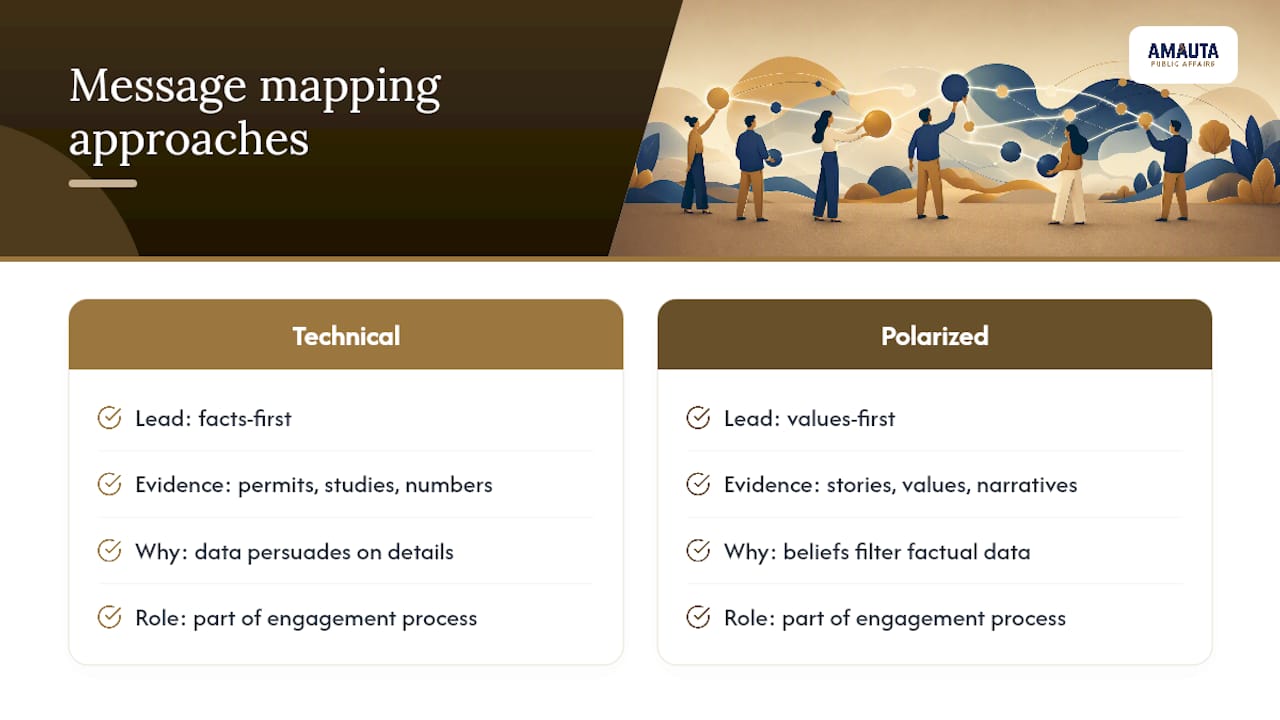
Message maps work differently depending on the fight. On technical land-use questions, facts-first pillars often win: permits, traffic studies, economic impact numbers. On polarized or values-charged issues, narrative-change research suggests leading with values and stories before facts, because audiences filter data through their existing beliefs before they’ll engage with it at all.
Amautapublicaffairs builds message maps as one layer inside a broader stakeholder engagement process, not a standalone deliverable. A map tells you what to say; a stakeholder communication strategy tells you who needs to hear it first and through what channel.
The organizations that win contested land-use and infrastructure fights aren’t the ones with the most polished pillars. They’re the ones who tested those pillars against real community pushback before the opposition ever showed up to a hearing.
Pro Tip: If your project touches a polarized issue, draft two versions of your core message during the workshop: one facts-first, one values-first. Test both before you commit to either.
Should You Choose a Message Map or a Broader Narrative Framework?
Use a message map when you need consistency across people and channels; use a full narrative-change strategy when you’re trying to shift how an entire audience feels about an issue over months, not weeks. In most campaigns, the map comes first, built inside the first workshop, with narrative work layered on top once the pillars are stress-tested.
— Ignacio
How Amauta Public Affairs Turns Message Maps Into Campaigns
A message map is only as strong as the team executing it. Amautapublicaffairs is the alternative to building this in-house without facilitation experience: instead of a document that sits in a shared drive after one meeting, you get a workshop-tested map, integrated stakeholder outreach, and media relations support from a team that has run this process on contested land-use and infrastructure fights before.
Amautapublicaffairs facilitates the full workshop agenda described above, then carries the resulting pillars into community engagement, digital advocacy, and press strategy so the messaging never drifts between the planning room and the public hearing. Running this in-house makes sense when you already have a trained facilitator and a stress-tested process. Hiring outside help makes sense when the project timeline is tight or the stakes of a contradictory public statement are high.
If you’re preparing for a permitting fight, a controversial development proposal, or a campaign that needs consistent messaging across a dozen stakeholders, explore AMAUTA’s services and start with a scoping call before your next public meeting.
Where to Learn More About Message Mapping
Pragmatic Institute’s practitioner guide on structuring pillars and proof points.
Purdue Brand Studio’s message map template for a downloadable institutional example.
Product Marketing Alliance’s benefits breakdown for implementation steps.
Amautapublicaffairs’s stakeholder mapping workshop templates for a companion exercise to run alongside your message map.
Sources
Recommended
Comments