
Environmental Review Process: A Hire-Ready Playbook

Hire a tiered, campaign-style public-affairs program that begins before any public announcement and runs through post-decision report-back. That single decision, made early, is the most reliable way to reduce delay risk during environmental review. The decide-announce-defend pattern, where developers go public only after internal decisions are locked, consistently generates the opposition it was meant to avoid. Front-loading public affairs reverses that dynamic.
Your immediate checklist:
Days 1–30: Complete stakeholder mapping, brief legal counsel, align messaging with technical and land teams, and identify trusted community intermediaries.
Days 31–90: Launch tiered outreach, hold first landowner and local-leader conversations, publish a project fact sheet, and open a digital feedback channel.
Days 91–180: Run public events (open houses, office hours), activate coalition partners, submit earned-media pitches, and deliver a first report-back to participants.
Pro Tip: Coordinate your public-affairs lead with legal counsel before any outreach begins. Landowner conversations and agency pre-application meetings often create public record; aligning messaging and timing across both disciplines prevents contradictions that opponents exploit.
Key Takeaways
Effective environmental review management requires a tiered, campaign-style public-affairs program that begins before any public announcement and tracks every community commitment through to post-decision report-back.
Point | Details |
Start pre-announcement | Hire public-affairs support before the first landowner conversation to avoid a defensive posture once filings are public. |
Map stakeholders first | Score officials, neighbors, intermediaries, and advocates by influence and urgency before any outreach begins. |
Match intensity to tier | Scale tactics and staffing to project complexity; a Tier 1 approach on a Tier 3 project generates organized opposition. |
Track every commitment | Log all community asks and report back on each one; Promise→Proof tracking converts skeptics into neutral observers. |
Amautapublicaffairs | Provides campaign-style engagement, media relations, and digital advocacy with a structured intake and measurement framework. |
Table of Contents
What does the first 30/90/180 days look like in practice?
Effective environmental review guidance starts with a concrete schedule, not a vague communications plan. Use the milestones below to build procurement language and resource allocations.
Ownership checklist:
Communications lead: message house, press releases, digital content
Field/land outreach staff: landowner and neighbor conversations
Technical brief author: project facts, mitigation summaries
Legal sign-off: all public-facing materials before release
Budget note: plan for a moderate amount of total staff hours across the first 180 days for a moderate-complexity project. Complex or high-stakes projects typically require a dedicated team.
How do you scale engagement to match project complexity?
Not every project warrants a full campaign. Calibrating outreach intensity to actual impact avoids wasted resources and inadequate trust-building alike. Nashville’s Community Engagement Playbook formalizes this tiered logic, matching engagement depth to project scope and committing to quarterly report-back as standard practice.
Tier | Project type | Core tactics | Staffing range |
1 – Low impact | Minor permits, small commercial | Fact sheet, email notice, one public meeting | 1 part-time coordinator |
2 – Moderate | Mid-scale infrastructure, rezoning | Stakeholder map, two open houses, digital channel | 1 FTE + field support |
3 – Complex | Large energy, transit, mixed-use | Full campaign: events, media, coalition, digital ads | 2–3 FTE + consultants |
4 – Transformative | Regional infrastructure, contested siting | Multi-year campaign, environmental-justice integration, earned + paid media | Dedicated team |
A Tier 1 project that receives Tier 3 treatment wastes budget and signals anxiety. A Tier 3 project handled at Tier 1 intensity almost always generates organized opposition that adds months to the schedule.
Who do you engage, and in what order?
Stakeholder mapping is a prerequisite, not an afterthought. Structure the map across seven categories: elected and appointed officials, landowners and adjacent property owners, neighboring residents, community organizations, labor and business groups, environmental advocates, and media contacts. Score each group on influence, urgency, and trustworthiness to build a prioritization matrix.
Recommended outreach sequence:
Landowners and directly affected neighbors (private conversations, before any public announcement)
Local elected officials and agency staff (briefings with technical summaries)
Trusted community intermediaries (faith leaders, neighborhood associations, workforce organizations)
Broader community (public events, digital channels)
Media (coordinated release after foundational relationships are in place)
Recruiting trusted intermediaries is often the highest-leverage move available. A local workforce organization or faith community that co-sponsors an open house carries credibility that a developer or government agency cannot manufacture. Early outreach and integrated planning consistently reduce conflict and improve siting outcomes, and trusted local actors are central to that dynamic. For a deeper look at structuring these relationships, the stakeholder communication strategies framework offers a repeatable template.
How do you craft messages that build trust and close the loop?
A message house keeps every team member aligned and prevents contradictions across channels. Build it around three layers: a core claim (what the project does and why it matters locally), three supporting proof points (jobs, environmental mitigation, community benefits), and a report-back promise (what you will tell participants, when, and who is responsible).
Channel checklist:
In-person: open houses, office hours, tabling at community events
Digital: project website, email list, social media, virtual town halls
Earned media: local newspaper, TV, and radio pitches
Paid: targeted digital ads for hearing notices and event promotion
Multilingual materials and accessibility provisions are not optional for projects in linguistically diverse communities. NYSERDA’s community engagement guidance recommends co-designing activities with community members, providing translated materials, and compensating participants for longer engagements. The report-back promise should specify: what commitments were made, which were acted on, and the cadence for updates (quarterly is a widely adopted standard).
Which tactics produce the best results by objective?
Tactic | Primary objective | Best timing | Notes |
Office hours | Listen, build trust | Pre-announcement through hearings | Low-barrier, high-quality conversation |
Open house | Inform, gather input | A quarter or more before hearings | Staff with technical and PA leads |
Virtual town hall | Inform, reach dispersed audiences | Ongoing | Record and post for accessibility |
Telephone town hall | Mobilize, activate supporters | 2–4 weeks before hearings | Confirmed-supporter lists only |
Coalition letter | Neutralize opposition | 30 days before decision | Anchor with labor and civic groups |
Earned media pitch | Inform, frame narrative | At key milestones | Lead with local economic angle |

Targeted activation and confirmed-support turnout outperform broad, generic outreach. Only bring confirmed supporters to public hearings; activating ambivalent contacts risks adding opposition voices to the record.
Pro Tip: Pitch local media with an economic-impact angle first, not a technical one. Reporters covering land use respond to jobs numbers and tax revenue figures far more reliably than to engineering specifications. Prepare a one-page economic brief before your first media call.
For detailed media relations tactics, the environmental organization media outreach guide covers pitch structure and timing.
How do you manage opposition before it becomes a crisis?
Opposition rarely appears without warning. Monitor for early signals: negative social media volume, attendance spikes at unrelated public meetings, organized petition activity, and opponent coalition formation. Build a five-step escalation flow into the engagement plan from day one.
Escalation flow:
Monitor: Track sentiment weekly across social, local press, and public comment channels.
Triage: Classify each signal as informational, relational, or adversarial.
Local response: Assign a field lead to address concerns directly, in person where possible.
Executive escalation: Brief project leadership and legal counsel when adversarial signals persist.
Legal coordination: Align public messaging with counsel’s guidance before any formal response.
Sample crisis message template: “We heard [specific concern]. Here is what we know: [fact]. Here is what we are doing: [action]. Here is when we will update you: [date].” That structure, specific and time-bound, de-escalates faster than a general reassurance. Brief technical experts before any public escalation so they can speak plainly to community concerns without contradicting the legal record.
When should you hire public-affairs support, and what should the scope include?
Engaging public-affairs support early prevents the defensive posture that sets in once application filings become public record. The right time to hire is before the first landowner conversation, not after the first opposition letter.
Sample scope-of-work checklist:
Stakeholder research and mapping
Message house development and testing
Engagement plan with tiered tactics and timeline
Paid and organic digital strategy
Earned media outreach and spokesperson prep
On-the-ground event staffing and facilitation
Coalition identification and partner recruitment
Measurement framework and engagement report
Vendor screening questions:
Can you show a project where you managed opposition and maintained schedule?
What local networks do you have in this geography?
How do you track commitments made to community members?
What does your real-time adjustment process look like?
Retainer models typically run three to twelve months depending on project tier. Project-fee arrangements work for defined phases (pre-announcement, hearing prep). Amautapublicaffairs operates on a campaign-style methodology, aligning community engagement with permitting milestones and tracking Promise→Proof commitments throughout the project lifecycle.
How do you measure whether engagement is working?
TxDOT’s strategic public engagement guidance recommends tracking outreach metrics for formal evaluation, including venue selection, staffing, promotion, and accommodation provisions. Request a dashboard from your vendor that shows these fields updated monthly. Adaptive management means reviewing the dashboard at 30-day intervals and authorizing strategy pivots when sentiment or reach metrics fall below targets. The project lead, not the vendor alone, should approve any significant tactical shift.
An editorial perspective on what actually moves projects forward
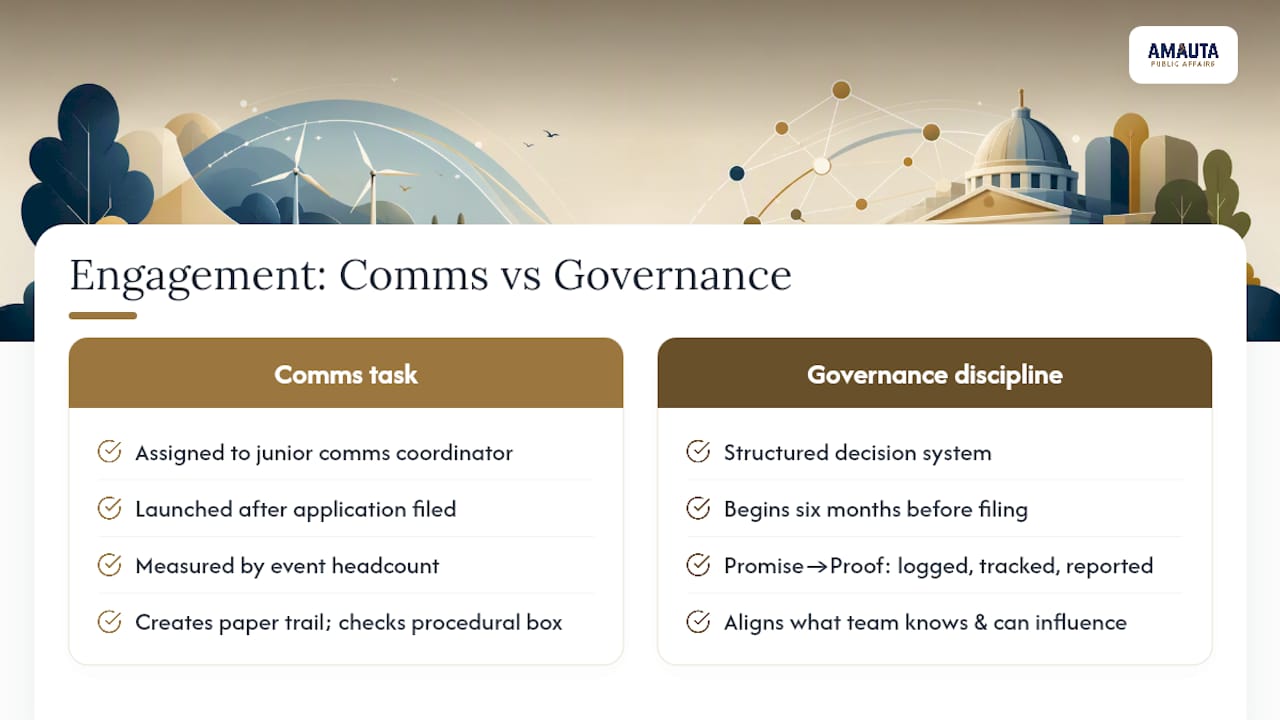
The most persistent mistake in environmental review is treating community engagement as a communications task rather than a governance discipline. Teams that assign it to a junior communications coordinator, launch it after the application is filed, and measure it by event headcount are not running engagement. They are creating a paper trail that satisfies a procedural checkbox while doing nothing to reduce opposition risk.
What actually moves projects forward is a structured decision system: one that aligns what the project team knows, what it can influence, who holds relational trust in the community, and what commitments it is prepared to keep. The Promise→Proof framework, where every public commitment is logged, tracked, and reported back to participants, is not a nice feature. It is the mechanism that converts skeptical neighbors into neutral observers and neutral observers into quiet supporters.
The second underestimated factor is timing. A project that begins stakeholder outreach six months before filing has time to hear concerns, adjust design elements, and document responsiveness. A project that begins outreach the week before a public hearing has none of that runway. The schedule implications are not marginal. Practitioners who have managed entitlement timelines consistently report that front-loading engagement by even 90 days can compress the back end of a review by a comparable period.
What does working with Amautapublicaffairs look like from day one?
Amautapublicaffairs brings a campaign-style methodology to every engagement, built around three intake steps: a project brief (site facts, timeline, and permission triggers), a tailored proposal with tiered tactics and a measurement framework, and a kickoff that aligns the public-affairs team with legal counsel and technical leads before any outreach begins.
The firm’s full service scope covers stakeholder mapping, message development, digital advocacy, earned media, coalition-building, and on-the-ground event staffing. Every engagement includes a Promise→Proof tracking system and a formal engagement report at each major milestone. To prepare for a rapid proposal, gather your site description, projected timeline, key permitting triggers, and any known opposition signals. Contact Amautapublicaffairs to schedule a project brief and receive a scope-of-work proposal within five business days.
Sources
The following documents informed this playbook and contain templates, checklists, and policy analysis that project teams can cite in scopes of work or use directly.
Recommended
Comments