
Nonprofit Advocacy Campaign Messaging Guide 2026

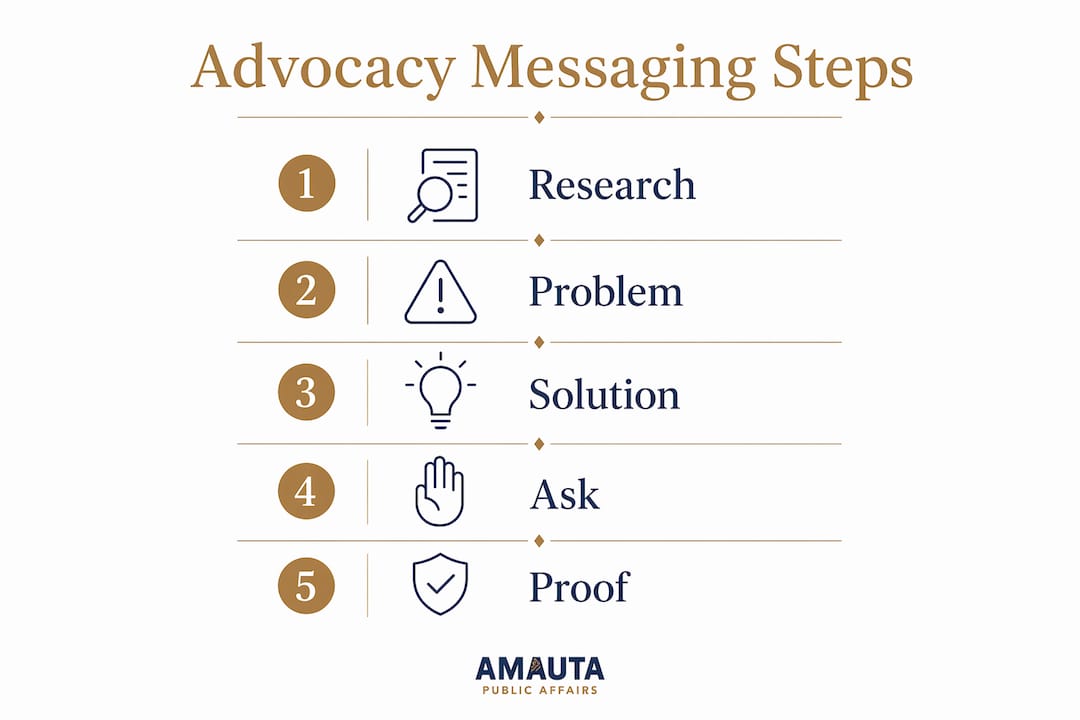
Nonprofit advocacy campaign messaging is the process of building a unified message platform that moves audiences from awareness to action on your cause. The industry standard framework organizes every campaign around four elements: problem, solution, ask, and proof. Advocacy campaign planning typically spans 90 days, with audience segmentation and multi-channel outreach built into that timeline from day one. Campaigns that skip this structure produce fragmented messages that confuse supporters and stall momentum. This guide gives nonprofit professionals a clear, field-tested path to craft messages that resonate, reach the right people, and sustain engagement through every stage of a campaign.
What are the essential components of a nonprofit advocacy campaign message?
Every effective advocacy message rests on four components: a clear problem, a specific solution, a single ask, and credible proof. Skipping any one of them produces a message that either fails to motivate or fails to direct. Nonprofit professionals who treat these four elements as non-negotiable produce campaigns with far greater consistency across channels and audiences.
The problem must be concrete and personal, not abstract. Vague language like “climate change threatens our future” produces less engagement than a message tied to a household bill or a neighborhood risk. The Sierra Club learned this directly: reframing environmental advocacy around household utility bills produced a 164% higher click-through rate than abstract climate crisis language. That result shows the power of connecting a policy issue to an immediate personal pain point.
The solution should be simple enough to repeat in one sentence. Supporters who cannot explain your solution in 15 seconds will not recruit others. Effective advocacy communication avoids technical policy language and instead describes the outcome the audience wants to see.

The ask must be singular. Campaigns that present multiple asks in one message reduce the likelihood of any action being taken. Choose one action per message, whether that is signing a petition, calling a legislator, or sharing a post.
Proof closes the credibility gap. This means data, testimonials, or real stories that show the problem is real and the solution works. Privacy-aware storytelling uses persona-driven narratives to connect donors without exposing individuals, which is especially important for sensitive advocacy issues like mental health or immigration.
Lead with the personal pain point, not the policy position.
State the solution in one sentence a supporter can repeat.
Give one ask per message, not three.
Back every claim with a story, a statistic, or a named outcome.
Pro Tip: Write your solution statement first, then build the problem and proof around it. If you cannot state the solution in under 20 words, the message is not ready for public deployment.
How to identify and segment your audiences for targeted messaging
Audience segmentation is the prerequisite for any messaging that actually converts. A single message written for everyone reaches no one with full force. The standard approach divides audiences into three tiers: primary, secondary, and tertiary.
Primary audience: The decision-makers your campaign needs to move. For a land use campaign, this might be city council members or planning commissioners. Messages for this group emphasize legal authority, community consensus, and economic data.
Secondary audience: Organized supporters who amplify your message. These include allied nonprofits, faith communities, and neighborhood associations. Messages for this group focus on shared values and specific coalition actions.
Tertiary audience: The broader public whose opinion shapes political will. Messages for this group prioritize emotional resonance, simple language, and a clear call to action.
Each tier requires a distinct message version. The core platform stays consistent, but the framing, tone, and ask shift to match what each group cares about most. A city council member responds to data and process. A community member responds to a neighbor’s story.
Audience understanding surveys conducted before message testing uncover hidden objections and motivators that gut instinct misses entirely. Grow Progress recommends this method as a prerequisite to direct message testing, because campaigns built on assumption often hit walls that research would have predicted. Knowing that a segment objects to cost before you launch saves weeks of reactive messaging.
Experts recommend starting with audience research to reveal barriers and motivators before any message goes live. This approach produces stronger, longer-lasting results than launching on instinct and adjusting after the fact.
Pro Tip: Run a short audience insight survey with 10 to 15 respondents from each segment before finalizing your message. The objections you hear will sharpen your proof points and prevent costly course corrections mid-campaign.
What are the most effective channels for delivering advocacy messages in 2026?
Multi-channel delivery is not optional for campaigns that want to reach diverse audiences. Each channel carries a different level of attention and trust, and the message must be tailored to fit the platform without losing its core meaning.
Text messaging is the highest-attention channel available. Text messages achieve 98% open rates, making them the most reliable way to deliver time-sensitive asks like “call your legislator today.” That open rate dwarfs email, which means text should anchor any action-oriented moment in a campaign timeline.
Social media and influencer partnerships extend reach to audiences that traditional outreach never touches. The #TeamWater influencer campaign generated over 100,000 donations, with 99% coming from new donors and 62% from supporters under 35. That result demonstrates how influencer-led campaigns can build a donor base that no direct mail list or email newsletter could replicate.
Physical installations create empathy at scale in ways digital channels cannot. A campaign using a worn-out shoe installation in a shopping area drove a 20% lift in online conversations during peak consumer periods. The physical experience gave people a visceral connection to the issue that translated directly into digital engagement.
Channel | Primary strength | Best use case |
Text messaging | 98% open rate | Time-sensitive action asks |
Social media | Broad reach and sharing | Awareness and peer amplification |
Depth and segmentation | Donor cultivation and updates | |
Influencer partnerships | New audience acquisition | Younger donor and supporter recruitment |
Physical installations | Emotional impact | High-traffic community moments |
Tailor the message format to each platform while keeping the core ask identical.
Use text for urgency, email for depth, and social for reach.
Pair influencer campaigns with a clear donation or sign-up link to capture momentum.
Treat physical activations as content generators that feed digital channels.
Understanding how advocacy communications work across these channels helps nonprofit teams allocate budget and staff time where they will produce the most measurable results.
How to sustain supporter momentum with message sequencing
Momentum is the most fragile asset in any advocacy campaign. Most campaigns lose it within 48 hours of a supporter’s first action because no follow-up arrives to deepen the relationship. The solution is treating each ask as a compound interest step, where every action triggers the next.
Automate the first follow-up within one hour. When a supporter signs a petition or sends a message to a legislator, an automated email should arrive immediately with a thank-you, a campaign update, and a second ask. Waiting 24 hours cuts response rates significantly.
Layer peer-to-peer prompts into the sequence. After the first action, ask supporters to share the campaign with three contacts. Peer-to-peer outreach consistently outperforms broadcast messaging because it carries personal trust.
Provide structured templates for every advocate action. Structured letter templates and AI-driven drafting tools dramatically improve participation rates and message consistency. Asking supporters to write from scratch produces low completion rates and off-message content.
Escalate the ask with each sequence step. Start with a low-barrier action like sharing a post, then move to signing a petition, then to calling a legislator. Each step builds commitment and makes the next ask feel natural.
Each supporter action should trigger automated, layered follow-ups to compound engagement rather than let momentum fade. This is the key to scaling advocacy impact beyond the initial burst of attention a campaign launch generates.
Pro Tip: Build your follow-up sequence before you launch, not after. Map out at least four touchpoints for each supporter segment and load them into your email platform so the sequence runs without manual intervention.
Digital advocacy campaigns that combine automated sequencing with platform-tailored messaging consistently outperform single-channel efforts in both conversion and retention.
Key takeaways
Effective nonprofit advocacy campaign messaging requires a four-part message platform, audience segmentation by tier, multi-channel delivery, and automated follow-up sequences that compound each supporter’s engagement over time.
Point | Details |
Build a four-part message platform | Every campaign needs a clear problem, solution, single ask, and proof before launch. |
Segment audiences into three tiers | Primary, secondary, and tertiary audiences each need a distinct message version. |
Use text messaging for urgent asks | Text messages achieve 98% open rates, making them the highest-attention channel available. |
Automate follow-ups within one hour | Immediate automated sequences prevent momentum loss after a supporter’s first action. |
Provide structured templates | Pre-built letter templates and drafting tools increase participation rates and keep messages on target. |
What I’ve learned about messaging that most guides won’t tell you
The most common mistake I see nonprofit teams make is writing their message for themselves rather than for their audience. The language feels right internally because it reflects months of policy work and organizational values. To a community member reading it for the first time, it reads like a press release from a government agency.
The campaigns that break through are the ones willing to test uncomfortable simplicity. When the Sierra Club stopped talking about the climate crisis and started talking about utility bills, it felt like a retreat to some advocates. The 164% lift in click-through rates proved otherwise. Simplicity is not a compromise. It is the mechanism by which complex ideas reach people who have not spent years thinking about them.
I also think the field underestimates the privacy dimension of storytelling. Balancing empathy with privacy in impact narratives is not just an ethical obligation. It is a trust-building tool. Audiences who sense that an organization handles personal stories with care are more likely to share their own networks and donate. Persona-driven narratives that protect individual identity while conveying real experience are the standard I recommend for any sensitive advocacy issue.
Finally, message testing before scale is non-negotiable in 2026. Audience understanding surveys take two weeks and cost far less than a failed campaign. The teams that invest in research before deployment consistently outperform those that trust instinct. That pattern holds across issue areas, from environmental advocacy to housing to public health.
— Ignacio
How Amautapublicaffairs supports nonprofit advocacy messaging
Amautapublicaffairs works with nonprofits and civic organizations to build the kind of message platforms that produce real public support, not just awareness. The approach starts with a granular assessment of the community landscape, identifying who the key audiences are, what motivates them, and where the message needs to go.
From there, Amautapublicaffairs develops tailored message frameworks and multi-channel outreach plans that align with each campaign’s timeline and goals. Services include community engagement, media relations, and digital advocacy planning, all coordinated to deliver a consistent message across every touchpoint. If your organization is ready to move from a general communications approach to a campaign-grade messaging strategy, Amautapublicaffairs is the partner built for that work.
FAQ
What is a nonprofit advocacy campaign message platform?
A message platform is a structured document that defines the campaign’s core problem, solution, ask, and proof. It serves as the single source of truth for all communications across channels and audiences.
How long does it take to plan an advocacy campaign?
Advocacy campaign planning typically spans 90 days, covering message development, audience mapping, channel selection, and follow-up sequencing before launch.
What channel has the highest open rate for advocacy outreach?
Text messaging achieves a 98% open rate, making it the most reliable channel for time-sensitive advocacy asks like legislative call-in days or petition deadlines.
How do I keep supporters engaged after their first action?
Automated follow-up sequences triggered within one hour of a supporter’s first action are the most effective method. Each follow-up should include a thank-you, a campaign update, and a next-step ask that escalates commitment gradually.
How do I write campaign messages for different audience segments?
Start with audience understanding surveys to identify each segment’s motivators and objections. Then adapt the core message platform to match each group’s priorities, keeping the problem, solution, and ask consistent while adjusting tone and framing.
Recommended
Comments