
45–21 Day U.S. Campaign Hearing Prep Wins Planning Commission Votes

Winning at a planning commission hearing depends less on the hearing itself than on the six weeks before it. A campaign-style approach, one that front-loads staff coordination, targeted neighbor outreach, technical studies, and documented evidence, wins approval far more often than a last-minute slide deck. Prioritize staff alignment and neighbor one-on-ones during the 45–21 day window, and treat every letter of support and outreach log entry as evidence for the record.
TL;DR:
Building a strong, documented campaign with early technical studies and neighbor outreach in the 90–45 days before the hearing greatly increases approval chances.
Prioritizing one-on-one stakeholder conversations, especially with immediate neighbors and community leaders, produces concrete support and valuable evidence for the record.
Selecting and commissioning only the most relevant technical studies (traffic, noise, arborist, drainage, geotechnical) is sufficient, as commissioners base decisions on these findings.
Preparing a clear presentation packet, rehearsing responses, and controlling the record through organized outreach logs are crucial for a confident and credible hearing appearance.
Treat the hearing as the culmination of a campaign built through continuous engagement, feedback, and evidence collection over the weeks leading up to the event.
Table of Contents
What Does Planning Commission Hearing Prep Actually Require?
Planning commission hearing prep means building a documented, staff-aligned case for approval long before anyone steps up to the podium. It borrows its logic from political campaigns: identify your coalition, secure commitments early, and arrive at the decisive moment with the outcome already mostly settled. The 90-day starter framework for community engagement maps closely to the timeline below, and for good reason. Commissioners rarely reverse a staff recommendation, and staff rarely recommend approval for a project surrounded by unresolved neighbor complaints.
The 90–60, 45–21, and Final-Week Checklist
90 to 60 days out. Confirm your entitlement pathway with planning staff and get a straight answer on which studies and findings the commission will need. Commission your traffic, noise, arborist, and drainage studies now. Studies commissioned late routinely become the reason a hearing gets continued, since staff cannot write a report around evidence that hasn’t arrived. Begin quiet, low-pressure outreach to the neighbors most directly affected.
45 to 21 days out. This is the working core of the campaign. Run your primary outreach events, whether that’s a small open house or a round of one-on-one visits, and start collecting signed letters of support and sign-in sheets. A hearing-prep checklist built around this exact window recommends refining site plans based on what neighbors actually say during this stretch, not after. If a neighbor raises a legitimate concern about truck routing or noise hours, adjust the operations plan now while it still reads as responsiveness rather than concession.
Final week. Submit exhibits by the clerk’s stated deadline, confirm the hearing room’s audiovisual setup, and finalize who speaks and in what order. Print packets for every commissioner and staff member; do not assume the clerk will duplicate your materials.
Front-loading studies and staff conversations matters because planning commissions run on findings, and findings run on evidence that has to exist in the record before the vote. A team that waits until three weeks out to start a traffic study is negotiating with a clock they cannot win.
How Do You Map and Reach the Stakeholders Who Matter?
Not every neighbor carries equal weight at a hearing, and treating them as if they do wastes limited outreach time. Sort your stakeholder universe into tiers, then spend your best hours on the tiers most likely to speak or write.
Immediate adjacents. Property owners and residents sharing a fence line or sightline with the project. Their objections carry disproportionate weight with commissioners.
Neighborhood and homeowner associations. Groups whose leadership can mobilize dozens of residents with a single email.
Local business owners. Often overlooked, but a chamber member’s letter reads as credible and disinterested in a way a paid consultant’s never will.
Faith leaders and community anchors. Frequently trusted messengers in communities where trust in developers runs low.
Advocacy and civic groups. Housing, environmental, or transportation organizations whose institutional support can offset organized opposition.
The one-on-one conversation is still the highest-yield outreach tactic available, and it follows a simple structure: a one-sentence introduction, real listening before any pitch, an offer of concrete mitigations, and a direct ask for a commitment or letter. Skipping the listening step is the most common mistake project teams make. Practitioners who track local government minutes and repeat their outreach across multiple rounds consistently report that iterative input surfaces alternatives that satisfy both the community and the project sponsor, often revealing a fix nobody on the design team had considered.
Surveys and small workshops widen the net beyond the people who show up to meetings, and the data they generate gives staff and commissioners something concrete to cite in their findings. Every conversation should end somewhere on paper: a signed letter, a name on a sign-in sheet, a short quoted endorsement, or a brief video clip you can play at the hearing itself. The stakeholder communication strategies that work best treat each of these as evidence, not goodwill.
Pro Tip: Ask every supportive neighbor for their letter at the end of the conversation that earned it, not a week later by email. Momentum fades fast, and a follow-up request gets ignored more often than it gets answered.
Which Technical Studies Do Commissioners Actually Need?
Commissioners approve projects by adopting specific findings, and findings require evidence in a form staff can cite without editing. The studies that typically matter most are:
Traffic and parking memos addressing peak-hour impacts and site access
Noise reports, especially for projects near residential zones or with extended operating hours
Arborist or tree assessments where removal or protection ordinances apply
Drainage and stormwater analyses for anything expanding impervious surface
Geotechnical summaries for slopes, fill, or seismic considerations
Brief planning staff early and ask them directly what evidence would satisfy the required findings. Staff members who work with your team through the process, rather than around it, tend to write staff reports that align with approval. Write your findings using the same language as the local general plan or municipal code; commissioners can adopt language they recognize far more easily than language they have to translate. Operations commitments, a management plan, a neighbor hotline, restricted delivery hours, become far more persuasive when framed as enforceable conditions of approval rather than informal promises.
What Goes Into the Presentation Packet and Slide Deck?
Build a 15 to 20 slide deck. Front-load the first five slides with the site plan, zoning compliance summary, key study findings, and the specific action you’re requesting. Commissioners who skim will still catch the essentials.
Assemble a packet led by a one-page executive summary, followed by technical appendices and clearly labeled exhibits, printed at 11x17 where site plans need the extra size to read clearly.
Submit exhibits by the clerk’s posted deadline and bring printed copies for every commissioner and staff member; a projector failure should never be the reason your evidence goes unseen.
Confirm audiovisual setup and arrive early, with handouts ready for public distribution so residents in the audience can follow along without craning at a screen.
A packet built this way lets a commissioner locate your strongest evidence in seconds rather than hunting through appendices during a crowded agenda.
How Should the Project Team Rehearse for the Hearing?
Timed rehearsal is the single most underused tool in hearing prep, and it separates confident presenters from teams that ramble into their allotted three minutes and run out before the point lands.
Run full timed practice sessions, and assign one person to play a hostile or skeptical commissioner asking the hardest question your team can imagine.
Limit your speaking team to one lead presenter plus no more than two technical specialists; a crowded table reads as disorganized.
Prepare two or three focused rebuttals in advance, keep them factual and brief, and resist the urge to argue every point raised in opposition.
Know when to request a recess or offer a conditional compromise on the spot rather than digging in on a position the commission clearly won’t accept.
Coordinate with supportive speakers beforehand so their remarks reinforce your findings instead of repeating the same anecdote five times in a row.
What Records Should You Keep Before and After the Hearing?
An outreach log is the backbone of your evidentiary record, and it should track the date, contact name, address, topic discussed, commitment made, and follow-up status for every conversation. Recommended practice ties each field directly to entries staff and commissioners can point to when writing their findings, which is exactly why sloppy logs undercut otherwise strong outreach.
Letters of support and survey responses become part of the public record once submitted, and commissioners cite them directly in their deliberations.
Sign-in sheets from outreach events establish attendance and participation that staff can reference in the staff report.
After the hearing, negotiate condition language carefully; vague wording around operating hours or mitigation triggers creates enforcement headaches later.
If the commission continues the item or an appeal follows, update every stakeholder promptly so support doesn’t erode during the delay.
A packet with a well-organized outreach log and evidence placed in the first pages reduces the friction that causes commissioners to table an otherwise solid application.
Why Campaign-Style Prep Changes the Odds
Most teams treat the hearing as the event. It isn’t. The hearing is the closing argument in a case built weeks earlier, in living rooms and church basements and quiet one-on-one conversations that never make it into a staff report but shape every vote that does. Continuous recalibration, adjusting messaging and mitigations as real feedback comes in, builds the kind of community trust, which a polished slide deck alone never manages. Projects run this way tend to arrive at the hearing with their outcome largely decided.
— Ignacio
How Amauta Public Affairs Supports Hearing-Ready Campaigns
A hearing date should be treated as a deadline for a campaign, not a standalone event to prep for in isolation. Where a solo consultant hands you a slide template, Amautapublicaffairs runs the full campaign: campaign management, community engagement, and permitting support built around your specific project and jurisdiction.
A typical engagement might start with an audit of the stakeholder landscape and staff relationships, move into a scoped campaign covering outreach, coalition building, and supporter turnout, and remain active through real-time tactical recalibration based on community feedback and staff conversations. Permitting support and stakeholder relations can help keep evidence, findings, and outreach records aligned as the hearing date approaches. If your hearing is on the calendar and your outreach hasn’t started, get connected with the Amautapublicaffairs team now to scope a campaign around your timeline.
Where to Go for Statutory Norms and Outreach Templates
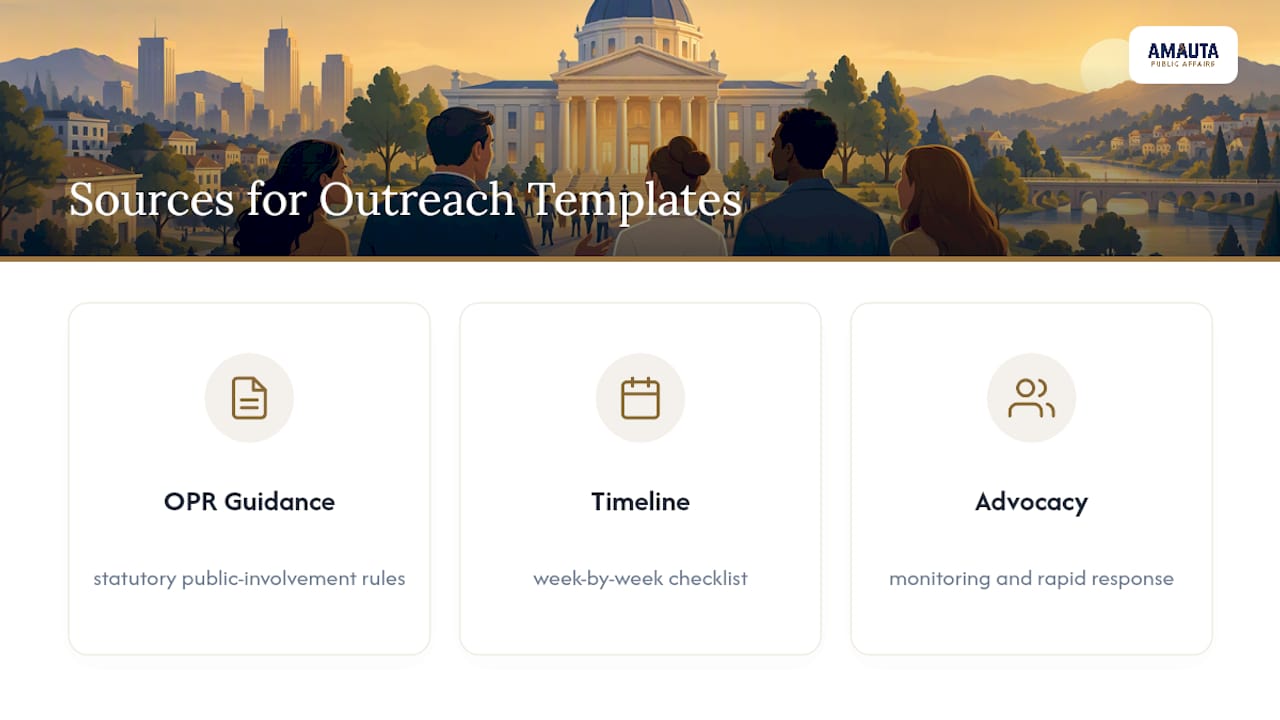
The OPR outreach guidance lays out the statutory public involvement requirements behind California general plan hearings. The hearing-prep timeline breakdown offers a practical week-by-week checklist. For infrastructure-specific outreach tactics, the grassroots advocacy framework covers monitoring and rapid response.
Sources
FAQ
How far in advance should hearing prep start?
Start serious prep 90 to 60 days before the hearing date, confirming your entitlement pathway and commissioning technical studies during that window. Waiting until inside 45 days leaves too little time for studies to return results and for neighbor outreach to produce documented support.
What evidence do commissioners weigh most heavily?
Commissioners lean most heavily on the staff report’s recommended findings, supported by technical studies and a documented outreach record. Letters of support, sign-in sheets, and survey data submitted into the record all factor directly into how those findings get written.
What happens if planning staff doesn’t support the project?
Staff opposition is a signal to go back to the drawing board on mitigations and findings language before the hearing, not to push forward unchanged. Early staff conversations exist precisely to surface these issues while there’s still time to adjust the plan.
What if the commission continues the item instead of voting?
A continuance usually means the commission wants additional information, revised conditions, or more resolved community concerns before deciding. Use the extra time to update your outreach log, tighten condition language, and keep every supportive stakeholder informed so momentum doesn’t fade.
Can Amauta Public Affairs help with hearing prep on a project already close to its hearing date?
Amautapublicaffairs scopes campaigns around whatever timeline a project has, compressing outreach and coalition-building tactics when the hearing date is close. Current service details and scoping are available through Amautapublicaffairs’s services page.
Recommended
Comments