
When Meetings Top 12: Public Meeting Facilitation for Land Use Teams
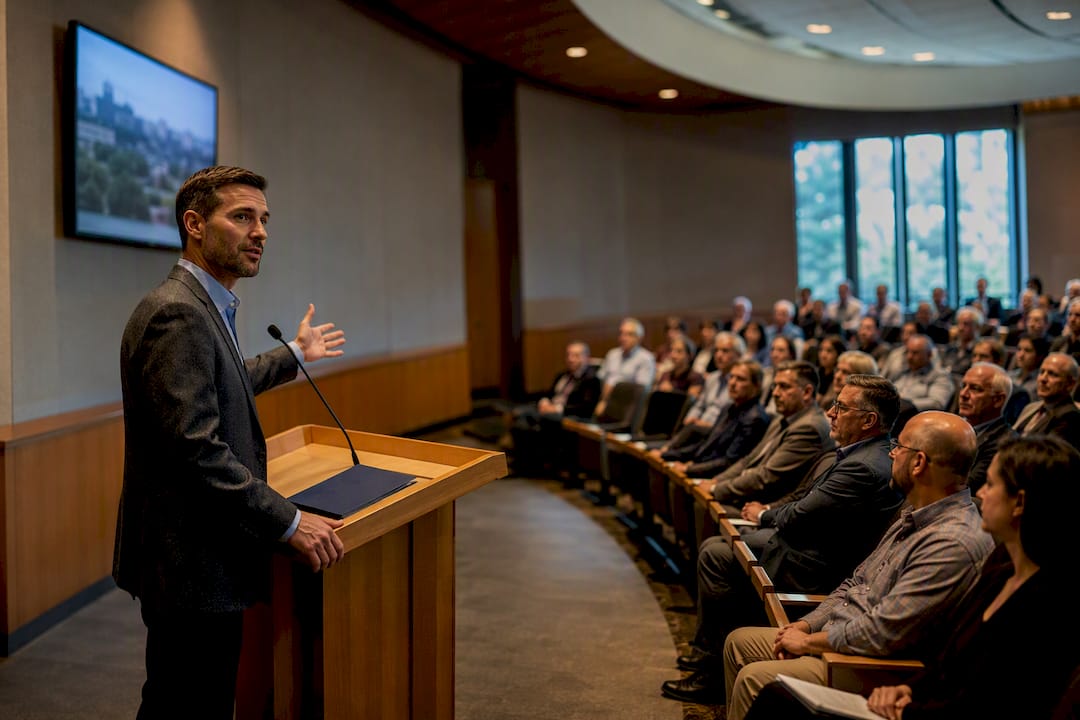
Effective public meeting facilitation produces inclusive, actionable decisions, so the first thing to do is set a clear purpose and a time-boxed agenda. The facilitator’s job is to manage that process, not steer its outcome. Every technique that follows, from the parking lot to structured breakouts, exists to protect that distinction and get your community to a decision it can actually stand behind.
TL;DR:
Effective facilitation requires thorough pre-meeting planning, including defining outcomes, mapping stakeholders, and building a focused, outcome-oriented agenda at least a week in advance.
Small meetings under a dozen participants may not need a facilitator, but larger or contentious sessions benefit from clear roles, time-boxing, and techniques like breakout groups and structured turns to maintain productivity.
Managing dominant voices involves using process-focused interventions, visual ground rules, and taking personal disputes offline to preserve neutrality and trust.
Ending meetings with a clear summary, documented decisions, and timely distribution of minutes and feedback fosters transparency and demonstrates that attendee input influences decisions.
Outside facilitators are recommended for high-stakes or oppositional land-use meetings where neutrality and prior stakeholder testing boost community trust and help prevent delays.
Table of Contents
What Public Meeting Facilitation Actually Means
Facilitation is process management, not content ownership. As MIT Human Resources frames it, facilitation is the deliberate work of guiding a group toward specific objectives through structured planning, managed dynamics, and methods that produce real participation and shared decisions. The facilitator does not advocate for an outcome. The project sponsor does.
That separation matters more as stakes rise. Practitioners consistently note that facilitators should be distinct from project leaders, so leaders stay free to argue for their content while someone else protects the process itself. Bring in a dedicated facilitator when a meeting involves more than roughly a dozen attendees, competing interests, or a contentious land-use decision. Smaller, low-stakes internal meetings usually don’t need one.
Clear roles keep this from collapsing under pressure:
Facilitator: manages process, time, and neutrality; never argues a position.
Chair or sponsor: owns the content and the decision authority.
Recorder: documents decisions, not just discussion.
Timekeeper: enforces the clock so the agenda doesn’t quietly expand.
How Do You Plan and Prepare for a Public Meeting?
Planning eats more hours than the meeting itself. UCSF’s facilitation guidance makes this plain: purpose, participant selection, agenda design, and logistics take more total labor than the two hours you spend in the room. Treat the meeting as the finish line of that work, not the starting point.
Work through this sequence before you send a single invitation:
Define the outcome. State what decision or input the meeting must produce, and name the decision method: consensus, majority vote, or advisory input to a body that decides later.
Map your stakeholders. Identify who needs to be there, who needs advance briefing, and who might derail the room if surprised on the day.
Build the agenda around outcomes, not topics. Each line should show the item, the desired outcome, the time allotted, the method (discussion, vote, report), and the lead person.
Assign roles early. Confirm your facilitator, recorder, and timekeeper days ahead, not the morning of.
Check accessibility. Confirm interpretation needs, physical access, and a working remote-participation option, drawing on guidance like San Diego’s public engagement standards for honoring different communication norms.
Pro Tip: Send the agenda at least 72 hours ahead with one guiding question per item. Attendees who arrive already thinking about the question participate faster and argue less.
For a deeper walkthrough of participant selection and outcome-setting, see how public meeting participation works.
What Should You Say and Do When the Meeting Starts?
Open with four things, in order: purpose, desired outcomes, ground rules, and the timeline. Something close to this works: “We’re here to decide X. By the end tonight, we need Y. Here’s how we’ll get there, and here’s when we’ll stop.” That thirty-second script sets expectations before anyone has a chance to hijack the floor.
Time-boxing keeps that promise honest. Put a visible timer on every agenda item and stick to it, even when the conversation is good. If a topic runs long, name it out loud and move it to a parking lot, a visible list of items to revisit later or handle offline. PMI’s guidance on facilitating project meetings identifies the parking lot and time-boxing as two of the most reliable tools for keeping discussion productive instead of circular.
Group size changes your tactics. Once attendance passes roughly twelve people, the dynamics shift enough that open floor discussion stops working. Break into smaller groups with a clear report-back format, such as three minutes per group covering one key theme and one open question. Other reliable techniques:
Round-robin: each person speaks briefly before anyone speaks twice.
Silent brainstorming: write ideas individually before discussing, which curbs anchoring on the first voice heard.
Digital backchannels: a live chat or comment queue for hybrid meetings, monitored by a co-facilitator, not the lead.
Practical facilitation techniques like these are covered in more depth in turning talk into decisions.
How Do You Handle Dominant Voices and Conflict in a Public Meeting?
Quiet participants and dominant ones are two sides of the same problem: uneven airtime. A go-around, where everyone gets a fixed, brief turn before open discussion resumes, resets the balance without singling anyone out. Small-group listening circles do the same work at scale, and interpretation or accessible materials extend that equity to people the standard format would otherwise exclude.
When someone dominates or derails, intervene on process, not on the person. Useful phrases:
“Let’s hear from someone who hasn’t spoken yet.”
“That’s a great point for the parking lot. Let’s capture it and keep moving.”
“We’re at time on this item. Can we take the rest offline?”
Posted ground rules and a simple hand signal for “time’s up” or “point of process” let you enforce norms visually, which is far less confrontational than interrupting verbally every time.
Pro Tip: If a conflict is personal rather than procedural, take it offline immediately. Public meetings settle process disputes in the room; personal disputes need a private conversation or, for genuinely contentious land-use fights, an outside neutral facilitator, which the EPA’s facilitation guidance recommends precisely because outsiders read as more objective than staff.
Trust and neutrality are what let any of this work. The Planning organization’s facilitation report identifies participant trust and consistent, visible neutrality as the two pillars that give a facilitator standing to intervene at all. Without them, even the best script sounds like control.
How Do You Close a Public Meeting and Follow Up Effectively?
A meeting that ends without a clear record accomplishes little. Close every session with this sequence:
Summarize decisions out loud and confirm each action item has a named owner and a deadline.
Distribute minutes within 48 hours, alongside a plain-language public summary for anyone who couldn’t attend.
Collect a short evaluation, a three-question pulse survey works, asking what worked, what didn’t, and whether people felt heard.
Debrief with your project team within a week to capture what to change next time.
Prompt documentation and follow-up matter more than they seem to. The Stanford facilitation job aid notes that fast, visible follow-through is one of the clearest signals to attendees that their input actually shaped a decision, rather than disappearing into a file.
Preparing and Distributing Meeting Materials in Advance
Materials sent late are materials nobody reads. A packet delivered the morning of a meeting guarantees that attendees arrive reacting instead of thinking, which slows every discussion that follows.
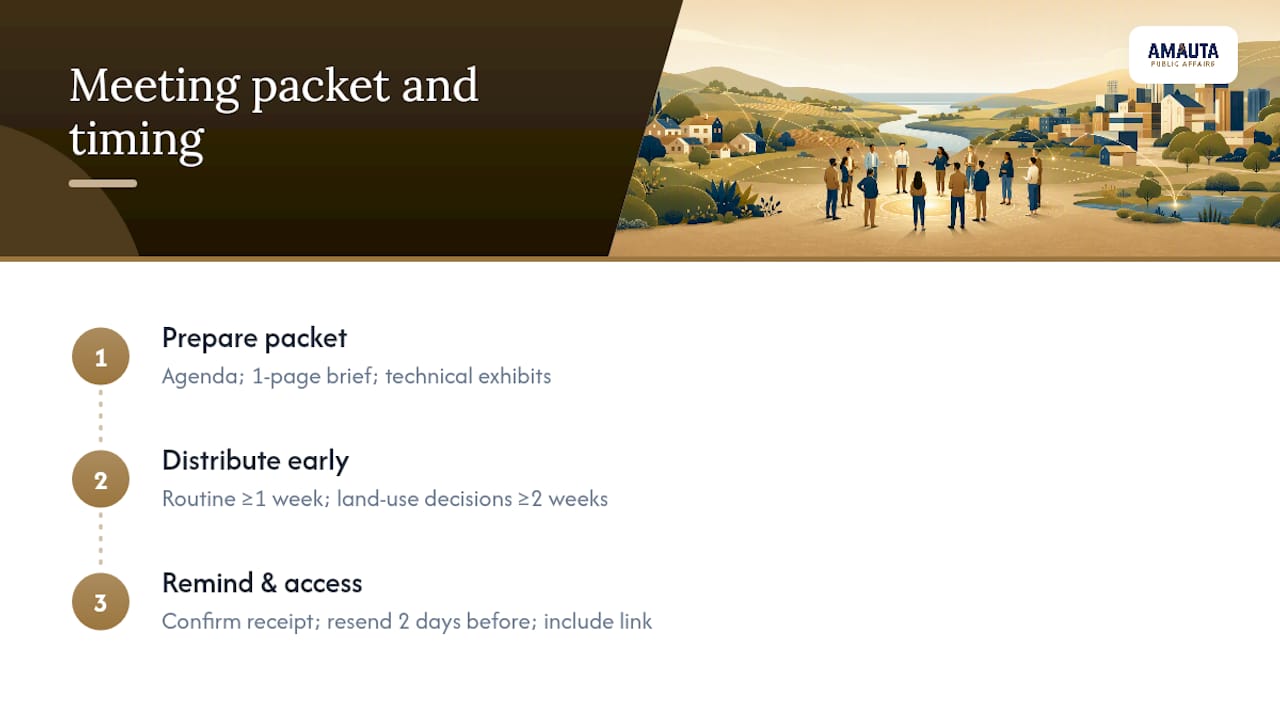
Build your packet around three documents: the agenda with outcomes and time allotments, a one-page background brief on the decision at hand, and any technical exhibits (site plans, budget tables, environmental data) that inform the discussion. Send all three at least a week ahead for routine meetings, and closer to two weeks for anything involving a land-use decision with real community consequence.
Format for skimming, not reading cover to cover. Bold the guiding question for each agenda item. Use plain language summaries above any technical appendix, since most attendees will read the summary and skip the raw data unless something in it concerns them directly. If your audience includes non-English speakers or residents without reliable internet access, translated summaries and printed copies at accessible community locations aren’t optional extras, they’re what makes the “public” in public meeting real.
Confirm receipt where you can. A short email or text reminder two days out, with the materials attached again, catches the attendees who filed the first email away and forgot to open it. For meetings with a virtual or hybrid component, pair this with the login link and a one-line note on how to submit questions in advance, a technique covered further in what a virtual town hall must deliver.
How Do You Get Quiet Attendees to Participate?
Silence in a public meeting rarely means agreement. It usually means someone doesn’t feel safe, doesn’t think their input matters, or hasn’t found an opening in a conversation dominated by more confident speakers.
Structure creates the opening that spontaneous discussion doesn’t. A round-robin, where each person gets a guaranteed short turn before the floor opens generally, works because it removes the need to compete for airtime. Written formats help just as much: index cards, sticky notes, or a live digital poll let people contribute without speaking aloud, which matters for attendees uncomfortable with public speaking or unfamiliar with meeting norms.

Small groups lower the stakes further. Someone who won’t speak to a room of eighty will often speak to a table of five. Structured breakouts with a clear report-back format capture that input and bring it back to the full group without forcing the original speaker to repeat themselves publicly.
Direct invitation helps too, used carefully. “I’d like to hear from someone at this table we haven’t heard from yet” works better than calling on one person by name, which can put someone on the spot. Give people advance notice when possible: sharing discussion questions in the pre-meeting materials lets attendees who process information more slowly, or in a second language, arrive ready rather than caught off guard.
Do Icebreakers and Energizers Actually Help in Public Meetings?
A short icebreaker at the start of a public meeting isn’t filler. It resets the room from spectators watching a presentation into participants expected to talk, which is precisely the shift facilitation depends on.
Keep it relevant and brief, sixty to ninety seconds per person, not a getting-to-know-you exercise disconnected from the topic. A simple prompt like “share your name, your connection to this neighborhood, and one word for how you’re feeling about tonight’s topic” does double duty: it warms up the room and gives the facilitator an early read on the emotional temperature before the substantive discussion starts.
Energizers matter more in longer sessions. A two-hour public hearing that runs without a break loses attention by the ninety-minute mark regardless of how well it’s run. A five-minute stand-up stretch, or a quick paired discussion where attendees turn to a neighbor before reporting back to the room, resets focus without derailing the agenda.
Skip icebreakers that feel gimmicky for the setting. A room debating a contested rezoning doesn’t need a trivia game; it needs a facilitator who acknowledges the tension directly and moves quickly into structured, purposeful dialogue.
AMAUTA Public Affairs’ Perspective on High-Stakes Land-Use Meetings
Neutral facilitation earns its value fastest in contentious land-use fights, where residents often distrust a project’s sponsor before the first agenda item is read. AMAUTA Public Affairs approaches these meetings the way a campaign approaches a contested race: stakeholder mapping first, message testing second, and a tailored engagement method built around what a specific community landscape actually requires rather than a generic template.
That sequencing matters because a facilitator can only be as effective as the planning behind them. Facilitators often have to give up some control in the room to gain real authority over the process, and that trade only works when stakeholder relationships and messaging have already been tested before the public meeting starts, not improvised during it.
— Ignacio
How AMAUTA Public Affairs Supports Your Next Public Meeting
An outside facilitator can be the alternative to building a facilitation function from scratch inside your own team for a land-use, energy, or infrastructure project where the stakes are high. Where an internal staff member juggling facilitation alongside their regular job can lose neutrality the moment a resident challenges their agency’s own project, an outside facilitator walks in with no institutional stake in the outcome, which is exactly the credibility a contentious hearing needs.
Some firms handle the full sequence: pre-meeting stakeholder mapping and message testing, on-site or virtual facilitation with defined neutrality, and post-meeting follow-up that documents decisions and closes the loop with attendees. That full-cycle approach fits projects where a single mishandled meeting could stall a permit or fracture community trust for years.
Use an internal facilitator for routine, low-conflict meetings. Bring in an outside consultant once the agenda touches zoning, environmental impact, or any decision likely to draw organized opposition. Review AMAUTA’s facilitation and consulting services or explore its land management experience to see how a tailored engagement plan could apply to your next public meeting, and reach out to scope your project’s stakeholder landscape before you finalize your next agenda.
Sources
FAQ
What Does Meeting Facilitation Mean?
Meeting facilitation means managing the process of a group discussion, structure, time, participation, and decision method, without directing the actual content or outcome the group decides on, per MIT’s definition.
What Is the 40/20/40 Rule for Meetings?
This informal rule suggests spending roughly 40% of your effort preparing before a meeting, 20% running it, and 40% following up afterward. It reflects the same principle UCSF documents directly: pre-meeting planning and post-meeting follow-through typically demand more total effort than the meeting itself.
What Are the Four P’s of Facilitation?
Definitions of the “four P’s” vary by practitioner, but a common version covers Purpose, Participants, Process, and Product, essentially the outcome you want, who needs to be in the room, how you’ll get there, and what you’ll leave with.
How Much Does a Meeting Facilitator Cost?
Facilitator fees vary widely by project scope, region, and whether the engagement includes pre-meeting stakeholder work or just on-site facilitation, so there’s no single standard rate. For high-stakes land-use or infrastructure meetings, firms like Amautapublicaffairs typically scope facilitation as part of a broader engagement plan, which you can review through their services page.
Recommended
Comments