
Rapid Response Communications: A PR Team's Guide

Rapid response communications is the practice of delivering timely, accurate, and strategic messages to shape public discourse and protect organizational reputation during unfolding events. For PR professionals and crisis management teams, it is the difference between controlling a narrative and reacting to one. This discipline combines preparation, disciplined approval workflows, and real-time monitoring to ensure that when a story breaks, your organization speaks first and speaks credibly. Understanding what is rapid response communications, and how to execute it well, is now a prerequisite for any team managing public issues.
What is rapid response communications and why does it matter?
Rapid response communications is defined as the coordinated, time-sensitive delivery of accurate messaging to address emerging news, public criticism, or crisis events before they escalate. The industry also refers to this practice as rapid response PR or issue response communications, and it sits at the intersection of media relations, crisis management, and real-time stakeholder engagement.
The core purpose is influence. When a story breaks, the first credible voice to frame it tends to define public perception. Acting within hours or one business day is the operational standard, because news cycles move faster than most internal approval processes. That gap between the speed of news and the speed of organizations is where reputations are won or lost.

PR teams that treat rapid response as a reactive exercise consistently underperform. The teams that succeed treat it as a standing operational program, with pre-built infrastructure, trained personnel, and clear decision rights. The distinction is not talent. It is preparation.
What are the core components of an effective rapid response strategy?
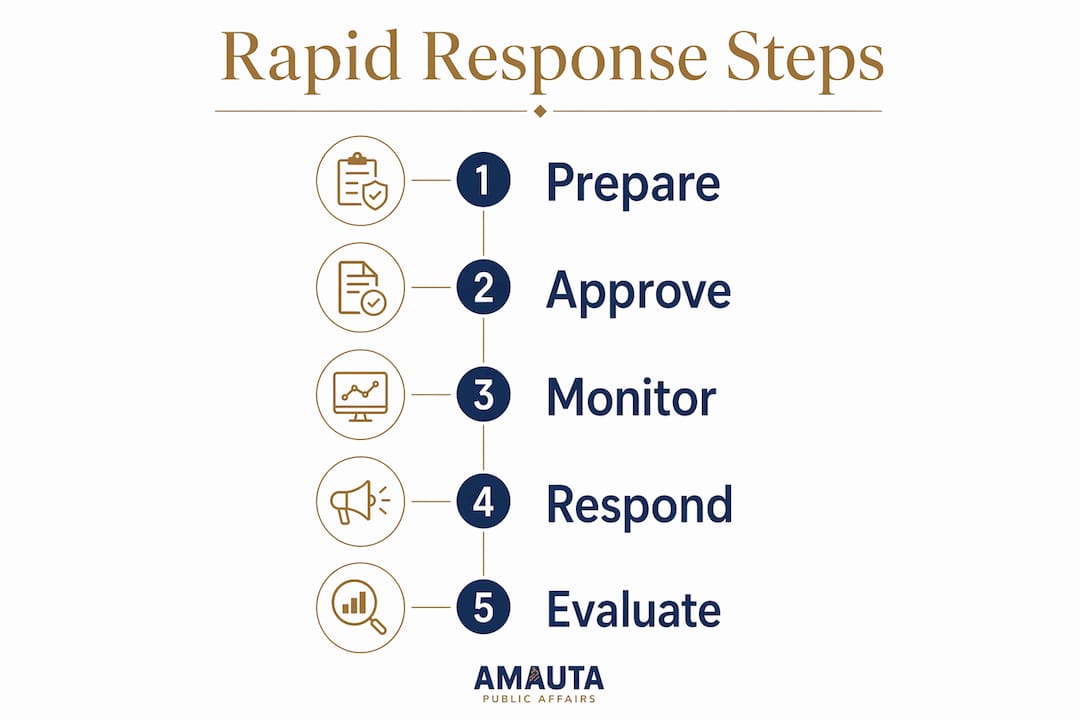
A rapid response strategy rests on five operational pillars. Each one removes friction from the moment a story breaks to the moment your message reaches the public.
Scenario mapping and SME alignment. Before any crisis hits, teams must map likely issue categories and identify subject-matter experts (SMEs) for each. An SME who has never been briefed on media engagement will slow you down at the worst possible moment.
Media and social monitoring. Real-time monitoring of traditional press, social platforms, and industry channels identifies the moment a story becomes relevant. Without this, teams are always behind.
Streamlined internal workflows. Most rapid response failures stem from cumbersome approval processes, not from a lack of speed. Limiting approvals to one or two senior decision-makers is the standard that keeps pace with news cycles.
Pre-approved message templates. Templates drafted and cleared before a crisis allow teams to adapt and deploy within minutes. A template that still needs legal sign-off during an active event is not a template. It is a liability.
Multi-channel deployment readiness. Coordinated messaging across social media, traditional press, and internal channels maximizes reach and prevents contradictory statements from appearing on different platforms.
Pro Tip: Secure leadership and legal sign-off on your core message templates before any crisis occurs. Seeking approval during an active event adds hours you do not have.
The approval workflow deserves special emphasis. Pre-approval of templates by legal and leadership is the single most reliable way to accelerate response time without sacrificing accuracy. Teams that skip this step consistently find themselves negotiating language while journalists are already publishing.
How to balance speed and strategy in rapid response communications
Speed without strategy produces a different kind of crisis. The concept of “strategic speed” captures the discipline required: moving fast enough to be relevant, but deliberately enough to be credible.
The risks of unvetted rapid messaging are concrete. Issuing a statement based on incomplete information forces a correction, and corrections signal disorganization. Worse, a premature resolution statement can reopen the crisis narrative rather than close it. Resolution statements should only be issued once the situation is genuinely stable and the response is fully credible. Issuing one too early invites further scrutiny and signals that your team is managing optics rather than facts.
The calibration process for timing involves three questions:
Is the information verified? No message should go out on unconfirmed facts, regardless of competitive pressure to respond first.
Does this moment require a response? Not every mention demands engagement. Teams must distinguish between noise and genuine narrative threats.
Which channel reaches the right audience fastest? A statement on LinkedIn reaches a different audience than a press release to wire services. Channel selection is a strategic decision, not a default.
“Strategic speed is the difference between success and failure in rapid response. Speed must be combined with smart strategy and timing to protect credibility and maximize impact.”
Industry leaders consistently identify this balance as the defining competency of high-performing PR teams. Speed gets you into the conversation. Strategy determines whether you win it.
What practical steps can PR teams take to implement a rapid response program?
Building a rapid response program is an operational project, not a communications exercise. The infrastructure must exist before it is needed.
Build a rapid response playbook. The playbook documents issue categories, escalation triggers, approval chains, and channel protocols. It should be specific to your organization’s structure, not a generic template downloaded from the internet.
Identify and train SMEs. Each SME should know their role, their preferred media engagement format (on-record, background, or no comment), and the boundaries of what they can confirm. Training should include media simulation exercises, not just briefing documents.
Curate and maintain media contact lists. Ready media lists and interview briefing materials enable fast, targeted outreach. A list that has not been updated in six months is a source of delays, not speed.
Deploy social listening tools. Real-time monitoring platforms flag relevant mentions, trending topics, and emerging narratives before they reach mainstream press. This early warning function is what separates proactive teams from reactive ones.
Assign explicit ownership roles. Every rapid response action, from drafting to approval to pitching, must have a named owner. Ambiguity about who drafts the first statement costs hours.
Coordinate internal and external messaging simultaneously. External statements and internal employee communications must align. A gap between what employees hear internally and what the public reads externally creates confusion and erodes trust.
Pro Tip: Post a “no-news” update at a predetermined time even when there are no new developments. Timely no-news updates signal active management and prevent speculation from filling the silence.
For teams working on land use, infrastructure, or community-facing projects, the media relations strategy layer is especially critical. These issues attract sustained local media attention, and a rapid response program without a strong media relations foundation will struggle to place its messages effectively.
Consulting resources that address communications and growth strategy can also help teams think through the organizational design of their rapid response function, particularly when the communications team is small and must cover multiple issue areas simultaneously.
How does rapid response fit within a broader crisis communication plan?
Rapid response is not a substitute for a crisis communication plan. It is a component of one. The distinction matters operationally.
A crisis communication plan provides the full architecture: escalation protocols, stakeholder mapping, approval hierarchies, legal review processes, and messaging frameworks for every phase of a crisis. Rapid response addresses the first hours of an emerging story. It operates within the plan’s structure, not outside it.
Dimension | Rapid response communications | Traditional crisis communication |
Timing | Hours to one business day | Days to weeks |
Trigger | Breaking news, trending issue | Declared organizational crisis |
Approval chain | One to two decision-makers | Full legal and executive review |
Message format | Pre-approved templates, adapted quickly | Fully drafted, reviewed statements |
Primary channel | Social media, direct media outreach | Press releases, formal statements |
Goal | Narrative influence, early positioning | Reputation recovery, stakeholder reassurance |
Internal communication is a dimension that PR teams frequently underweight. Employees must be informed before or concurrent with public messaging. When employees hear about an organizational issue from a news alert rather than from leadership, the internal damage compounds the external one.
Measuring effectiveness closes the loop. Teams should track media coverage sentiment, social volume, and message penetration after each rapid response event. This feedback informs the next iteration of the playbook and refines the approval workflow. The goal is a program that improves with each activation, not one that resets to zero after every event. For nonprofit organizations, the nonprofit crisis communications framework offers additional guidance on integrating rapid response within governance-heavy structures.
Key takeaways
Rapid response communications succeeds when preparation, disciplined approvals, and real-time monitoring combine into a standing operational program, not a reactive scramble.
Point | Details |
Define before the crisis | Build scenario maps, train SMEs, and assign ownership roles before any issue emerges. |
Pre-approve all templates | Templates without prior legal and leadership clearance slow response and damage credibility. |
Limit the approval chain | Restricting approvals to one or two decision-makers is the standard for matching news cycle speed. |
Align internal and external messaging | Employees must hear organizational news from leadership, not from press coverage. |
Post no-news updates | Scheduled updates with no new information signal control and prevent damaging speculation. |
Why the approval chain is the real battleground
After years of working in public affairs and crisis communications, the pattern I see most often is not teams that lack speed. It is teams that lack permission. The approval chain is where rapid response programs collapse.
Organizations invest in monitoring tools, draft playbooks, and train spokespeople. Then a story breaks at 4:00 PM on a Friday, the general counsel is traveling, and the CEO wants to review the statement personally. By monday morning, the narrative has been written by someone else.
The fix is not faster writers. It is pre-authorized language. Every organization should have a library of pre-approved statements covering its most likely issue categories, signed off by legal and leadership during a calm period. When the moment arrives, the team adapts the template and deploys. The approval has already happened.
I have also seen teams damage their credibility by issuing resolution statements too early. The instinct to declare the crisis over is understandable. The consequences of doing it prematurely are not. Once you say the situation is resolved and it resurfaces, you have lost the public’s trust in your communications, not just in the underlying issue.
The 24/7 news and social media environment has compressed every timeline. Teams that run quarterly simulation exercises, not just annual ones, are the teams that perform when it counts. Preparation is not a one-time project. It is an ongoing discipline.
— Ignacio
How Amautapublicaffairs supports your rapid response program
Rapid response communications requires more than good instincts. It requires a program built before the pressure arrives.
Amautapublicaffairs works with PR teams and crisis management professionals to build the operational infrastructure that makes rapid response effective. From customized playbooks and SME training to media relations strategy and real-time monitoring support, the team brings a campaign-style approach to issue management. Whether your organization faces land use opposition, community pushback, or breaking news, Amautapublicaffairs provides the structure and expertise to respond with speed and credibility. Explore the full range of crisis communications services and find the right support for your team’s needs.
FAQ
What is rapid response communications in PR?
Rapid response communications is the practice of delivering timely, accurate messages to shape public perception during breaking news or emerging issues. It combines pre-built infrastructure, real-time monitoring, and disciplined approval workflows to enable organizations to respond within hours.
How fast should a rapid response be?
Effective rapid response requires acting within hours or one business day to stay relevant in fast-moving news cycles. Delays beyond that window allow other voices to define the narrative.
What is the biggest cause of rapid response failure?
Cumbersome approval processes are the leading cause of rapid response failure, not a lack of speed or skill. Limiting approvals to one or two decision-makers is the most effective structural fix.
How does rapid response differ from a crisis communication plan?
Rapid response addresses the first hours of an emerging story using pre-approved templates and a short approval chain. A crisis communication plan covers the full arc of a declared crisis, including escalation protocols, stakeholder management, and multi-phase messaging.
Should employees be informed before public statements are issued?
Yes. Employees should be informed before or at the same time as public messaging. When employees learn about organizational issues from outside sources, it compounds both internal and external damage.
Recommended
Comments