
What a Risk Communication Project Actually Delivers

A risk communication project is a project-wide public-affairs and community-engagement program that secures social license by embedding structured dialogue, transparent fact governance, and measurable commitments. It is not a brochure campaign or a single town hall. For project owners weighing land-use or infrastructure approvals, the immediate action is straightforward: commission a short stakeholder mapping and scoping engagement plan before you finalize design or announce the project publicly.
Ask your first vendor conversation to produce three deliverables:
A stakeholder map identifying influence, interest, and likely opposition points
A fact register establishing what claims are confirmed, pending, or disputed
A proposed governance matrix showing who approves messages and who can offer concessions
Pro Tip: Commission the scoping plan before your engineering design is locked. Once drawings are final, community input options shrink to “accept or object,” and that framing invites exactly the opposition you’re trying to prevent.
Key Takeaways
A successful risk communication project depends on early stakeholder mapping, documented fact governance, and structured dialogue tied to measurable approval outcomes.
Point | Details |
Start at scoping | Commission stakeholder mapping and a governance plan before design decisions are locked in. |
Governance beats volume | One named authority for facts and concessions prevents the contradictions that fuel opposition. |
Match method to audience | Use deliberative workshops and small-group sessions for contested issues, surveys for broad sentiment. |
Measure outcomes, not activity | Track unresolved high-risk issues and formal objections, not just meetings held. |
Amautapublicaffairs delivers this model | Its campaign-style process builds a Promise-to-Proof tracker and SEP-style plan into every engagement. |
Table of Contents
Why Proactive Risk Communication Projects Reduce Approval Risk
Delay is the most expensive line item in any land-use project, and it is almost always avoidable. Early, meaningful engagement reduces the risk of drawn-out approvals, costly redesigns, and outright cancellations, according to BCG’s analysis of mega-project community engagement. Opposition is rarely irrational. It reflects a community’s judgment about tradeoffs, and structured dialogue changes how people weigh those tradeoffs, per reporting on housing development conflicts.
Three effects compound once engagement starts early:
Fewer surprises reach elected officials right before a vote
Design changes happen on paper, not after a lawsuit
Community relationships outlast any single approval milestone
Projects that treat engagement as embedded infrastructure, not an add-on, see stronger long-term value and fewer social friction costs over the project lifecycle, a pattern BCG’s research also identifies; see more on effective community engagement methods.
What Belongs in an Effective Risk Communication Project
A scope of work missing any of these pieces is incomplete, regardless of how polished the tactics look.
Stakeholder mapping and influence analysis. Identify elected officials, adjacent property owners, advocacy groups, and media contacts, with coverage targets for each tier of influence.
Fact register and message governance. One team owns which facts are approved for public release, and a named decision-maker holds authority to concede on negotiable points. Without this, spokespeople contradict each other within days.
Structured dialogue methods matched to the audience. Surveys for broad sentiment, deliberative workshops for contested technical questions, small-group sessions for directly affected residents. Overcoming public opposition research from the University of Waterloo shows that pre-consultation research into stakeholder values produces sharper, more durable dialogue than generic outreach.
A tactical mix beyond meetings. Town halls, targeted outreach to specific blocks or associations, media relations, and digital advocacy each serve a different audience segment.
Documentation and continuity through construction. Meeting records, decision logs, and SEP-style plan updates should begin at scoping, per IFC’s handbook on stakeholder engagement, and continue past groundbreaking. Our community engagement strategy overview walks through how these pieces connect operationally.
Skipping documentation is the most common shortcut, and it is the one that costs the most when a permit gets challenged later.
How to Commission and Evaluate a Risk Communication Vendor
Most procurement teams write vague scopes and then struggle to compare proposals. Fix the scope first.
Define what’s negotiable and what’s fixed. Decide before you talk to vendors which project elements (site boundaries, hours of construction, mitigation commitments) can move and which cannot. Vendors need this to design honest messaging, not just optimistic messaging.
Require a pre-proposal stakeholder scan. A vendor who can produce a rough risk posture memo before contract signature, based on public records and prior local disputes, is telling you they do the work rather than sell a template.
Require a governance matrix in the proposal itself. Ask who on their team owns issue resolution, who escalates to your organization, and how fast that escalation happens. Our stakeholder communication strategies guide outlines what a workable matrix looks like on paper.
Ask for KPIs and a Promise-to-Proof tracker. This is the single best filter for vendor quality. A firm that cannot show you how it tracks commitments made to the community against commitments delivered is asking you to trust intent instead of results.
Include a continuity plan for construction and operations. Community engagement teams often disband after approval, leaving construction crews to handle noise complaints and traffic disputes with no relationship history. Require a named handoff plan in the contract.
Pro Tip: Score every vendor proposal on whether it names a specific person with authority to say “yes” to a community request on-site. Proposals that route every decision back to a corporate office add weeks to issue resolution.
Procurement Checklist for a Risk Communication RFP
Copy this into your internal memo or RFP language directly.
Minimum scope items to require:
Stakeholder map with coverage targets by tier
SEP-style engagement plan with documented meeting records
Fact register with a named approval authority
Monitoring plan tied to project milestones
Escalation path with response-time commitments
Evaluation criteria to score proposals against:
Demonstrated experience on comparable land-use or infrastructure approvals
Structured-dialogue capability, not just meeting facilitation
A measurement approach tied to permitting outcomes, not activity counts
Transparency in reporting, including access to raw feedback data
Budget scales with geography, the size of the affected population, technical complexity of the project, and timeline compression. A rushed six-month approval window costs more per month of engagement than a phased eighteen-month schedule.
How Do You Measure Whether Engagement Is Reducing Risk?
Activity metrics (meetings held, flyers distributed) tell you almost nothing about whether opposition is shrinking. Tie every metric to either operational health or project outcome.
Metric type | What to track |
Stakeholder coverage | Percentage of mapped stakeholders contacted at least once per phase |
Unresolved high-risk issues | Count of open concerns flagged as high-risk, tracked weekly |
Commitments completed | Ratio of commitments made to commitments delivered on schedule |
Sentiment change | Baseline versus follow-up survey results on project favorability |
Formal objections | Number filed at each permitting milestone versus prior comparable projects |
Measurement should include baseline and follow-up surveys, ongoing sentiment tracking, attendance and representation data from meetings, and media monitoring for tone shifts. Connecting engagement activity to permitting milestones and reduced formal objections, rather than counting event attendance, is what turns engagement into a defensible line item on a project budget. Review the engagement plan on a set schedule, not just when a crisis forces a reaction.
How AMAUTA Runs a Risk Communication Project
Amautapublicaffairs approaches every land-use and infrastructure engagement as a campaign, not a checklist. The process moves through scoping and stakeholder mapping, message governance, structured dialogue, media relations, and continuous adjustment based on real-time feedback from the field.
Deliverables clients receive typically include a Promise-to-Proof tracker, a SEP-style engagement plan, a live stakeholder database, a response log for community concerns, and sample messaging built around the project’s specific fact register.
A campaign-style approach means priorities get reassessed as new information comes in from the field, not locked in at kickoff and forgotten until the next public meeting.
… For a look at how this plays out tactically, see our guide on improving public perception of a commercial project.
Crisis Communication Protocols and Contingency Planning
Every risk communication project needs a crisis protocol before it needs one in practice. Waiting until a viral social post or a hostile news segment forces your hand means you are writing your response under pressure, with your credibility already damaged.
A workable protocol names a single spokesperson for crisis moments, distinct from the day-to-day community liaison, so messaging stays consistent under scrutiny. It defines a response-time target, ideally within hours, not days, for any claim that reaches local media or spreads on neighborhood social platforms. Practitioner reporting on builder pushback confirms that unaddressed claims escalate fast once amplified by social sharing, often outpacing a project’s ability to correct the record.
Contingency planning also means pre-drafting holding statements for foreseeable flashpoints such as construction accidents, missed deadlines, or permit hearings to ensure timely and consistent communication when needed.
Finally, the fact register from your core engagement plan becomes the crisis team’s single source of truth. If your spokesperson and your community liaison are pulling from different documents during a fast-moving situation, you will contradict yourself publicly within the same news cycle. That single inconsistency can undo months of trust-building faster than any one bad headline.
Using Technology and Digital Tools in Community Engagement
Digital tools extend the reach of a risk communication project, but they do not replace structured, in-person dialogue for the residents most directly affected. Treat technology as an amplifier of your engagement plan, not a substitute for it.
Interactive project maps let residents see exactly how a proposal affects their block, which reduces the “I didn’t know this was happening near me” complaint that fuels late-stage opposition. Online comment portals and digital town halls widen participation for people who cannot attend evening meetings, particularly working parents and shift workers who are otherwise underrepresented in public comment records.

Sentiment tracking across local social media and news coverage gives your team an early warning system for shifting community mood, often days before it surfaces at a public hearing. Text and email alert systems keep stakeholders updated on construction timelines and milestones without requiring them to check a project website.
Our comparison of business community engagement platforms breaks down which tools fit which project scale, since a small infill development and a regional transmission line need very different digital infrastructure. Whatever platform you choose, keep a human response behind it. A resident who submits a concern through a digital portal and gets a form-letter reply with no follow-up learns quickly that the tool is decorative, and that lesson spreads through a neighborhood faster than any positive message you send through the same channel.
Cultural and Demographic Factors That Shape Risk Perception
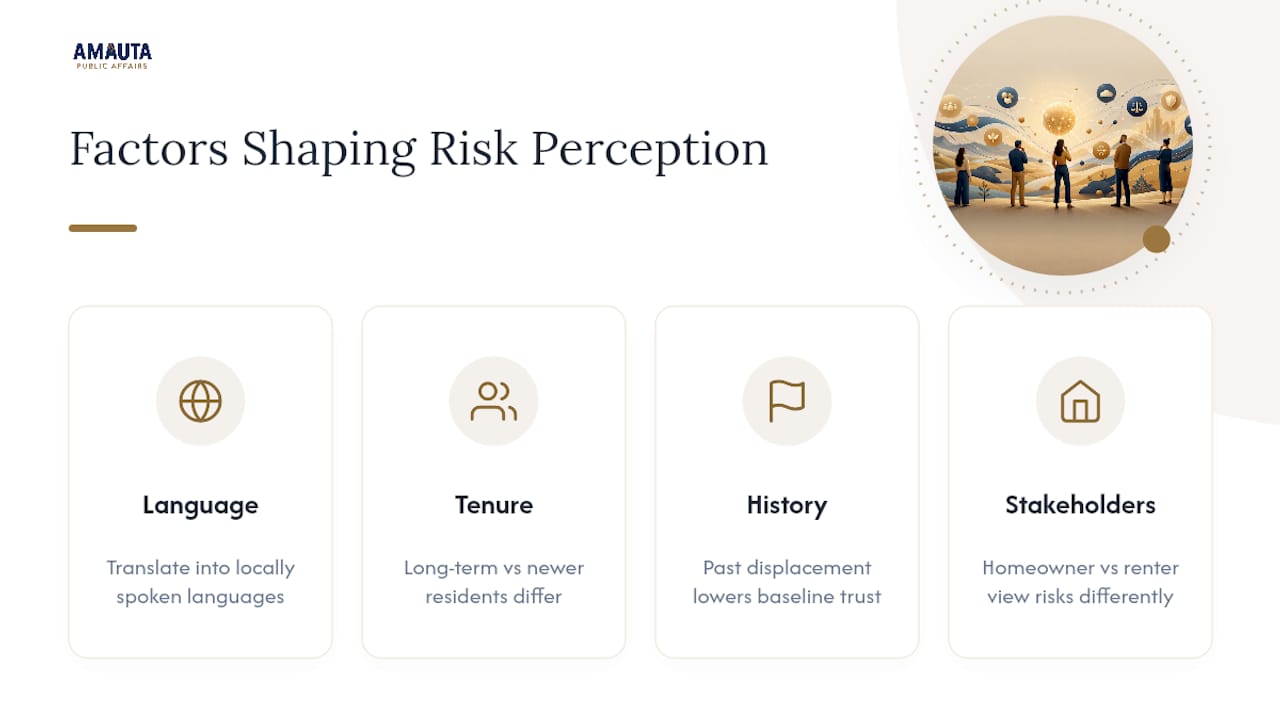
Communities do not evaluate risk uniformly, and treating every stakeholder group with identical messaging is one of the fastest ways to lose credibility with all of them at once. A retired homeowner weighing property value concerns and a renter worried about displacement are reading the same project through entirely different lenses.
Language access matters more than most scopes of work budget for. Materials adapted for low-literacy audiences and translated into the languages actually spoken in the affected area, not just the region’s dominant language, are part of IFC’s guidance on inclusive stakeholder engagement. Skipping this step effectively excludes entire population segments from the process, which then surfaces as opposition at the exact moment you can least afford it: a public hearing.
Historical context shapes perception too. A community that has previously been displaced by infrastructure projects, or that has watched past promises go unfulfilled, brings a different baseline trust level than a community with no such history. Your stakeholder map should flag this history explicitly, because a generic trust-building approach will underperform badly in a neighborhood with legitimate reasons for skepticism.
Age and tenure also matter: long-term residents often weigh legacy and character concerns heavily, while newer arrivals may prioritize practical impacts like traffic or noise. A single message deck rarely serves both groups well, which is why segmented, values-based outreach outperforms a one-size messaging approach on nearly every contested project.
Training Requirements for Project Staff and Spokespeople
Engagement plans fail in the field almost as often as they fail on paper, and the usual cause is an untrained spokesperson improvising an answer that contradicts the fact register. Training is not optional polish; it is risk management.
Every person who might field a public question, from the project manager to the site superintendent, needs a working knowledge of the approved fact register and clear instructions to redirect questions outside their scope to the named spokesperson. This single discipline prevents the most common and most damaging failure: two staff members giving a reporter or a resident two different answers to the same question.
Formal spokesperson training should cover message discipline under hostile questioning, how to acknowledge a valid community concern without conceding a fact that hasn’t been verified, and how to bridge from a difficult question back to the project’s core commitments. Media training matters specifically because local reporters often ask the question a resident is too polite to ask directly at a public meeting.
Staff also need training on when to escalate. A field team member who tries to resolve a legal threat or a serious safety allegation on the spot, without looping in the governance matrix’s designated decision-maker, can create liability the project didn’t need to take on. Build escalation drills into onboarding, not just a policy document nobody reads twice.
Turning Scientific and Technical Data Into Public-Facing Materials
Environmental impact statements, traffic studies, and engineering reports are written for regulators and other engineers, not for the residents whose support you need. Handing a community a 200-page technical appendix and calling it transparency actually reduces trust, because it reads as either indifference or an attempt to bury the answer in volume.
The fix is translation, not simplification to the point of inaccuracy. Take the specific finding a resident cares about, noise levels during construction, groundwater impact, traffic counts at a particular intersection, and present it with the same rigor but in plain language, visual aids, and direct comparisons residents can evaluate for themselves. A decibel reading means little to most people; a comparison to a familiar sound (a passing truck, a lawn mower) makes the same data usable.
Every technical claim in public materials should trace back to the fact register, so your spokesperson and your engineers are never contradicting each other in front of a reporter or a planning commission. When technical uncertainty exists, say so plainly rather than rounding it into false certainty. Communities forgive uncertainty far more readily than they forgive a confident claim that later turns out to be wrong.
What Project Owners Consistently Get Wrong
Most organizations treat risk communication as a compliance requirement to satisfy after the real decisions are made. That sequencing is the core mistake the research keeps surfacing: engagement bolted onto a finished design produces exactly the opposition it was meant to prevent, because residents correctly sense they are being informed rather than consulted.
The conventional advice, hold more meetings, distribute more flyers, hire a bigger PR firm, misses the actual lever. Volume of outreach does not move judgment about tradeoffs; structured dialogue does. A project that runs three well-designed deliberative sessions with the right stakeholders will outperform a project that runs fifteen generic open houses, every time.
What deserves priority first is not the tactical mix. It’s the governance question: who owns the fact register, and who has actual authority to concede on a negotiable point. Projects that skip governance and jump straight to town halls often face spokespeople contradicting each other publicly, damaging trust more than if no comment had been made. Establishing governance before public meetings improves communication consistency and resilience under pressure.
— Ignacio
How Amautapublicaffairs Supports Your Next Project
Amautapublicaffairs is the direct-service alternative to assembling an in-house engagement team from scratch. Rather than hiring separate media relations, community outreach, and digital advocacy staff, you get a single campaign-style team that has already run stakeholder mapping, message governance, and structured dialogue on comparable land-use and infrastructure projects.
The firm’s approach ties every engagement activity to a measurable commitment, refined continuously against real-time feedback rather than a static plan drafted once at kickoff. That means the fact register, the governance matrix, and the Promise-to-Proof tracker described throughout this guide are not theoretical templates. They are the actual deliverables Amautapublicaffairs builds for land-use, energy, and infrastructure clients. If your project is heading toward a permitting decision in the next year, visit the services page to see the full scope of community engagement, media relations, and public affairs support available, or review land management-specific offerings if your project involves land acquisition or resettlement questions. Request a scoping conversation before your design is finalized, not after.
Sources
Recommended
Comments