
Role of Public Affairs Nonprofits: 2026 Guide

Public affairs nonprofits are organizations that engage in advocacy, communication, and civic engagement to influence public policy and shape the conditions under which communities live and work. The role of public affairs nonprofits extends well beyond issuing press releases or attending hearings. These organizations serve as connective tissue between citizens and government, translating community concerns into policy language that lawmakers and regulators can act on. Yet the sector faces a defining challenge: advocacy participation has dropped from 74% in 2002 to 31% in 2022, driven by staff capacity gaps, funding shortfalls, and legal uncertainty. That decline represents a serious erosion of civic voice at exactly the moment communities need it most.
What is the role of public affairs nonprofits in advocacy?
Public affairs nonprofits perform three core functions: shaping public narratives, building relationships with policymakers and media, and mobilizing stakeholders around specific policy goals. These functions are not sequential. They run simultaneously and reinforce each other when executed well.
Organizations like the Bipartisan Policy Center and Independent Sector have documented how the nonprofit sector’s influence depends on its ability to coordinate these functions across a decentralized field. The U.S. tax-exempt sector grew its assets by 81% from 2008 to 2022, and nonprofits now mobilize millions of volunteers representing billions of hours annually. That scale creates real leverage, but only when organizations channel it through deliberate public affairs strategy.

Public interest advocacy organizations also serve a representational function. They give voice to constituencies that lack direct access to legislative chambers or regulatory agencies. Environmental justice groups, housing coalitions, and rural health networks all operate in this space, translating lived experience into policy testimony. The functions of nonprofit advocacy, at their best, make democracy more responsive to the people it is supposed to serve.
How do public affairs nonprofits operate day to day?
The operational model of a public affairs nonprofit depends heavily on its size, IRS designation, and available resources. A 2026 Springer Nature mixed-methods study found that agricultural nonprofits use both direct and indirect advocacy, with the choice of tactic reflecting organizational capacity and leadership knowledge rather than mission alone.
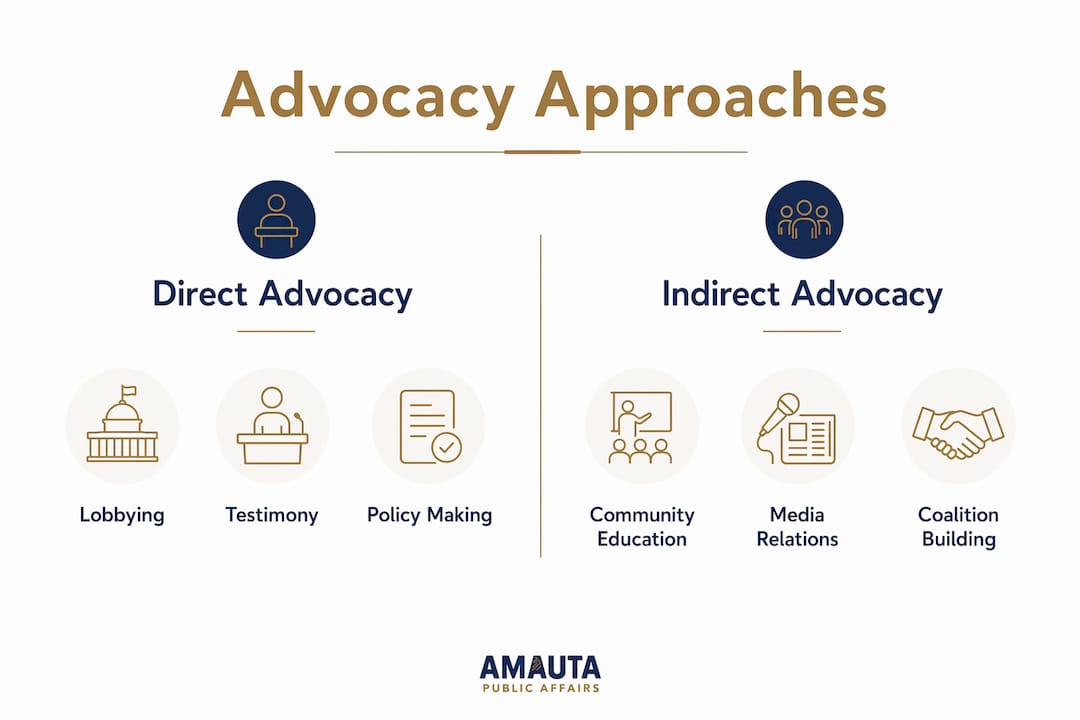
Direct advocacy includes:
Formal testimony before legislative committees or regulatory bodies
Serving on government advisory boards
Direct lobbying of elected officials or agency staff
Coalition coordination with allied organizations
Indirect advocacy includes:
Community education workshops and public forums
Publishing research, policy briefs, and issue guides
Media relations and earned media campaigns
Voter registration and nonpartisan get-out-the-vote programs
The distinction matters legally and strategically. A small nonprofit with one staff member may rely almost entirely on indirect methods, while a larger organization like the Alliance for Justice or the National Council of Nonprofits can maintain dedicated government relations staff. Both approaches generate real impact of public affairs nonprofits when aligned with a clear theory of change.
Pro Tip: Map your organization’s advocacy tactic portfolio against your current staff capacity and IRS designation before committing to a campaign. Misalignment between ambition and capacity is the most common reason nonprofit advocacy efforts stall.
What legal constraints shape nonprofit public affairs roles?
Legal compliance is not a background concern for public affairs nonprofits. It is a prerequisite for sustained advocacy. The IRS rules governing 501©(3) organizations create a clear boundary: 501©(3) nonprofits cannot support or oppose candidates for office but may conduct nonpartisan voter engagement aligned with their missions. That distinction is absolute, not a matter of degree.
The legal terrain shifted further after Louisiana v. Callais, a 2026 decision that prompted the Alliance for Justice to update its guidance for nonprofits navigating election-year advocacy. The core message from that guidance: focus on permitted civic engagement formats like nonpartisan get-out-the-vote campaigns rather than activities that could be construed as candidate support.
Krieg DeVault LLP’s May 2026 overview of nonprofit political activity outlines a practical framework for compliance:
Separate nonpartisan voter engagement from all candidate-related communications using distinct messaging tracks.
Develop pre-approved messaging templates that staff can use without legal review for routine activities.
Establish clear escalation protocols so staff know when to consult legal counsel before acting.
Train board members on the difference between issue advocacy, lobbying, and political campaign intervention.
Conduct an annual compliance audit before any election cycle begins.
The election-year planning framework from Krieg DeVault reinforces that effective public affairs separate nonpartisan voter engagement from candidate-related activities through pre-approved messaging and clear leadership thresholds. Organizations that skip this step expose themselves to IRS scrutiny and reputational risk simultaneously.
Pro Tip: Treat legal review as a design input, not a final checkpoint. Build compliance review into the campaign planning phase, not after messaging is already drafted. This approach, recommended by Independent Sector’s expert panel, prevents costly revisions and protects your organization’s tax-exempt status.
How do public affairs nonprofits build trust and influence?
Nonprofits enjoy a level of public trust that most government agencies and corporations cannot match. The challenge, as Independent Sector’s Principles Panel on Advocacy documents, is that legal complexity and political polarization limit the sector’s ability to convert that trust into durable policy influence. Trust is necessary but not sufficient.
Dr. Akilah Watkins, a leading voice in nonprofit sector leadership, emphasizes that public affairs roles depend not only on communication skills but also on legal knowledge and coordination to translate sector trust into influence. That framing reorients how nonprofit leaders should think about capacity. Communication is the visible output. Legal knowledge and coordination are the infrastructure that makes it possible.
“The nonprofit sector’s greatest asset is its credibility with the public. The challenge is building the internal infrastructure to deploy that credibility strategically and sustainably.” — Independent Sector Principles Panel on Advocacy, 2026
Several strategies help organizations overcome the barriers to influence:
Capacity-building programs that train staff and board members on advocacy law, messaging, and stakeholder engagement
Coalition convening that aggregates the voices of multiple organizations around shared policy goals, amplifying reach without requiring each member to build independent capacity
Storytelling campaigns that connect policy positions to lived community experience, making abstract issues concrete for both policymakers and the public
Coordinated advocacy calendars that align lobbying, media, and community engagement activities for maximum timing impact
The nonprofit government relations function is most effective when it operates as a year-round discipline rather than a reactive response to legislative threats. Organizations that build this muscle consistently outperform those that mobilize only in crisis.
Direct vs. indirect advocacy: which approach fits your mission?
The capacity logic model from the 2026 Springer Nature study confirms that nonprofits’ advocacy impact directly reflects their resources, leadership expertise, and mission orientation. No single tactic portfolio fits every organization. The table below compares direct and indirect advocacy across the dimensions that matter most for nonprofit leaders making strategic decisions.
Dimension | Direct Advocacy | Indirect Advocacy |
Primary methods | Legislative testimony, lobbying, government board service | Workshops, publications, media relations, voter education |
Legal risk level | Higher; requires careful lobbying expenditure tracking | Lower; educational activities face fewer IRS restrictions |
Capacity requirements | Dedicated staff, legal counsel, policymaker relationships | Content development, community outreach infrastructure |
Typical outcomes | Direct policy change, regulatory influence, legislative wins | Shifted public opinion, increased civic participation, coalition growth |
Best fit for | Organizations with established relationships and legal support | Smaller organizations or those building advocacy capacity |
Both approaches generate real policy impact when executed with discipline. A rural health nonprofit running community education workshops on Medicaid eligibility is doing indirect advocacy that directly shapes how constituents engage with the political system. A housing coalition testifying before a city council is doing direct advocacy that can change zoning law within months. The most effective public affairs programs combine both, calibrating the mix to available capacity and the specific policy window at hand.
For organizations developing their first formal policy advocacy campaign, starting with indirect methods builds the community relationships and credibility that make direct advocacy more effective later.
Key takeaways
Public affairs nonprofits generate the most durable policy influence when they integrate legal compliance, community trust, and coordinated advocacy tactics from the start rather than treating each as a separate workstream.
Point | Details |
Advocacy participation is declining | Only 31% of nonprofits engaged in advocacy in 2022, down from 74% in 2002, signaling a sector-wide capacity gap. |
Legal compliance is a design input | Build IRS compliance and pre-approved messaging into campaign planning, not as a final review step. |
Tactic choice reflects capacity | Match direct or indirect advocacy methods to your organization’s resources, legal designation, and leadership expertise. |
Trust requires infrastructure | High public trust in nonprofits only converts to policy influence when backed by legal knowledge and coordinated strategy. |
Coalition-building multiplies impact | Aggregating voices across organizations amplifies advocacy reach without requiring each member to build independent capacity. |
What i’ve learned about nonprofit advocacy that most guides won’t tell you
After working with public affairs organizations across a range of policy contexts, the pattern I see most consistently is this: nonprofits treat advocacy as a communications problem when it is actually an organizational capacity problem. They invest in messaging and underinvest in the legal review, staff training, and board governance that make messaging credible and sustainable.
The organizations that generate real policy wins share one structural trait. They treat compliance as a prerequisite for advocacy, not an obstacle to it. They build pre-approved messaging libraries before campaigns launch. They train board members on the difference between issue advocacy and political campaign intervention. They run compliance audits before election cycles, not after a problem surfaces.
The second pattern I see is an overreliance on direct advocacy before the community relationships that give it weight are in place. Testimony without community backing is just one more voice in a crowded room. The nonprofits that move policy combine storytelling from constituents with formal engagement with policymakers, creating a feedback loop that makes their advocacy harder to ignore.
The sector’s decline in advocacy participation is not inevitable. It reflects underinvestment in the infrastructure that makes advocacy possible. Organizations that prioritize capacity-building, legal integration, and coalition coordination will find that their public trust translates into genuine influence. The pathway is clear. The work is demanding. The impact is worth it.
— Ignacio
How Amautapublicaffairs helps nonprofits strengthen their public affairs work
Amautapublicaffairs brings a campaign-style approach to nonprofit public affairs, combining community engagement, media relations, and digital advocacy into a single, coordinated strategy tailored to your organization’s mission and capacity.
Whether you are building your first advocacy program or refining an existing one, Amautapublicaffairs evaluates your community context, identifies key stakeholders, and develops messaging strategies grounded in both compliance and community trust. The team’s consulting services are designed specifically for organizations navigating complex policy environments where legal precision and community credibility both matter. If you are ready to build a public affairs function that generates real results, connect with the team to start the conversation.
FAQ
What is the role of public affairs nonprofits?
Public affairs nonprofits engage in advocacy, civic education, media relations, and stakeholder engagement to influence public policy and amplify community voices. Their core function is translating community concerns into policy action through both direct and indirect advocacy methods.
Can a 501©(3) nonprofit lobby or engage in political activity?
A 501©(3) nonprofit may engage in limited lobbying and nonpartisan civic activities like voter registration, but faces an absolute prohibition on supporting or opposing candidates for office. The Alliance for Justice and Krieg DeVault LLP both provide updated guidance on navigating these boundaries in 2026.
Why has nonprofit advocacy participation declined so sharply?
Advocacy participation dropped from 74% in 2002 to 31% in 2022, according to Independent Sector’s polling data. The primary barriers are insufficient staff capacity, limited funding for advocacy functions, and uncertainty about what activities are legally permissible.
What is the difference between direct and indirect nonprofit advocacy?
Direct advocacy involves formal engagement with policymakers through lobbying, testimony, and government board service. Indirect advocacy includes community education, publications, and media outreach. The right mix depends on organizational capacity, legal designation, and the specific policy goal being pursued.
How do public affairs nonprofits build credibility with policymakers?
Nonprofits build policymaker credibility by combining community storytelling with consistent, legally compliant engagement over time. Coalition-building that aggregates multiple organizational voices around shared goals significantly increases the weight of any single organization’s advocacy.
Recommended
Comments