
Role of Public Comment Campaigns in Civic Advocacy

Public comment campaigns are defined as organized efforts by citizens, advocacy groups, or civic organizations to submit formal feedback on proposed government rules, regulations, or land use decisions. This process has been legally required since the Administrative Procedure Act of 1946, which mandates that federal agencies publish proposed rules and accept public input before finalizing them. The role of public comment campaigns extends far beyond symbolic participation. When executed with specificity and evidence, these campaigns can directly alter regulatory outcomes, force agency reconsideration, and build lasting administrative records that serve future advocacy or litigation.
How do public comment campaigns influence government rulemaking?
Public comment campaigns influence rulemaking through a legally binding procedural mechanism. Under the Administrative Procedure Act, agencies must consider all “relevant matter” submitted during a comment period and respond to substantive issues in their final rule justification. This is not a courtesy. It is a legal obligation that creates accountability at every stage of the rulemaking process.

The procedural weight of this obligation is significant. When an agency receives comments that raise legal, economic, or technical objections, it must either address those objections in writing or risk having the final rule challenged in court. This creates a direct pathway from public input to policy outcome. Civic groups that understand this mechanism can use it to force transparency on issues agencies might otherwise sidestep.
The impact of public comments becomes clearest in cases where campaigns expose insufficient regulatory justification. In 2019, the USDA withdrew a proposed rule affecting 1.7 million SNAP households after 158,000 opposing comments demonstrated the agency had not adequately justified the change. The volume mattered less than the substance. Comments that identified specific legal and factual gaps in the agency’s reasoning made withdrawal unavoidable.
Comments create a legal record. Every submitted comment becomes part of the administrative record, which courts review if the rule is challenged.
Agencies must respond to substantive objections. Generic or duplicate submissions are grouped and addressed collectively, but unique factual or legal arguments require individual responses.
Unaddressed comments create litigation risk. If an agency ignores a well-reasoned objection, that omission can be grounds for a court to vacate the rule.
Pro Tip: Frame your comment around the agency’s stated justification for the rule. If you can show the justification is factually incomplete or legally insufficient, the agency is obligated to respond directly.
What makes public comment campaigns effective?
Effectiveness in public comment campaigns comes from quality, not quantity. Unique, factual, and technical data consistently outweigh mass duplicate submissions in terms of regulatory influence. Agencies are required to address substantive points, but they can dismiss form letters with a single collective response. A single comment containing original economic data or a legal analysis the agency overlooked carries more procedural weight than 10,000 identical emails.
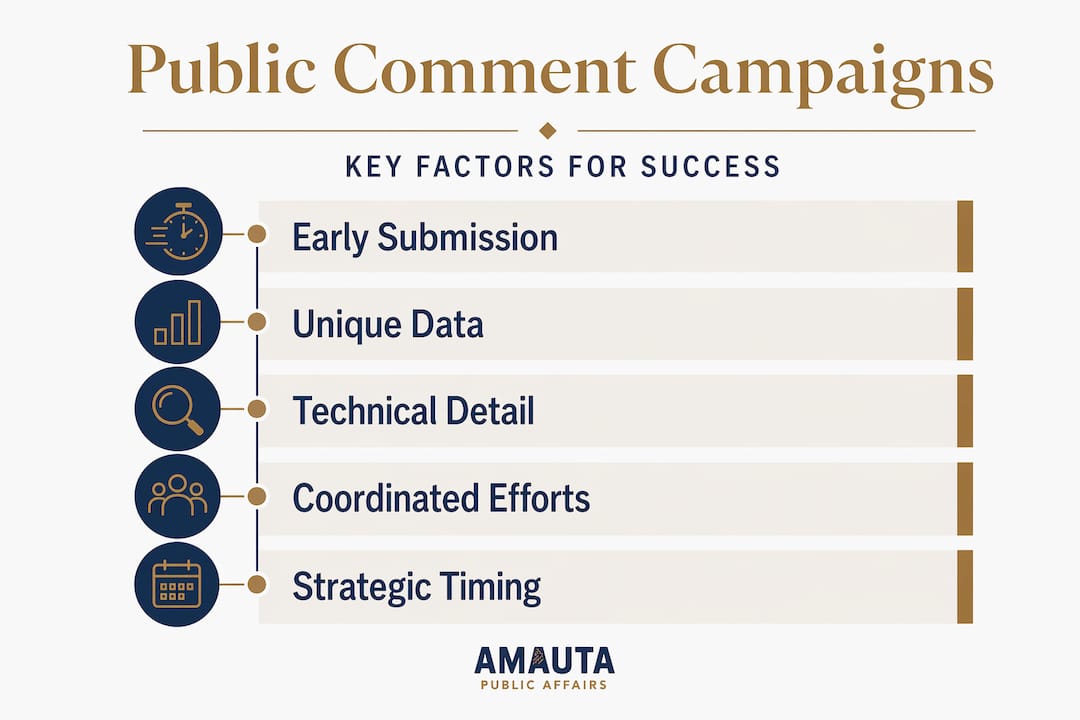
Timing is the second critical factor. Positions often harden by the time a notice is published, meaning the formal comment period is frequently more reactive than generative. Pre-proposal engagement, during scoping meetings or informal agency consultations, gives advocates the best chance to shape the rule before it is drafted. Civic groups that wait for the Federal Register notice are often responding to a proposal that has already been internally finalized.
The third factor is the depth of reasoning. Comments that integrate legal, economic, and technical logic build a more durable case than those relying on a single argument. When counter-evidence appears across multiple dimensions, it exposes regulatory vulnerabilities that agencies cannot easily paper over. This multi-layered approach also strengthens any subsequent legal challenge if the agency proceeds despite the objections.
Key characteristics of high-impact public comment campaigns:
Specificity: Comments reference exact rule sections, statutory language, or data gaps rather than general opposition.
Evidence: Original data, expert declarations, or peer-reviewed research give agencies something concrete to address or rebut.
Legal grounding: Connecting personal impact to legal protections and citing relevant statutes increases procedural weight.
Coordination: Multiple organizations submitting distinct, complementary comments demonstrate breadth of concern without duplicating content.
Timing: Submissions early in the comment window receive more agency attention than those filed in the final hours.
Pro Tip: Coordinate with peer organizations to divide the argument. One group covers economic impact, another covers legal authority, and a third covers community harm. This creates a multi-dimensional record that is far harder for an agency to dismiss.
What are common challenges and limitations of public comment campaigns?
The public comment process is not a level playing field. Well-funded actors, including large firms and industry incumbents, routinely dominate influence on final rules by submitting sophisticated comments that combine legal, economic, and technical reasoning. These actors often retain specialized regulatory counsel, conduct original economic modeling, and engage agencies during pre-proposal stages that grassroots groups rarely access. The result is an asymmetry that civic advocates must acknowledge and plan around.
Grassroots organizations face several structural constraints:
Resource gaps: Producing original technical or economic analysis requires time, expertise, and funding that most civic groups do not have in abundance.
Timing disadvantages: By the time a rule is published for comment, industry stakeholders have often already shaped its core provisions through informal engagement.
Volume without impact: Mass comment drives generate attention but rarely move agencies unless accompanied by substantive, differentiated arguments.
Limited direct access: Smaller organizations may lack the relationships with agency staff that larger actors use to influence rule development before the formal period opens.
Despite these constraints, civic groups retain meaningful tools. Even unsuccessful comment campaigns create administrative records that support litigation or future policy revision. A comment that does not change a rule today can become the evidentiary foundation for a court challenge tomorrow. This long-game perspective reframes the purpose of public comment participation from immediate victory to sustained accountability.
The shrinking window for public input also presents a structural challenge. Regulatory agencies in both the U.S. and the EU have been quietly narrowing comment opportunities, compressing timelines and reducing pre-proposal engagement. Civic groups that rely solely on formal comment periods are working within an increasingly constrained space.
How can civic groups maximize the impact of their comment campaigns?
Maximizing the impact of public comment campaigns requires a deliberate approach to timing, messaging, coalition-building, and follow-through. The most effective civic groups treat public comment not as a standalone action but as one component of a broader public engagement strategy that includes direct agency meetings, legislative oversight, and media outreach.
Engage before the formal period opens. Request meetings with agency staff during scoping phases. Submit advance comments during Requests for Information or Advance Notices of Proposed Rulemaking. Early engagement with agency staff during informal rule development gives grassroots organizations the best chance to shape the rule’s foundational assumptions.
Craft comments that are clear, specific, and evidence-based. Identify the exact provision you are addressing. Cite the statutory authority the agency is relying on. Provide data or expert analysis that directly contradicts or qualifies the agency’s stated justification. Vague opposition does not create a record that agencies or courts must take seriously.
Coordinate with allied organizations to demonstrate breadth. A coalition of ten organizations submitting ten distinct, substantive comments is far more effective than one organization mobilizing 10,000 form letters. Each comment should address a different dimension of the issue, creating a comprehensive record that covers legal, economic, community, and technical concerns.
Use comments as part of a broader advocacy effort. Submit comments, then follow up with agency leadership. Brief sympathetic legislators on the record you have created. Share comment summaries with journalists covering the regulatory area. Public participation in governance is most durable when it operates across multiple channels simultaneously.
Document and preserve your record. Save confirmation numbers, submission receipts, and copies of every comment filed. If the agency proceeds despite your objections, this documentation becomes the foundation for any administrative or judicial challenge.
The broader benefit of this approach extends beyond any single rule. Citizen engagement that visibly influences policy builds trust between communities and government institutions, creating conditions for continued democratic participation. Organizations that build a reputation for substantive, well-documented advocacy gain credibility with agencies over time, making future engagement more productive.
Key Takeaways
Effective public comment campaigns require substantive, evidence-based submissions made early in the rulemaking process, supported by coordinated coalition advocacy and a long-term record-building strategy.
Point | Details |
Quality over volume | Unique, factual, and technically grounded comments carry more weight than mass duplicate submissions. |
Early engagement wins | Pre-proposal input shapes rules before positions harden; formal comment periods are often reactive. |
Build a durable record | Even unsuccessful campaigns create administrative documentation useful for litigation or future policy revision. |
Coordinate strategically | Coalition members should submit distinct, complementary comments covering legal, economic, and community dimensions. |
Comment within a broader strategy | Public comment is most effective when paired with direct agency meetings, legislative outreach, and media engagement. |
What I have learned about public comment campaigns after years in the field
The most common mistake I see civic groups make is treating the formal comment period as the main event. By the time a proposed rule appears in the Federal Register, the agency has usually spent months, sometimes years, developing its position. Walking in at that stage with a well-written comment is better than nothing, but it is rarely enough to pivot the outcome on its own.
What actually moves the needle is showing up earlier. The organizations that consistently influence policy are the ones building relationships with agency staff during scoping, submitting input during Requests for Information, and attending pre-proposal stakeholder sessions that most groups do not even know exist. That early presence shapes the assumptions baked into the rule before anyone outside the agency sees a draft.
I have also seen campaigns that “lost” in the formal process go on to win in court, precisely because the administrative record they built was airtight. A comment that forces an agency to respond on the record is never wasted. It either changes the rule or it creates the evidence trail that changes it later.
The groups that sustain real influence over time are the ones that view public comment as one instrument in a larger civic engagement program, not a one-time action. Pair your comments with direct meetings, legislative briefings, and consistent media presence. That combination is what turns a comment campaign into a durable policy force.
— Ignacio
How Amautapublicaffairs supports effective public comment campaigns
Amautapublicaffairs brings a campaign-style approach to public affairs that goes well beyond drafting comments. The team evaluates the full community and regulatory landscape before a single word is submitted, identifying the timing windows, agency relationships, and messaging angles that give each campaign its best chance of success. Services span community engagement and digital advocacy to media relations and stakeholder coordination, all calibrated to the specific regulatory context a client faces. For civic groups and project developers navigating complex land use or environmental comment processes, Amautapublicaffairs provides the expertise to build records that hold up, whether at the agency level or in court. Reach out through the Amautapublicaffairs contact page to discuss how professional support can sharpen your next campaign.
FAQ
What is the legal basis for public comment campaigns?
The Administrative Procedure Act of 1946 requires federal agencies to publish proposed rules and accept public comment before finalizing them. Agencies must consider all relevant submissions and respond to substantive objections in their final rule justification.
Do public comments actually change government decisions?
Yes. In 2019, the USDA withdrew a rule affecting 1.7 million SNAP households after 158,000 comments exposed insufficient justification. Substantive, evidence-based comments carry legal weight that agencies cannot ignore.
What makes a public comment more effective than others?
Comments that cite specific rule provisions, reference statutory authority, and provide original data or expert analysis are far more effective than general opposition statements or duplicate form letters.
When is the best time to submit a public comment?
Early in the comment window, and ideally before the formal period opens. Pre-proposal engagement during scoping or Requests for Information gives advocates the greatest opportunity to shape a rule’s foundational assumptions.
Can a public comment campaign still matter if it does not change the rule?
Absolutely. Every submitted comment becomes part of the administrative record. That record supports litigation or future policy revision, meaning a campaign that does not win immediately can still produce results over time.
Recommended
Comments