
Spokesperson Media Training: Build Messages That Hold Up

Spokesperson media training produces one measurable outcome: a person who can deliver the same three core messages, cleanly and quotably, whether the question is friendly or hostile. That consistency is what separates a spokesperson who moves a story forward from one who becomes the story.
Training matters most before three moments: a product or project launch, a live crisis, and any interview where the reporter has an adversarial angle already in mind. A standard session builds three capacities in sequence: message construction, question handling under pressure, and rehearsal against a recording camera. Skip the rehearsal step and the other two rarely survive contact with a real interview.
Message development: compressing your position into a core statement, a proof point, and a concrete example
Question handling: bridging techniques for hostile, off-topic, or speculative questions
Format tailoring: adjusting pacing and tone for broadcast, podcast, phone, and written Q&A
Rehearsal: timed mock interviews with video playback and a structured debrief
Pro Tip: Book training at least two weeks before a scheduled launch interview. Message discipline improves with spaced repetition, not a single cram session the night before.
Key Takeaways
Spokesperson media training works because it pairs a compressible, three-layer message structure with a recorded rehearsal discipline that exposes weaknesses before a real reporter does.
Point | Details |
Build messages in three layers | Write a one-sentence core point, attach one safe proof, then add one vivid example. |
Time every rehearsal answer | Broadcast-style responses should land in the 8 to 15 second range before editing cuts them further. |
Drill at least three mock interviews | Include one hostile question, record every session on video, and debrief immediately. |
Master the bridge, not evasion | Acknowledge the question, answer accurately within safe bounds, then bridge to your message. |
Track pull-through after coverage runs | Check whether your intended quote and proof point actually made it into the final piece. |
Amautapublicaffairs integrates training into campaigns | Message testing and rehearsal get tied to real permitting milestones, not a generic coaching session. |
Table of Contents
How Should You Adjust Tactics for Different Interview Formats?
What Rehearsal Method Actually Prepares You for a Real Interview?
What Should You Understand About the Media Landscape Before You Go on Record?
Why Does Body Language Change What a Reporter and Audience Hear?
How Should Messages Change for Different Audiences and Cultures?
Working With AMAUTA Public Affairs on Spokesperson Preparation
What Does Spokesperson Media Training Actually Cover?
Effective programs build around a small set of durable components rather than a long list of tips. The NASFAA guide to spokesperson training identifies message discipline, question handling, and physical presence, calibrated for the specific format, as the three pillars nearly every credible curriculum shares.
Programs typically combine classroom-style instruction for message development with individual on-camera sessions to simulate interview pressure. Many firms now offer this combination in-person or virtually, which matters if your organization has spokespeople across multiple locations who all need the same message discipline.
A session that actually moves the needle follows a predictable structure:
Message audit: identify the three to five statements your organization needs every spokesperson to defend consistently
Question stress test: a facilitator throws hostile, speculative, and off-topic questions to expose weak spots
Recorded rehearsal: mock interviews on camera, timed and reviewed
Debrief and revision: messages get rewritten based on what broke down under pressure
Before hiring a trainer or vendor, request a deliverables checklist that includes:
A written message map (not just verbal coaching)
At least one recorded mock interview with playback
A hostile-question drill, not only softball practice
A post-session summary of gaps and recommended fixes
If a program skips the recording step entirely, treat that as a red flag. Coaching without video review leaves a spokesperson guessing at their own habits.
How Should You Adjust Tactics for Different Interview Formats?
The format dictates pacing, length, and tone as much as the topic does. A message that lands in a magazine feature can fall flat, or run long, on live television.
Broadcast (live TV/radio): Keep answers compressed. Practical media training guidance recommends timing every rehearsal answer, since broadcast responses typically run 8 to 15 seconds before a host or anchor moves on.
Recorded TV: You get slightly more room to restate a point, but editors will cut for the cleanest soundbite, so lead with your strongest sentence, not your most nuanced one.
Phone interviews: Without visual cues, tone and pacing carry the whole message. Slow down slightly and pause between message points so a reporter typing quotes doesn’t lose your intended emphasis.
Podcasts: Conversational range is rewarded here. You can develop an example over two or three sentences, but the same core message still has to survive the longer format intact.
Written Q&A: Precision replaces delivery. Every sentence gets quoted exactly as written, so draft answers the way you’d want them to appear in print.
For on-camera formats, check lighting, framing, and audio before the call starts, not after the reporter joins. A cluttered background or poor mic placement undercuts a well-crafted message before you say a word.
Pro Tip: If you’re the technical spokesperson for a product interview, bring benchmark data and sandbox access. Reporters covering developer platforms increasingly test claims live, and a spokesperson who can’t go deep on request loses credibility fast.
How Do You Compress a Key Message Into Something Quotable?
A message that requires two paragraphs to explain will never survive a broadcast segment or a scroll-stopping headline. The fix is a three-layer structure that forces compression without losing substance.
Write the core in one sentence. State your position plainly enough that a stranger could repeat it back after hearing it once. If it takes a subordinate clause and a qualifier to make sense, it’s not ready.
Attach one safe, verifiable proof point. A statistic, a named policy, or a documented outcome. This is where credibility gets built or lost, so only use proof you can defend without hedging.
Add one vivid, concrete example. Abstractions don’t get quoted. A specific scenario, a named project, a real timeline, does.
This structure, core point, proof, example, is the backbone practical media training uses to pressure-test language before a spokesperson ever faces a reporter. Run each message through all three layers, then read it aloud. If it takes longer than 15 seconds to say, cut a clause.
There’s a second reason this discipline matters now: search engines and AI summarization tools increasingly lift direct quotes into their own answers. A message written precisely enough to satisfy a skeptical journalist tends to also be precise enough to get pulled cleanly into an AI-generated summary, which extends your message’s reach well past the original interview.
How Do You Bridge Without Sounding Evasive?
The bridge technique is the single most trainable skill in this entire discipline, and also the most commonly botched. Done well, it lets a spokesperson acknowledge a hard question, answer honestly within safe boundaries, and redirect to a message that matters, without sounding like a dodge.
The pattern has three parts:
Acknowledge the question directly. Repeating a hostile question back verbatim, calmly, defuses its edge.
Give a safe, accurate answer. Never lie and never claim you can’t discuss something you clearly can. Partial candor beats visible evasion every time.
Bridge to your core message using a natural transition: “What matters here is…”, “The context worth understanding is…”, “Here’s what’s actually changing…”
Avoid stock phrases like “That’s a great question” or “I’m glad you asked,” which reporters and audiences now recognize instantly as evasion signals.
If a question requires information you don’t have on hand, commit to a specific follow-up, a date and a channel, and log that promise immediately after the interview ends. An unfulfilled follow-up damages trust faster than almost any other spokesperson mistake, including a bad answer in the moment.
Pro Tip: Practice sitting in silence for two full seconds before answering a hostile question. That pause reads as composure on camera, not hesitation, and it gives you time to select the right bridge instead of reaching for a rambling non-answer.
What Rehearsal Method Actually Prepares You for a Real Interview?
Rehearsal is where most training programs either earn their fee or waste it. A single run-through of friendly questions doesn’t expose the gaps that a real reporter will find. A defensible drill discipline includes at least three mock interviews, with one built entirely around a hostile or no-win question, every answer timed, and every session recorded on video.
Draft the question set. Include softball, neutral, and at least one adversarial question with no comfortable answer.
Run the mock interview live, with a facilitator playing reporter and interrupting if the answer runs long.
Time every answer. Broadcast-style responses should be kept brief and concise, with timing monitored to ensure clarity and impact.
Record on camera. Video exposes pacing problems, filler words, and body language habits that a spokesperson almost never notices in the moment.
Debrief immediately while the exchange is still fresh, and rewrite any message that broke down under pressure.
Drill element | Target |
Minimum mock interviews per session | Three, including one hostile-question round |
Broadcast answer length | 8 to 15 seconds |
Recording requirement | Every rehearsal on video, reviewed same day |
Debrief timing | Immediately after each mock interview |
A partner service like corporate interview video production can raise the production quality of these recordings, which matters if you’re reviewing footage for subtle body language cues that a phone camera might blur past.
What Are the Non-Negotiable Dos and Don’ts?
Keep this list posted somewhere visible before every interview, live or recorded.
Do answer the question asked before bridging to your message.
Do sit still and keep hand gestures controlled on camera; fidgeting reads as nervousness even when you feel calm.
Don’t repeat a reporter’s negative framing or profanity back verbatim, it gets clipped into a quote.
Don’t say “no comment.” Bridge instead, even briefly.
Wear solid colors; avoid busy patterns and pure white or black, which can distort on camera.
Check mic levels, lighting, and background thirty minutes before any recorded segment starts.
How Do You Know If the Training Worked?
Measurement happens after the interview airs, not during rehearsal. Pull the published piece or segment and check whether your core message actually made it into the final quote, a metric called message pull-through. If a reporter used your example but dropped your proof point, that’s a signal to tighten the proof layer next time.
Track quote quality: did the outlet use your intended phrasing, or a paraphrase that muddied the point?
Assess correction risk: did anything you said require a follow-up clarification or correction?
Weigh relationship value: did the interview strengthen or strain the reporter relationship for future coverage?
Monitor downstream visibility: search results and AI-generated summaries increasingly surface direct quotes, so a clean, quotable answer extends reach well beyond the original outlet.
None of this requires expensive tooling. A spreadsheet tracking date, outlet, message pull-through, and any correction issues across a handful of interviews reveals patterns fast, usually within three or four appearances.
How AMAUTA Public Affairs Applies This in Project Work
Land use, energy, and infrastructure projects rarely get one clean interview. They get a sustained sequence of community meetings, permitting hearings, and press inquiries, each one testing whether your spokesperson’s message actually holds up under local scrutiny. AMAUTA Public Affairs builds training into that sequence rather than treating it as a one-time coaching event.
Message testing against real community concerns before a project’s first public hearing
Spokesperson coaching tied to specific permitting milestones, not a generic media-day session
Coordination between community engagement findings and the messages a spokesperson delivers to press
A project’s spokesperson only holds credibility if the message survives contact with the community that will actually live with the outcome. Training that ignores local stakeholder concerns produces a spokesperson who sounds polished and unconvincing at the same time.
Clients typically receive a tailored engagement plan, message maps built from community and media relations research, and rehearsal sessions scheduled around real project milestones rather than an arbitrary calendar date.
What Should You Understand About the Media Landscape Before You Go on Record?
Reporters operate under different constraints than most spokespeople assume. A daily news reporter is often working a same-day deadline with limited space, which is why they favor sources who deliver a clean, quotable answer over one who requires three follow-up questions to make a point. A trade or technical journalist, by contrast, usually has more room and expects you to go deeper, including specific data or documentation if you claim it exists.
Understanding which type of outlet you’re speaking to changes your entire approach. A reporter working a breaking story wants your fastest, most defensible statement, not your full context. A feature writer on a longer deadline wants texture, a real example, a human detail, something beyond the press release.
Most reporters also work from an angle before the interview starts. That’s not adversarial by default, it’s how journalism functions: they have a thesis and are testing it against sources. Your job isn’t to fight the angle; it’s to make sure your message is represented accurately within whatever angle the story takes. Assume every recorded comment can become a quote, and every phone call can be characterized as an interview, whether or not anyone said “this is on the record.”
Editors also cut for space and time constraints you’ll never see. That’s exactly why a compressed core message survives editing better than a nuanced one; the nuance is usually what gets trimmed first.
Why Does Body Language Change What a Reporter and Audience Hear?
Non-verbal signals reach an audience before your words do, especially on camera. A spokesperson who crosses their arms, avoids eye contact, or fidgets with a pen communicates defensiveness regardless of how confident the actual answer sounds.
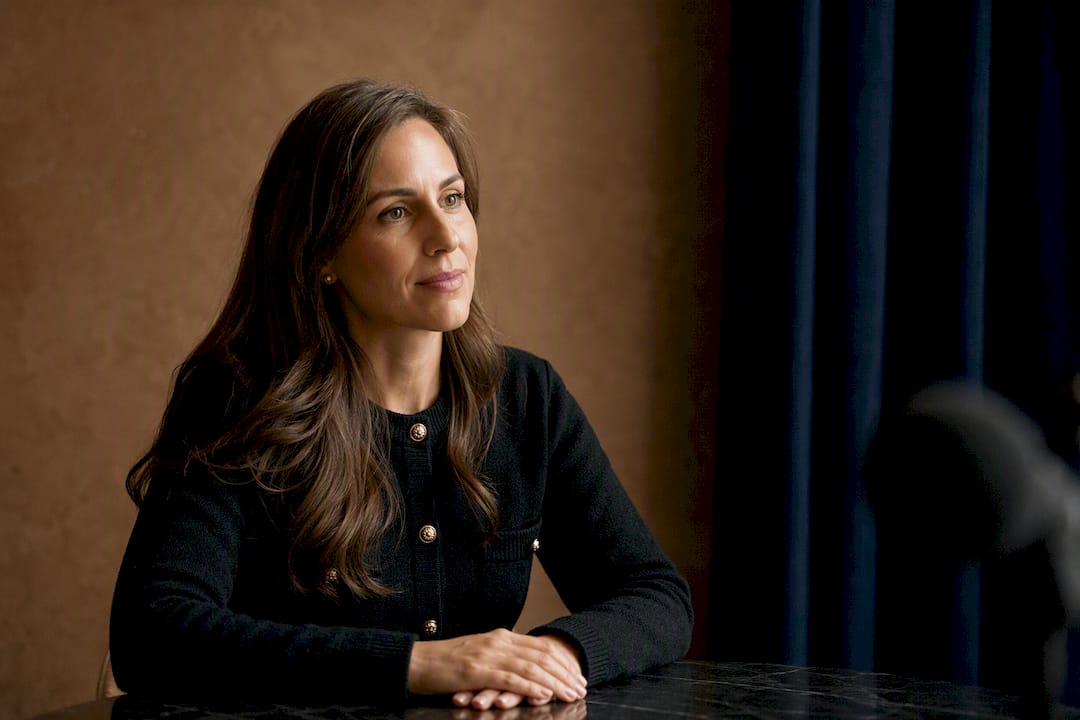
Posture carries more weight than most spokespeople expect. Sitting upright with shoulders relaxed, rather than leaning back or hunching forward, signals composure without looking rigid. Hand gestures should stay controlled and purposeful; excessive movement reads as nervous energy, while completely still hands can look stiff or evasive.
Eye contact matters differently by format. On camera, look at the interviewer, not the lens, unless specifically directed otherwise, since staring into a camera reads as unnatural to viewers. On the phone, where no one sees you, posture still affects your voice. Sitting up straight changes breath support and vocal tone even when nobody’s watching.
Facial expression is the detail spokespeople manage worst under pressure. A neutral, engaged expression during a hostile question prevents the visible wince or eye roll that gets clipped into highlight reels far more often than the actual verbal answer does. Rehearsal on video is the only reliable way to catch these habits, since almost no one accurately predicts their own on-camera tics without watching the footage back.
How Do You Manage Communications During an Active Crisis?
Crisis communication is spokesperson training under maximum pressure, and the rules shift in a few specific ways. Speed now competes directly with accuracy, and getting that balance wrong in either direction damages trust.
The first statement matters disproportionately. It doesn’t need every fact, but it does need to acknowledge what happened, state what your organization is doing right now, and commit to a specific follow-up window. Silence in the first hours of a crisis reads as evasion even when your team is legitimately still gathering facts.
Message discipline gets harder in a crisis because emotions run higher on both sides of the interview. This is exactly where the bridge technique proves its value: acknowledge the severity of the situation honestly, then move to what’s verifiably true and what action is underway. Speculating about causes or outcomes before you have confirmed information is one of the fastest ways to create a second, self-inflicted crisis on top of the original one.
Rehearsal for crisis scenarios should include the worst plausible question a reporter could ask, not a softened version of it. If your spokesperson has never practiced answering “who is responsible” or “did anyone die,” that gap will show up in the actual moment when it matters most. Rapid-response planning, built before a crisis hits rather than during one, is what makes that composure possible; see how a structured rapid-response framework supports this kind of preparation.
How Should Messages Change for Different Audiences and Cultures?
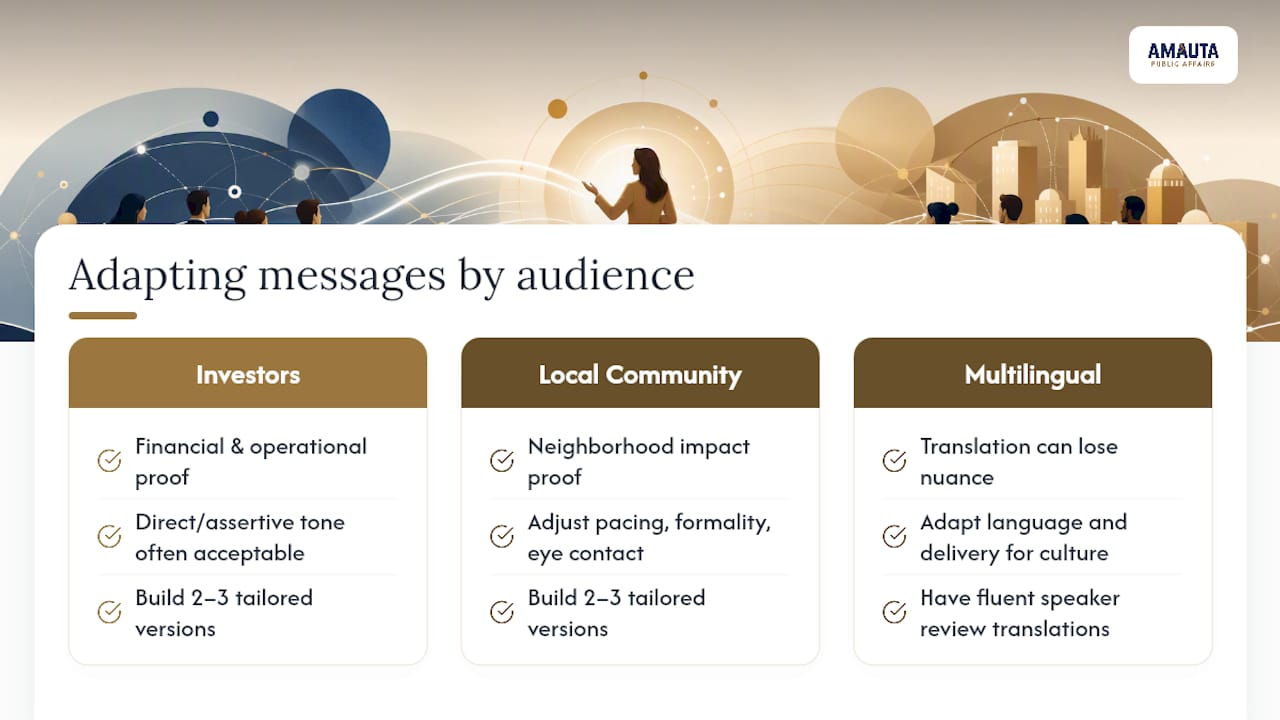
The same core message often needs different proof points and examples depending on who’s actually listening. A message aimed at investors emphasizes financial and operational proof. The identical position, delivered to a local community audience, needs a proof point about direct neighborhood impact instead, or it will sound tone-deaf regardless of how accurate it is.
Cultural context shapes both language and delivery style. A direct, assertive tone that reads as confident in one regional or cultural context can read as dismissive or aggressive in another. Spokespeople working across diverse community stakeholders, which is common in land use and infrastructure projects, need to adjust pacing, formality, and even eye contact norms depending on the audience in the room.
Translation adds another layer of risk. A message compressed perfectly in English can lose its proof point or its nuance when translated, so any spokesperson working in a multilingual community setting should have messages reviewed by a fluent speaker before delivery, not after.
The safest practice is building two or three versions of the same core message, each with a different proof point and example, so the underlying position stays identical while the supporting evidence shifts to match what that specific audience actually cares about. This matters most for organizations working in a specific neighborhood or municipality, where the wrong proof point can undo weeks of community trust-building in a single interview.
What Mistakes Derail Spokespeople Most Often?
Nearly every avoidable failure in a media interview traces back to a handful of repeated patterns. Rambling tops the list: fear of silence pushes an untrained spokesperson to keep talking past their strongest point, and that extra material is exactly what gets clipped into a damaging quote. Common training failures consistently identify this fear of silence, and the rambling it produces, as the single most damaging habit spokespeople bring into an interview.
A second frequent mistake is repeating a reporter’s negative framing verbatim. If a reporter asks “why did the project fail the community,” repeating “the project didn’t fail the community” hands the outlet a usable negative quote either way. Reframe instead of echoing.
Overcommitting under pressure ranks third. A spokesperson who promises a document, a timeline, or an answer they can’t actually deliver creates a credibility gap that outlasts the original interview by months. Log every promise the moment the interview ends, and follow through exactly as stated.
Finally, treating every format the same trips up even experienced spokespeople. An answer built for a five-minute podcast conversation will ramble badly on live television, and a broadcast-length soundbite will feel abrupt and evasive in a longer print interview. Match your rehearsal to the actual format you’re walking into, not a generic version of “media training” that ignores where the interview will run.
The Gap Between Training Theory and What Actually Holds Up
Most advice on this topic treats message discipline and rehearsal as separate skills taught in sequence. That’s backward. A message that hasn’t been pressure-tested against a hostile question in a recorded mock interview isn’t actually a finished message, it’s a draft that happens to sound good in a quiet room. The real work only starts once a spokesperson watches their own footage and sees where the compression breaks down.
The overrated piece of conventional wisdom is confidence coaching in isolation. Confidence without a defensible, three-layer message just produces a spokesperson who sounds composed while saying something a reporter can pick apart in the second follow-up question. Composure matters, but it’s a delivery layer sitting on top of message architecture, not a substitute for it.
If you take one thing from this and act on it immediately, make it the recording. Skip the classroom theory if you have to, but never skip watching yourself answer a hostile question on video. That single habit, repeated across a handful of mock interviews, closes more gaps than any amount of coaching talk ever will.
— Ignacio
Working With AMAUTA Public Affairs on Spokesperson Preparation
If your organization is navigating a land use, energy, or infrastructure project, spokesperson readiness rarely exists in a vacuum. It sits alongside community engagement research, permitting timelines, and a media relations plan that has to hold together across months, not one interview. Amautapublicaffairs builds spokesperson preparation into that larger campaign structure instead of selling it as a standalone coaching product, which means your messages get tested against actual community feedback before they ever reach a reporter’s microphone.
A first engagement typically starts with a message audit tied to your project’s current permitting stage, followed by rehearsal sessions scheduled around real public hearings or press moments rather than a generic training calendar. You’ll walk away with a written message map, at least one recorded mock interview, and a debrief that flags exactly where your answers need more proof or a sharper example. If you’re preparing a spokesperson for an upcoming hearing, launch, or press cycle, visit the Services page to request a tailored engagement scoped to your project’s timeline.
Sources
Recommended
Comments