
Stakeholder Analysis Methods: 60–90 Minute Workshops for Project Teams
- ibarragan7
- 1 day ago
- 12 min read

Use a repeatable three-step routine: identify, prioritize, plan engagement, and start with a power/interest grid or an impact-interest matrix depending on whether formal authority is the deciding factor on your project. The strongest starting toolkit pairs that grid with a stakeholder salience model, a RACI matrix for internal role clarity, and an engagement assessment matrix to track sentiment over time. The immediate next step is straightforward: run a 60 to 90 minute mapping workshop or build a spreadsheet with columns for power, interest, and current engagement level.
TL;DR:
Using impact-interest or salience models over standard power/interest grids better captures stakeholders most affected by land-use projects.
Conduct stakeholder analysis early, ideally before finalizing project charters, to avoid late-stage opposition and costly rework.
Regularly update and document stakeholder maps after key project milestones to maintain accuracy and support transparent decision-making.
Combine multiple frameworks, such as influence diagrams and participation matrices, for a comprehensive understanding of formal and informal stakeholder power.
In community projects, prioritize listening sessions and cultural considerations to address hidden agendas and build trust with vulnerable groups.
Table of Contents
Why Stakeholder Analysis Methods Matter Before You Build
Skipping this work does not save time. It just moves the cost downstream, usually to the moment when a project manager discovers a well-connected opponent three weeks before a permit hearing. A structured analysis, run early, surfaces the decision-makers who actually control approvals, funding, or public opinion, long before those people become obstacles.
The mechanics are simple in concept: identify who is affected, prioritize them by power and interest, and then build engagement strategies suited to each group. The IIBA’s stakeholder analysis framework frames this as a three-step cycle precisely because skipping any step tends to produce the same failure pattern, missed requirements, ignored decision-makers, and communication gaps that surface only after damage is done.
The risks of running a project without this discipline are specific and recurring:
Missed technical or regulatory requirements that surface late, after design or budget decisions are locked in.
Opposition that appears at a public hearing instead of during a private conversation, where it could have been resolved quietly.
Scope changes driven by stakeholders nobody consulted, forcing rework that a 90-minute workshop could have prevented.
Communication channels that never got established, so urgent updates reach the wrong people or reach no one.
Pro Tip: Run your first stakeholder analysis before you finalize a project charter, not after. Once budgets and timelines are locked, incorporating a newly discovered stakeholder’s concerns gets exponentially harder.
Timing matters as much as method. Most project teams benefit from analysis at four points: project initiation, before any major milestone or public announcement, immediately after a scope change, and whenever staffing turns over on either side of the table. Tying your review cadence to these gates, rather than to a calendar date, keeps the map relevant to what is actually happening on the ground.
How Do You Run a Stakeholder Analysis Step by Step?
A stakeholder map is only as good as the process that built it. Here is a routine you can run in an afternoon and repeat at every project gate.
Identify stakeholders. Pull names from project charters, permit applications, community directories, prior meeting minutes, and organizational charts on both the client and community side. Ask a simple prompt in every workshop: “Who gets hurt or helped if this project succeeds?” Then ask who benefits if it fails, since that question often surfaces opponents nobody wanted to name out loud.
Assess each stakeholder. Score power, interest, and (where relevant) legitimacy and urgency on a simple three-point scale: low, medium, high. A city council member with veto authority over zoning scores high on power regardless of how vocal they’ve been. A resident who has attended every meeting for a year but holds no formal authority scores high on interest and low on power, a very different management strategy.
Prioritize and map. Place each stakeholder onto your chosen grid and write a one-line rationale for the placement. This documentation step is the one teams skip, and it is the one that saves you when someone challenges the map six months later and nobody remembers why a stakeholder landed where they did.
Build engagement actions. Every stakeholder above medium interest needs at least one assigned action, a briefing call, a site visit invitation, a follow-up email, and an owner responsible for delivering it. Unassigned actions are the single most common reason engagement plans stall.
Monitor and reassess. Set review triggers: a phase gate, a leadership change on either side, a public announcement, or a shift in community sentiment. The rework.com stakeholder analysis matrix guide recommends treating movement between quadrants, someone shifting from Monitor to Manage Closely, as a project risk in its own right, not just a map update.
Minimum documentation for each cycle should include: the date of the last review, who conducted it, what changed, and the evidence source for that change (a meeting, a news article, a direct conversation). That log becomes invaluable when a sponsor asks why your engagement priorities shifted midway through the project.
Which Stakeholder Analysis Method Should You Use?
No single framework covers every situation, and the practitioners who get the most out of stakeholder analysis techniques tend to run two or three methods in combination rather than picking one and stopping. Here is how the major approaches actually work, where each one shines, and where each one falls short.
Power/interest grid (the Mendelow matrix)
The power/interest grid plots stakeholders across two axes: how much formal authority they hold, and how much they care about the outcome. The result is four quadrants, each demanding a different tactic.
High power, high interest (Manage Closely): These stakeholders need frequent, direct engagement. A regulator who can block your permit belongs here.
High power, low interest (Keep Satisfied): Update them periodically and avoid surprises, but don’t over-communicate to someone who does not want daily detail.
Low power, high interest (Keep Informed): Vocal community members often land here. They can shift opinion even without formal authority, so regular updates buy goodwill.
Low power, low interest (Monitor): Light-touch tracking is enough, but do not delete them from the map. Circumstances change.
The grid works best when formal authority genuinely predicts influence, corporate settings, procurement decisions, internal reorganizations. Its limitation shows up fast in community projects: a resident with zero formal power can still generate enough local media attention to stall a permit for months.
Impact-interest or influence-impact matrix
For land-use and infrastructure work, a straight power/interest grid frequently misclassifies the people who matter most. A homeowner living adjacent to a proposed facility has no formal power over the approval process, but the impact on their daily life is severe, and that combination of low power with high impact is exactly what drives organized opposition. AltexSoft’s stakeholder matrix guide makes the case for swapping the power axis for an impact axis in these situations, since impact tends to predict who shows up to fight a decision better than formal authority does.
Community-facing projects, environmental reviews, and public infrastructure work all benefit from this swap. The CTB participation guide from the University of Kansas reinforces this by matching engagement intensity to the level of participation you’re actually promising, informing someone is a different commitment than empowering them to make decisions, and the matrix should reflect that distinction honestly.
Stakeholder salience model
The salience model scores stakeholders across three dimensions rather than two: power, legitimacy, and urgency. A stakeholder with all three (a regulator demanding immediate compliance on a legally required issue) is “definitive” and requires top priority. A stakeholder with only one attribute (a resident with a legitimate but non-urgent concern) can wait for a scheduled update rather than an emergency call.
This model earns its complexity on politically sensitive projects where power alone misses the picture. A tribal nation asserting treaty rights over a proposed pipeline route may hold limited formal veto power in a given jurisdiction, but their legitimacy claim and the urgency of the timeline can outweigh stakeholders with more conventional authority. Use salience scoring when you suspect the standard grid is underrating someone who has a real claim but no obvious lever.
RACI matrix for internal role clarity
A RACI matrix (Responsible, Accountable, Consulted, Informed) solves a different problem than stakeholder mapping does. Where the grid tells you how to engage external parties, RACI clarifies who on your own team owns which decision. Practitioners often run both side by side: the IIBA’s guidance on analyzing stakeholders notes that RACI handles internal task ownership while the stakeholder map drives the external engagement tactics, and confusing the two documents leads to gaps where everyone assumes someone else made the call.
Engagement assessment matrix
This tool tracks where a stakeholder’s attitude currently sits against where you need it to be. Categories typically run from Unaware, through Resistant and Neutral, to Supportive and Leading. Plotting current state against desired state turns an abstract sentiment into a concrete gap you can close with specific interventions.
Tracking the delta between current and desired engagement, rather than an absolute score, keeps the reporting focused on what actually needs to change instead of on a static snapshot that quickly goes stale.
Influence and relationship diagrams
Formal grids miss informal power almost by design. Influence diagrams map who talks to whom, who trusts whom, and who can move an opinion inside a community or organization without holding any official title. Bryson’s stakeholder identification techniques describe gathering this data through direct interviews and cross-checking it against multiple informants, since relying on a single source risks building your map around one person’s biased read of who matters.
What Templates and Workshop Formats Actually Work?
The right spreadsheet columns turn a vague mapping exercise into something you can hand off, audit, and update in ten minutes. At minimum, track: stakeholder name and organization, power score, interest score, legitimacy and urgency (if using salience scoring), current engagement category, desired engagement category, assigned engagement action, owner, and date of last review. Smartsheet’s collection of free stakeholder analysis templates offers ready-made versions of most of these formats if you’d rather adapt than build from scratch.
Two workshop formats cover most project needs:
The 60-minute sticky-dot mapping session. Print a large power/interest grid on a wall or whiteboard. Hand each participant a stack of sticky dots and have them place names on the grid silently first, then discuss disagreements out loud. This low-tech format surfaces disagreements about who actually holds power faster than any survey, because people reveal their assumptions the moment dots land in different quadrants.
The 90-minute influence-diagram and prioritization session. Spend the first 45 minutes mapping informal relationships with arrows and lines connecting names, then spend the remaining time transferring the clearest influence patterns onto a prioritization matrix.
For remote teams, a virtual whiteboard tool paired with a live polling feature replicates the sticky-dot exercise reasonably well, though something is lost when participants can’t see each other hesitate before placing a name in a sensitive quadrant. Detailed facilitation notes and a full workshop template are available on Amautapublicaffairs’s stakeholder mapping guide, including timing breakdowns for both formats above.
How Do You Track Progress and Keep the Map Current?
A stakeholder map that never gets revisited is worse than no map at all, because teams keep making decisions based on data that quietly went stale months ago. Three KPIs are worth tracking on any project of real complexity: the sentiment delta (how far current engagement sits from desired engagement, averaged across your priority stakeholders), the percentage of assigned engagement actions actually completed on schedule, and the frequency of escalations that required intervention above the project manager’s authority.
Review cadence should follow project structure rather than the calendar. Public-facing projects benefit from monthly reviews given how quickly community sentiment can shift after a single news story. High-change environments, projects facing frequent leadership turnover, litigation risk, or contested permitting, warrant a review at every milestone trigger rather than waiting for a scheduled monthly check-in. The rework.com guidance on stakeholder matrices recommends building these checkpoints directly into project phase gates so reassessment isn’t optional or easily skipped when the team gets busy.
Logging changes matters as much as making them. Each map update should record:
Who made the change and on what date.
What moved (a stakeholder shifting quadrants, a new name added, an engagement action completed or abandoned).
The evidence source behind the change, a meeting, a direct quote, a news report, or a documented conversation.
Why the change was made, in one sentence, so a future reviewer isn’t left guessing.
This discipline pays off during audits and, more commonly, during the inevitable moment when a sponsor asks why a stakeholder who seemed quiet six months ago is suddenly driving the agenda.
How Should Community and Land-Use Projects Adapt These Methods?
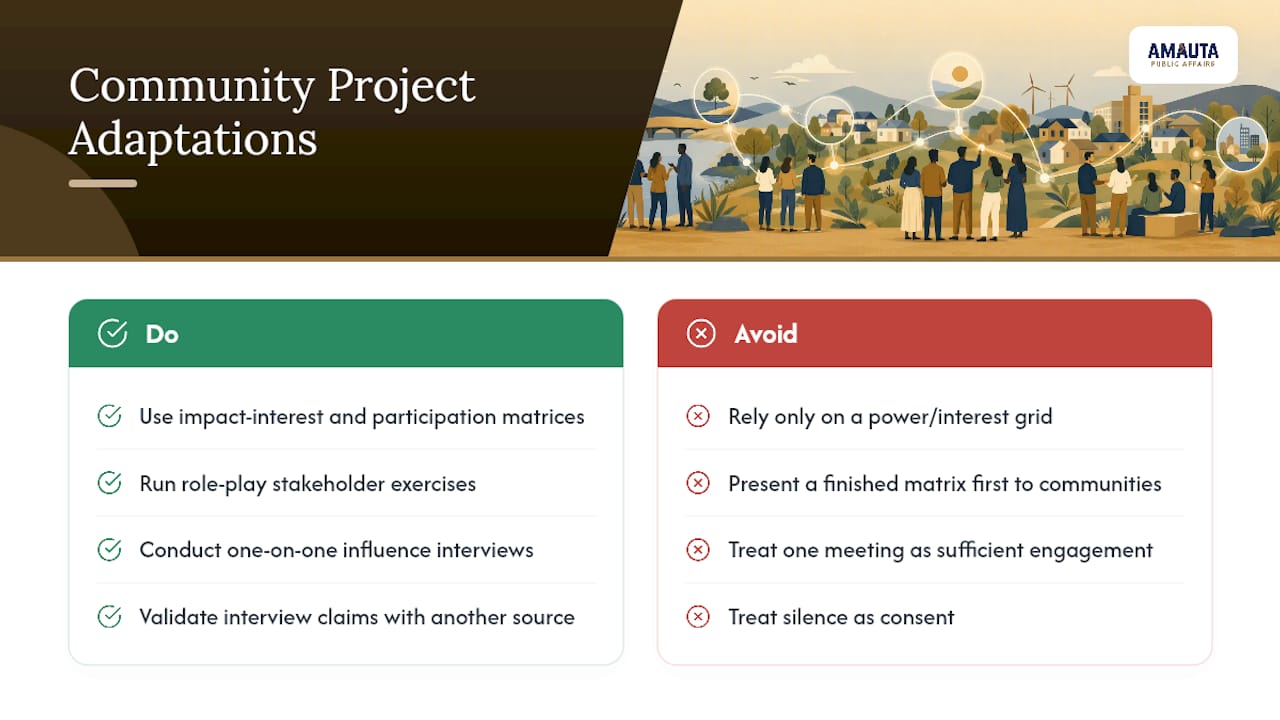
Land-use and infrastructure projects break the assumptions baked into most corporate stakeholder frameworks. Formal power and real influence rarely line up cleanly when the people most affected by a decision, adjacent residents, small business owners, tribal communities, hold no vote on the permitting body itself. This is precisely why the impact-interest matrix and the participation planning matrix tend to outperform a pure power/interest grid on these projects: they weight the people bearing the consequences, not just the people signing approvals.
Hidden agendas surface more often in political and community contexts than in internal corporate projects, and they’re harder to detect through a survey. Role-play exercises during workshops, where team members argue a skeptical stakeholder’s position out loud, often expose objections nobody was willing to raise directly. One-on-one influence interviews work even better, provided you validate what one informant tells you against at least one other source before treating it as fact. PMI’s own guidance on stakeholder practice makes a similar point: uncovering informal interests requires careful, repeated facilitation, not a single meeting.
Pro Tip: When mapping a community with a history of being over-surveyed and under-heard, lead with listening sessions before you ever show a grid. Presenting a finished matrix to a skeptical community can read as presumptuous, even when the intent is transparency.
Ethical guardrails matter most when engaging vulnerable groups, low-income residents, non-English speakers, communities with a documented history of being excluded from prior planning decisions. Translate materials, hold sessions at accessible times and locations, and never treat silence as consent. Turning analysis into coalition building means identifying your natural allies early, the “Keep Satisfied” and “Keep Informed” stakeholders who share your project’s underlying goals, and giving them the tools and talking points to advocate on your behalf in rooms you can’t personally attend.
How Amauta Applies These Methods in Real Campaigns
Some firms build their land-use campaigns around a 90-day playbook that starts with the mapping discipline described above: identify, score, map, and assign engagement actions before a single public meeting gets scheduled. That sequencing matters more than any individual framework, because a campaign built on an incomplete map spends its later weeks reacting to surprises instead of driving the agenda.
In practice, firms tend to favor sticky-dot workshops for the initial mapping session, since they surface internal disagreement about who holds real power faster than any written survey. Influence diagrams come next, particularly on projects where a small number of long-tenured residents or officials hold outsized informal sway over public opinion. Participation matrices round out the toolkit on projects where formal authority and community impact clearly diverge, which describes most contested land-use fights.
Readers who want to see this applied step by step can review Amautapublicaffairs’s 90-day stakeholder engagement plan, which lays out the templates and metrics used across live campaigns, alongside the stakeholder mapping workshop guide referenced earlier in this article.
— Ignacio
How to Bring in Amauta for Your Next Engagement Plan
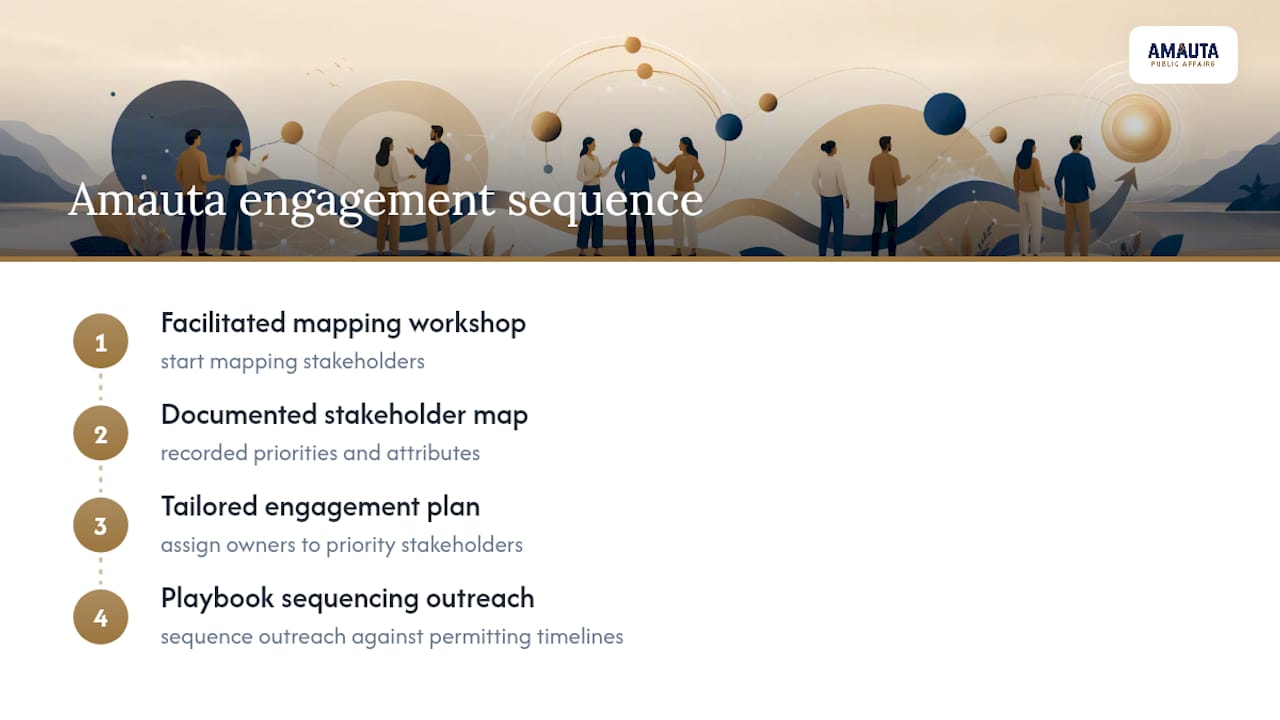
Some consulting teams provide project groups with a faster path to a defensible stakeholder map than building one alone from a blank spreadsheet, using a process pre-built around a proven 90-day structure rather than trial and error. Initial engagements often start with a facilitated mapping workshop, followed by a documented stakeholder map, a tailored engagement plan assigning owners to each priority stakeholder, and a playbook that sequences outreach against project permitting or approval timelines.
That structure matters most on land-use, energy, and infrastructure projects, where the gap between formal authority and real community impact routinely trips up teams using generic corporate templates; understanding strategic stakeholder engagement in these contexts is essential for success, as detailed in reputation management for public safety agencies. Amautapublicaffairs’s land management work applies exactly this adapted approach, weighting impact and legitimacy alongside formal power rather than defaulting to a grid built for boardroom politics.
If your project is heading into a permitting cycle, a rezoning fight, or a public comment period in the next 90 days, the practical next step is a direct conversation about scope. Visit Amautapublicaffairs’s services page to outline your project and get a sense of what an initial workshop and engagement plan would look like for your specific timeline.
Where to Go Deeper on Stakeholder Analysis
A few sources back the frameworks covered above and reward a closer read if you want to build internal training material or a facilitator’s script.
IIBA’s stakeholder analysis knowledge hub lays out the identify-prioritize-engage cycle in business analysis terms, with clear category definitions for engagement assessment matrices.
PMI’s article on stakeholder analysis as a pivotal practice focuses on the risks of missing informal influence and hidden agendas.
Bryson’s stakeholder identification and analysis techniques catalogs fifteen low-tech facilitation techniques built for public value projects.
The CTB participation guide from the University of Kansas offers a practical framework for matching engagement intensity to community projects.
Amautapublicaffairs’s own stakeholder communication strategies guide extends this into ongoing communication cadence once the initial map is built.
Sources
Recommended
Comments