
The Role of Community Engagement Strategy in Projects

A community engagement strategy is defined as a purposeful, structured approach to building collaborative relationships between project leaders and the communities they affect. The role of community engagement strategy goes far beyond distributing newsletters or hosting a single public meeting. Proactive engagement reduces scope changes by 40% when implemented early and authentically. That figure signals one clear truth: the communities you engage are not obstacles to manage. They are co-designers of outcomes that last. For local government officials, developers, and nonprofit leaders, this distinction separates projects that stall from projects that succeed.
How does community engagement strategy reduce risks and improve project outcomes?
Authentic community participation directly lowers project risk. When residents, advocacy groups, and local stakeholders are brought into the process early, they surface problems that internal teams miss. They flag land use conflicts, cultural sensitivities, and logistical barriers before those issues become costly delays. Early, authentic engagement cuts scope changes by 40%, a reduction that translates directly into saved budget and preserved timelines.
The benefits of community involvement extend beyond project mechanics. Research shows that prosocial participation correlates with a 10 times higher likelihood of reporting good overall health. That finding matters for project leaders because it means active community members are invested, energized, and more likely to sustain long-term partnerships rather than disengage after a single consultation.
Genuine collaboration must address power imbalances directly. When organizations fail to share control, communities experience the process as tokenism rather than partnership. Tokenism destroys trust faster than no engagement at all, because it signals that the organization went through the motions without any real intention to listen.
The distinction between genuine collaboration and performative consultation is the most consequential design decision in any engagement program. Low-level consultations create mistrust when power imbalances go unaddressed. Developers and government agencies that treat public meetings as checkboxes consistently face organized opposition, permit delays, and reputational damage. Those that build two-way feedback loops from the start build social license instead.
What are best practices to design an effective community engagement strategy?
A well-designed community participation strategy rests on four pillars: clear purpose, genuine inclusivity, leadership sponsorship, and consistent two-way dialogue. Each pillar must be present. Removing any one of them produces a program that looks like engagement but functions like a press release.

Clear purpose means defining what decisions the community can actually influence. Vague invitations to “share your thoughts” without specifying how input will be used breed cynicism. Spell out the scope of community influence at the start.
Genuine inclusivity requires active outreach beyond formal meetings. Barriers exist for lower socioeconomic groups to participate in standard consultation formats. Ambassador programs, meetings held in community centers or places of worship, and materials in multiple languages all expand who gets a seat at the table.
Leadership sponsorship is non-negotiable. Visible executive commitment signals that engagement is an institutional priority, not a public relations exercise. When senior leaders attend community sessions and respond publicly to feedback, participation rates rise and trust compounds over time.
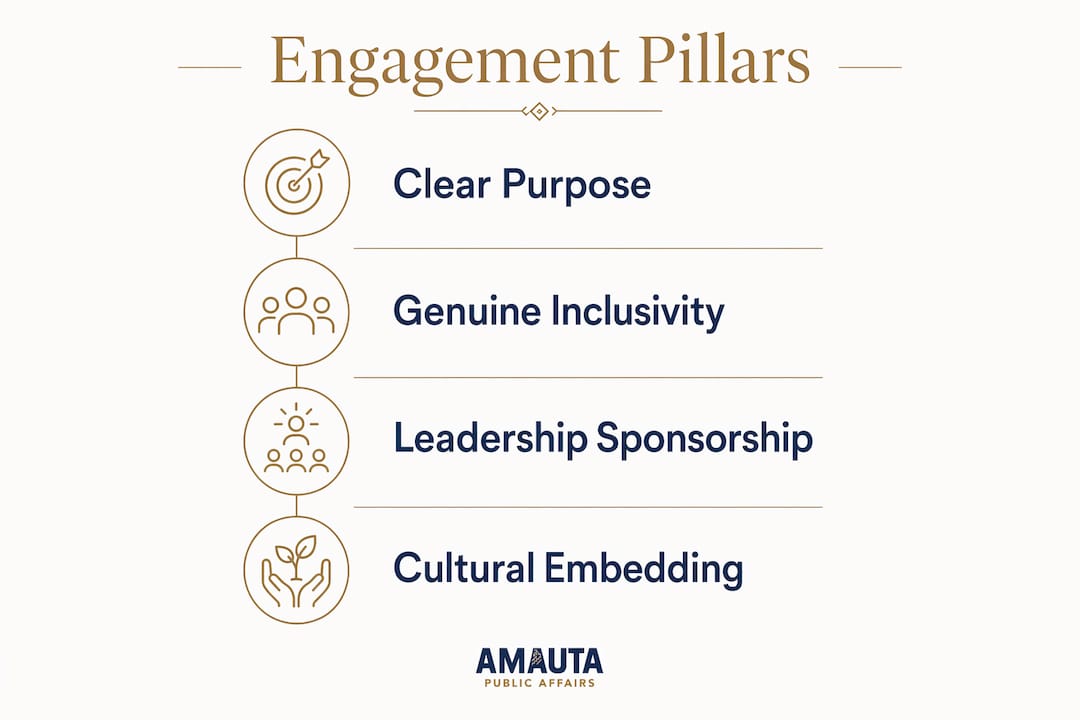
Consistent dialogue means closing the feedback loop every time. Tell communities what you heard, what changed because of it, and what did not change and why. Silence after a listening session is one of the most common and damaging mistakes in community outreach.
Practical steps for implementation include:
Map your stakeholder groups before designing any outreach format.
Identify barriers to participation for marginalized or lower-income residents.
Assign a dedicated engagement lead with authority to escalate community concerns internally.
Schedule feedback reporting at fixed intervals, not just at project milestones.
Use authentic storytelling, including community voices in your own communications, to demonstrate that input shapes decisions.
Pro Tip: Meet communities where they already gather. A neighborhood association meeting, a faith community breakfast, or a local farmers market will generate more candid feedback than a formal public hearing ever will.
Embedding engagement within organizational culture, rather than treating it as a project phase, is what separates organizations that build lasting public support from those that restart from zero on every new project. Embedding engagement in corporate DNA with visible leadership sponsorship is the single most reliable predictor of authentic, sustained results.
How does community engagement strategy differ from traditional stakeholder communications?
Stakeholder communications and community engagement are not the same thing. Conflating them is one of the most common and costly errors in project development. Understanding the difference changes how you allocate budget, staff, and time.
Community engagement differs from stakeholder communications by requiring authentic storytelling and feedback rather than one-way updates. A communications plan pushes information outward. An engagement strategy pulls community knowledge inward and uses it to shape decisions.
Dimension | Stakeholder communications | Community engagement |
Direction | One-way, outbound | Two-way, iterative |
Goal | Inform and update | Co-design and build trust |
Feedback mechanism | Optional or reactive | Structured and required |
Power dynamic | Organization controls message | Shared control with community |
Success metric | Reach and impressions | Trust, participation, and influence on decisions |
The risks of treating engagement as communications are concrete. Organizations that run performative consultations, where community input is collected but never visibly acted upon, face organized opposition, regulatory scrutiny, and reputational damage. Performance-oriented interactions must be replaced with true collaboration and shared control to build the trust that projects require.
Making engagement measurable is the practical solution. Track participation rates across demographic groups, document how community input changed project decisions, and report those changes publicly. That accountability loop is what converts a communications program into a genuine engagement strategy.
What frameworks and models support community engagement in diverse contexts?
Recognized frameworks give engagement programs structure and credibility. The 6C model, used in public health and urban development contexts, organizes engagement around six dimensions: co-learning, critical consciousness, cultural competence, capacity building, community context, and co-design. Each dimension addresses a specific failure mode that generic outreach programs miss.
Treating community members as experts in their own context is the foundational principle across all credible frameworks. Lived expertise, the knowledge that comes from actually inhabiting a neighborhood, using a transit system, or depending on a local watershed, produces insights that no consultant survey can replicate. Recognizing that expertise shifts the power dynamic from extraction to partnership.
The table below maps common engagement contexts to the framework dimensions most relevant to each:
Context | Most relevant framework dimensions | Key application |
Urban development | Co-design, community context | Integrate residents in site planning from day one |
Public health programs | Critical consciousness, capacity building | Address structural barriers before designing interventions |
Infrastructure projects | Cultural competence, co-learning | Identify cultural land use values early in permitting |
Renewable energy siting | Co-design, co-learning | Share technical data and receive local ecological knowledge |
Citizens prioritize wellbeing, health, and local economic resilience over technological advancement when given the opportunity to co-create research agendas. That finding directly challenges the assumption that technical briefings are sufficient community engagement. Communities want to shape the questions, not just receive the answers.
For projects with multi-decade lifespans, adaptive engagement is a prerequisite. Community engagement is a core strategic capability for mega-projects because community priorities, leadership, and demographics shift over time. A strategy designed in year one must be revisited and updated throughout the project lifecycle, not archived after groundbreaking.
How to apply community engagement strategies to enhance social license and public support?
Social license to operate is the ongoing acceptance by a community that a project has the right to proceed. It is not granted by a permit. It is earned through consistent, transparent, and responsive engagement over time. Losing it mid-project is one of the most expensive outcomes a developer or government agency can face.
Mega-project developers view community engagement as essential for social license, not optional risk mitigation. That shift in framing changes the entire resource allocation conversation. Engagement is not a line item to cut when budgets tighten. It is the mechanism that keeps projects moving.
Practical steps for building and sustaining social license include:
Establish a community advisory panel with real decision-making input, not just advisory status.
Publish a public engagement report at each major project phase, documenting what was heard and what changed.
Cultivate ongoing partnerships with community organizations beyond the immediate project footprint.
Assign governance accountability for engagement outcomes at the executive level.
Pro Tip: Identify two or three trusted community voices early in the project and invest in those relationships before you need them. When opposition emerges, those relationships become your most credible channel for dialogue.
Measurement matters here. Track social license indicators such as media sentiment, participation trends, and the ratio of community-initiated contact to organization-initiated contact. A community that calls you with questions is more engaged than one that only responds to your outreach. For developers working on public support strategies, that distinction shapes the entire communications architecture.
Key Takeaways
A community engagement strategy is the prerequisite for social license, risk reduction, and lasting public support on any complex project.
Point | Details |
Early engagement cuts risk | Proactive community involvement reduces scope changes by 40%, protecting timelines and budgets. |
Genuine collaboration builds trust | Addressing power imbalances and sharing control prevents tokenism and sustains community support. |
Leadership sponsorship is required | Visible executive commitment signals institutional seriousness and drives higher participation. |
Frameworks guide authentic practice | Models like the 6C framework structure engagement around co-design, lived expertise, and cultural competence. |
Social license must be earned continuously | Engagement does not end at project approval; it must adapt across the full project lifecycle. |
Why I think most engagement programs fail before they start
After working with governments, developers, and nonprofits on complex projects, the pattern I see most often is not a lack of effort. It is a lack of intent. Organizations launch engagement programs because a permit requires it or because a communications advisor recommended it. They design the process around their own schedule and comfort, not around the community’s actual capacity to participate.
The most damaging version of this is the single public hearing held on a Tuesday afternoon in a government building. The people most affected by a project are often the least able to attend that meeting. They work hourly jobs, lack transportation, or simply do not trust the institution hosting the event. When the attendance sheet comes back thin, the organization concludes that the community is not interested. The community concludes that the organization was never serious.
What actually works is meeting people where they are, both physically and relationally. I have seen community outreach before project launch change the entire trajectory of a permitting process because the developer spent three months building relationships before asking for anything. That investment paid off when opposition emerged. The community already knew the team, trusted their responsiveness, and had seen their input reflected in project design. That is not luck. It is the result of treating engagement as a core function rather than a compliance task.
The organizations that get this right share one trait: their leaders show up personally, consistently, and without a script. No consultant can substitute for that.
— Ignacio
Amautapublicaffairs: Tailored community engagement for complex projects
Amautapublicaffairs works with local governments, developers, and nonprofits to build community engagement programs that generate real public support, not just documented outreach. The team applies a campaign-style approach to each project, assessing the community context, identifying key stakeholders, and designing participation strategies that fit the specific political and social environment.
Services include community engagement consulting, media relations, and digital advocacy, all coordinated to build trust and move projects forward. Amautapublicaffairs also supports clients in navigating complex administrative processes where community opposition can stall approvals. If you are working on a project that requires genuine public support, the Amautapublicaffairs team can help you build the relationships that make that possible. For projects involving land use, the land management practice offers specialized engagement solutions tailored to those unique challenges.
FAQ
What is the role of community engagement strategy?
A community engagement strategy defines how an organization builds collaborative relationships with affected communities to shape decisions, reduce conflict, and secure public support. It differs from communications by requiring two-way feedback and genuine responsiveness to community input.
How does community engagement reduce project risk?
Proactive engagement reduces scope changes by 40% when implemented early, because communities surface local knowledge and concerns before they become costly design or permitting problems.
What is social license to operate?
Social license to operate is the ongoing acceptance by a community that a project has the right to proceed. It is earned through consistent, transparent engagement and can be lost if organizations stop listening or fail to act on community input.
How do you avoid tokenism in community engagement?
Tokenism occurs when organizations collect community input without any real intention to act on it. Avoiding it requires specifying what decisions the community can influence, sharing control over parts of the process, and publicly reporting how input changed project outcomes.
What frameworks support effective community engagement?
The 6C model organizes engagement around co-learning, critical consciousness, cultural competence, capacity building, community context, and co-design. These dimensions address the most common failure points in generic outreach programs and apply across public health, urban development, and infrastructure contexts.
Recommended
Comments