
The Role of Nonprofit Press Release in 2026
- ibarragan7
- Jul 13
- 8 min read

A nonprofit press release is an official written announcement that communicates a mission-driven organization’s newsworthy activities to journalists, donors, and the public. Unlike a corporate announcement focused on revenue or product launches, the role of nonprofit press release communications is to translate organizational impact into earned media coverage that builds credibility and advances the mission. When written well, a press release does not just inform. It compels a journalist to pick up the phone, a donor to give, and a community member to show up. The gap between a press release that gets covered and one that gets deleted comes down to structure, specificity, and a clear human story told in the first 50 words.
What makes nonprofit press releases different from corporate ones?
Nonprofit press releases operate on a fundamentally different logic than corporate announcements. Where a corporate release leads with quarterly earnings or product features, a nonprofit release leads with human impact. The measure of success is not revenue. It is meals served, families housed, or students graduated.
The most effective nonprofit releases share several defining characteristics:
Mission-first framing. Every announcement connects directly to the organization’s stated purpose. A food bank does not announce “a successful Q3.” It announces “12,000 meals delivered to food-insecure families in September.”
Measurable impact metrics. Concrete numbers replace vague claims. Impact numbers and beneficiary stories outperform generic statements like “we had a strong year” in generating news coverage.
Beneficiary voices. Quotes from the people your organization serves carry more weight than quotes from the executive director alone. A journalist writing a story needs a human face, not an institutional statement.
Factual, non-promotional language. Nonprofit press releases avoid sales language. They present verifiable facts and let the impact speak for itself.
501©(3) status disclosure. Including tax-exempt status in the boilerplate signals legitimacy to journalists and grant committees reviewing your organization.
Earned media coverage functions as third-party validation, boosting credibility with donors and grant committees beyond what paid advertising achieves. That distinction matters enormously when your organization depends on public trust to operate.
How to write an effective nonprofit press release

The inverted pyramid structure is the standard framework for press release writing. It places the most critical information at the top and supporting detail below. Journalists scan quickly, and the first paragraph determines whether they read further.
Follow this sequence when drafting:
Write a headline that states the impact. “Local Shelter Provides Emergency Housing to 200 Families After Flooding” outperforms “Community Organization Responds to Recent Events.” Specificity signals credibility.
Lead with who, what, when, where, and why in the first 30–50 words. Effective nonprofit press releases must answer these five questions immediately to capture journalist attention.
Keep the total length to 400–600 words. Releases within this range are read in full. Longer releases get skimmed or discarded.
Include one strong quote from a beneficiary or program participant. Active, specific quotes from leadership or beneficiaries outperform sanitized institutional statements every time.
Add verifiable data in the body. Cite the number of people served, funds raised, or outcomes achieved. Avoid estimates unless clearly labeled.
Close with a boilerplate paragraph. Include your organization’s name, founding year, mission statement, 501©(3) status, and website URL.
List a named media contact. Provide a specific person’s name, title, phone number, and email. Anonymous “media relations” contacts reduce journalist response rates.
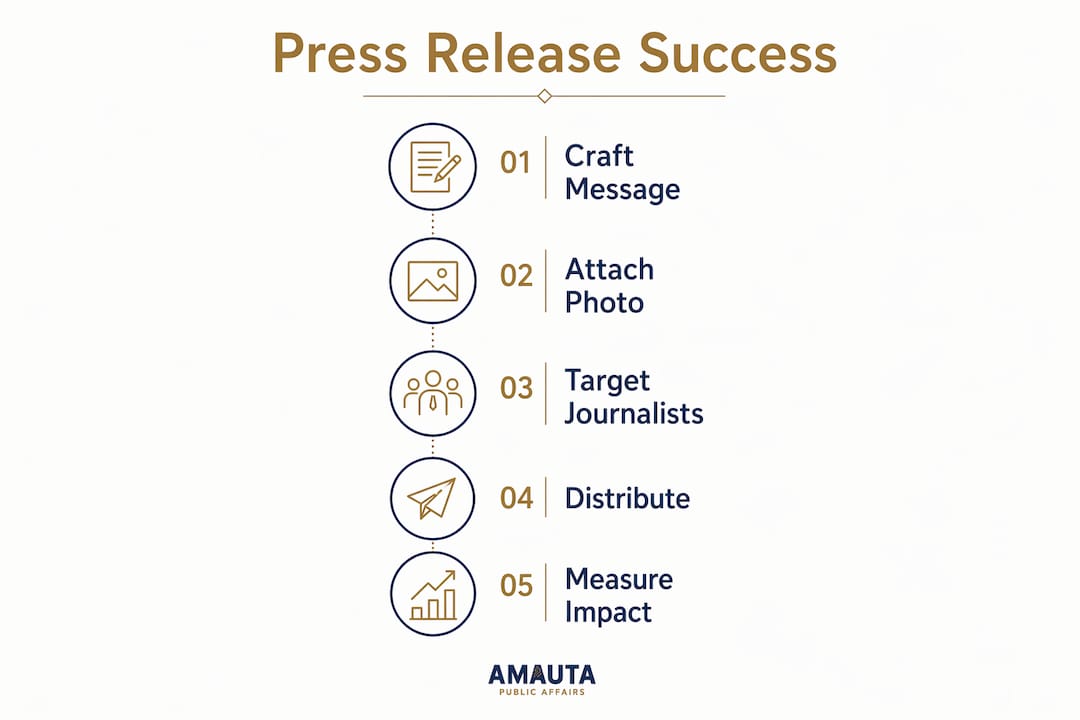
Pro Tip: Attach one high-resolution photo to every press release you send. Journalists working on tight deadlines are far more likely to run a story when usable images are already available.
Avoid burying your news under paragraphs of organizational history. Journalists scan the first 50 words of a release. If the news is not there, they move on.
Common mistakes nonprofits make with press releases
Most nonprofit press releases fail before a journalist finishes the first paragraph. The errors are predictable, and they are fixable.
Writing from the inside out. Organizations describe what the event means to them internally, not why it matters to a journalist’s audience. Press releases must be crafted from an external perspective, focusing on the journalist’s readers rather than the organization’s internal view.
Generic headlines. “Annual Gala a Success” tells a journalist nothing. A headline must state a specific outcome or announcement.
Over-polished quotes. Quotes reviewed by five committee members lose all personality. They become filler that no journalist will print verbatim.
No human story. Data without a face is forgettable. A statistic paired with one person’s story becomes a narrative worth covering.
Softened language. Non-urgent messaging reduces press release effectiveness. If your mission addresses a real crisis, the language should reflect that reality.
No clear newsworthy hook. A press release needs a news peg: a milestone, an event, a grant award, a partnership, or a response to a current issue.
Mass distribution without relationship-building. Sending a release to 500 generic contacts produces far less coverage than sending it to 20 journalists who cover your sector.
Pro Tip: Before sending, ask yourself: “Would a journalist who has never heard of us care about this?” If the answer is no, revise the hook before distributing.
For a deeper look at PR execution pitfalls that apply across sectors, the patterns are consistent: vague claims, weak hooks, and no follow-through.
Strategies for distributing press releases to maximize impact
Writing a strong press release is only half the work. Distribution determines whether it reaches the right journalists at the right moment.
Distribution Method | Best Use Case | Key Advantage |
Curated journalist email list | Event announcements, grant awards | Personal relationship, higher open rates |
Professional wire service | Major milestones, national reach | SEO visibility, referral traffic |
Direct email pitch | Feature stories, investigative angles | Tailored human hook, higher response |
Social media amplification | Post-coverage sharing | Extends earned media reach |
Donor newsletter inclusion | Fundraising campaigns | Reinforces credibility with existing supporters |
Journalists may ignore up to 90% of unsolicited press release pitches. That figure underscores why a curated, relationship-driven media list outperforms mass distribution every time.
Timing matters as much as targeting. Send releases 7–14 days before a scheduled event to give journalists time to plan coverage. For breaking news or grant announcements, same-day distribution is appropriate, paired with a direct phone call to your top three media contacts.
Professional distribution services improve SEO visibility and referral traffic, amplifying outreach effectiveness beyond what email alone achieves. Combine wire distribution with personalized pitches for maximum reach. A media outreach strategy that integrates both approaches consistently outperforms either method used alone.
For nonprofits hosting community events, understanding how local nonprofit events generate community engagement can sharpen the news angle in your release and make it more relevant to local journalists.
Measuring the impact and value of press releases
Tracking results separates organizations that improve over time from those that repeat the same ineffective approach. The metrics worth monitoring go well beyond whether a release was “picked up.”
Media placements. Count the number of outlets that published or broadcast coverage. Track the audience size of each outlet.
Referral traffic. Use Google Analytics to measure website visits driven by press release links. One mid-size nonprofit saw annual website visits increase from 11,500 to 16,200, a gain of 40.8%, after consistent multi-release distribution over 12 months.
Donation and sign-up correlation. Compare donation volume and volunteer registrations in the weeks following a release versus baseline periods.
Journalist response rate. Track which contacts replied, requested interviews, or asked for additional information. This data builds a smarter media list over time.
Earned media as social proof. Coverage from credible outlets reassures donors and grant committees of your organization’s legitimacy. Press releases compress the time needed to generate public attention during critical fundraising windows when supported by clear donor pathways.
Pro Tip: Create a simple media log after every release cycle. Record the outlet, journalist name, coverage date, and any resulting action. After six months, patterns emerge that tell you exactly which stories and which contacts produce results.
Refining your approach based on real data is what separates a one-time press release from a repeatable communications program. For guidance on building that program, nonprofit media relations best practices provide a structured framework worth reviewing.
Key Takeaways
A nonprofit press release earns media coverage and donor trust only when it leads with a specific human impact, follows the inverted pyramid structure, and reaches journalists through targeted, relationship-driven outreach.
Point | Details |
Lead with human impact | Open with a concrete outcome, not a mission statement, to hold journalist attention. |
Follow the 400–600 word rule | Releases within this length are read in full; longer releases get skimmed or ignored. |
Build a curated media list | Targeted outreach to 20 relevant journalists outperforms mass distribution to 500 generic contacts. |
Track referral traffic and donations | Measure website visits and donation volume after each release to refine future strategy. |
Earned media builds lasting credibility | Third-party coverage reassures donors and grant committees in ways paid advertising cannot. |
What I’ve learned after years of nonprofit press release work
Most nonprofit communications professionals treat press releases as a box to check. They write one before a gala, send it to a generic list, and move on. That approach produces almost no coverage and, over time, trains journalists to ignore the organization entirely.
The releases that actually move the needle share one quality: they treat the journalist as the primary audience, not the board of directors. Every word choice, every headline, every quote gets filtered through one question. “Does this give a journalist something their readers will care about?” When the answer is yes, coverage follows. When the answer is no, no amount of distribution fixes the problem.
The other lesson I keep returning to is the power of authentic quotes. I have seen organizations spend weeks polishing a quote until it says nothing. A beneficiary saying “I didn’t know where my kids would sleep that night” is worth more than any executive statement about “delivering transformational community outcomes.” Journalists print what sounds human. Give them that.
Press releases also work best as part of a repeatable system, not a one-off effort. Organizations that send four to six targeted releases per year, track their results, and build genuine relationships with two or three journalists in their sector consistently outperform those that treat each release as an isolated event. The relationship is the asset. The press release is the reason to start the conversation.
— Ignacio
How Amautapublicaffairs supports nonprofit media strategy
Nonprofit communications teams often have the story but lack the time or structure to turn it into coverage. Amautapublicaffairs works directly with nonprofit organizations to write press releases that lead with impact, reach the right journalists, and connect to fundraising goals.
Amautapublicaffairs provides professional press release writing, targeted media outreach, and communications strategy consulting tailored to nonprofit realities, including limited budgets and lean teams. The approach is pay-as-you-go, so organizations access expert support without long-term retainer commitments. If your organization is ready to build a press release program that produces measurable results, review the full range of nonprofit communications services available through Amautapublicaffairs.
FAQ
What is the role of a nonprofit press release?
A nonprofit press release communicates newsworthy organizational activities to journalists and the public, generating earned media coverage that builds credibility and advances the mission. It functions as the primary tool for translating impact into public awareness.
How long should a nonprofit press release be?
The optimal length is 400–600 words. Releases within this range are read in full by journalists, while longer releases are typically skimmed or discarded.
What is the biggest mistake nonprofits make in press releases?
The most common mistake is writing from an internal perspective rather than focusing on what matters to a journalist’s audience. Burying the news under mission statements or organizational history causes journalists to disengage within the first 50 words.
How do you distribute a nonprofit press release effectively?
Combine a curated journalist email list with direct, personalized pitches and a professional wire service for major announcements. Send releases 7–14 days before events and track which contacts respond to build a smarter media list over time.
How do you measure the impact of a nonprofit press release?
Track media placements, referral website traffic, and donation or volunteer sign-up volume in the weeks following each release. One nonprofit increased annual website visits by 40.8% over 12 months through consistent, targeted press release distribution.
Recommended
Comments