
Types of Green Infrastructure Community Projects, Explained
Five project types cover nearly every community engagement task a green infrastructure sponsor will need: Inform, Consult, Involve, Collaborate/Advocate, and Empower. Each corresponds to a specific level of decision authority, ranging from one way notification to shared control over outcomes, and each fits a distinct combination of project tier and phase. A Tier 1 stormwater retrofit generally needs only Inform and Consult activities during planning. A Tier 4 regional greenway or contested energy corridor needs Involve, Collaborate/Advocate, and often Empower structures sustained across planning, design, and construction.
This typology draws directly from frameworks already in use across the public sector. The IAP2 Spectrum, adapted by agencies like Fairfax County into an “Understand to Decide” continuum, maps decision authority to method choice. EBRD Performance Requirement 10 sets the compliance floor for disclosure and grievance mechanisms on internationally financed projects. And TxDOT’s public engagement guidance lays out the sequencing questions every scope of work should answer before a consultant is hired.
Inform: one way disclosure, fact sheets, project websites, public notices.
Consult: structured feedback, surveys, public meetings, comment periods.
Involve: working groups, focus groups, iterative design workshops.
Collaborate/Advocate: coalition building, joint messaging, media relations, digital advocacy campaigns.
Empower: advisory boards or community panels with real influence over final decisions.
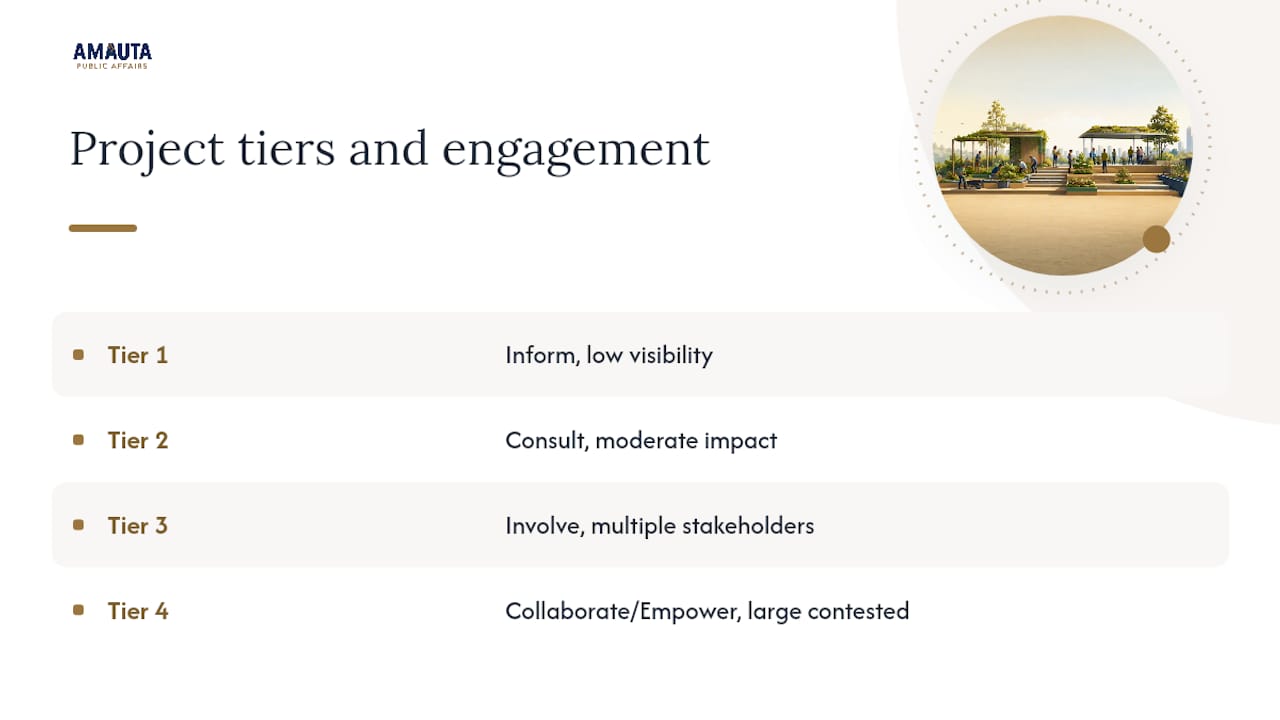
Quick scoping rule: Tier 1 to 2 projects typically stay in Inform and Consult territory; Tier 3 projects need Involve plus early Collaborate work; Tier 4 projects require the full spectrum, often with a formal Empower structure such as a community advisory board written into the permit conditions.
Key Takeaways
Matching engagement type to project tier and phase, documenting every interaction, and budgeting accessibility from the start are what separate projects that get permitted on schedule from projects that stall.
Point | Details |
Match method to tier | Tier 1 to 2 projects need Inform/Consult; Tier 3 to 4 need Involve, Collaborate/Advocate, and Empower structures. |
Budget by percentage | Tier 3 projects commonly allocate 3 to 5% of total project budget to engagement, per Nashville’s playbook. |
Engage before decisions are fixed | Delayed outreach after designs lock in is a leading cause of legal challenge and schedule delay. |
Build the audit trail continuously | Log every interaction with dates and tags in one queryable system, not at project close. |
Amautapublicaffairs maps services to typology | Engagement strategy, permitting support, and digital advocacy are scoped to your project’s specific tier and phase. |
Table of Contents
What Types of Green Infrastructure Community Projects Fit Each Tier and Phase?
Tiering exists because a bioswale retrofit on a quiet residential block does not carry the same political risk as a regional flood control greenway that displaces parking or crosses a contested watershed. The Nashville Community Engagement Playbook formalizes this logic into four tiers, and it’s a model worth borrowing regardless of jurisdiction.
Tier 1 covers routine, low visibility projects (a rain garden retrofit, a small drainage easement) where Inform activities such as a project webpage and mailed notice usually satisfy public involvement requirements. Tier 2 adds moderate complexity or mild neighborhood impact, so Consult methods like a public meeting or online survey enter the mix during planning. Tier 3 projects carry real stakes, multiple affected parties, or land acquisition, and need Involve level engagement (working groups, focus groups) sustained from planning into design. Tier 4 projects are large, contested, or politically visible, requiring Collaborate/Advocate and often Empower structures maintained across all three phases: planning, design, and construction.
Engagement type shifts as a project moves through its lifecycle. Planning-phase work leans toward Inform and Consult to surface concerns before designs are locked in. Design-phase work shifts toward Involve, since community input can still shape layout and materials. Construction-phase work returns to Inform and light Consult, mostly focused on managing disruption and complaints.
Pro Tip: Match your method to what the community can actually influence. If the alignment is fixed by a grant condition, running a “collaborative design workshop” sets an expectation you can’t deliver on. Name the decision authority explicitly in your invitation language: “we want your input on landscaping and signage,” not “help us design this project,” when the big decisions are already made.
How Do You Scope a Community Engagement Plan?
A public involvement (PI) plan or engagement scope of work needs the same core inputs regardless of project size. Skipping any of these tends to surface later as a permitting delay or a missed grievance deadline.
Project summary: one paragraph describing scope, location, and timeline, written for a non-technical reader.
Engagement goals: what decision the input is meant to inform, and what is already fixed.
Focus communities: who is affected, including renters, non-English speakers, and groups without easy access to public meetings.
Decision authority: where each activity sits on the Inform-to-Empower spectrum, stated plainly.
Required outputs: comment logs, summary reports, revised design documents.
Success metrics: participation diversity, response rates, grievance resolution time.
Schedule and milestones: tied to permitting deadlines and comment windows, not just internal deadlines.
Staffing and roles: community lead, translator, data manager, technical advisor.
Language and accessibility needs: translation, ADA compliant venues, captioning for virtual events.
Grievance mechanism: a documented channel for complaints, with a defined response timeline.
TxDOT’s guidance frames this as a chronological checklist: summarize the project, define goals, identify focus communities, choose engagement types, pick venues and times, then staff accordingly, including translation. Sequence your outreach against permitting windows rather than around them. A comment period that opens the week after a public meeting, instead of two weeks before, invites the perception that input was collected for show.
Which Engagement Methods Work Best for Each Project Type?
Every method has a resource profile, a best use case, and a failure mode. NYSERDA’s Guide to Community Engagement Plans catalogs these tradeoffs in detail, and the pattern holds across most green infrastructure work.
Public meetings deliver broad visibility and satisfy formal notice requirements, but they draw a self-selected crowd and rarely capture renters or shift workers. Pop-ups and tabling at existing farmers markets, transit hubs, or school events reach people who would never attend a formal meeting, and NYSERDA’s research finds this mixed-method approach consistently outperforms relying on meetings alone. Surveys, paper and digital, scale cheaply but suffer from low response rates unless paired with in-person prompting. Focus groups and advisory groups produce depth and legitimacy for Tier 3 and 4 projects but require compensation and skilled facilitation. One-on-one interviews with key informants surface issues no survey will catch, at high staff time cost per contact. Digital engagement and webinars extend reach but exclude residents without reliable internet. Media relations and digital advocacy build the coalition support that carries a project through a contested hearing. Stakeholder relationship management (SRM) platforms replace spreadsheets for tracking every interaction, which matters once a project draws legal scrutiny.

Budget for accessibility from the start: translation and interpretation, ADA compliant venues, and materials written at a plain-language reading level. Staff estimates should include a community lead, technical advisor, outreach coordinator, translator, and data manager, even on modest Tier 2 projects.
Pro Tip: Compensate community advisory members for their time. An unpaid advisory board skews toward retirees and homeowners with flexible schedules, which quietly excludes renters, hourly workers, and younger residents, exactly the groups most affected by land use change.
How Do Partnerships and Equity Shape Outreach Design?
Community based organizations, schools, and faith organizations reach residents that a consultant showing up cold never will. The relationship works best when it’s structured, not transactional: identify partners early, define a specific role (co-hosting an event, distributing materials in a trusted language), and compensate them for staff time.
Faith organizations often support one-on-one relationship building and can host evening or weekend events at low cost.
Schools provide access to families with children, a group frequently underrepresented in weekday daytime meetings.
CBOs serving immigrant or non-English-speaking communities are essential for language access and cultural translation, not just literal translation.
An equity-first checklist covers language access, ADA accessible meeting locations, meeting times outside standard work hours, compensation for participant time, and childcare during in-person events. The World Bank’s inclusive engagement guidance flags inadequate accessibility as a frequent grounds for legal challenge, which makes this a compliance issue as much as a fairness one. Guidance on partnering with developers on environmental goals covers how to formalize these relationships for longer engagements.
Pro Tip: Ask your CBO partners what “safe” looks like for their members before you set a venue. A location that feels neutral to project staff can feel surveilled or unwelcoming to residents with immigration concerns or a history of tense encounters with local government.
Why Do Digital Permitting Portals Matter for Community Trust?
Predictable comment windows and public dashboards do more than speed up approvals. They change what a project sponsor visibly promises the public, and broken promises on timing are one of the fastest ways to lose community trust.
Public milestone dashboards let residents see exactly where a project sits without calling a case manager.
Defined comment windows, published well in advance, remove the suspicion that input was gathered only after decisions were finalized.
Digital document access reduces the burden on residents who can’t attend a business-hours office visit.
Multilingual digital materials extend reach beyond what a single translated flyer accomplishes.
Industry groups and advocacy coalitions, including C2ES and the U.S. Chamber’s Permit America to Build initiative, are pushing permitting reform built around exactly these features: digitized review, predictable windows, and greater transparency. The World Bank’s permitting modernization framework frames this as a direct lever on both delay reduction and community outcomes. The practical risk callout: timely, accessible disclosure and a documented engagement record are among the strongest defenses against a permit challenge, since most legal objections turn on inadequate notice, not the underlying merits of the project.
What Metrics Prove Engagement Actually Worked?
Participation counts alone tell you almost nothing. Track participation diversity (age, language, renter versus owner, geography within the project footprint), response rate against your outreach volume, time to resolution for grievances, the ratio of commitments made versus delivered, and a sentiment trend across the project lifecycle rather than a single snapshot.
An after-action review should happen at the close of each major phase, not just at project end. Capture what worked, what didn’t, who signed off on the summary, and where the full record lives. Fairfax County’s capital projects framework requires exactly this kind of after-action assessment to feed adaptive learning into the next project, rather than relearning the same lessons every cycle.
Log every interaction with a date stamp and tag it by stakeholder and issue.
Store all responses and follow-up actions in one queryable system, not scattered spreadsheets.
Archive the full record before the project closes out, not after a records request forces the issue.
Pro Tip: Build your audit trail as a byproduct of daily work, not a end-of-project scramble. A stakeholder relationship management platform that tags every contact by issue and date turns a permit hearing from a scramble into a five-minute report pull.
How Should You Budget Engagement Work by Project Tier?
Budget as a percentage of total project cost, scaled to tier, rather than a flat consultant fee. Nashville’s playbook offers a useful benchmark: Tier 3 projects commonly allocate 3 to 5 percent of total project budget to engagement, with Tier 4 projects often exceeding that range given sustained advisory structures and media work.
Tier | Typical allocation | Core line items |
Tier 1 | Under 1% | Notice mailing, project webpage |
Tier 2 | 1 to 2% | Survey platform, one public meeting, basic translation |
Tier 3 | 3 to 5% | Working group facilitation, translation/interpretation, venue rental |
Tier 4 | 5%+ | Advisory board stipends, media relations, SRM platform licensing, sustained multilingual outreach |
A scope of work should list every deliverable as a billable, auditable item: comment logs, summary reports, translated materials, meeting facilitation hours, and platform licensing fees. Vague line items like “community outreach, as needed” are the first thing a funder or auditor will flag.
How Does Amautapublicaffairs Structure These Engagement Projects?
Amautapublicaffairs runs green infrastructure engagement as a campaign, not a checklist item bolted onto a project schedule. That distinction shows up in how work gets scoped: every engagement is assessed against the specific tier and phase of the project, then staffed and messaged accordingly, rather than defaulting to the same public meeting template regardless of stakes.
Community engagement strategy tailored to the project’s decision authority and local political landscape.
Media relations and digital advocacy to build coalition support ahead of contested hearings.
Permitting support that aligns outreach milestones with formal comment windows.
Stakeholder relationship management to keep a defensible, queryable record from day one.
Related reading on [stakeholder communication strategies for land use projects](https://amautapublicaffairs.com/post/stakeholder communication strategies for land use projects) and the role of community engagement strategy in projects covers the messaging and sequencing decisions that shape these scopes. For examples of how coalition building plays out on a live project, Building Bridges: winning community support for data centers and energy initiatives walks through a comparable case.
What Do Practitioners Get Wrong About Timing and Trust?
The single most damaging mistake in this work is engaging the public only after the real decisions are already fixed. Residents can tell the difference between a workshop where their input shapes the outcome and one staged to check a compliance box, and once that trust breaks, it rarely comes back for the rest of the project’s life.
The second mistake is treating accessibility as an afterthought rather than a design input. A meeting held at 2 p.m. on a Tuesday, with no translation and no childcare, isn’t a neutral choice. It’s a filter that quietly excludes exactly the residents most likely to be affected by the project.
Adaptive learning is what breaks this cycle. Teams that run a genuine after-action review, and actually change their next scope of work based on it, cut months off their permitting timelines on subsequent projects because they stop relearning the same lessons about venue selection, language access, and comment window sequencing.
How Can Amautapublicaffairs Support Your Next Project?
Amautapublicaffairs replaces the guesswork of assembling engagement staff, translators, and media contacts project by project with a campaign-style team that already knows how to map your tier, phase, and decision authority before the scope is written. That means your project summary, engagement goals, and staffing plan get built once, correctly, instead of revised twice after a permitting delay.
Services span community engagement strategy, permitting support, media relations, digital advocacy, and stakeholder relationship management, matched directly to the typology covered above: Inform and Consult work for Tier 1 and 2 projects, full Involve and Collaborate/Advocate structures for Tier 3 and 4 work. A first conversation typically starts as a scoping call: what tier your project sits at, what decisions are still open, and what a realistic engagement budget looks like given your timeline. From there, Amautapublicaffairs can turn that scoping call into a proposal within days. Visit the services overview to see the full range of offerings, or review digital advocacy capabilities if your project is facing organized opposition and needs coalition support fast.
Where Can You Find More on This Topic?
World Bank’s permitting modernization framework covers transparency and predictable input windows in depth.
Nashville’s Community Engagement Playbook details the Tier 1–4 framework and budget benchmarks.
NYSERDA’s Guide to Community Engagement Plans catalogs method-by-method pros and cons.
EBRD PR10 sets the compliance standard for disclosure and grievance mechanisms.
La Verne’s community sustainability initiatives offer a local example of grassroots outreach tactics.
Do I need a formal engagement plan for a small Tier 1 project? Yes, though it can be brief. Even a Tier 1 rain garden retrofit benefits from a one-page plan naming the goal, affected residents, and notice method, since it creates a record if questions arise later.
How early should engagement start relative to permitting? Engagement should begin at the formative planning stage, before design decisions are fixed, since delayed outreach is a common trigger for legal challenges and added delay.
What’s the difference between Consult and Involve? Consult gathers feedback on a proposal that’s largely set; Involve gives the community a real hand in shaping design choices before they’re finalized.
Do digital-only engagement methods satisfy legal notice requirements? Usually not alone. Most jurisdictions and funders, including EBRD-financed projects, expect a mix of digital and in-person or printed outreach to reach residents without reliable internet access.
Sources
Recommended
Comments