
What a Virtual Town Hall Must Deliver for Land‑Use Projects

A virtual town hall succeeds when it lets residents genuinely influence a defined decision, reaches people regardless of income or ability, and leaves a documented public record behind it. That means pairing a hybrid outreach plan with an accessible platform, staffing it with dedicated moderators and technical support, and publishing a comment summary once the meeting ends. Skip any one of those pieces and the meeting looks like engagement without functioning as engagement.
State upfront what the decision affects and what residents can still change.
Run a hybrid model: phone-in access, captioning, and translated materials alongside the livestream.
Staff moderation and tech support live, then publish the comment record.
The FHWA’s virtual public involvement case studies show state transportation agencies now treat virtual formats as permanent infrastructure, not pandemic-era substitutes, because pre-registration and multiple comment channels consistently produced better-informed public input.
TL;DR:
Virtual town halls must clearly define which decisions residents can influence to avoid misleading expectations and build trust.
Accessibility features like professional captioning, translated materials, and accommodation processes must be budgeted and scheduled from the start.
Combining formats such as phone-in options with livestreams expands outreach to residents with limited internet access.
Full dress rehearsals and technical orientation for presenters minimize on-air issues and enhance the meeting’s smooth operation.
Publishing a comprehensive comment summary and response log after the event is essential to maintaining transparency and community confidence.
Table of Contents
How Do You Plan a Virtual Town Hall That Actually Works?
Start by naming the decision the meeting can change. If the zoning variance is already approved, don’t frame the meeting as if residents can still block it. Vague purpose statements are the fastest way to erode trust before the meeting even starts.
Define the purpose and the decision boundaries: what’s fixed, what’s flexible.
Map stakeholders, including groups historically absent from planning meetings.
Choose your participation level (inform, consult, or collaborate) and lock a timeline: notice period, materials release, rehearsal date.
Assign roles: moderator, producer or tech lead, note taker, and someone responsible for legal records.
Planning needs to start roughly two months out for a standard meeting, according to ERDC/USACE’s virtual engagement guidance, with more lead time for multilingual or high-complexity projects. Teams that treat stakeholder mapping as a real exercise, not a formality, tend to catch opposition early instead of discovering it live on camera. Amautapublicaffairs’ work on stakeholder communication strategies for land-use projects walks through how that mapping should inform messaging before a single slide gets built.
Pro Tip: Write your meeting’s “what can’t change” list before you write the agenda. It keeps facilitators from accidentally promising flexibility that doesn’t exist.
How Do You Make a Virtual Town Hall ADA Accessible?
Agencies have a legal obligation to plan for accessibility, not retrofit it after complaints arrive. Professional captioning, large-print materials, and accessible document formats all need to be budgeted and scheduled, not treated as optional add-ons.
Provide professional captioning (not auto-generated captions alone), large-print handouts, and screen-reader-compatible documents.
Offer translated notices and interpretation for the languages spoken in the project area.
Publish an accommodation request process with a clear deadline, tied to your advance notice window.
Build hybrid outreach into the plan: phone-in lines, mailed notices, and partnerships with community organizations that reach residents without broadband.
The ILG Planning Handbook treats hybrid outreach as essential infrastructure, not a nice-to-have, specifically because broadband gaps map closely onto the populations most affected by land-use decisions. Advance notice of at least 21 days, and never less than 14, gives residents enough runway to actually request an accommodation, per Mass.
Which Format Fits Your Virtual Public Meeting?
Telephone town halls, webinars, livestreams, and on-demand recordings each solve a different problem, and picking the wrong one is a common reason attendance disappoints.
Telephone town halls reach residents without reliable internet, and can dial out to thousands of households at once with translated audio simulcasts running alongside the primary call. Webinars work best for structured presentations with moderated Q&A. Livestreams suit large public hearings where residents mostly watch and submit written comment. On-demand recordings extend access to anyone who couldn’t attend live, and pairing a telephone town hall with a website open house often outperforms either format alone.
Whatever platform you choose, require these features:
Dial-in access alongside the web option
Professional captioning, live
Authenticated speaker queues for anyone giving testimony
Exportable, timestamped logs of attendance and comments
Purpose-built public hearing platforms tend to offer these features out of the box, which matters for meetings that will become part of a formal legal record. A small stakeholder workshop can run on lighter tools; a contested public hearing on a permitting decision cannot.
When Should You Promote a Virtual Town Hall?
Promotion timing determines who shows up, and underserved residents are the group most likely to miss a meeting announced too late or through too few channels.
Send the first notice at least 21 days out, then follow with staggered reminders at two weeks, one week, and 48 hours.
Use both digital and traditional channels: email lists, social posts, geo-targeted paid ads, mailers, and local media coverage.
Recruit community partners, elected officials, and other trusted messengers to share the invitation in their own voice.
Collect registration data (with resident consent) so you can check whether your outreach actually reached a demographically representative audience, not just the usual attendees.
Amautapublicaffairs’ guide to digital advocacy tools for government planning breaks down which channels perform best for different project types, and OneGov’s stakeholder identification guidance offers a useful framework for mapping who those trusted messengers should be before outreach begins.
What Does a Well-Run Virtual Town Hall Look Like on the Night?
A public meeting lives or dies on its run of show. Draft one with specific timings: opening remarks, presentation blocks, Q&A windows, and built-in breaks if the meeting runs past 90 minutes.
Assign a moderator, a producer or tech lead, a note taker, and a records contact who owns the legal comment file.
Run a full dress rehearsal in the live environment, not a stripped-down test call, since Mass.gov’s guidance finds rehearsals cut on-air issues and shorten total run time.
Hold a short technical orientation for presenters and speakers before the event.
Set clear ground rules for chat and comment moderation, plus an escalation protocol for hostile or off-topic behavior.
Pro Tip: Assign one staffer whose only job during the live event is watching for technical failures. A moderator juggling both content and connectivity problems will eventually drop one of them.
Plain language matters here too. Presenters who lean on technical jargon lose residents fast, and Smart Growth America’s review of virtual engagement found that visual explanation and iterative feedback loops expanded participation well beyond the small group of residents who always show up.

How Do You Collect and Preserve Public Comments?
Different input channels enter the public record differently, and mixing them up creates real legal exposure for contested projects.
Live authenticated testimony requires speaker verification and becomes part of the formal transcript.
Surveys and polls capture broader sentiment but typically stay anonymous unless you explicitly collect identifying information.
Mail and phone comments need the same timestamped logging as digital submissions to count equally.
Channel | Record Treatment |
Live testimony | Authenticated, transcribed, part of formal record |
Survey/poll | Aggregated, generally anonymous unless stated otherwise |
Mail/phone comment | Logged with timestamp, included in comment summary |
Chat/Q&A | Consolidated into summary, not verbatim transcript |
Official public comment for permitting decisions usually requires a name and address; general sentiment surveys don’t. Extend your comment window past the live event and consolidate everything into one summary document rather than leaving four scattered records.
How Do You Measure and Follow Up After a Virtual Town Hall?
Attendance numbers alone don’t tell you whether the meeting worked. Track participation against your project area’s demographics, the volume of substantive (not just procedural) comments, and recurring themes in what residents said.
Compare attendee demographics to the project area to spot who’s still missing.
Count substantive comments separately from simple attendance or “thumbs up” reactions.
Publish a comment summary and response log within a set window, with named owners for each open question.
Feed these metrics into your next meeting’s outreach plan rather than starting from zero.
The NCHRP’s research on virtual public involvement recommends tracking both quantitative reach and qualitative sentiment, since a well-attended meeting with shallow comments signals a different problem than a small meeting with detailed, substantive input.
How Amautapublicaffairs Builds Virtual Town Halls Into Bigger Campaigns
A single virtual town hall rarely wins community support on its own. Amautapublicaffairs treats each meeting as one tactic inside a campaign-style strategy that assesses the community landscape, sets priorities, and adjusts messaging as real-time feedback comes in.
Tailored strategies replace generic playbooks, built around each project’s specific opposition and support base.
Services span community engagement, media relations, and digital advocacy, all aimed at building durable trust rather than one-time compliance.
Complex permitting, cross-jurisdictional projects, or high reputational risk are the clearest signals it’s time to bring in outside consulting support.
Projects with data centers or energy infrastructure tend to face the steepest version of this challenge, where technical complexity and community skepticism compound each other.
Key Takeaways
A virtual town hall earns public trust only when accessibility, hybrid outreach, and a documented comment record are built into the plan from the start, not added afterward.
Point | Details |
Define decision boundaries early | State clearly what residents can and cannot influence before promoting the meeting. |
Budget for real accessibility | Professional captioning, translated materials, and accommodation requests need dedicated planning time. |
Combine formats deliberately | Pair telephone town halls or phone-in lines with livestreams to reach residents without broadband. |
Rehearse in the live environment | A full dress rehearsal reduces on-air technical failures during the actual meeting. |
Publish the comment record | A published summary and response log closes the loop and sustains trust for future meetings. |
What Actually Matters Most in Virtual Public Engagement
Most guidance on virtual town halls treats accessibility as a compliance checkbox and outreach as a marketing problem. Both miss the point. The research consistently shows that meetings fail not because agencies skip captioning, but because they never define what residents can actually change, then wonder why turnout feels hostile or apathetic.
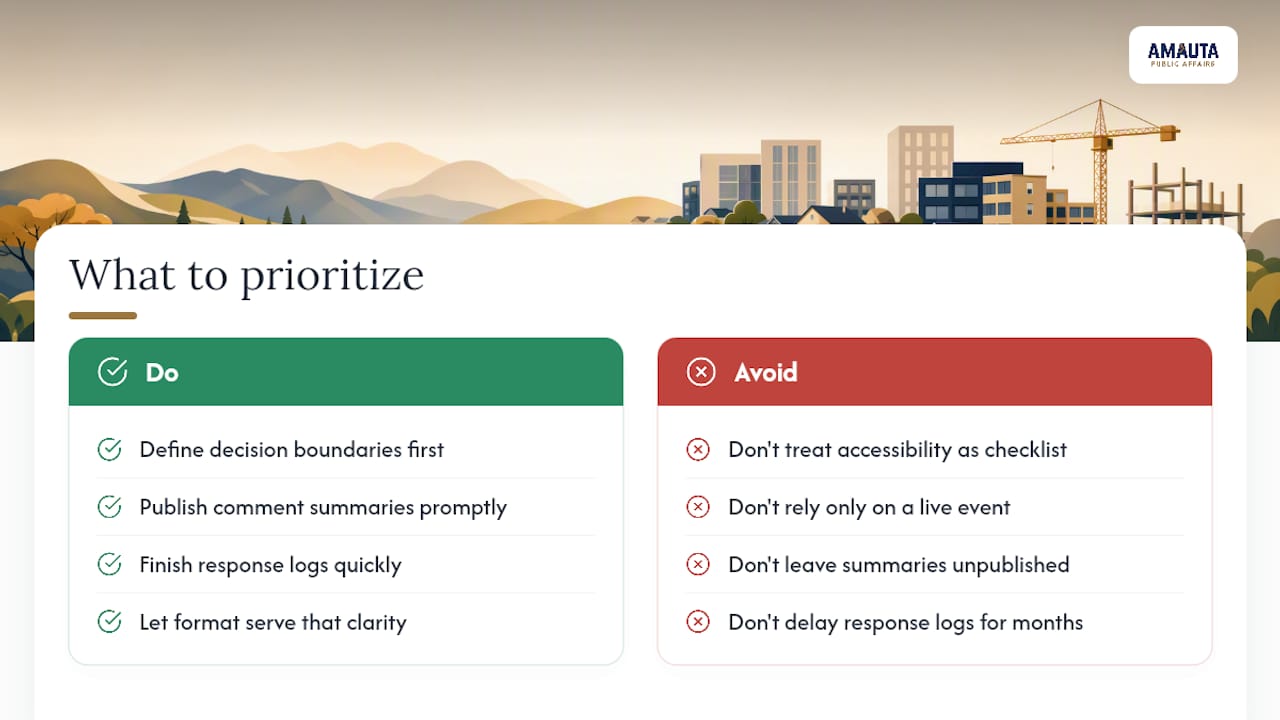
The conventional advice overweights the live event and underweights what happens after. A polished 90-minute broadcast means little if the comment summary never gets published or the response log sits unfinished for months. That’s where trust actually erodes.
If you’re prioritizing one thing first, make it this: write down the decision boundaries before you touch the platform or the promotion plan. Everything else, format choice, outreach channels, rehearsal schedules, exists to serve that clarity. A technically flawless meeting built on a vague purpose still fails the community it was meant to serve.
— Ignacio
Sources
Recommended
Comments