
What Does Community Outreach Mean for Organizations?
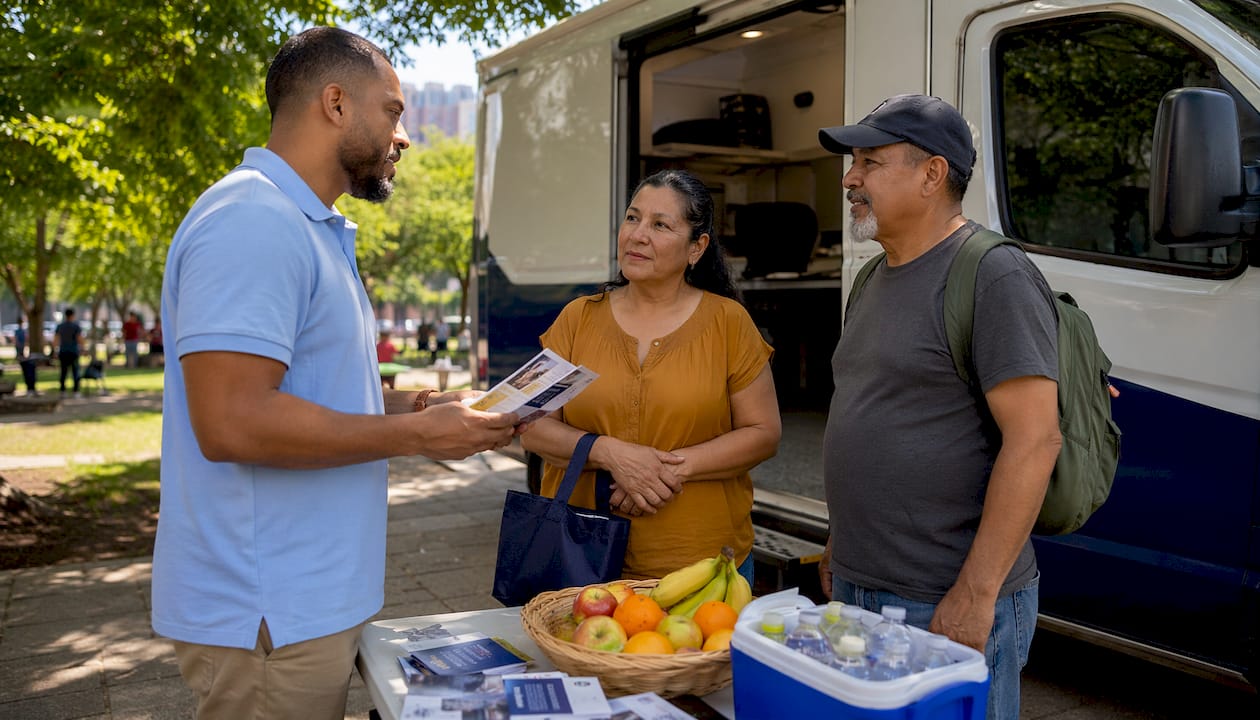
Community outreach is defined as the proactive, mobile delivery of services, information, and support directly to underserved populations in their own environments. Unlike passive service models, outreach is fundamentally mobile, meeting people where they live, work, and gather rather than waiting for them to seek help. This distinction matters because populations with the greatest need often face the highest barriers to access. Organizations that understand this definition can design programs that actually reach the people they intend to serve, not just those already close to existing systems.
What does community outreach mean, and how is it different from engagement?
Community outreach and community engagement are related but distinct concepts. Conflating them produces programs that look active on paper but fail to create real change on the ground.
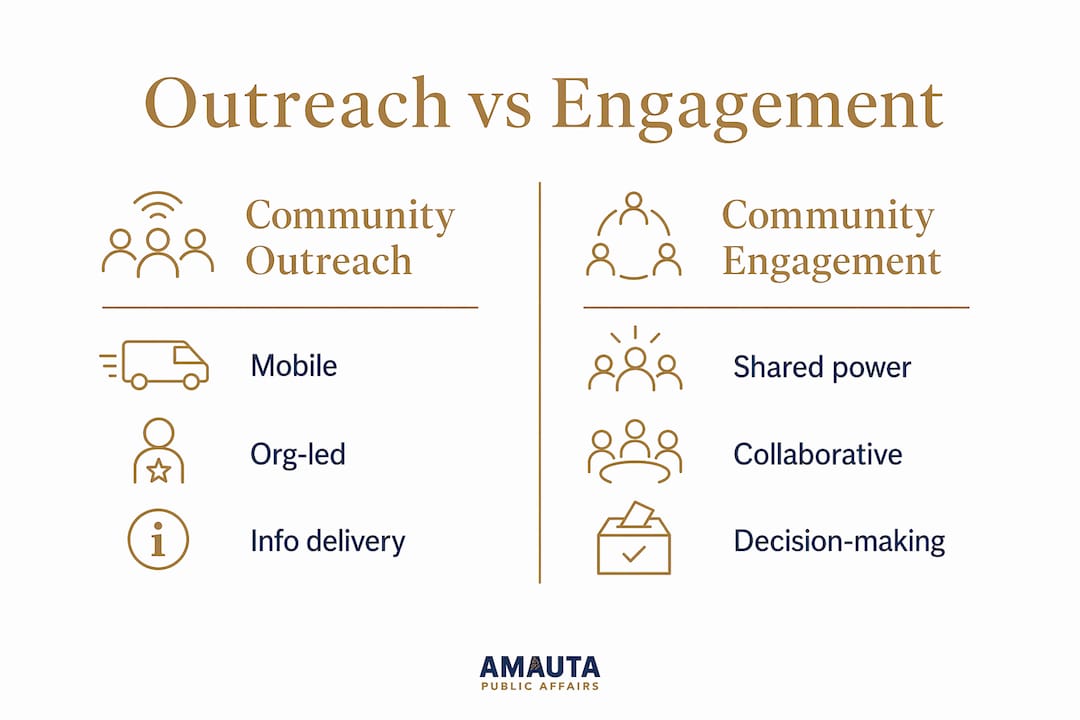
Community outreach is the first move. It involves going to communities, identifying unmet needs, and connecting people to resources through coordination, education, and referral. Outreach specialists connect underserved populations to social, behavioral, and public health services. The work is directional: the organization moves toward the community.

Community engagement goes further. Engagement requires shared decision-making power with communities, not just communication or consultation. CE Canvas defines it as a process where communities hold genuine influence over outcomes, not just input. That is a meaningful difference from outreach, which can still be top-down in its design.
Community service is different again. It typically describes volunteer work at fixed locations, such as food banks, shelters, or community centers. People come to the service. Outreach, by contrast, goes to the people.
Concept | Who moves? | Decision power | Typical format |
Community outreach | Organization moves to community | Organization-led | Home visits, mobile clinics, street outreach |
Community engagement | Shared movement | Shared with community | Co-design sessions, advisory boards |
Community service | Community moves to organization | Organization-led | Fixed-location volunteering |
The University of Michigan and frameworks like CE Canvas both emphasize that real engagement involves accountability and transparency, not just presence. Organizations that treat outreach as the endpoint miss the deeper work that builds lasting trust.
What are the key methods and examples of community outreach in practice?
Effective outreach programs share one defining feature: they meet people physically and culturally where they are. True outreach focuses on mobility, reaching people in community spaces rather than expecting them to travel to centralized offices.
Common outreach methods
Street outreach: Workers go directly to locations where homeless or at-risk individuals spend time, offering harm-reduction supplies, referrals, and basic services.
Home visits: Health workers and social workers visit families in their residences to assess needs, deliver care, and connect people to programs.
Mobile clinics: Health agencies bring medical services, vaccinations, or mental health support directly into underserved neighborhoods.
Community workshops: Schools, nonprofits, and public agencies hold educational sessions in local venues to raise awareness about available resources.
Digital outreach: Organizations use targeted messaging through social media, SMS, and email to reach populations who are online but not physically accessible.
Sectors that rely on outreach
Nonprofits, public health agencies, school districts, and land-use organizations all run outreach programs. Each sector adapts the core model to its context. A school district might send counselors to apartment complexes where students live. A public health agency might park a mobile clinic outside a grocery store in a low-income neighborhood. A land-use firm like Amautapublicaffairs might conduct door-to-door engagement before a project launch to surface community concerns early. You can see how this applies in practice with pre-launch outreach guidance for project-based organizations.
Outreach carries an educational role as well, raising awareness about existing services and promoting social inclusion. This function is often undervalued. Many people do not access services because they do not know those services exist, not because they are unwilling.
Pro Tip: Design outreach materials at a 6th-grade reading level and in the primary languages of your target population. Literacy and language barriers are among the most common reasons outreach fails to connect.
What are the biggest challenges in community outreach?
The most common failure in community outreach is tokenism. Tokenistic outreach that lacks transparency or tangible benefit erodes trust that is costly to rebuild. Organizations that conduct outreach as a compliance checkbox, collecting community input with no intention of acting on it, do lasting damage to the relationships they claim to build.
Power dynamics are the second major challenge. Organizations typically hold resources, timelines, and decision authority. Communities hold local knowledge, lived experience, and the legitimacy that no outside organization can manufacture. When these two sides do not share power, outreach becomes extraction rather than partnership.
Effective community outreach requires navigating complex power dynamics and building reciprocal partnerships that stress accountability. The most effective outreach practices view community members as experts and equal partners, respecting their resources and knowledge.
Three principles consistently separate effective outreach from performative outreach:
Recognition of local expertise: Community members understand their own context better than any outside organization. Effective programs build on that knowledge rather than overriding it.
Equitable reciprocal partnerships: Both sides give and receive. Organizations provide resources and access; communities provide knowledge, trust, and legitimacy.
Accountability: Organizations must report back on how community input shaped decisions. Without this step, sustained engagement beyond compliance is impossible to achieve.
Reviewing common community relations mistakes gives organizations a practical checklist for avoiding the most damaging patterns before they take root.
Pro Tip: After every outreach event, send a brief summary back to participants explaining what you heard and what you plan to do with that input. This single habit separates organizations that build trust from those that burn it.
What are the benefits of community outreach for communities and organizations?
The case for investing in outreach is well supported. Community-based outreach initiatives increase health outcomes by up to 25% and reduce local crime rates by as much as 30% within target populations. These are not marginal gains. They represent measurable shifts in the quality of life for the people outreach programs serve.
For communities, the benefits extend beyond health and safety. Outreach programs support social inclusion, reduce poverty-related isolation, and connect people to mental health resources they would not otherwise reach. They also build a sense of agency. When people see organizations showing up in their neighborhoods, listening, and following through, civic participation tends to increase.
For organizations, the returns are equally concrete. Projects that invest in genuine outreach before and during implementation face less opposition, build stronger reputations, and achieve better outcomes. A land-use project that engages affected residents early is far less likely to face regulatory delays or public opposition than one that treats community input as an afterthought.
Benefit area | Community impact | Organizational impact |
Health outcomes | Up to 25% improvement in target populations | Reduced liability and stronger public health partnerships |
Safety | Up to 30% reduction in local crime rates | Safer project environments and lower security costs |
Social inclusion | Greater access to services and civic participation | Broader stakeholder base and public legitimacy |
Trust | Stronger relationships with institutions | Reduced opposition, faster approvals, better project outcomes |
Mental health | Improved access to support services | Positive reputation and community goodwill |
The data points to a clear conclusion: outreach is not a cost center. It is a prerequisite for durable project success and genuine community benefit.
How do you start and sustain a community outreach program?
Building an outreach program that lasts requires more than good intentions. Effective outreach fills gaps in government services with person-centered, trauma-informed, harm-reduction approaches rather than compliance-driven enforcement. That framework applies whether you are running a public health program or a land-use engagement process.
Map the community landscape. Identify who is underserved, what barriers they face, and which organizations already work in the space. Avoid duplicating efforts or competing with trusted local actors.
Set shared goals with community input. Bring community members into the goal-setting process before designing any program. Goals imposed from outside rarely reflect actual needs.
Choose methods that fit the population. Street outreach works for homeless populations. Mobile clinics work for rural communities without transportation. Digital outreach works for younger populations with smartphone access. Match the method to the people.
Train outreach workers in trauma-informed practice. Workers who understand trauma, cultural context, and harm reduction build trust faster and retain it longer.
Evaluate and adjust in real time. Collect feedback after every interaction. Track whether people are actually connecting to services. Adjust the program based on what the data shows, not what the plan assumed.
Build reciprocal partnerships. Recognizing local expertise and equitable partnerships are foundational to programs that last beyond a single funding cycle.
A well-designed community engagement strategy gives organizations the framework to move from one-time outreach events to sustained, trusted relationships with the communities they serve.
Key Takeaways
Genuine community outreach requires mobility, shared power, and sustained accountability to produce measurable benefits for both communities and the organizations that serve them.
Point | Details |
Outreach is mobile by definition | Effective programs go to communities rather than waiting for people to seek services. |
Outreach differs from engagement | Engagement requires shared decision-making power; outreach alone does not. |
Tokenism destroys trust | Outreach without transparency or follow-through erodes community relationships that are hard to rebuild. |
Benefits are measurable | Outreach programs improve health outcomes by up to 25% and reduce crime rates by up to 30%. |
Sustained programs outperform one-time efforts | Ongoing relationship-building and real-time evaluation separate effective programs from compliance exercises. |
Why the “show up once” model keeps failing communities
I have watched organizations launch outreach programs with genuine enthusiasm, only to abandon them after the first round of community meetings. The pattern is predictable. Leadership approves a budget for engagement, a team holds a few events, and then the project moves forward regardless of what was heard. Communities notice. They always notice.
The uncomfortable truth is that most outreach failures are not failures of method. They are failures of commitment. Organizations design outreach to satisfy a requirement rather than to genuinely understand the people they claim to serve. The result is a program that looks good in a report and accomplishes very little in the field.
What I have found actually works is treating the first outreach event as the beginning of a relationship, not the relationship itself. The organizations that build real trust are the ones that come back. They report what they heard. They explain what changed because of community input. They show up when there is no immediate project need, not just when approvals are on the line.
Technology is making this easier. Digital platforms now allow organizations to maintain ongoing dialogue with community members between in-person events. That continuity, even in small doses, signals that the relationship is real. I am genuinely optimistic about what this means for the next generation of outreach programs. The tools exist. The question is whether organizations will use them with the same commitment they bring to their project timelines.
— Ignacio
How Amautapublicaffairs supports your outreach goals
Organizations working on land use, infrastructure, or public projects face a specific version of the outreach challenge: they need community trust before they can move forward, and they often have limited time to build it.
Amautapublicaffairs brings a campaign-style approach to community engagement and outreach services, combining granular community landscape assessments with targeted messaging strategies that reflect the actual concerns of affected residents. The team handles the full process, from initial stakeholder mapping to real-time feedback integration, so organizations can focus on project delivery while building the public support their projects require. If your organization needs a credible, results-driven outreach partner, Amautapublicaffairs is built for exactly that work.
FAQ
What does community outreach mean in simple terms?
Community outreach is the proactive practice of bringing services, information, and support directly to underserved populations rather than waiting for them to seek help. It is defined by mobility and a focus on reducing barriers to access.
How is community outreach different from community engagement?
Outreach delivers services and information to communities, while community engagement requires shared decision-making power between organizations and community members. Engagement goes further by giving communities genuine influence over outcomes.
What are some examples of community outreach programs?
Common examples include street outreach to homeless populations, mobile health clinics in underserved neighborhoods, educational workshops in schools, and home visits by social workers or public health nurses.
Why does community outreach matter for organizations?
Organizations that invest in genuine outreach build public trust, reduce project opposition, and achieve better outcomes. Programs linked to outreach show health improvements of up to 25% and crime reductions of up to 30% in target communities.
What makes community outreach fail?
Tokenistic outreach, where organizations collect community input without acting on it, is the leading cause of failure. Lack of transparency, one-time engagement events, and compliance-only mindsets all erode the trust that outreach depends on to function.
Recommended
Comments