
What Does Issue Framing Mean for Advocates and Negotiators

Issue framing is the strategic selection and presentation of certain aspects of a problem so one interpretation feels natural and points toward particular solutions. A frame does four things at once: it defines what the problem is, assigns a cause, renders a moral judgment, and implies a remedy. Consider a proposed warehouse near a residential neighborhood. Framed as “jobs and tax revenue,” the natural solution is approval with conditions. Framed as “traffic and health risk to families,” the natural solution is denial or major redesign. Same project, same facts, two entirely different policy conclusions.
The concept traces to communication scholar Robert Entman, whose foundational 1993 article still anchors most academic and practitioner discussions of framing. The FrameWorks Institute has spent decades translating that theory into applied guidance for advocacy campaigns. At Amautapublicaffairs, framing decisions shape nearly every land-use and infrastructure engagement we advise on, because the frame a community adopts early usually outlasts any later fact-check.
A working frame is built from four components:
Selection and salience: which facts get emphasized, which get left out
Causal claim: who or what is presented as responsible for the condition
Moral evaluation: whether the situation reads as acceptable, unjust, or urgent
Recommended remedy: the solution that follows logically once the first three are set
A rezoning battle framed as “preserving neighborhood character” produces a fight over aesthetics and precedent. The same rezoning framed as “unlocking affordable housing supply” produces a fight over equity and access. The underlying zoning map never changes. The politics do.
Key Takeaways
Issue framing works because it decides which problem definition, cause, moral judgment, and remedy an audience accepts as natural, and testing that frame against real audience values determines whether a campaign succeeds or stalls.
Point | Details |
Definition matters first | Issue framing is the strategic selection of problem, cause, judgment, and remedy that shapes accepted solutions. |
Four functions drive every frame | Entman’s model covers problem definition, causal interpretation, moral evaluation, and treatment recommendation. |
Psychology explains persuasion limits | Schemata, priming, and messenger credibility determine whether a frame lands or is ignored. |
Testing beats guessing | Small-scale A/B message tests and focus groups reveal comprehension and resonance before public rollout. |
Ethics require transparency | Evidence-backed, transparent framing avoids manipulation and long-term credibility damage. |
Amautapublicaffairs applies this directly | The firm builds frame diagnosis and message testing into land-use and infrastructure campaign strategy from day one. |
Table of Contents
What Is Issue Framing and How Do Its Core Functions Work?
Entman’s model breaks framing into four distinct jobs a message performs, often within a single sentence or headline. Understanding these functions separately is what lets a practitioner diagnose why a frame is failing instead of just sensing that “the messaging feels off.”
Problem definition decides what the issue actually is. A rise in emergency room visits tied to extreme heat can be defined as a public health emergency or as evidence of inadequate housing stock. Causal interpretation assigns responsibility. Is a factory closure the result of corporate decision-making, global trade shifts, or local tax policy? Moral evaluation signals whether the audience should feel outrage, sympathy, or indifference. Treatment recommendation is the payoff: once the first three elements are set, a remedy tends to feel obvious rather than argued for.
Entman argued frames work by selecting and highlighting particular elements of an event or issue while pushing others into the background, which is precisely what makes framing feel like description rather than persuasion.
Function | What it does |
Problem definition | Decides what condition counts as “the issue” worth public attention |
Causal interpretation | Assigns responsibility to a person, institution, or system |
Moral evaluation | Signals whether the situation deserves sympathy, outrage, or acceptance |
Treatment recommendation | Makes a specific remedy feel like the logical next step |
Each function does its work quietly. Readers rarely notice that a frame has told them who to blame; they simply notice that they feel a certain way about the story, which is exactly the effect skilled message design is built to produce.
How Does Issue Framing Actually Change What People Think?
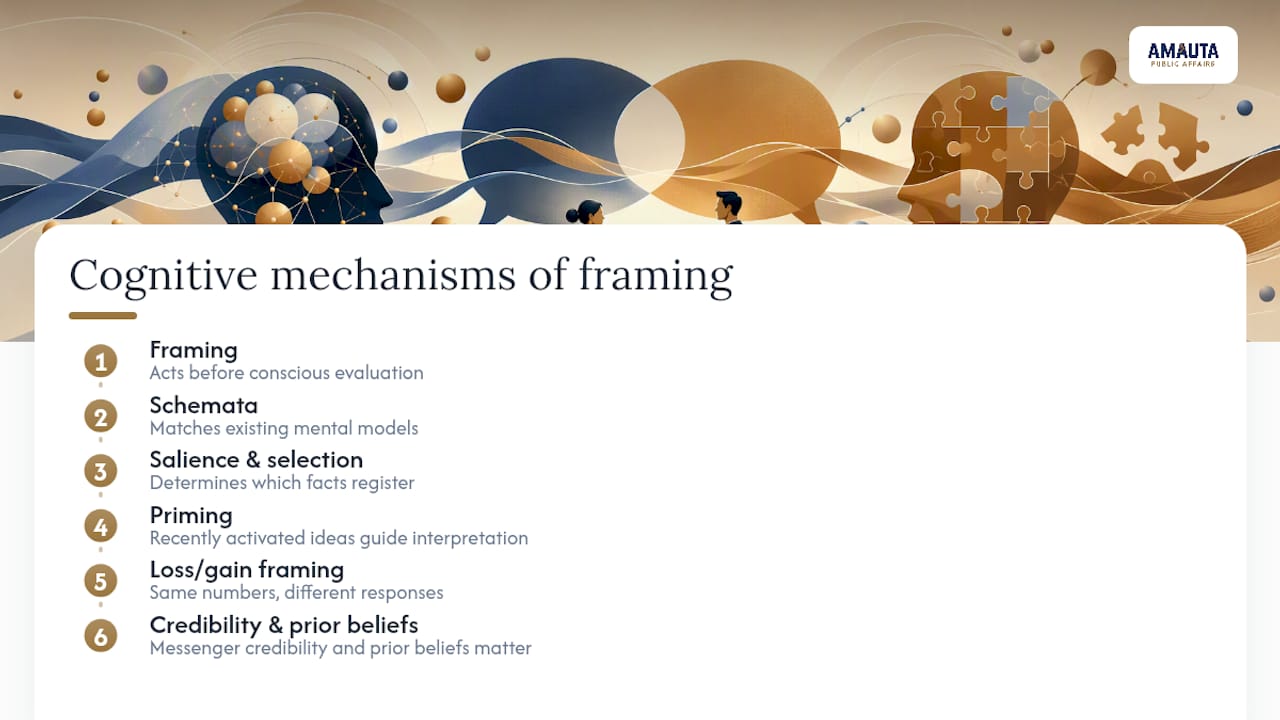
Framing works because human cognition relies on shortcuts, not exhaustive analysis. Several mechanisms operate together, and most of them act before a person consciously evaluates a claim at all.
Schemata are the mental models people already carry. A frame that matches an existing schema, such as “government waste” for a skeptic of public spending, requires almost no persuasive effort. A frame that fights an existing schema faces resistance regardless of how strong the evidence is. Salience and selection determine which facts even register; information outside the frame often goes unprocessed rather than rejected. Priming means that recently activated ideas influence how new information gets interpreted, which is why the order of arguments in a public meeting can matter as much as their content. Loss and gain framing, documented in the classic behavioral experiments by Kahneman and Tversky, shows that people respond very differently to a policy described as “saving 200 lives” versus one described as “failing to save 200 lives,” even when the underlying numbers are identical.
Pro Tip: Test both a gain frame and a loss frame on the same policy before finalizing messaging. Audiences that skew risk-averse often respond more strongly to loss framing, but this varies by issue and demographic, so guessing is a bad substitute for a quick test.
Framing effects are not automatic or universal. Chong and Druckman’s research shows that persuasion depends heavily on the credibility of the messenger and the audience’s prior beliefs. A frame delivered by a distrusted source often backfires regardless of how well it is constructed. This is also why messenger selection deserves as much strategic attention as message content, a point scholarly reviews of framing research return to repeatedly.
What Are Real Examples of Issue Framing in Action?
Abstract definitions only go so far. Here is how the same underlying condition gets recast across different domains, each time pointing toward a different remedy.
Disease control: Framed as “protecting public health,” mandatory measures feel justified. Framed as “government overreach into personal choice,” the same measures feel like a civil liberties violation demanding resistance.
Environmental regulation: Framed as “economic burden on small business,” new emissions rules look like a threat to livelihoods. Framed as “job creation in clean energy,” the identical rule looks like an investment opportunity.
Social policy: Framed as “personal failing,” poverty implies individual responsibility and modest safety-net solutions. Framed as “systemic issue,” the same condition implies structural reform, from housing policy to wage floors.
Migration debates: Framed as “security threat,” border policy discussions center on enforcement. Framed as “humanitarian crisis,” the same population movement centers on protection and asylum processing.
Land-use development: Framed as “community disruption,” a proposed distribution center draws organized opposition at every hearing. Framed as “local hiring pipeline with independently monitored traffic mitigation,” the same project can shift a skeptical planning commission toward conditional approval.
The CTB Community Toolbox at the University of Kansas describes this last shift precisely: reframing converts a “social condition” the public has learned to tolerate into a “social issue” that seems to demand public policy action. Nothing about the physical project changes. What changes is whether residents perceive the trucking route as an unavoidable nuisance or a solvable design problem, and that perception decides whether a hearing turns hostile or constructive.
The struggle over a controversial project is rarely a struggle over facts. It’s a struggle over which facts get to define the problem in the first place.
Why Does Issue Framing Matter at Every Stage of Policy?
Framing does not stop mattering once a bill passes or a permit gets approved. It shapes outcomes across the entire policy cycle, and the stakes shift at each stage.
Agenda-setting: A frame turns an ordinary condition into a recognized issue. Traffic congestion sits ignored for years until a fatal accident gets framed as a “systemic safety failure,” suddenly demanding council action.
Policy formulation: The frame narrows which solutions even get drafted. “Housing shortage” framing produces zoning reform proposals; “neighborhood preservation” framing produces building-height caps.
Adoption: Decision-makers respond to how a vote will be perceived by their own constituents, so the frame that reaches the voting body matters as much as the policy’s technical merits.
Implementation: The frame set during adoption shapes how much public patience exists for delays, cost overruns, or enforcement gaps.
Evaluation: Success or failure is judged against the goals the original frame implied. A project framed around “job creation” gets evaluated on employment numbers; one framed around “environmental stewardship” gets judged on entirely different metrics.
Practical signals that a framing shift is overdue at a given stage include stalled media coverage despite active organizing, decision-makers repeating the opposition’s language back at you, and community meetings where the conversation keeps drifting to a topic your materials never mention. Each of those signals means the frame in circulation is no longer yours to control. Our overview of public affairs strategy walks through how framing integrates with broader campaign planning across these same stages.
How Do You Craft, Test, and Roll Out a New Frame?
Reframing an issue is a method, not an instinct. Skipping steps, especially testing, is the most common reason a well-intentioned reframe falls flat in front of a real audience.
Diagnose the current frame. Identify what problem definition, cause, moral judgment, and remedy the existing narrative implies.
Map audience schemata and values. Interview or survey the target audience to learn which existing mental models your message will either fit or fight.
Choose what to elevate or downplay. Decide which true facts deserve emphasis and which, while accurate, undercut the frame you need.
Build the problem-cause-value-remedy chain. Draft language for all four framing functions so they reinforce each other rather than sending mixed signals.
Test the message with real people. Run it past a small sample of the actual target audience, not colleagues who already agree with you.
Iterate based on feedback. Revise language that confused people or triggered unintended associations before wider release.
Plan messenger and channel strategy. Match the frame to a credible messenger and the channels that audience actually trusts.
Pro Tip: Run a quick A/B message test with two small audience segments before a public rollout. Even 20 to 30 respondents per version can reveal whether a frame lands or backfires, according to FrameWorks Institute’s applied guidance on testing methodology.
Comprehension check: can respondents restate the core message in their own words?
Resonance check: does the frame connect to values the audience already holds?
Behavioral intent check: does exposure to the frame shift stated willingness to support, oppose, or act?
Picture a proposed solar farm meeting resistance framed around “loss of farmland.” A diagnostic round of interviews reveals the underlying concern isn’t farmland at all. It’s fear that outside developers will extract value and leave nothing behind. Reframing around “locally anchored energy infrastructure with revenue-sharing for the host township” tested well in small focus groups precisely because it addressed the real, previously unspoken concern rather than the surface objection. Our environmental messaging strategies checklist offers a similar step sequence tailored to clean energy campaigns specifically.
When Does Issue Framing Cross Into Manipulation?
Framing is a tool, and like most tools, it can be misused. Advocates and negotiators need clear lines to avoid crossing from persuasion into deception.
The core ethical risks include presenting a frame that deliberately obscures material facts, erasing the voices of communities most affected by the issue being framed, and treating evidence as a prop rather than a foundation. Practitioner guidance from the Community Toolbox warns specifically against “information dumping,” piling on data points that lack a clear warrant connecting them to the policy claim being made. A frame built on cherry-picked statistics might win a single hearing, but it tends to collapse under scrutiny and damages credibility for future campaigns.
Certain situations call for slowing down rather than optimizing:
High-stakes legal proceedings where a misleading frame could constitute actual misrepresentation
Vulnerable populations who may lack the standing or resources to correct a distorted narrative about them
Genuine factual ambiguity, where the honest answer is uncertainty rather than a confident-sounding frame
Transparency about goals and a consistent preference for evidence-backed claims over emotionally convenient ones are what separate strategic framing from spin. A frame that cannot survive its own supporting evidence being made public was never a sound frame to begin with.
What Do Public Affairs Professionals Learn From Reframing Real Projects?
Community resistance to a project rarely starts as opposition to the project itself. More often, it starts as opposition to how the project was first described. A permitting process that stalls for months frequently traces back to an early public meeting where the developer led with technical specifications instead of addressing the concern residents actually had, which was usually about control, not construction details.

Practitioners work inside real constraints. Regulatory comment windows are fixed and short. Coalition partners rarely agree on emphasis even when they agree on the underlying goal. Time pressure often forces a frame into the field before it has been tested as thoroughly as anyone would like. Framing work in this environment gets built into the broader campaign timeline from day one, not bolted on after opposition has already organized around a competing narrative.
One recurring pattern: a land-use project framed initially around economic output tests poorly with residents whose primary concern is neighborhood identity. A revised frame centered on “community-directed development with binding local input” often performs better in message testing, not because it hides the project’s economic case, but because it leads with the value the audience actually holds. Small message adjustments, tested before a major hearing rather than after one goes badly, routinely change the trajectory of an entire approval process. Our guide on how campaign-style advocacy works covers how this iterative testing gets built into a full campaign timeline.
The Frame You Choose Decides the Fight You Have
Most organizations treat message testing as optional, something to do if time allows after the strategy is set. That gets the order backward. The frame is the strategy. Everything downstream, coalition building, media relations, permitting timelines, gets easier or harder depending on whether the initial frame matched what the audience actually cared about.
The bigger blind spot is messenger fit. Practitioners obsess over word choice while underinvesting in who delivers the message. A technically perfect frame delivered by a source the audience distrusts will underperform a mediocre frame delivered by someone the community already believes. That’s not a communications footnote. It’s often the single biggest lever available, and it’s the one most campaigns adjust last instead of first.
Reframing also is not a one-time fix. Audiences update their schemata, opposition groups counter-frame, and news cycles shift what feels salient. Treating a frame as a finished product rather than a living hypothesis is why campaigns that won a frame war in year one sometimes lose it by year three.
How Amautapublicaffairs Helps You Apply Issue Framing
Amautapublicaffairs builds framing strategy into every community engagement and public affairs campaign we run for land-use, energy, and infrastructure clients, rather than treating messaging as an afterthought to permitting. That means diagnosing the frame already in circulation before your first public hearing, not reacting to it after opposition has already organized around it.
Our services include message testing, stakeholder mapping, and campaign design built specifically for projects facing community resistance or permitting delays. If your project touches land-use approval, our land management practice applies this same diagnostic process to zoning, siting, and development fights specifically. Reach out to request a short framing diagnostic and see how your current messaging holds up before your next public meeting.
Where to Learn More About Issue Framing
Entman’s 1993 framing article: the original theoretical foundation defining the four framing functions.
FrameWorks Institute: applied guidance on connecting framing choices to real policy outcomes.
CTB Community Toolbox reframing guide: practical, step-by-step advocacy reframing methodology.
Chong and Druckman’s framing theory review: explains why framing effects depend on messenger and audience.
Beyond Intractability’s framing essay: covers framing’s cognitive, pre-conscious dimension and its role in conflict escalation.
Frequently Asked Questions
What does issue framing mean in a policy context? Issue framing means the strategic selection and presentation of specific facts about a problem so that a preferred cause, judgment, and solution feel like the natural conclusion, rather than one option among many.
What is issue framing used for in negotiation? Negotiators use issue framing to define what a dispute is fundamentally about, which shapes what counts as a reasonable concession and what counts as a win for each side.
How does issue framing differ from spin or propaganda? Legitimate framing selects and emphasizes true facts to tell an honest story; spin distorts, omits material context, or misrepresents facts outright to mislead rather than persuade.
Why does the same fact produce different reactions under different frames? Because people evaluate new information against existing mental models. A frame that matches those models feels credible immediately, while one that clashes with them faces resistance regardless of accuracy.
Can issue framing backfire? Yes. A frame delivered by a distrusted messenger, one that clashes with deeply held audience values, or one perceived as manipulative can strengthen opposition instead of building support.
Sources
Recommended
Comments