
How Donor Communication Strategy Works for Nonprofits
- ibarragan7
- 3 days ago
- 8 min read

A donor communication strategy is a structured plan nonprofits use to engage supporters through personalized, timely, and trust-building messages that deepen relationships and encourage ongoing giving. The industry term for the relationship-building dimension of this work is donor stewardship, and the two concepts work together: strategy sets the framework, stewardship delivers the human connection. When these functions align, nonprofits see stronger retention, higher lifetime donor value, and a community of supporters who feel genuinely invested in the mission. The 3:1 stewardship-to-solicitation ratio is the most widely cited benchmark for preventing donor fatigue while sustaining engagement.
How donor communication strategy works: the essential components
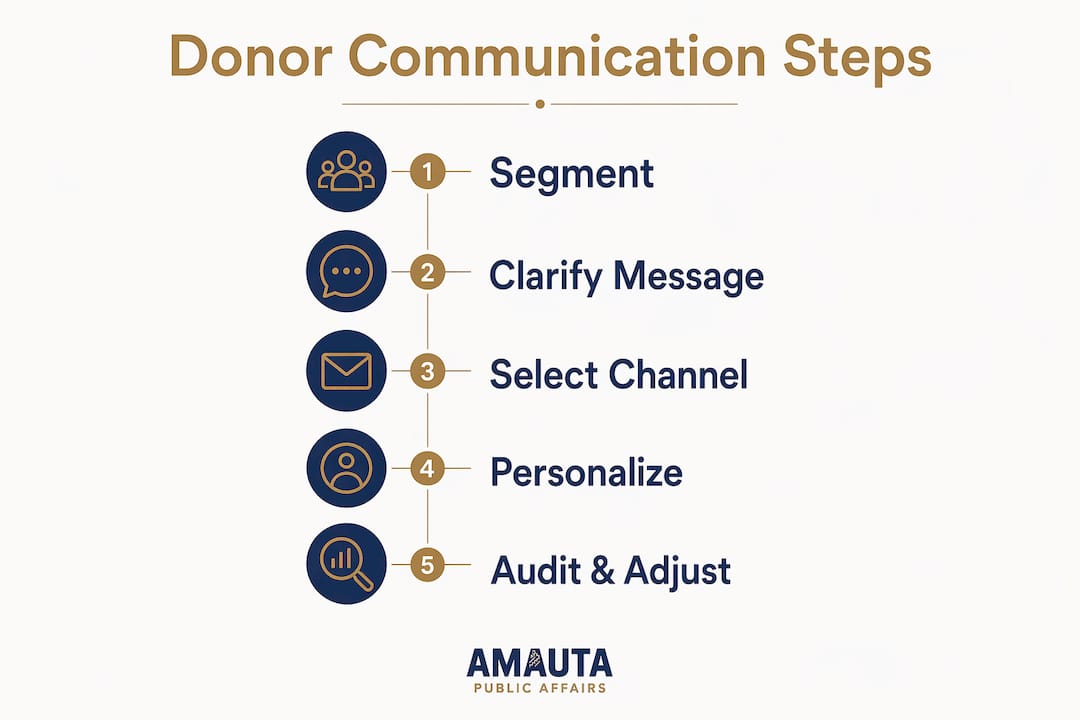
An effective donor communication strategy rests on four structural pillars: segmentation, message clarity, channel selection, and stewardship integration. Each pillar reinforces the others, and weakness in one undermines the whole system.
Segmentation is the starting point. Grouping donors by giving history, engagement level, and stated interests allows your team to send messages that feel relevant rather than generic. A first-time donor needs a different message than a ten-year recurring supporter.

Message clarity means every communication has a single purpose. One story. One call to action. Donors who receive cluttered emails with multiple asks and competing narratives disengage faster than those who receive focused, purposeful messages.
Channel selection requires matching the medium to the message. Email remains the workhorse of nonprofit outreach, but SMS open rates exceed 90%, making text messaging the right tool for urgent, time-sensitive asks. Phone calls carry the highest personal weight and work best for major donors.
Stewardship integration means weaving non-transactional relationship messages into the calendar alongside fundraising asks. The AFP Global framework recommends treating stewardship as a separate function from marketing, with its own voice, goals, and metrics.
Segment donors into at least three core groups: new, recurring, and major
Define the communication goal for each message before writing it
Build a 12-month calendar with outreach touchpoints mapped by segment
Assign ownership for stewardship communications separately from fundraising asks
Review channel performance quarterly and adjust based on open and response rates
Pro Tip: Before building your calendar, audit your last 12 months of outreach. Count how many messages were asks versus relationship-building touches. If the ratio is inverted from 3:1, you have a retention risk.
How does personalization and data-driven outreach enhance donor communication?
Personalization is the single greatest differentiator between donor communications that retain supporters and those that lose them. Generic program-focused messaging tells donors what your organization does. Personalized messaging tells donors what they made possible.
The most effective framing is donor agency: phrases like “Because you gave, this happened” engage donors more effectively than any description of organizational achievement. Donors recognize when they are positioned as the hero of the story, and that recognition builds loyalty.
Data-driven outreach takes personalization further. Predictive analytics and donor scoring models allow nonprofits to identify when a donor is most likely to give, what cause area resonates most, and what communication channel they prefer. This approach moves toward what practitioners call N=1 communications, tailoring each interaction to the individual rather than the segment. That level of specificity was once available only to major gift officers managing small portfolios. Technology now makes it accessible at scale.
Use giving history to predict the right ask amount and timing
Reference the donor’s specific past gift in every stewardship message
Apply behavioral data to identify lapsed donors before they fully disengage
Balance urgency with hope in crisis messaging to prevent emotional shutdown
Avoid one-size-fits-all annual fund appeals to your most engaged supporters
Balancing urgency with hope is a discipline, not an instinct. Crisis messaging that leans too hard on urgency triggers emotional shutdown in donors, reducing response rates. The most effective appeals pair a clear problem with a credible, hopeful solution the donor can fund.
What is the recommended communication cadence and content mix?
Cadence matters more than volume. Quarterly outreach that remains donor-focused sustains awareness and trust better than high-frequency messaging across every available platform. Donors do not disengage because they hear from you too rarely. They disengage because what they hear feels irrelevant or transactional.
The 3:1 stewardship-to-solicitation ratio is the practical expression of this principle. For every fundraising ask, send three relationship-building messages: an impact story, a program update, or a personal thank-you. This ratio prevents fatigue and keeps donors emotionally connected between campaigns.
Content type | Purpose | Recommended frequency |
Impact story | Show donor agency and mission results | Monthly or bi-monthly |
Program update | Build transparency and organizational trust | Quarterly |
Personal thank-you | Acknowledge the gift and the giver | Within 48 hours of gift |
Fundraising ask | Solicit a specific gift | No more than 1 per 3 touches |
Event or engagement invite | Deepen relationship beyond giving | 2–4 times per year |
The 48-hour impact touch after a gift is the single most effective retention practice in nonprofit fundraising. A personal call, a handwritten note, or a specific email referencing the donor’s gift signals immediate appreciation. That signal is more powerful than any year-end campaign.
Pro Tip: Use SMS for your 48-hour thank-you only when you have an established relationship with the donor. For new donors, a personal email or call lands better and sets the right tone for the relationship.
How can nonprofits integrate storytelling and authentic voice?
Storytelling is not a content tactic. It is the primary mechanism through which donors connect their identity to your mission. The most effective nonprofit storytelling centers one person, one moment, and one outcome per message. Complexity dilutes emotional impact.
Authentic voice means writing the way your organization actually speaks, not the way a grant application reads. Donors respond to transparency, specificity, and human language. Avoid mission-statement prose in donor communications. Write as if you are telling a friend what happened because of their gift.
Lead every story with a specific person or moment, not a statistic
Pair one qualitative story with one quantitative result to satisfy both emotional and rational donors
Make the donor the agent of change, not the organization
Use social norming techniques like peer-giving data to show community involvement and normalize participation
Avoid marketing jargon; replace it with plain, direct language
Giving donors multiple engagement options beyond a financial ask deepens the relationship without pressure. Invite them to a site visit, a webinar, or a volunteer shift. Donors who engage in multiple ways give more consistently over time.
What practical steps can nonprofits take to implement a donor communication strategy?
Implementation requires clear ownership, a repeatable system, and a willingness to audit what is not working. The following steps provide a pathway from concept to execution.
Assign a stewardship owner. One person or team must be accountable for non-transactional donor communications. Without clear ownership, stewardship defaults to the fundraising team and becomes transactional by default.
Build a 12-month communication calendar. Map every donor touchpoint by segment, channel, and content type. A calendar makes the 3:1 ratio visible and prevents last-minute, reactive messaging.
Segment your donor base into three core groups. New donors need onboarding and orientation. Recurring donors need recognition and deepening. Major donors need personal, high-touch stewardship separate from mass communications.
Audit your current outreach against best practices. Review the last year of communications and count asks versus relationship touches. Align recognition programs with actual donor behavior to confirm your messaging reflects what donors actually gave.
Use technology to automate without depersonalizing. Automation handles timing and delivery. Personalization handles content. The two are not in conflict when your data is clean and your segments are well-defined. Explore email advocacy tools to scale personalized outreach without losing the human tone.
Review and refine quarterly. Track open rates, response rates, and retention by segment. Adjust channel mix, content type, and cadence based on what the data shows, not what feels comfortable.
Key Takeaways
Effective donor communication strategy works by combining segmentation, stewardship ratios, personalized messaging, and consistent cadence to build trust and sustain long-term giving.
Point | Details |
Use the 3:1 ratio | Send three relationship-building messages for every one fundraising ask to prevent donor fatigue. |
Personalize with donor agency | Reference each donor’s specific gift and frame impact as something they personally made possible. |
Act within 48 hours | A personal touchpoint within 48 hours of a gift is the most effective donor-retention practice available. |
Separate stewardship from marketing | Assign distinct ownership and voice to stewardship communications to keep them relationship-focused. |
Cadence beats volume | Consistent quarterly outreach outperforms high-frequency messaging across too many channels. |
The relationship-first principle most nonprofits underestimate
After working across public affairs and community engagement campaigns, the pattern I see most often is this: nonprofits invest heavily in acquisition and almost nothing in the relationship that follows. They celebrate the new donor and then treat that person like a name on a list.
The 48-hour impact touch is not a tactic. It is a signal about organizational culture. When leadership prioritizes that call or note, it tells the entire team that relationships matter more than the next campaign. When it gets skipped because “we’re too busy,” donors feel it, even if they cannot name why they stopped giving.
Technology creates a real opportunity here, but only if the underlying data is honest. I have seen organizations deploy sophisticated donor scoring models on top of messy, unaudited CRM data. The result is personalization theater: messages that feel targeted but reference the wrong gift amount, the wrong program, or the wrong year. That erodes trust faster than a generic appeal.
The organizations that get this right treat stewardship as a leadership function, not a communications task. They audit their recognition programs against actual donor behavior. They separate the stewardship voice from the fundraising voice. And they build calendars that make the 3:1 ratio a structural commitment, not an aspiration. That discipline is what separates organizations with strong retention from those perpetually chasing new donors to replace the ones they lost.
— Ignacio
How Amautapublicaffairs supports your donor communication strategy
Amautapublicaffairs brings a campaign-style approach to nonprofit communication challenges, combining community engagement expertise with messaging strategy built for real-world complexity. Whether you are building a donor communication plan from scratch or refining an existing system, the team applies data-driven analysis and personalized outreach frameworks to fit your specific organizational context.
From digital infrastructure that supports automated yet personal outreach, to messaging strategy grounded in stewardship best practices, Amautapublicaffairs delivers results-oriented consulting tailored to your donor base. Explore the full range of nonprofit communication services and find the right starting point for your organization.
FAQ
What is a donor communication strategy?
A donor communication strategy is a structured plan that guides how a nonprofit engages supporters through personalized, timely, and relationship-centered messages. It combines segmentation, channel selection, stewardship ratios, and content planning to sustain donor trust and giving over time.
What is the recommended stewardship-to-solicitation ratio?
The widely recommended benchmark is a 3:1 ratio: three relationship-building communications for every one fundraising ask. This ratio prevents donor fatigue and keeps supporters emotionally connected between campaigns.
How soon should nonprofits follow up after a gift?
A personal touchpoint within 48 hours of a gift is the most effective donor-retention practice in nonprofit fundraising. A call, handwritten note, or personalized email referencing the specific gift signals immediate appreciation and strengthens the relationship.
How does personalization improve donor engagement?
Personalized messaging that highlights donor agency, framing impact as something the donor personally made possible, engages supporters more effectively than generic program-focused communications. Data-driven approaches allow nonprofits to tailor timing, channel, and content to individual donor behavior.
How often should nonprofits communicate with donors?
Consistent quarterly outreach sustains donor awareness and trust better than high-frequency messaging across multiple platforms. The key is relevance and focus: each message should have a single purpose and speak directly to the donor’s connection to the mission.
Recommended
Comments