
Administrative Record: A Practical Guide for Project Sponsors
- ibarragan7
- Aug 3
- 11 min read

An administrative record is the curated set of non-deliberative documents an agency relied on when making a final decision, assembled so a court can review that decision under the Administrative Procedure Act. Put plainly: it is the paper trail that proves an agency’s decision was reasoned, lawful, and grounded in evidence.
Three contexts drive most of the practical demand for administrative records:
Judicial review — courts reviewing agency action under the APA are limited to the administrative record; what is not in the record generally cannot be used to defend or challenge the decision.
Public transparency — the record documents that the agency considered public comments, contrary evidence, and alternatives before deciding.
Project defense — for permitting, cleanup, or rulemaking decisions, a complete record is the first line of defense against reversal or remand.
Understanding the definition of administrative record is prerequisite knowledge for anyone managing a federal permitting project, responding to a CERCLA cleanup order, or supporting an agency through rulemaking. The sections below unpack the legal role, typical contents, compilation process, and a practical checklist you can use starting today.
Table of Contents
Where do you encounter an administrative record?
Administrative records surface across a wide range of federal decision types. Recognizing which decisions require one, and who will eventually request it, is the first step toward building a defensible record from day one.
Common decision contexts:
Informal rulemaking — a final rule published in the Federal Register; the record supports the agency’s response to public comments and the legal basis for the rule.
NEPA/EIS permitting — an Environmental Impact Statement or Environmental Assessment for a highway, pipeline, or energy project; the record captures all studies, agency consultations, and public input.
CERCLA response actions — EPA’s remedy selection for a Superfund site; the record must explain why a particular cleanup approach was chosen and include public comments with EPA responses.
Agency licensing and permits — major federal permits (Section 404, Section 7 consultations under the Endangered Species Act, FERC licenses); the record documents the factual and legal basis for approval or denial.
Internal decisions subject to litigation — any agency action a party might challenge in federal court, even if no formal public process was required.
Who uses or requests the record? Courts and litigants are the primary audience when a decision is challenged. Project sponsors and their counsel review the record to assess litigation exposure. Federal agencies file it with the court. Members of the public may access portions through FOIA or a public docket, though the public docket and the certified administrative record for judicial review are not the same thing. That distinction gets its own section below.
What is the administrative record’s legal role under the APA?
The administrative record sits at the center of federal judicial review. Under the APA, a court reviewing an agency action asks whether the decision was “arbitrary, capricious, an abuse of discretion, or otherwise not in accordance with law.” To answer that question, the court looks at the whole record, not just the materials the agency chose to highlight.

EPA guidance defines the administrative record filed with a court as the set of non-deliberative documents the decision-maker actually considered, and it must include information that supports and contradicts the decision. That last point matters: a record that contains only favorable materials is not a complete record.
The Administrative Conference of the United States (ACUS) recommends that agencies maintain three separate compilations: an internal rulemaking record, a public docket, and an administrative record for judicial review. Each serves a distinct purpose and is compiled differently. Conflating them, or treating the public docket as the judicial record, is one of the most common and costly mistakes agencies and project teams make.
DOJ guidance and agency practice memoranda reinforce this framework. The Department of the Interior’s standardized guidance, for example, instructs bureaus and offices to create decision files contemporaneously with agency decisions, precisely because retroactive reconstruction is both unreliable and legally vulnerable.
What documents belong in an administrative record?
The record contains non-deliberative materials the decision-maker considered, not internal drafts or candid staff opinions. EPA guidance identifies the following as typical contents:
Proposed actions and alternatives considered
Technical analyses and engineering reports
Scientific data, risk assessments, and modeling results
Maps, site characterization data, and sampling records
Transcripts of public meetings and hearings
Public comments received and the agency’s written responses
Significant correspondence with other agencies, tribes, or stakeholders
Legal consultations (non-privileged portions)
Mandatory economic impact analyses
Contractor reports and third-party studies
Grouped by decision type:
Decision Type | Typical Record Contents |
EIS/NEPA permitting | Purpose and need statement, alternatives analysis, biological assessments, Section 7 consultation letters, public scoping comments, agency coordination letters |
Informal rulemaking | Proposed rule, public comments, agency responses, economic analyses, technical studies cited in the preamble |
CERCLA remedy selection | Remedial investigation, feasibility study, proposed plan, public comments, responsiveness summary, risk assessment |
Agency licensing/permits | Application, technical review, interagency consultation records, public notice, objections received, decision document |
One document type that practitioners sometimes overlook: contrary evidence. Materials that challenge the agency’s preferred outcome belong in the record. Omitting unfavorable studies or critical public comments can appear as an attempt to conceal the actual basis for the decision, which courts treat as a serious deficiency.
How is an administrative record compiled, and when?
The record should be compiled continuously and contemporaneously from the moment a project or rulemaking begins, not reconstructed after a decision is signed. U.S. Fish and Wildlife Service policy is explicit: compiling the record retroactively after litigation is a failed practice. Memory reconstruction introduces gaps, and courts can tell.
The process in practice:
Project inception — designate a records coordinator and open a decision file. Every document generated or received that relates to the decision goes into the file.
Throughout the project — the project manager, technical leads, and records coordinator capture materials as they are created or received. Counsel reviews periodically to flag privilege issues.
At decision signature — the decision file is reviewed, deliberative materials are filtered out with counsel’s guidance, and the remaining documents are indexed and organized as the administrative record.
Post-decision — the record is preserved securely. If litigation is filed, the certified record is compiled and filed with the court.
Responsibility matrix:
Role | Primary Responsibility |
Project manager | Continuous capture; ensures nothing is discarded |
Records coordinator | Indexing, metadata, file organization |
Technical lead | Accuracy of scientific and engineering materials |
Counsel | Privilege review; filters deliberative materials; certifies |
Decision-maker | Signs the decision; confirms the record reflects what was considered |
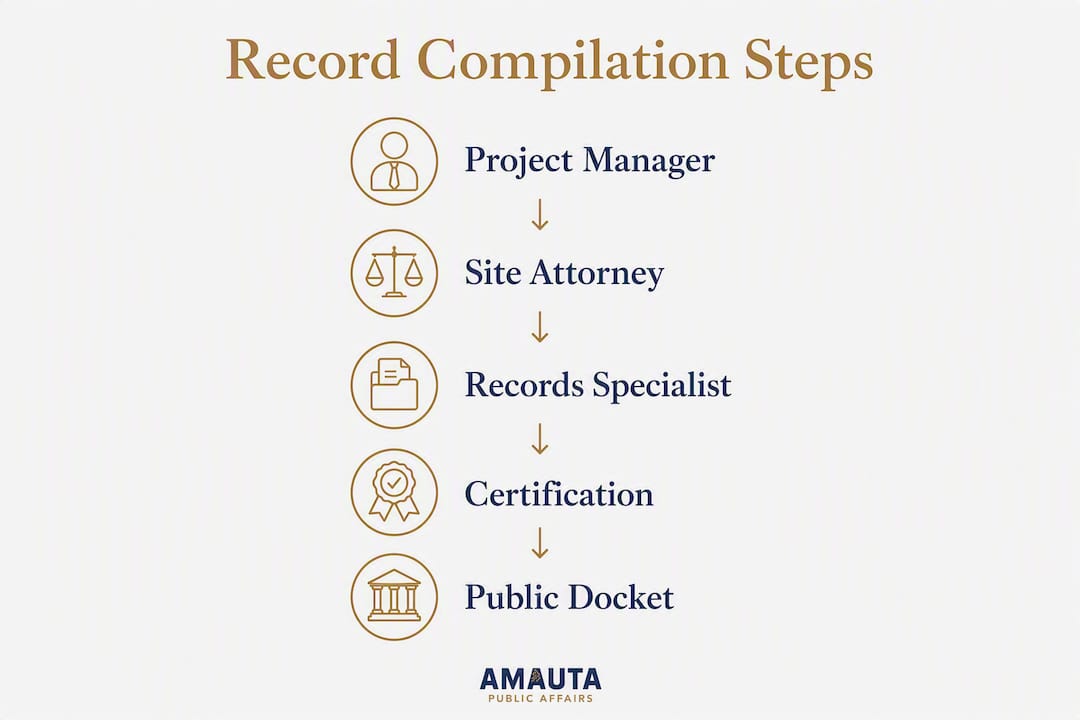
For complex CERCLA site work, EPA guidance recommends coordinating the remedial project manager, site attorney, records coordinator, and technical leads so the record tells a coherent story linking contaminants, risk assessments, alternatives considered, and the rationale for the chosen response.
Pro Tip: The public docket (the file open for public inspection during a rulemaking or permitting process) and the certified administrative record for judicial review are not the same thing. The docket is broader and includes materials the agency may not have relied on. The judicial record is a curated subset. Treat them as separate files from day one.
How do archival definitions differ from the legal administrative record?
The Society of American Archivists defines “administrative records” in an archival context as materials relating to internal operations and management, such as personnel files, budget documents, meeting minutes, and routine correspondence. This archival meaning is broader, often transitory, and focused on organizational housekeeping rather than decision defense.
The legal/regulatory administrative record is narrower and purpose-built: it contains only the materials a decision-maker considered when reaching a specific final decision, filtered to exclude deliberative process materials, and certified for court.
Dimension | Archival Administrative Records (SAA) | Legal/Regulatory Administrative Record |
Context/usage | Internal operations, records management, institutional memory | Specific agency decision subject to judicial review |
Typical contents | Personnel files, budgets, meeting minutes, routine correspondence | Technical analyses, public comments, scientific data, legal consultations |
Who compiles/certifies | Records manager or archivist | Records coordinator, project manager, and counsel |
Public access | Often subject to FOIA; retention schedules vary | Public docket is accessible; certified judicial record is filed with court |
Timing/logistics | Ongoing; follows retention schedules | Compiled contemporaneously; finalized at decision; filed if litigated |
Conflating these two meanings creates real litigation risk. An agency that treats its archival housekeeping files as the judicial administrative record may discover that critical technical analyses, public comment responses, or contractor reports were never captured in a single, certifiable file. SAA guidance and ACUS both warn that agencies must maintain the internal decision file separately from public dockets and general records management systems.
What is a certified administrative record, and how do courts treat it?
A certified administrative record is the version of the record that an agency’s authorized official attests, under oath or official certification, is complete and accurate as of the date of the final decision. It is filed with the federal court when litigation is initiated.
Courts reviewing agency action under the APA generally limit their review to the certified record. A judge will not consider new evidence or arguments that were not before the agency at the time of the decision. This principle, known as record review, means the completeness of the record at the time of the decision is everything.
When a record is incomplete, courts have several remedies available. They may order the agency to supplement the record with materials that were actually before the decision-maker but were omitted. In narrower circumstances, they may permit limited discovery. Most consequentially, a court may find the agency’s decision arbitrary and capricious and remand or reverse it entirely, requiring the agency to restart the decision process.
Consider a permitting scenario: an agency issues a major infrastructure permit but fails to include the biological assessment it received from the U.S. Fish and Wildlife Service. A challenger argues the agency ignored species impacts. Because the biological assessment is missing from the certified record, the agency cannot demonstrate it was considered. The court remands the permit. The project loses months or years.
An incomplete or retroactively compiled record is the single most preventable cause of permit reversal in federal court.
Checklist for compiling a defensible administrative record
Following this checklist reduces litigation risk and supports the transparency that makes agency decisions durable. It is designed for project managers, records coordinators, and counsel working on permitting, rulemaking, or response action decisions.
Open a decision file at project inception. Designate a records coordinator on day one. Every document generated or received that relates to the decision enters the file immediately.
Capture materials continuously. Do not batch-collect at the end. FWS and EPA practice guidance both treat contemporaneous capture as the baseline standard.
Index and add metadata as you go. Document title, author, date, recipient, and relevance to the decision. A searchable index is not optional; lack of indexing prolongs litigation and increases discovery risk.
Include contrary evidence. Technical studies, public comments, and agency correspondence that challenge the preferred outcome belong in the record. Their presence demonstrates deliberation.
Capture all public comments and agency responses. Every comment received during a public participation period, and every written response, must be preserved and included.
Coordinate with counsel before finalizing. Deliberative, predecisional materials (internal drafts, candid staff opinions) must be filtered out. Work with counsel to apply deliberative process protections correctly without stripping factual or technical materials.
Prepare a final index and certification. The index should list every document by title, date, author, and document number. The certifying official attests the record is complete and accurate.
Preserve the record securely. Once certified, the record should be stored in a format that prevents alteration. For digital records, proper chain-of-custody and litigation data preservation protocols apply.
File promptly if litigation is initiated. Coordinate with DOJ or agency counsel to meet court-ordered filing deadlines for the certified record.
Pro Tip: Use digital advocacy and engagement platforms that export comment data with timestamps and metadata already attached. This eliminates a common indexing gap and makes the public comment portion of the record audit-ready from the moment comments close.
Common mistakes that weaken an administrative record
Some widespread practices undermine a record’s defensibility before litigation even begins. Recognizing these red flags early gives a team time to remediate.
Late-added documents — Adding materials to the record after the decision-maker signed the decision is prohibited. EPA guidance is unambiguous: the record cannot be cured by post-decision document creation.
When red flags appear, the immediate steps are: stop altering or adding to the file, implement a document preservation hold, and consult counsel before taking any further action on the record.
Key Takeaways
A defensible administrative record is built continuously from project inception, includes contrary evidence, and is certified by counsel before filing with a court.
Point | Details |
Core definition | An administrative record is the curated set of non-deliberative documents an agency relied on when making a final decision. |
Legal role under the APA | Courts limit review to the certified record; an incomplete record can result in remand or reversal of the agency’s decision. |
Contemporaneous compilation | Compile the record from day one; retroactive reconstruction is unreliable and legally vulnerable under FWS and EPA guidance. |
Include contrary evidence | Omitting unfavorable studies or comments signals arbitrary decision-making and weakens the record’s defensibility in court. |
Amautapublicaffairs support | Amautapublicaffairs provides records-ready stakeholder engagement and permitting support, helping project sponsors build complete, defensible records from project inception. |
Why records-ready engagement changes the outcome
The most underappreciated risk in permitting and rulemaking is not the legal standard itself. It is the gap between what an agency or project sponsor did during the decision process and what the administrative record can actually prove they did. Those two things are not always the same, and courts only see the second one.
Public engagement that is well-documented, transparent, and structured around the record’s evidentiary needs is a fundamentally different practice from engagement that is designed only to satisfy a public notice requirement. When stakeholder communication strategies are built with the record in mind, every comment received, every response issued, and every community meeting transcript becomes a document that strengthens the agency’s or sponsor’s position in court, not a loose file that may or may not surface later.
The practitioners who understand this distinction tend to move projects through permitting faster, with fewer remands, and with stronger community relationships. Those who treat engagement as a box to check and recordkeeping as an afterthought often find themselves explaining to a federal judge why the biological assessment is missing from the file.
The ACUS framework, the APA’s whole-record standard, and EPA’s guidance all point to the same conclusion: the record is not a post-decision formality. It is the decision, documented in real time.
How Amautapublicaffairs supports records-ready permitting
Project sponsors managing land use, energy, or infrastructure approvals face a specific challenge: the public engagement process that builds community support must also generate the documentation that defends the project in court. Those two goals require the same discipline, applied from the start.

Amautapublicaffairs brings a campaign-style approach to permitting support and community engagement, with services structured to keep the administrative record defensible at every stage. Working alongside project counsel, the team ensures that public participation is documented, comment responses are substantive and preserved, and the engagement record tells a coherent story that holds up under judicial scrutiny.
Relevant services include:
Digital advocacy — with comment capture and metadata tracking
To discuss how Amautapublicaffairs can support your next permitting or rulemaking project, visit the services page or explore the firm’s land management practice for project-specific guidance.
Authoritative sources and further reading
The sources below are primary government and professional references for administrative record practice in the United States. Each is annotated with its primary use.
Source | What It Provides |
ACUS Handbook on Compiling Administrative Records | Best practices for distinguishing internal rulemaking records, public dockets, and judicial records; recommended by the Administrative Conference of the United States |
Core EPA guidance on what belongs in a record, the prohibition on post-decision additions, and the requirement to include contrary evidence | |
Revised Guidance on Compiling Administrative Records for CERCLA Response Actions | Detailed EPA guidance for Superfund remedy selection records, including public comment requirements and judicial review implications |
U.S. Fish and Wildlife Service — Compiling a Decision File and Administrative Record | FWS policy on contemporaneous recordkeeping and the distinction between decision files and administrative records |
SAA Dictionary: administrative record | Society of American Archivists definition; essential for understanding the archival meaning and avoiding conflation with the legal/regulatory record |
LII / Legal Information Institute | Statutory definition of “administrative record” as a compilation of all materials before the agency at the time of its final decision |
For litigation-specific questions about compiling, certifying, or supplementing an administrative record, consult qualified legal counsel with federal administrative law experience. The sources above provide general guidance; specific cases turn on the governing statute, the agency’s own procedures, and the facts of the decision at issue.
Recommended
Comments