
Build a Cross-Sector Sustainability Coalition That Scales

Launch a narrowly scoped, time-bound pilot led by an anchor stakeholder while you map the system and lock simple governance and shared KPIs. That sequence, in that order, is what separates coalitions that produce real systemic outcomes from the ones that stall in their charter phase. An anchor-funded pilot generates proof points fast, which is what unlocks the next round of partners and money.
Four steps make up the fast-start version:
Map the system and draft a one-page shared problem statement before recruiting anyone.
Recruit an anchor stakeholder plus two or three complementary partners, not a dozen.
Set minimal governance: a steering group, a secretariat function, and clear decision rights.
Secure seed funding for a bounded pilot and define three to four shared metrics up front.
Pro Tip: Broad, value-chain-spanning coalitions are about four times more likely to scale their sustainability outcomes than narrower, single-industry groups, according to BCG research. Recruit width before depth. Frameworks like Collective Impact and the Consolidated Framework for Collaboration Research (CFCR) exist precisely because ad hoc coalitions repeat the same governance mistakes. AMAUTA Public Affairs has watched land-use and infrastructure alliances succeed and fail on exactly this sequencing.
Key Takeaways
A cross-sector sustainability coalition succeeds when an anchor stakeholder funds a bounded pilot while partners share governance, a joint fact base, and measurable KPIs from day one.
Point | Details |
Start with a fact base | Map the system and draft a one-page shared problem statement before recruiting partners. |
Recruit for role, not size | Choose an anchor stakeholder plus complementary partners who each bring distinct resources. |
Keep governance minimal | Use a steering committee, working groups, and a funded secretariat to manage coordination. |
Pilot before you scale | Test with two to four measurable KPIs and a defined evaluation checkpoint. |
Get execution support | Amautapublicaffairs provides secretariat, engagement, and funding-strategy services for coalitions moving from pilot to scale. |
Table of Contents
Is a Cross-Sector Sustainability Coalition the Right Move?
A coalition earns its overhead when the problem is systemic, no single actor controls enough resources to fix it, and community legitimacy determines whether a project survives permitting or public comment, which is why it’s important to learn how to use your business to make a difference through pooled purchasing and sustainability savings. Watershed restoration, regional decarbonization, and contested land-use corridors all fit this profile because they demand pooled purchasing power, shared political cover, or cross-jurisdictional data no one party holds alone.
Skip the coalition model when you need fast, single-actor delivery, when stakeholder interdependence is low, or when existing regulation already gives you a clear compliance path. Coordination costs grow with every added partner, so weigh your funding horizon and political risk honestly. A twelve-month grant with low controversy rarely justifies a formal steering committee.
How Do You Map the System and Build a Shared Fact Base?
Every credible coalition starts with a joint fact base, not a mission statement. Skipping this step is the single most common reason partners fall apart before the first pilot begins.
Run a landscape scan of existing initiatives, regulations, and funding streams touching the problem.
Build a stakeholder map that scores each actor on influence, legitimacy, and resource control.
Trace the value chain to locate where environmental or social harm concentrates.
Run a hotspot analysis to prioritize which two or three issues the coalition will actually tackle first.
Synthesize findings into a one-page joint fact base every prospective partner reviews and signs off on before joining.
A useful problem statement follows a simple template: “[Affected population] experiences [specific harm] because [systemic cause], and no single actor currently has the mandate or resources to fix it.” Splitting a broad sustainability vision into segments like this gives partners something concrete to negotiate around instead of vague aspiration. When commissioning a systems map or running a mapping workshop, use this prompt: “Show every actor who touches this problem, where money and authority concentrate, and where the biggest gaps in accountability sit.”
Who Should You Recruit, and Who Plays the Anchor Role?
Partner selection follows role, not headcount. You need an anchor funder or convenor, a technical lead, a community representative, an implementation partner, an evaluator, and a broker or secretariat function. Each brings something distinct: convening power, domain expertise, lived experience, delivery capacity, independent measurement, or day-to-day coordination.
Vet every candidate against capacity, demonstrated commitment, what resources they actually contribute, potential conflicts of interest, and their track record in prior collaborations.
Does the partner control a budget line, or only goodwill?
Have they finished a multi-year commitment before, or dropped out mid-cycle?
Would their participation create a conflict with another coalition member’s interests?
The anchor stakeholder, often a philanthropic funder or a private actor with a longer time horizon, accepts more risk than anyone else at the table. Their willingness to fund an unproven pilot is usually what moves a coalition from concept to launch within months instead of years.
What Governance and Funding Model Actually Works?
Governance should be minimal enough to launch fast and durable enough to survive turnover. A steering committee sets direction, working groups handle execution, and a funded secretariat or coordinator manages the daily friction of running a multi-party effort. Coordination effort grows nonlinearly as you add stakeholders, since every new partner adds several new relationships to manage, so a dedicated coordinator often decides whether a coalition survives past its second year.
Realistic funding models include:
Anchor seed funding to cover the first twelve to eighteen months.
Pooled grants from multiple philanthropic or public sources.
Cost-sharing agreements tied to each partner’s proportional benefit.
Fee-for-service arrangements for technical or evaluation work.
A pathway toward public funding once pilot results exist.
Document three things at minimum: a one-page terms of reference, an annual public progress report, and written conflict-of-interest rules. The SDG Partnership Guidebook offers templates for all three that adapt easily to a city-level or regional coalition.
How Do You Build Trust and Include Community Voice?
Trust gets built through repetition, not a single kickoff meeting. Facilitated one-on-one conversations, a shared glossary that removes jargon barriers, and regular informal touchpoints between formal meetings all signal that partners are staying engaged between milestones. Senior-level attendance, not just delegate attendance, tells community partners the coalition is serious.

Inclusion needs mechanics, not intentions: reserve governance seats for community representatives, compensate their time the same way you’d compensate a technical consultant, and build co-creation protocols into how decisions actually get made. Accessible communication formats, plain-language summaries, translated materials, evening meeting times, remove barriers that quietly exclude the people most affected by the project.
Pro Tip: Peer accountability, meaning regular public progress reports with partner-level milestones, tends to drive long-term compliance better than heavy legal enforcement. Publishing your own shortfalls builds more credibility than hiding them.
How Do You Pilot, Measure, and Prepare to Scale?
Scope a bounded pilot with a defined end date, not an open-ended initiative. Define two to four measurable KPIs that span social, environmental, and operational dimensions, assign clear data ownership to one partner per metric, and set an evaluation checkpoint before the pilot’s midpoint.
Choose KPIs like tons of emissions displaced, number of households engaged, and cost per unit of impact.
Monitor monthly for operational metrics, quarterly for outcome metrics.
Watch for unintended harms early, displacement effects, unequal benefit distribution, so you can correct course before scaling.
Package pilot results into a short evidence brief that shows funders and prospective partners exactly what worked.
Pilot data is your best recruitment tool. A coalition that can point to a completed pilot with real numbers moves faster in its next funding conversation than one still selling a concept.
How Do You Manage Partner Heterogeneity and Wicked Problems?
Competing goals are not a failure of planning, they’re the normal condition of any coalition spanning sectors with different incentive structures. Run a tradeoff-mapping exercise early: list where partners’ short-term wins conflict with the coalition’s systemic goals, and decide explicitly which sequencing you’ll accept. Set clear rules up front for sensitive commercial or intellectual property issues so no partner feels blindsided later.
A conflict protocol needs three parts: a mediation step before anything escalates, a defined escalation ladder for unresolved disputes, and transparent criteria for when a partner’s role gets rebalanced or the partner exits entirely.
Sustainability alliances confront genuinely wicked problems, and the deciding managerial challenge is moving from formation to operational stability by building relationships grounded in trust and reciprocity rather than leaning on contracts alone.
Alliance management capability helps sustain these partnerships over time, but in highly formalized organizations it can actually dampen the benefits of simple goal alignment. The lesson: build enough process to function, not so much that it strangles the coalition’s ability to adapt.
Which Frameworks and Evidence Should Guide Your Design?
Two frameworks do most of the heavy lifting. Collective Impact, developed by Kania and Kramer, supplies the vision, shared measurement, and mutually reinforcing activities model useful at coalition launch. The Consolidated Framework for Collaboration Research organizes collaboration into seven domains, community context, composition, structure, dynamics, social capital, and activities, useful once you’re diagnosing why a mature coalition is underperforming.
Pull your vision and shared metrics language from Collective Impact.
Pull your structural diagnostic checklist from CFCR.
Remember the 4x scaling advantage tied to broad value-chain participation when you’re tempted to keep the coalition narrow.
What Does a 6 to 12 Month Starter Roadmap Look Like?
Months 0 to 2: Complete the landscape scan and stakeholder map; identify and secure commitment from your anchor stakeholder.
Months 2 to 4: Recruit complementary partners, draft governance terms of reference, and finalize the joint fact base.
Months 4 to 6: Design and launch the pilot with shared KPIs assigned to specific data owners.
Months 6 to 9: Run the first evaluation checkpoint; use results to attract follow-on funding.
Months 9 to 12: Package pilot evidence into a public report and open recruitment for the scaling phase.
Each phase transition should be triggered by evidence, a signed partner commitment, a completed fact base, a pilot evaluation, not by the calendar alone.
What Lessons Hold Up Across Land-Use Coalitions?
The pattern I’ve seen hold up across land-use and infrastructure coalitions is consistent: anchor-backed pilots move faster than consensus-first processes, early visible community wins buy patience for the slower systemic work, and transparent communication prevents the small disputes that otherwise kill momentum. Review documented outcomes in AMAUTA’s coalition case studies for a sense of how this plays out in practice.
How AMAUTA Public Affairs Supports Coalitions From Launch to Scale
Most coalitions don’t fail on strategy, they fail on execution capacity: nobody owns the secretariat function, nobody is running stakeholder outreach full-time, and community engagement gets treated as an afterthought instead of infrastructure. Amautapublicaffairs exists to fill exactly that gap for land-use, energy, and infrastructure coalitions that need a dedicated team rather than a part-time volunteer coordinator.
Our work maps directly onto the stages covered here: landscape and stakeholder mapping to build your fact base, secretariat services to keep governance running between meetings, community engagement and messaging strategy to build the trust your pilot depends on, and funding application support to translate pilot evidence into your next round of resourcing. If your coalition is touching permitting, energy systems, or contested land use, our land management services are built specifically for that terrain. Visit our services overview to see how we’d structure support for your coalition’s current stage, and reach out for a conversation about where you’re stuck.
Frequently Asked Questions
What’s the fastest way to build a cross-sector sustainability coalition? Secure an anchor stakeholder willing to fund a bounded pilot, then recruit two or three complementary partners around a shared fact base. Skip large, unfocused kickoff processes; they slow launch without adding legitimacy.
How many partners should a new coalition start with? Start small, an anchor plus two or three complementary partners, then expand once your pilot produces evidence. Coordination effort compounds with every added partner, so width should follow proof, not precede it.
What’s the difference between Collective Impact and CFCR? Collective Impact supplies the vision, shared metrics, and mutually reinforcing activities framework useful at launch. CFCR organizes collaboration into seven structural domains, useful for diagnosing why an established coalition is underperforming.
Who should serve as the anchor stakeholder? Typically a philanthropic funder or private actor with a longer time horizon and higher risk tolerance than other partners. Their willingness to fund an unproven pilot is often what determines how fast the coalition launches.
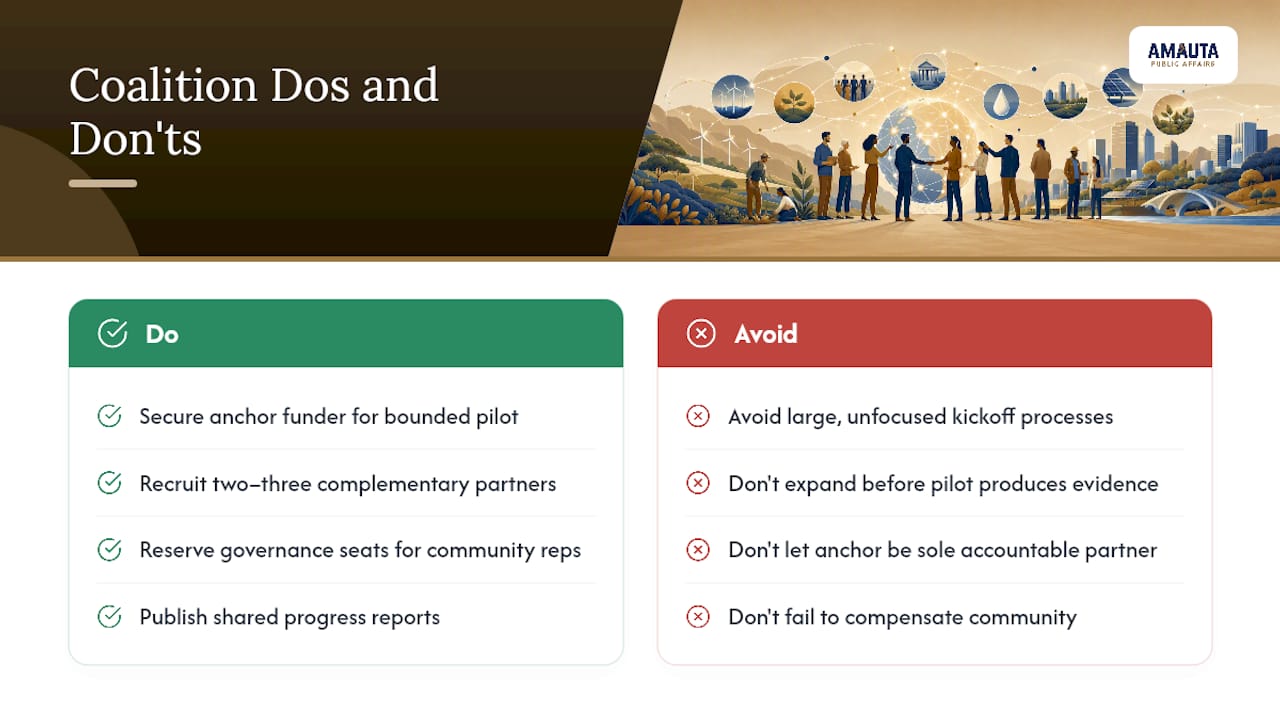
How do you keep community voice central once a coalition scales? Reserve governance seats for community representatives, compensate their participation, and publish progress reports that hold every partner, including the anchor, accountable to the same standard.
Sources
Recommended
Comments