
Campaign Communications Plan: A Guide for Local Leaders
- ibarragan7
- 11 hours ago
- 7 min read

A campaign communications plan is the operational document that specifies who needs what information, when they need it, through which channels it will be delivered, and who is responsible for delivering it. In the public affairs world, this document is the difference between a campaign that builds genuine community trust and one that generates confusion and opposition. Local government officials, community developers, and nonprofit leaders who understand what a campaign communications plan requires will run more effective, inclusive, and credible campaigns. The plan translates a broader campaign communication strategy into concrete, scheduled actions that teams can execute and measure.
What is a campaign communications plan and its core components?
A campaign communications plan is a structured blueprint that turns ad hoc messaging into predictable, accountable communication. The five core elements are goals and objectives, stakeholders and audiences, key messages, channels and frequency, and roles and owners. Each element depends on the one before it, which is why practitioners who skip audience analysis before choosing channels consistently produce misaligned messaging.
The elements of a campaign communications plan break down as follows:
Objectives. Every objective must be SMART: specific, measurable, achievable, relevant, and time-bound. “Increase community awareness of the rezoning proposal by 40% before the public hearing” is an objective. “Communicate better” is not.
Audiences and stakeholders. Segment your audiences by interest, influence, and information need. A local government campaign may address residents, business owners, advocacy groups, and elected officials, each requiring a different message frame.
Key messages. Each audience segment needs a tailored message that speaks to their specific concerns. A developer’s message to a neighborhood association differs from the message to a city planning board.
Channels and frequency. Match channels to audience habits. Older residents may rely on printed notices and community meetings. Younger residents engage through social media and email. Mixing digital and non-digital channels is not optional for inclusive campaigns. It is a prerequisite.
Roles and responsibilities. Every task needs a named owner and a deadline. Without this, plans become wish lists rather than working guides.
Feedback and evaluation. Build in checkpoints to assess whether messages are landing and whether participation reflects the full community.
Pro Tip: Draft your objectives before you write a single message. Objectives define what success looks like. Messages are only as strong as the goal they serve.
How does a communications plan support adaptive public engagement?
Adaptive engagement means adjusting your approach in real time based on who is and is not participating. Monitoring participation during public consultations and adjusting messaging for under-represented groups is critical for both credibility and inclusivity. A plan that does not include monitoring mechanisms is a static document, not a living guide.
The GOV.UK guidance on public engagement for local planning makes this point directly:
“Good engagement builds trust with diverse sources and requires a well-defined engagement strategy supported by a communications plan including clear purpose, target audience, and mixed engagement methods.” GOV.UK
Adaptive communication planning for public campaigns requires several active practices:
Track participation data by demographic and geography to identify gaps early.
Adjust messaging tone and format when specific groups are not engaging.
Offer non-digital participation options such as phone lines, printed materials, and in-person drop-in sessions.
Publish findings and updates online to maintain transparency throughout the campaign.
Schedule regular internal reviews to assess whether the plan reflects current campaign realities.
The importance of communication in campaigns is not just about volume. It is about reaching the right people with the right message at the right moment. Maintaining non-digital options protects accessibility for residents who are not online, which is a legal and ethical obligation for many local government consultations.
Amautapublicaffairs builds this adaptive layer into every campaign it manages. The firm’s community outreach approach treats participation monitoring as a core deliverable, not an afterthought.
What are the common pitfalls in campaign communications planning?
Most campaign communications plans fail for one of five predictable reasons. Recognizing these pitfalls before you build your plan is far more efficient than diagnosing them mid-campaign.
Confusing strategy with execution. Distinguishing strategy from the plan is the first discipline of effective communications. Strategy answers why. The plan answers what, how, and when. Teams that conflate the two spend meeting time debating positioning when they should be scheduling posts and printing flyers.
Failing to assign named owners. Plans without named owners and clear cadences produce vague intent, not results. Every task in the plan must have a person’s name and a due date attached to it.
Skipping mid-campaign evaluation. Measurable objectives and review cycles are what keep a plan relevant as a campaign evolves. Teams that never revisit the plan after launch often discover at the end that they measured nothing useful.
Relying on a single channel. No single channel reaches every stakeholder. Campaigns that go digital-only consistently under-represent older residents, lower-income communities, and people with limited internet access.
Ignoring accessibility in message design. Plain language, translated materials, and accessible formats are not extras. They are the baseline for any public-facing campaign that claims to be inclusive.
Pro Tip: Run a pre-launch audit of your plan. Ask: Does every task have a named owner? Does every audience segment have a tailored message? If the answer to either question is no, the plan is not ready.
How to create an effective campaign communications plan step by step
Constructing a communications plan by sequencing objectives first clarifies message purpose before channel selection. This prevents the common mistake of choosing platforms before understanding what you need to say or to whom.

The sequence that works is: objectives, then audiences, then messages, then channels, then timeline, then roles. Each step informs the next. Reversing the order, such as choosing social media before defining your audience, produces misaligned efforts that waste budget and time.
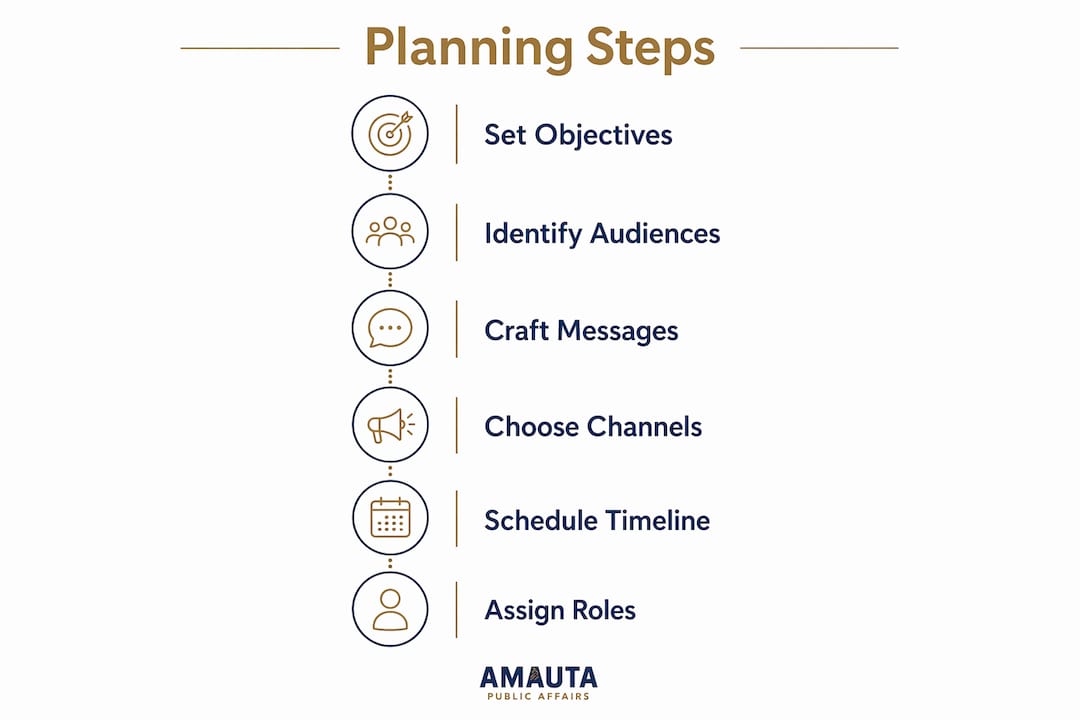
Step | Action | Output |
1. Set objectives | Define SMART goals for the campaign | Written objective statements |
2. Map audiences | Identify all stakeholder groups and their information needs | Audience segmentation matrix |
3. Develop messages | Write tailored key messages for each segment | Message guide by audience |
4. Select channels | Match channels to audience habits and accessibility needs | Channel plan with frequency |
5. Assign roles | Name owners for every task with deadlines | Responsibility matrix |
6. Build feedback loops | Define metrics and review schedule | Monitoring and evaluation plan |
Regular review and feedback mechanisms keep the plan aligned with stakeholder needs as the campaign progresses. Schedule a formal review at least every two weeks during active campaign periods. Use participation data, media coverage, and direct stakeholder feedback to inform adjustments.
Effective communication for campaigns also requires a clear escalation path. When a message generates unexpected opposition or a channel underperforms, the plan should specify who decides on the adjustment and how fast it happens. Teams that lack this clarity lose days to internal debate while the public narrative moves without them.
For local government officials managing public affairs strategy, the step-by-step approach above provides a replicable framework that scales from a neighborhood rezoning consultation to a citywide infrastructure campaign.
Key Takeaways
A campaign communications plan succeeds when it sequences objectives before channels, assigns named owners to every task, and builds in adaptive feedback loops to maintain inclusive and credible engagement throughout the campaign.
Point | Details |
Define objectives first | SMART objectives set the direction before any message or channel is chosen. |
Segment your audiences | Each stakeholder group needs a tailored message that addresses their specific concerns. |
Assign named owners | Every task must have a person and a deadline to move from intent to execution. |
Mix digital and non-digital | Inclusive campaigns maintain non-digital options to reach all community members. |
Build in review cycles | Regular evaluation keeps the plan relevant and participation credible throughout the campaign. |
Why the plan is the campaign’s most underrated asset
From my experience working on public affairs campaigns, the communications plan is almost always the last document teams take seriously and the first one they blame when things go wrong. That pattern is avoidable.
The plans that work are not the most elaborate ones. They are the ones where every row in the responsibility matrix has a real name, every message has been tested against a real audience segment, and every channel choice has a reason behind it. I have seen well-funded campaigns collapse because no one owned the community newsletter update. I have also seen under-resourced nonprofit campaigns punch well above their weight because someone built a simple, disciplined plan and actually followed it.
The adaptive layer is where most plans fall short. Integrating an adaptive process for fair and inclusive engagement is not a nice-to-have. It is what separates a consultation that builds trust from one that generates a legal challenge. If your plan does not tell you what to do when participation from a specific neighborhood drops below expectations, it is incomplete.
The best communication plan examples I have encountered treat the document as a living guide, not a filing cabinet artifact. Review it weekly. Update it when the campaign shifts. And never confuse having a plan with executing one.
— Ignacio
How Amautapublicaffairs supports your communications planning
Amautapublicaffairs brings a campaign-style discipline to public affairs that most organizations cannot build internally. The firm’s work spans community engagement, media relations, and digital advocacy, all structured around the kind of communications planning framework this article describes.
For local government officials, community developers, and nonprofit leaders who need a communications plan that actually drives participation and builds public trust, Amautapublicaffairs offers hands-on support from objective setting through post-campaign evaluation. The firm’s full range of services covers every phase of the planning process, including audience analysis, message development, channel strategy, and real-time monitoring. If you are ready to move from a vague communications intent to a working plan with named owners and measurable outcomes, connect with the team to start the conversation.
FAQ
What is a campaign communications plan?
A campaign communications plan is the operational document that defines who needs what information, when, through which channels, and who is responsible for delivering it. It translates a broader communication strategy into scheduled, accountable actions.
How is a communications plan different from a communications strategy?
A communications strategy defines the why and overall direction of a campaign’s messaging. A communications plan specifies the what, how, and when, turning strategy into concrete tasks with named owners and deadlines.
What are the core elements of a campaign communications plan?
The five core elements are objectives, audiences and stakeholders, key messages, channels and frequency, and roles and owners. A feedback and evaluation mechanism is the sixth element that keeps the plan relevant throughout the campaign.
Why is audience targeting critical in a communications plan?
Different stakeholder groups have different information needs and communication habits. Tailoring messages and channels to each segment increases engagement, reduces opposition, and ensures the campaign reaches all relevant community members, including those without internet access.
How often should a campaign communications plan be reviewed?
Active campaigns should review the plan at least every two weeks. Participation data, media coverage, and stakeholder feedback should all inform adjustments to messaging, channels, and timing.
Recommended
Comments