
The Role of Public Affairs for Businesses in 2026

Public affairs is defined as the strategic function that manages stakeholder relationships, shapes the policy environment, and builds corporate reputation through coordinated communications and community engagement. Business leaders who treat public affairs as a core driver, not a support function, gain measurable advantages in market access, regulatory influence, and crisis resilience. The role of public affairs for businesses has grown sharply in 2026, with 83% of Corporate Affairs functions undergoing significant transformation and 43% of leaders now describing it as a growth driver. That shift signals a fundamental change in how boards and CEOs value the function. This guide breaks down what public affairs actually does, how it differs from lobbying, and what decision-makers must do to make it work.
What is the role of public affairs for businesses?
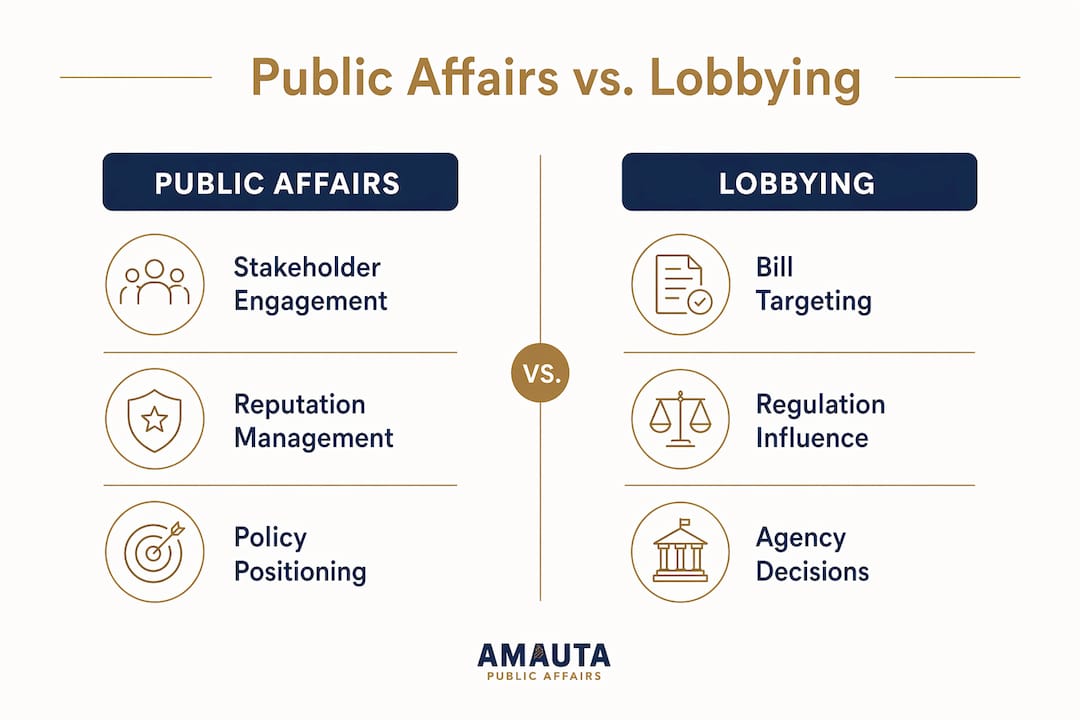
Public affairs is the broader strategic function that manages stakeholder engagement, reputation, and policy positioning. It is not synonymous with lobbying, though the two are often confused. Public affairs builds trust and stakeholder context that makes every other form of advocacy more effective. Lobbying is the direct effort to influence specific legislation. Public affairs is the environment in which that effort either succeeds or fails.
The scope of public affairs in corporate governance extends well beyond government relations. It includes media and communications management, community engagement, coalition building, and corporate social responsibility alignment. For business leaders, this breadth is the point. A company that only lobbies without building public trust is fighting every policy battle from a deficit position.

Public affairs is increasingly recognized as a core business driver tied to market access and crisis resilience, not just a communication support function. That recognition is reshaping how firms staff, fund, and measure the function.
How does public affairs differ from lobbying, and why do businesses need both?
Lobbying targets a specific bill, regulation, or agency decision. Public affairs builds the credibility and relationships that determine whether a lobbying effort lands. A company with strong public affairs groundwork walks into a legislative meeting with community support, media credibility, and a track record of transparent engagement. A company without it walks in alone.
The practical difference shows up in outcomes. Businesses that integrate both functions report stronger policy wins and faster regulatory approvals because their lobbying is backed by demonstrated community trust. The integration of policy engagement with visible, credible stakeholder relationships and clear messaging produces the strongest public affairs impact.
Key distinctions business leaders should understand:
Lobbying is direct, targeted, and often confidential. It focuses on specific policy outcomes within a defined timeframe.
Public affairs is continuous, visible, and relationship-driven. It builds the reputational capital that lobbying draws on.
Reputation management sits within public affairs and protects the firm from crises that could undermine any policy position.
Community engagement creates the social license that regulators and legislators notice when evaluating corporate requests.
Media relations shapes the public narrative before, during, and after policy battles.
Pro Tip: Map your current lobbying priorities against your public affairs activities. If you are lobbying on issues where your community trust is low or your media narrative is weak, you are spending political capital you have not yet earned.
The most effective public affairs strategy for firms treats lobbying as one tool within a larger system. Public affairs sets the conditions. Lobbying executes within them.
What are the core functions of a business public affairs program?
A well-built public affairs program covers six distinct operational areas. Each one contributes to the firm’s ability to influence its environment and protect its reputation.
Stakeholder engagement and relationship management. This means identifying every group with a material interest in the business, from regulators and elected officials to community organizations and local media, and building ongoing relationships before a crisis or policy fight demands them.
Government and regulatory monitoring. Public affairs teams track legislative calendars, regulatory dockets, and agency guidance to give business leaders early warning of changes that affect operations, permitting, or market access.
Media and communications management. Effective media relations strategies shape how journalists, editors, and digital platforms cover the company. This includes proactive story placement, rapid response to negative coverage, and consistent messaging across channels.
Coalition and partnership building. No company wins major policy battles alone. Public affairs teams build coalitions with trade associations, nonprofits, academic institutions, and peer companies to amplify credibility and reach.
Community engagement and CSR alignment. Citizens’ CSR expectations strongly influence corporate reputation and trust, which in turn affect financial reputation. Public affairs connects corporate responsibility commitments to visible community actions that stakeholders can verify.
Crisis communications and reputation risk mitigation. When a reputational threat emerges, public affairs teams coordinate the response across legal, communications, and executive leadership to protect trust and limit damage.
Function | Primary Output | Key Stakeholders |
Stakeholder engagement | Relationship capital | Regulators, community leaders |
Government monitoring | Early warning intelligence | Legal, executive team |
Media management | Narrative control | Journalists, public |
Coalition building | Amplified credibility | Trade groups, NGOs |
Community engagement | Social license | Local residents, advocacy groups |
Crisis communications | Reputation protection | All stakeholders |
Each function reinforces the others. A gap in any one area creates vulnerability across the entire program.
What challenges do businesses face in public affairs today?
The visibility gap is the most underestimated problem in public affairs right now. Only 39% of Americans are aware of how businesses respond to federal policy shifts. That means most corporate engagement, however genuine, goes unnoticed by the public it is meant to reach. Younger generations report higher awareness, but the overall deficit is significant.
Three additional challenges define the 2026 public affairs environment:
Cybersecurity, misinformation, and AI risks. Corporate affairs must address cybersecurity, misinformation, and AI as enterprise-level reputation risks. These threats require coordinated responses across communications, legal, and security functions, not just a press statement.
CSR credibility gaps. CSR messaging alone is insufficient without perceived authenticity. Companies that announce responsibility commitments without credible follow-through damage their reputation more than companies that say nothing.
Measurement difficulties. Many public affairs teams still struggle to translate impact into enterprise value language demanded by CEOs and boards. Without clear metrics, the function loses budget and influence.
“Silent internal engagement can be perceived as non-engagement without explicit communication pathways and proof points.” — PAC.org
Employees represent a critical and often overlooked trust signal. When employees do not understand or cannot articulate the company’s public positions, external stakeholders notice. Internal engagement is the first trust test, and failing it undermines every external effort.
Pro Tip: Before launching any external public affairs campaign, survey your own employees. If they cannot explain the company’s position on a key issue, your external messaging will lack the authenticity that stakeholders and journalists probe for.
Overcoming these challenges requires relationship-led engagement, not mass communication. Targeted outreach to specific stakeholder groups, with clear explanations of why the issue matters to workers, customers, and communities, consistently outperforms broad public statements.
How can business leaders use public affairs to build trust and brand reputation?
Business leaders who want to maximize the impact of public affairs must start with selective, transparent engagement. Businesses earn broader public support when they engage on policy issues tied to their specific role in society and economy, rather than commenting on every political topic. Relevance is the prerequisite for credibility.
Practical steps for executives building a high-impact public affairs program:
Tie engagement to economic and social relevance. Explain clearly how the issue affects your workers, your supply chain, or your community. Generic statements earn nothing. Specific, stakeholder-linked explanations earn trust.
Integrate public affairs with business strategy. Public affairs cannot operate as a separate department. It must connect to legal, finance, operations, and communications so that policy risks and opportunities surface at the executive level in real time.
Close the visibility gap with explicit proof points. Internal actions must be communicated externally through press releases, community meetings, digital channels, and direct stakeholder outreach. Stakeholder engagement effectiveness depends on being understood, not just acting internally.
Build cross-functional response teams. Cybersecurity incidents, misinformation campaigns, and AI-related controversies now require coordinated cross-functional responses that link communications, legal, and security. Public affairs leads that coordination.
Measure with strategic and economic indicators. Track policy wins, regulatory approval timelines, media sentiment scores, and community support levels alongside traditional reputation metrics. Evolving measurement practices now include commercial storytelling and strategic value demonstration to leadership.
The firms that treat public affairs as a pathway to implementation, not an afterthought, consistently outperform peers in regulatory environments and community acceptance. This is especially true for businesses in land use, energy, infrastructure, and other sectors where community trust directly determines project viability. Reviewing common community relations mistakes before launching a program prevents costly missteps that erode the trust you are trying to build.
Key Takeaways
Public affairs is a measurable business driver that builds the trust, visibility, and stakeholder relationships that lobbying and reputation management depend on to succeed.
Point | Details |
Public affairs vs. lobbying | Public affairs builds the credibility environment; lobbying executes within it. Both are needed. |
Visibility gap is real | Only 39% of Americans see how businesses engage on policy, so external proof points are non-negotiable. |
CSR must be credible | Responsibility claims without authentic follow-through damage reputation more than silence. |
Measurement is evolving | Use strategic and economic indicators, not just reputation scores, to demonstrate value to boards. |
Cross-functional integration | Link communications, legal, and security to manage cybersecurity and misinformation as reputation risks. |
Why public affairs deserves a seat at the executive table
I have worked with business leaders who treat public affairs as a communications expense and others who treat it as a competitive asset. The difference in outcomes is not subtle. Companies that integrate public affairs into their core decision-making process move faster through regulatory approvals, recover faster from reputational crises, and build community relationships that competitors cannot replicate quickly.
The measurement argument used to be the hardest sell. Boards wanted numbers, and public affairs teams offered sentiment scores. That is changing. The shift toward commercial indicators and strategic storytelling reflects a genuine maturation of the function. When a public affairs team can show that a specific engagement campaign shortened a permitting timeline by months or prevented a regulatory challenge that would have cost millions, the conversation with the CFO changes entirely.
What I find most telling is the employee trust signal. The companies that struggle most in public affairs are the ones where employees cannot explain what the company stands for on key issues. That internal gap always shows up externally. Fix the inside first, and the outside becomes far easier to manage.
Relationship-led engagement is not a soft strategy. It is the most durable competitive advantage available in a volatile policy environment. The firms that build genuine stakeholder relationships before they need them are the ones that survive the perfect storms that catch everyone else off guard.
— Ignacio
How Amautapublicaffairs supports your public affairs goals
Amautapublicaffairs brings a campaign-style approach to public affairs that most consulting firms do not offer. The firm evaluates community landscapes, identifies key stakeholder priorities, and builds tailored programs covering community engagement, media relations, and digital advocacy.
For business leaders managing land use, infrastructure, or energy projects, Amautapublicaffairs delivers the kind of granular, relationship-driven work that closes visibility gaps and builds durable public support. Every tactic is refined based on real-time feedback to maximize impact. If you are ready to treat public affairs as the business driver it is, explore the full range of consulting and advisory services or connect with the team directly to discuss your specific situation.
FAQ
What is the difference between public affairs and public relations?
Public affairs focuses on policy engagement, government relations, and stakeholder trust at a societal level. Public relations focuses primarily on media coverage and brand image management.
How does public affairs benefit businesses in regulated industries?
Public affairs builds the community trust and regulatory relationships that accelerate permitting, reduce opposition, and protect market access when policy environments shift.
Why do only 39% of Americans see corporate policy engagement?
Most companies act internally without creating visible proof points for external audiences. Explicit communication through community meetings, press releases, and digital channels closes that gap.
How should businesses measure public affairs success?
Effective measurement combines strategic indicators like regulatory approval timelines and policy wins with economic indicators like cost avoidance and market access gains, alongside traditional reputation metrics.
What is the first step for a business building a public affairs program?
Map your key stakeholders and identify the policy issues most directly tied to your business operations and community role. That mapping determines where selective, credible engagement will earn the most trust.
Recommended
Comments