
Digital Advocacy Nonprofit Awareness Campaigns That Convert

Digital advocacy nonprofit awareness campaigns are strategic, multi-platform efforts designed to convert online attention into explicit supporter actions, including donations, petition signatures, and community sign-ups, that directly advance a nonprofit’s mission. The standard industry term for this practice is digital public advocacy, and it encompasses everything from paid social media to creator partnerships and automated email sequences. Organizations like WaterAid and INCA have demonstrated that campaigns built on precise segmentation, platform-specific creative, and tools like Salsa Labs and Google Ad Grants consistently outperform those relying on organic reach alone. This guide gives nonprofit professionals a concrete framework for building campaigns that produce measurable results, not just impressions.
What are the essential channels and platforms for digital advocacy campaigns?
The most effective digital advocacy channels for nonprofit organizations are Meta, LinkedIn, TikTok, YouTube, and Google Ads, each serving a distinct audience segment and content format. Choosing the right mix is not a matter of preference. It is a matter of where your supporters already spend their attention and what action you need them to take.
Here is how each platform functions within a nonprofit campaign:
Meta (Facebook and Instagram): The broadest demographic reach, with Facebook excelling at community group mobilization and Instagram driving visual storytelling. INCA’s NET Cancer Day 2025 campaign saw Facebook engagement rise 1,354% and Instagram reach increase 7,254% through targeted paid distribution. Those numbers confirm that organic posting alone cannot replicate what paid placement achieves at scale.
LinkedIn: The preferred channel for policy-focused campaigns targeting legislators, corporate partners, and professional advocates. Content here should lead with data and outcomes, not emotional appeals.
TikTok and YouTube: Both platforms favor short-form and long-form video respectively, making them ideal for creator-led campaigns and documentary-style storytelling. TikTok’s algorithm rewards authenticity over production value, which lowers the barrier for resource-constrained nonprofits.
Google Ads and Ad Grants: Google’s nonprofit Ad Grants program provides up to $10,000 per month in free search advertising. This channel captures high-intent supporters who are already searching for causes to support, making it one of the highest-conversion channels available at no direct cost.
Multi-channel distribution is not optional for campaigns seeking scale. INCA’s campaign allocated spend across six platforms, including Meta, TikTok, LinkedIn, X, YouTube, and Google, generating 176.85 million impressions and a 249% increase in website sessions. That result reflects what happens when creative is tailored per platform rather than repurposed uniformly. Multilingual execution compounds this effect further. Campaigns that maintain consistent core messaging while customizing calls-to-action by region and language consistently outperform single-language campaigns in global reach metrics.
Pro Tip: Diversify your paid spend across at least three platforms from the start. If one platform’s algorithm changes or costs spike, your campaign maintains momentum through the others.
How can nonprofits use creator partnerships and simple messaging to amplify digital advocacy?
Creator-led campaigns expand reach into audiences that traditional nonprofit communications rarely touch, particularly younger demographics who distrust institutional messaging. The mechanism is straightforward: creators carry your message to their established communities with a level of trust that paid advertising cannot replicate.

WaterAid’s #TeamWater campaign is the clearest proof of this model. The campaign generated over 100,000 donations, with 99% coming from new donors and 62% from supporters under age 35. The message that powered this result was deliberately simple: $1 = 1 year of clean water. That formula gave every creator, regardless of niche or audience size, an immediately understandable and shareable claim to build content around.
Several structural elements made #TeamWater work beyond the message itself:
Diverse creator advisory group: WaterAid worked with creators across fitness, gaming, cooking, and lifestyle niches, not just cause-adjacent influencers. This cross-niche approach reached audiences who had never engaged with a water charity before.
Co-design, not briefing: Creators helped shape the campaign’s messaging and mechanics, which produced authentic audience resonance that scripted content rarely achieves. When creators feel ownership over a campaign, their audiences sense it.
Community participation tools: Leaderboards, livestream fundraising events, and milestone announcements kept supporters engaged beyond the initial donation moment. These mechanics transform a one-time transaction into a community experience.
Nonpartisan framing: Clean water is not a politically divisive issue. Campaigns that avoid partisan positioning can recruit creators across the ideological spectrum, which multiplies distribution without alienating any segment of the audience.
“Creators should be partners in campaign design, not just distribution channels. When they help shape the message, they carry it with conviction, and their audiences respond in kind.” — Harmony Labs, Inside the $40M Creator Campaign for Clean Water
Pro Tip: When approaching creators, lead with the campaign’s impact data and the simplicity of the message. Creators with engaged mid-size audiences (50,000 to 500,000 followers) often deliver better cost-per-action results than mega-influencers with passive followings.
What role does automation and segmentation play in successful advocacy campaign execution?
Advocacy campaign automation is the use of software to trigger personalized supporter communications based on predefined actions, time intervals, or engagement milestones, without requiring manual staff intervention for each touchpoint. For nonprofits operating with lean teams, this is not a luxury. It is the prerequisite for running campaigns at any meaningful scale.
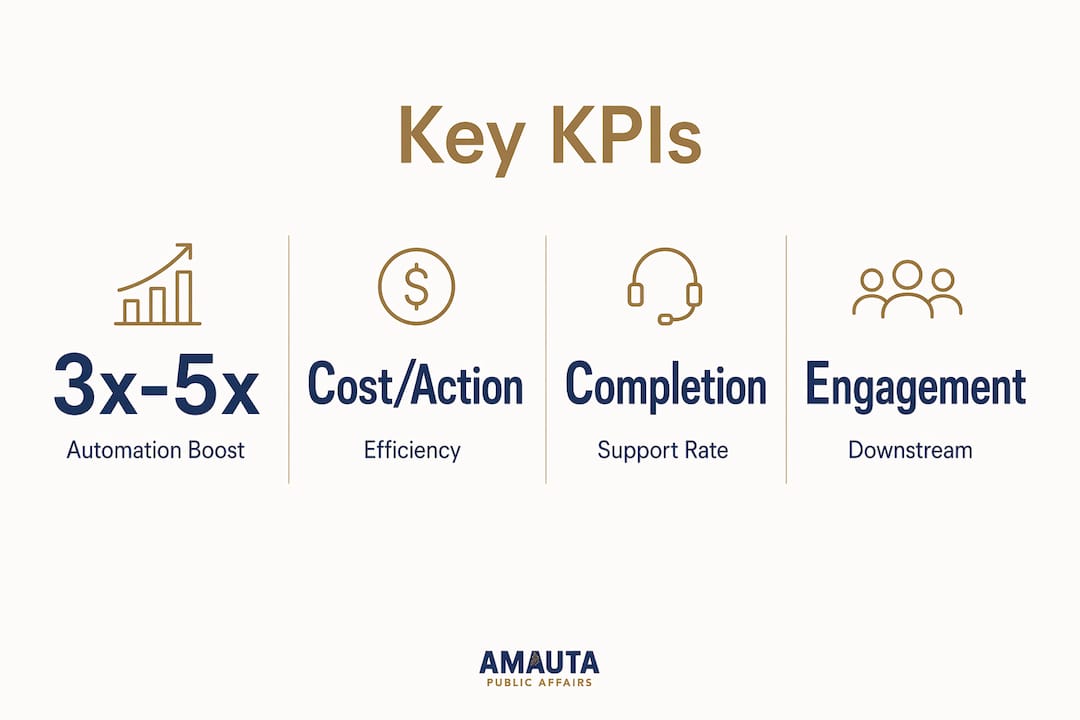
The performance data is direct: automated follow-up sequences improve completed advocacy actions by 3x to 5x compared to single-touch outreach, while segmentation boosts action rates by 40% to 60%. A supporter who signs a petition but has not donated responds differently to a follow-up than a lapsed donor who has not engaged in six months. Automation makes that distinction at scale.
Here is a practical execution sequence for a mid-size nonprofit campaign:
Segment your supporter database by geography, past action type (donor, volunteer, petition signer), and engagement recency before any campaign launches.
Build trigger-based workflows in a platform like Salsa Labs or EveryAction that fire follow-up emails within 24 hours of a supporter completing an action.
Set milestone triggers that send progress updates when the campaign hits 25%, 50%, and 75% of its goal. Milestone updates improve late-campaign completions by 22%, which is the period when most campaigns lose momentum.
Design micro-actions for supporters who have not completed the primary ask. A supporter unwilling to donate $50 may still share a post, sign a petition, or refer a friend. Each micro-action deepens their relationship with the cause.
Audit your CRM data before launch. Nonprofit CRMs often contain 20 to 30% invalid or duplicate records, which corrupt segmentation logic and trigger workflows for the wrong audiences.
Automation tactic | Expected impact |
Triggered follow-up within 24 hours | 3x to 5x increase in completed actions |
Geographic segmentation | 40% to 60% boost in action rates |
Milestone progress updates | 22% improvement in late-campaign completions |
CRM data audit pre-launch | Eliminates 20 to 30% targeting errors |
Pro Tip: Treat data hygiene as a campaign prerequisite, not an afterthought. Run a deduplication and validation pass on your supporter database at least two weeks before any major campaign launch to give your automation workflows clean inputs.
How should nonprofits measure and sustain digital advocacy awareness success?
Measuring digital advocacy success by impressions and likes produces a misleading picture of campaign health. The metrics that matter are conversion-focused: supporter completion rate, cost per action, petition sign-up volume, and downstream engagement such as repeat donations or volunteer sign-ups. These KPIs connect campaign activity directly to mission advancement.
The comparison below illustrates the difference between vanity metrics and conversion metrics in practice:
Metric type | Example | What it actually tells you |
Vanity metric | 2 million impressions | How many times your content appeared in a feed |
Conversion metric | Cost per petition signature | How efficiently your spend produces committed supporters |
Vanity metric | 15,000 likes on a post | Passive acknowledgment with no commitment |
Conversion metric | Supporter completion rate | Percentage of supporters who finished the full action sequence |
Sustaining campaign momentum beyond the initial launch requires a deliberate earned media strategy. Earned media placements convert into blogs, newsletters, and fundraising messaging, extending campaign reach into owned channels where the nonprofit controls the narrative. A news feature about your campaign, repurposed as a donor email and a social post series, generates compounding credibility that paid advertising cannot manufacture. Third-party validation from journalists, researchers, or community leaders carries more persuasive weight than self-reported impact claims.
Understanding how social media shapes public opinion is also central to sustaining momentum. Platforms reward content that generates conversation, not just consumption. Campaigns that build in comment prompts, community challenges, and response loops sustain algorithmic visibility longer than those that broadcast without inviting participation.
Pro Tip: Set a 90-day measurement cadence, not a campaign-end review. Weekly check-ins on cost per action and completion rates let you reallocate budget toward what is working before the campaign closes, not after.
Key takeaways
Effective digital advocacy nonprofit awareness campaigns require the integration of multi-channel distribution, creator co-design, automation with clean data, and conversion-focused measurement to produce results that advance mission goals.
Point | Details |
Multi-channel distribution | Spread paid spend across Meta, TikTok, YouTube, LinkedIn, and Google to maintain resilience and reach. |
Creator co-design | Partner with creators as campaign architects, not just messengers, to generate authentic audience engagement. |
Automation and segmentation | Use tools like Salsa Labs to trigger personalized follow-ups that improve completed actions by 3x to 5x. |
Conversion-focused KPIs | Track cost per action and supporter completion rates, not impressions, to measure real campaign impact. |
Earned media repurposing | Convert press coverage into owned content to extend reach and build donor trust beyond the campaign window. |
What I have learned about digital advocacy that most guides skip
From my experience working at the intersection of public affairs and digital strategy, the single most common failure in nonprofit digital campaigns is treating technology as a substitute for strategy. Organizations invest in automation platforms and paid media without first defining what a “completed action” means for their specific campaign. The result is sophisticated infrastructure pointed in the wrong direction.
The campaigns that consistently outperform are those that treat digital advocacy as a conversion system, mapping every touchpoint from first impression to final action before a single dollar is spent. Creator partnerships work because they are built on authentic co-design, not because the creator has a large following. Automation works because the underlying data is clean, not because the platform is expensive.
My honest caution to nonprofit professionals: resist the pull of vanity metrics. Impressions feel like progress. They are not. A campaign that generates 500 completed petition signatures from a targeted audience of 10,000 outperforms one that reaches 2 million people and produces 200 signatures. The trust analytics behind your campaign matter more than the volume of your reach. Build measurement frameworks before you build content, and let the data guide your creative decisions throughout the campaign, not just at the end.
— Ignacio
How Amautapublicaffairs supports your next advocacy campaign
Amautapublicaffairs brings a campaign-style approach to digital advocacy that most consulting firms do not offer. The team evaluates your community context, identifies the digital channels where your supporters are most active, and builds segmented, automated campaign infrastructures designed to produce measurable conversions, not just awareness.
Whether you are launching a first-time online advocacy initiative or scaling an existing program, Amautapublicaffairs offers campaign strategy and digital infrastructure services tailored to nonprofit organizations working in complex public affairs environments. The team’s expertise in community engagement, media relations, and paid digital distribution gives nonprofits a pathway from planning to execution without the typical trial-and-error costs. Connect with the team to discuss how a tailored digital advocacy strategy can advance your mission and maximize your campaign’s community impact.
FAQ
What is a digital advocacy nonprofit awareness campaign?
A digital advocacy nonprofit awareness campaign is a structured, multi-platform effort that converts online attention into specific supporter actions such as donations, petition signatures, or volunteer sign-ups. It differs from general social media posting by prioritizing conversion metrics over reach alone.
Which platforms work best for nonprofit digital campaigns?
Meta, Google Ad Grants, TikTok, LinkedIn, and YouTube each serve distinct audience segments and content formats. The most effective campaigns distribute paid spend across at least three platforms to maintain resilience and reach diverse supporter demographics.
How much does automation improve advocacy campaign results?
Automated follow-up sequences improve completed advocacy actions by 3x to 5x compared to single-touch outreach, and segmentation boosts action rates by 40% to 60%. Clean CRM data is the prerequisite for these gains to materialize.
What KPIs should nonprofits track in digital advocacy campaigns?
Nonprofits should track conversion-focused KPIs including cost per action, supporter completion rate, and downstream engagement such as repeat donations. Impressions and likes measure exposure, not commitment.
How do creator partnerships improve nonprofit campaign outcomes?
Creator partnerships work when creators co-design the campaign rather than simply distribute a brief. WaterAid’s #TeamWater campaign produced over 100,000 donations with 99% new donors by giving creators authentic ownership of the message and mechanics.
Recommended
Comments