
Earned Media Strategy for Marketing and PR Pros

An earned media strategy is a deliberate plan for generating unpaid, third-party publicity through content creation, relationship-building, and performance measurement. Unlike paid advertising or owned channels, earned media depends on external validation: press coverage, organic social shares, customer reviews, and influencer mentions that brands cannot simply buy. For marketing professionals and PR specialists, this distinction matters because earned coverage carries a credibility premium that paid placements cannot replicate. The core components of any effective approach include story development, journalist and influencer outreach, Earned Media Value (EMV) tracking, and integration with owned and paid media for amplification.
What is earned media strategy and how does it work?
An earned media strategy is the structured process by which organizations plan, execute, and measure their efforts to gain unpaid third-party publicity through content, relationships, and ongoing monitoring. The word “earned” is precise: this coverage is not purchased through ad spend, nor is it published on channels the brand controls. It is granted by journalists, bloggers, review platforms like Yelp, and social media audiences who find the content or story genuinely worth sharing.
The strategy works through a cycle. A brand creates compelling, share-worthy content or story angles. It then distributes those angles through targeted outreach to journalists, analysts, and influencers. When coverage appears, the brand amplifies it through owned channels and paid promotion, extending reach while reinforcing credibility. Platforms like Meltwater, Onclusive, and Cision support monitoring and measurement throughout this cycle.

The earned media definition in practice covers a wide spectrum: a feature story in The Wall Street Journal, a five-star product review on Google, a viral LinkedIn post from an industry thought leader, or a podcast interview with a sector expert. Each of these represents external validation that audiences trust more than branded content. That trust is the foundational benefit of earned media in marketing.
How does earned media differ from owned and paid media?
Owned, earned, and paid media represent three distinct channels that differ in control, cost, and credibility. Understanding these differences is prerequisite knowledge for any PR or marketing professional building a media program.
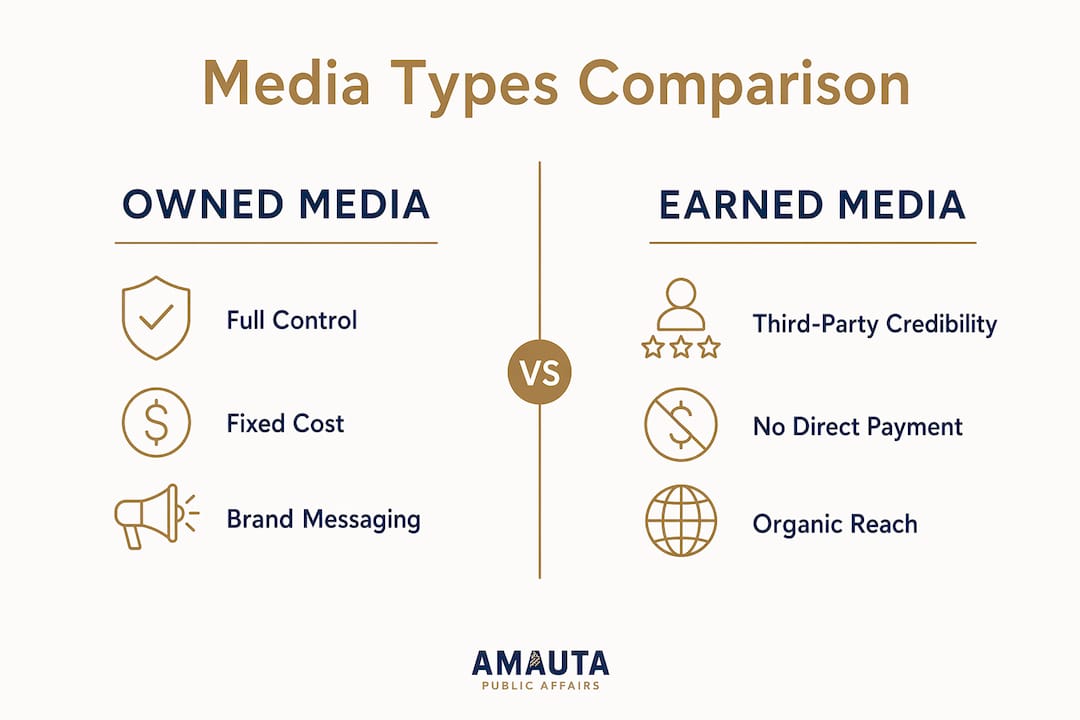
Media Type | Control Level | Cost Structure | Credibility Signal |
Owned | Full control | Fixed (production costs) | Moderate: brand-authored |
Paid | High control | Variable (ad spend) | Lower: audience knows it’s an ad |
Earned | No direct control | Low cost, high effort | Highest: third-party validated |
Owned media includes your website, blog, email newsletters, and social profiles. You control the message entirely, but audiences recognize the source as self-promotional. Paid media, from Google Ads to sponsored content, delivers reach and targeting precision, but trust scores drop because the commercial intent is transparent. Earned media sits at the top of the credibility hierarchy precisely because it is granted, not purchased.
The practical implication is that earned, owned, and paid media work best as a coordinated system rather than isolated tactics. Owned media provides the factual source of truth. Earned media builds external credibility. Paid media extends the reach of both. Teams that treat these as separate budgets rather than an integrated cycle consistently underperform those that coordinate across all three.
How to build an effective earned media strategy in six steps
Building a results-oriented earned media program requires more than sending press releases. Effective strategies follow a structured sequence that connects business objectives to measurable media outcomes.
Set measurable goals aligned with business objectives. Define what success looks like before any outreach begins. Goals might include a 20% increase in branded search volume, a target number of tier-one media placements, or a measurable lift in referral traffic from editorial sources.
Define your target audience and media personas. Identify not just who you want to reach, but which journalists, publications, and influencers hold authority with that audience. A renewable energy project targeting local regulators requires a different media list than a consumer product launch.
Develop share-worthy content and story angles. The content must serve the journalist’s audience, not just the brand’s messaging goals. Data-driven reports, expert commentary on breaking news, and community impact stories consistently generate coverage because they offer genuine editorial value.
Build and maintain an authentic media list. A targeted list of 50 relevant journalists outperforms a spray-and-pray list of 500. Research each contact’s recent coverage, beat, and preferred pitch format before making contact.
Execute personalized outreach and pitching. Successful pitching depends on tightly focused, relevant stories targeted to the right journalist rather than mass outreach. One well-researched pitch to a reporter who covers land use policy will outperform ten generic emails.
Track performance and optimize continuously. Use analytics platforms to monitor coverage volume, sentiment, referral traffic, and share of voice. Adjust story angles and outreach cadence based on what generates coverage and what does not.
Pro Tip: Build an editorial calendar that maps your story angles to news cycles, regulatory milestones, and seasonal events. Journalists are more receptive to pitches that connect to a story they are already tracking.
For organizations working in community engagement and public affairs, community outreach strategies that precede project launches create the authentic local narratives that journalists find most compelling.
How can PR teams measure earned media impact and ROI?
Measuring earned media requires moving well beyond clip counts. Meaningful measurement involves four distinct layers: activity (volume of coverage), quality (tier of publication and audience reach), narrative (whether key messages appear in coverage), and business impact (downstream effects on pipeline, search, and conversions).
The metrics that matter most at each layer include:
Activity: Total mentions, media impressions, share of voice versus competitors
Quality: Domain authority of covering publications, journalist reach, sentiment score
Narrative: Message pull-through rate, spokesperson quote inclusion, topic alignment
Business impact: Branded search volume lift, referral traffic from editorial sources, pipeline influence, conversion rate from earned traffic
Earned Media Value (EMV) is a widely used proxy metric that estimates the cost-equivalent of paid advertising for the coverage received. EMV is directional, not a revenue figure, and its methodology varies significantly across platforms. Meltwater, Cision, and Onclusive each calculate EMV differently, which means cross-platform comparisons require careful interpretation.
Timing adds another layer of complexity. Branded search volume may rise 10 to 40% within 7 to 30 days of significant coverage, while broader measurable impact often takes 30 to 90 days to materialize. SEO effects from earned backlinks can take even longer. This lag means that reporting windows must account for delayed attribution, and teams should resist drawing conclusions from 30-day snapshots alone.
Pro Tip: Present EMV alongside sentiment scores and referral traffic in executive reports. A high EMV figure from negative coverage is a liability, not an asset. Context transforms a number into an insight.
For a structured approach to measuring marketing ROI, frameworks that connect content outputs to business outcomes provide the clearest path from coverage data to executive-level reporting.
What are real-world examples of earned media strategies?
Earned media examples span industries and scales, but the most instructive cases share a common structure: a credible story, a targeted distribution channel, and a measurable outcome.
Press coverage through data-driven reports: A nonprofit environmental organization publishes original research on local air quality. Regional journalists cover the findings, generating dozens of earned placements and a measurable spike in branded search volume. The organization controlled the data, but not the coverage.
Organic social shares from community events: A land use consulting firm hosts a public forum on a proposed infrastructure project. Attendees share video clips and commentary across LinkedIn and X (formerly Twitter), generating reach that no paid campaign could replicate at the same credibility level.
Influencer mentions without direct payment: An industry analyst publishes a newsletter recommending a firm’s white paper as required reading. That single mention drives more qualified referral traffic than a month of paid LinkedIn ads.
Customer reviews as earned media: Positive reviews on Google Business Profile, Yelp, or industry-specific platforms like Clutch represent earned media in its most granular form. Customer reviews and social shares are core earned media elements because they originate from genuine user experience, not brand-controlled messaging.
“Earned media is the byproduct of doing something worth talking about. The strategy is the system that makes sure the right people hear about it.”
For organizations working in advocacy and public affairs, digital advocacy campaigns that generate organic community engagement represent one of the most effective pathways to sustained earned media coverage. Similarly, nonprofit media relations practices that prioritize journalist relationship-building over transactional pitching consistently produce higher-quality coverage over time.
Ongoing relationship-building and relevant thought leadership give journalists repeated reasons to reference brands, which is why the most successful earned media programs treat media relationships as long-term assets rather than campaign-specific contacts.
Key takeaways
An earned media strategy succeeds when it integrates credible story development, targeted journalist relationships, and a measurement framework that connects coverage to business outcomes, not just clip counts.
Point | Details |
Earned media definition | Unpaid, third-party publicity earned through content, relationships, and outreach, not ad spend. |
Credibility advantage | Earned coverage ranks highest in audience trust compared to owned or paid media channels. |
Six-step implementation | Set goals, define personas, create stories, build a media list, pitch personally, and track results. |
Measurement depth | Measure activity, quality, narrative alignment, and business impact, not just mention volume or EMV alone. |
Integration is required | Owned media provides the source of truth; earned media builds credibility; paid media extends reach. |
Why earned media strategy demands a longer view
From my experience working at the intersection of public affairs and media relations, the most common mistake I see marketing and PR teams make is treating earned media as a campaign rather than a program. A single press release does not constitute a strategy. Neither does a one-time influencer partnership. The organizations that consistently generate high-quality coverage are the ones that have built genuine relationships with journalists over months and years, not the ones that send the most pitches.
The second pattern I have observed is an over-reliance on EMV as the primary success metric. EMV is a useful shorthand for executive conversations, but it tells you nothing about whether your key messages landed, whether the coverage reached the right audience, or whether it moved anyone closer to a decision. I have seen campaigns with impressive EMV figures that generated zero pipeline influence because the coverage appeared in publications that the target audience never reads.
What actually works is the combination of evergreen story angles, consistent outreach cadence, and a measurement framework that tracks narrative quality alongside volume. The brands that maintain a newsroom with well-sourced, accurate content also benefit from an emerging advantage: AI-driven media discovery tools increasingly surface owned content as reference material, which means building outward from owned content supports accuracy and control in an environment where you cannot fully predict how your story will be found or framed.
The pathway to sustained earned media impact is not a sprint. It is a deliberate, ongoing investment in relationships, content quality, and measurement discipline.
— Ignacio
How Amautapublicaffairs supports your earned media program
Amautapublicaffairs brings a campaign-style discipline to earned media strategy development, combining media relations expertise with community engagement and digital advocacy to build programs that generate credible, measurable coverage.
Whether you are launching a land use project that requires community trust, or building a public affairs program that needs sustained media presence, Amautapublicaffairs designs outreach strategies tailored to your specific audience and regulatory context. The team evaluates your current media relationships, identifies the story angles most likely to generate coverage, and builds the measurement framework that connects earned media outcomes to business results. Explore the full range of public affairs services or get connected directly to discuss your program needs.
FAQ
What is the earned media definition in marketing?
Earned media is unpaid publicity generated by third parties, including press coverage, social shares, customer reviews, and influencer mentions. It differs from paid advertising and owned content because the brand does not control when or how it appears.
How does earned media differ from paid media?
Paid media involves direct ad spend for placement and message control, while earned media is granted by journalists, audiences, and influencers based on the merit of the story or product. Earned media consistently ranks higher in audience trust than paid placements.
What are the most important metrics for measuring earned media impact?
The most meaningful metrics include branded search volume lift, referral traffic from editorial sources, share of voice, sentiment scores, and pipeline influence. EMV is a useful directional proxy but should always be paired with narrative quality and business impact data.
How long does it take to see results from an earned media strategy?
Branded search volume can rise within 7 to 30 days of significant coverage, but broader business impact typically takes 30 to 90 days to materialize. SEO effects from earned backlinks often take longer, which means reporting windows must account for these time lags.
What is the difference between earned media and influencer marketing?
Earned media from influencers refers to organic mentions and recommendations made without direct payment or formal sponsorship agreements. Paid influencer partnerships are classified as paid media because the brand compensates the creator for the placement.
Recommended
Comments