
How Opposition Campaigns Work for Development Projects

Opposition campaigns targeting land-use and development projects pursue four core objectives: block the permit outright, delay approval long enough to kill financing, extract concessions that reshape the project’s economics, or reframe the public debate so the project’s own terms of legitimacy are undermined. Understanding how opposition campaigns work is the prerequisite for defending against them. In the next 72 hours, project teams should confirm permit status and all pending deadlines, activate a monitoring stream across permit portals, local media, and social platforms, notify counsel, prepare an initial messaging pivot, and begin stakeholder outreach. Freedom of Information Act (FOIA) records and public meeting minutes are the fastest intelligence sources available. Federal Election Commission (FEC) filings can surface political spending signals tied to organized opposition. AMAUTA Public Affairs can coordinate the full response architecture from day one.
Table of Contents
What does an opposition campaign actually target in land-use projects?
What legal and ethical limits apply to opposition campaigns in the U.S.?
How long do opposition campaigns last, and what do they cost to counter?
A case study in reframing: how one project team preserved its permit timeline
What project teams consistently underestimate about opposition campaigns
AMAUTA Public Affairs brings campaign-grade infrastructure to your project
What does an opposition campaign actually target in land-use projects?
An opposition campaign in a land-use context is an organized effort by one or more actors to alter, delay, or defeat a project’s regulatory approval or public legitimacy. The actors range from neighborhood associations and single-issue coalitions to well-funded advocacy organizations with professional staff.
The primary objectives are procedural delay (triggering appeal windows, requesting environmental reviews, filing administrative challenges), local political pressure (mobilizing planning commission testimony, lobbying elected officials), reputational damage (earned media, social amplification), and changing the terms of debate. That last objective is the most underestimated. Opposition actors increasingly prioritize transforming the framework of the debate, producing alternative standards, norms, and pseudo-scientific sources, rather than only blocking proposals at the margins.
Pro Tip: When opposition messaging shifts from “stop this project” to “projects like this always cause X harm,” the campaign has moved from a procedural fight to a framing war. That shift requires a different response: you need to contest the standard, not just the specific claim.
How do opposition campaigns move through their phases?
Most campaigns follow a recognizable lifecycle. Knowing the phase tells you which tactics are coming next.
Phase 1: Research and database building. Organizers mine public records, FEC filings, FOIA requests, court records, and social media to build a searchable archive of the project team’s statements, permits, and prior decisions. Opposition research operations produce comprehensive, indexed research books that enable rapid retrieval and timed media placement. Tracker programs record public interactions to build a library of contradictions used later to degrade trust.

Phase 2: Framing and targeting. Organizers test messages, identify the most persuasive frames, and begin seeding narratives through local media, neighborhood listservs, and social accounts. Organized coalitions produce repeatable messaging through regular trainings and convenings that supply curated talking points to allied groups.
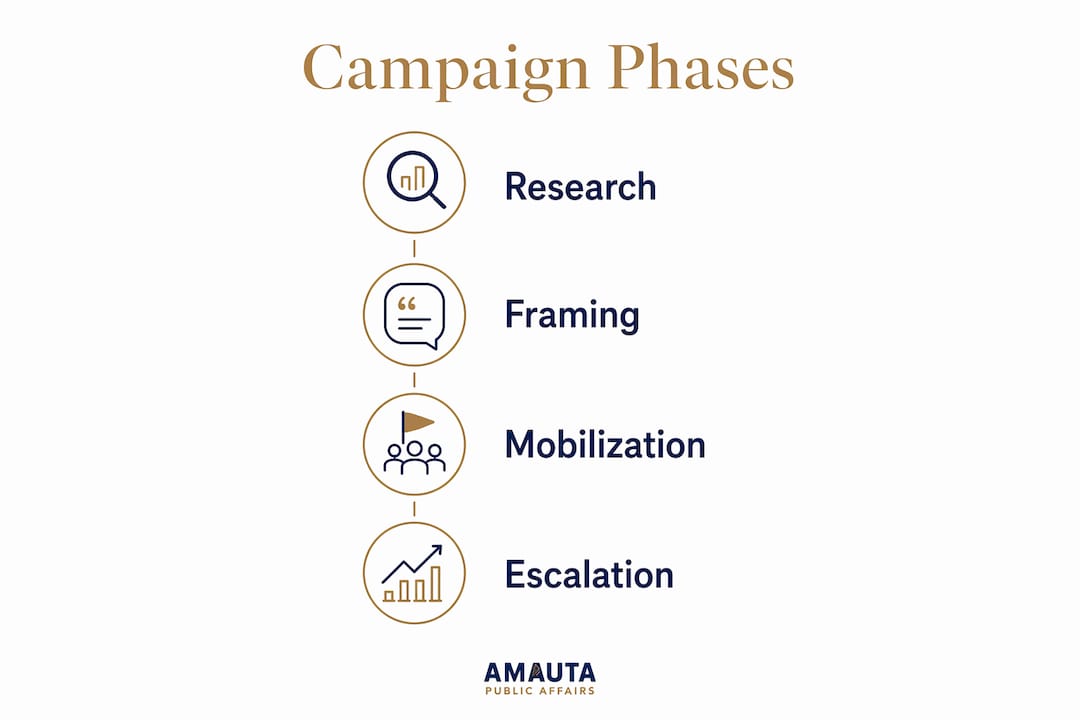
Phase 3: Grassroots mobilization. Petition drives, public comment surges, and packed planning commission hearings signal this phase. Digital platforms and petitions can produce rapid, high-volume signals that amplify opposition visibility far beyond the local community.
Phase 4: Escalation. Administrative appeals, permit challenges, ballot initiative filings, and litigation are the terminal escalation tools. Timing is deliberate: damaging research is often deployed in the final weeks before a key vote or permit decision, when stakeholders are paying the most attention.
Phase | Primary Tactics | Detection Signal |
Research/Intel | FOIA requests, public records mining, tracker programs | Unusual FOIA volume, new social accounts |
Framing | Message testing, pseudo-expert briefs, media seeding | Repeated new narrative in local press |
Mobilization | Petitions, public comment surges, coalition outreach | Spike in permit comments, packed hearings |
Escalation | Appeals, ballot measures, litigation | Formal filings, PAC registrations |
What legal and ethical limits apply to opposition campaigns in the U.S.?
U.S. law shapes what opposition actors can do, and knowing those limits helps project teams distinguish lawful pressure from conduct that warrants a legal response.
Key compliance areas include:
Lobbying disclosure: State and local lobbying registration requirements vary, but paid persuasion directed at elected officials or planning commissioners typically triggers disclosure obligations.
Campaign finance: When a ballot measure is involved, FEC rules (for federal actors) and state campaign finance laws govern PAC formation, contribution limits, and expenditure reporting.
Open records and public meetings: Opponents use open-records laws aggressively. Project teams should assume all communications with public agencies are discoverable.
Permit appeal windows: Most jurisdictions set narrow windows (often 10–30 days) for administrative appeals. Missing a response deadline can waive rights.
Defamation and deceptive practices: False statements of fact about a project or its principals can support a defamation claim; coordinated astroturfing that misrepresents grassroots support may implicate FTC guidelines on deceptive endorsements.
Pro Tip: Involve counsel before the first formal appeal is filed, not after. The administrative record built during the permit process becomes the evidentiary foundation for any subsequent litigation. Gaps in that record are very difficult to cure later.
When retaining counsel for rapid legal assessment, have these documents ready: all permit applications and agency correspondence, the project’s environmental review record, any prior public comment letters, records of all public meetings where the project was discussed, and any communications from opposition actors received to date.
How can you detect opposition activity before it escalates?
Early detection is the single highest-leverage action a project team can take. The operational advantage is not discovery but readiness: having a searchable, tagged archive that enables rapid response.
High-value early signals to watch:
Sudden increase in local meeting sign-ups or public comment submissions
New social media accounts or Facebook groups referencing the project
FOIA requests directed at the permitting agency
New PAC or nonprofit filings in state campaign finance databases
Formal appeal filings or requests for environmental review
Increased local press coverage with consistent framing
Surge in petition signatures on platforms like Change.org
Source | What to Monitor | Cadence |
Permit portals | New filings, comment submissions, appeal notices | Daily |
Local government calendars | Agenda items, hearing notices | Weekly |
Social listening | New accounts, hashtags, petition activity | Daily |
FEC/state campaign finance | New PAC registrations, expenditure reports | Weekly |
Local press | Coverage volume, narrative framing | Daily |
Neighborhood listservs/Nextdoor | Organizing language, meeting announcements | Weekly |
What does an effective defensive playbook look like?
A well-structured response coordinates legal, communications, community outreach, and executive functions simultaneously. Roles matter as much as tactics.
Assign a war-room lead who owns daily monitoring synthesis and escalation decisions.
Designate a legal point of contact who reviews all public statements before release and tracks permit deadlines.
Activate proactive stakeholder outreach to supporters before opposition mobilizes them into neutrality or opposition.
Prepare a rapid-response message library: pre-approved statements for the most likely attack vectors (environmental claims, traffic, economic impact, community character).
Establish an approval chain for reactive statements that can clear in under four hours. Rapid response centralizes monitoring, research retrieval, message drafting, approval, and distribution to meet same-day standards.
Build a coalition of credible third-party validators — local business associations, labor groups, environmental partners — who can speak independently.
Red flags that shift strategy from persuasion to legal defense: a formal appeal filed with the permitting authority, a ballot initiative petition certified for circulation, litigation filed or threatened, or coordinated media coverage that appears funded rather than organic.
Pro Tip: Test your core messages with a small group of persuadable community members before deploying them publicly. Real-time feedback from a 10-person dial session or a brief online survey will tell you which frames land and which ones harden opposition.
How long do opposition campaigns last, and what do they cost to counter?
Timelines and budgets vary significantly by opposition intensity. The table below reflects typical ranges for land-use projects in the U.S.
Intensity | Typical Duration | Primary Cost Drivers | Estimated Response Budget |
Low (neighborhood group, no legal) | several months | Monitoring, community outreach, earned media | typical modest budget |
Medium (organized coalition, admin appeals) | extended period | Legal fees, paid media, field mobilization | higher budget range |
High (ballot measure, litigation) | long-term duration | Litigation, ballot campaign, research capacity | large budget |
Primary budget drivers are legal fees (which escalate sharply once litigation is filed), paid media, field mobilization for coalition outreach, research capacity, and stipends for coalition partners. The most effective cost control is early detection: a low-intensity campaign caught in Phase 1 rarely requires the legal and media expenditures of one that reaches Phase 4.
Suggested KPIs for measuring response effectiveness: permit milestone status (on schedule vs. delayed), number of sustained appeals, local sentiment in targeted geographies, earned media volume and tone, social engagement velocity, and outcomes of stakeholder meetings.
A case study in reframing: how one project team preserved its permit timeline
A mid-size mixed-use development in a Western U.S. city faced a well-organized neighborhood coalition that had reframed the project from a housing and economic development question into a traffic and environmental health debate. By the time the project team engaged, the opposition had already seeded three local media stories using a pseudo-expert brief from an affiliated think tank.
The response team’s first action was rapid research retrieval: pulling the opposition coalition’s prior public statements, funding sources, and the think tank’s methodology to identify factual inconsistencies. Within 72 hours, the team had reframed the debate by introducing a peer-reviewed traffic study and securing endorsements from two local environmental organizations. Coalition outreach to labor and business groups produced testimony at the planning commission hearing that outnumbered opposition speakers. The administrative record was reinforced with expert declarations, closing the evidentiary gaps that would have supported an appeal.
The project received planning commission approval on its original timeline. The opposition filed an administrative appeal, which was denied within 60 days. No litigation followed. The single most important early action: engaging a monitoring infrastructure before the opposition’s media narrative had time to calcify in the public record.
Pro Tip: The window to contest a reframing narrative is narrow. Once a false or misleading frame appears in three or more local media outlets, it becomes the reference point for subsequent coverage. Respond within 48 hours of the first placement, not after the third.
Key Takeaways
Opposition campaigns are most effectively countered when project teams detect early, coordinate across legal and communications functions, and contest framing before it calcifies in the public record.
Point | Details |
Detect early | Monitor permit portals, social platforms, and FEC filings daily from project announcement onward. |
Know the phase | Each campaign phase brings predictable tactics; matching your response to the phase prevents over- or under-reaction. |
Protect the record | The administrative record built during permitting becomes the evidentiary foundation for any legal defense; involve counsel before the first appeal. |
Contest the frame | When opposition shifts to reframing the debate, respond within 48 hours with credible third-party validators and peer-reviewed sources. |
Amautapublicaffairs | AMAUTA Public Affairs provides monitoring, rapid-response coordination, coalition building, and permitting support structured around the phases described in this guide. |
What project teams consistently underestimate about opposition campaigns
The conventional wisdom treats opposition campaigns as a communications problem. Fix the messaging, hold a community meeting, and the opposition fades. That framing misses the structural reality: a well-resourced opposition campaign is an intelligence and legal operation first, and a communications operation second.
The teams that lose permit fights rarely lose them because their project was bad. They lose because they entered the administrative record unprepared, because they let a pseudo-expert narrative go unanswered for two weeks, or because they had no coalition to speak at the hearing. The campaign-style advocacy model exists precisely because development projects need the same operational infrastructure that political campaigns use: a war room, a research book, a rapid-response chain, and a coalition that can be activated on 48 hours’ notice.
The first 30 days after an opposition signal are the highest-leverage period. Stand up monitoring, brief counsel, and begin stakeholder outreach before the opposition has completed its mobilization phase. Waiting for a formal appeal to act is waiting too long.
AMAUTA Public Affairs brings campaign-grade infrastructure to your project
When a land-use project faces organized opposition, the gap between a preserved permit timeline and a two-year delay often comes down to whether the project team had the right infrastructure in place before the first appeal was filed.
AMAUTA Public Affairs provides the full operational stack: community engagement, monitoring and rapid-response coordination, media relations, coalition building, legal coordination support, and permitting support for land management and development projects. A typical engagement begins with a discovery and monitoring setup phase, moves into a war-room retainer structure with defined escalation triggers, and delivers a campaign execution plan calibrated to the opposition’s phase and intensity. Deliverables include a research book, a stakeholder map, a message library, and a coalition activation plan. To schedule an intake assessment or request a rapid-response scoping memo, visit AMAUTA’s services page and connect with the team directly.
Authoritative sources and further reading
Project teams and counsel should save the following sources into the project’s research book and war-room reference file.
Key opposition strategies and tactics | AWID: Documents how organized opposition actors invest in alternative standards and pseudo-expert sources to reframe debates; essential for understanding framing-phase tactics.
Opposition Research | Wikipedia: Covers tracker programs, database practices, and OSINT methods; useful for understanding the research-phase toolkit.
Chapter 32: Opposition Research and Rapid Response | Political Analytics: Detailed operational guide to research books, war-room structure, and rapid-response workflows; the closest thing to an industry-standard operations manual.
Opposition Research | IRLE, UCLA: Industry-standard methodology overview covering public records, financial filings, media analysis, and FOIA; practical for building a research book.
Opposition Research | LexisNexis: Defines competitive intelligence methods and the role of media monitoring and alert services; useful for selecting monitoring tools.
How Campaign-Style Advocacy Works | AMAUTA Public Affairs: Client-facing guide on applying campaign infrastructure to development outreach and opposition response.
This article provides general informational guidance on opposition campaign dynamics and is not legal advice. Confirm current permit rules, appeal windows, and disclosure requirements with qualified counsel for your specific project and jurisdiction.
Recommended
Comments