
Top Permit Approval Support Services for Infrastructure Projects
- ibarragan7
- Aug 8
- 9 min read
For complex U.S. land-use and regulatory approvals, the right first hire is a campaign-style public affairs firm that integrates stakeholder engagement, coalition building, and government relations with your NEPA, USACE, and tribal consultation processes. Start with a two-week internal discovery that brings together permitting counsel, technical project leads, and a senior public affairs partner to map opposition risk, identify tribal consultation obligations, and set a realistic engagement timeline before any public filing.
Two proof anchors belong in every RFP at minimum: documented NEPA familiarity and hands-on tribal consultation experience. Without both, a firm is unlikely to align outreach with the administrative record requirements that ultimately determine approval.
Key Takeaways
Campaign-style public affairs firms that integrate stakeholder engagement with NEPA, USACE, and tribal consultation processes are the most effective permit approval support model for complex U.S. infrastructure and land-use projects.
Point | Details |
Engage before filing | Pre-application outreach converts opponents into participants before positions harden. |
Require NEPA and tribal proof | Every RFP should demand documented NEPA familiarity and named tribal consultation references. |
Align outreach with legal constraints | Promises made in community meetings must be confirmed feasible by permitting counsel and finance. |
Demand documented deliverables | SOWs should specify meeting summaries, comment synthesis, and input integration reports. |
Amautapublicaffairs | Delivers the full campaign stack, from stakeholder mapping to hearings support, integrated with your permitting team. |
Table of Contents
What top permit approval support services businesses actually do
The term “permit approval support” covers two very different service categories. Permit-filing firms prepare and submit technical applications, coordinate plan review, and liaise with permitting offices. That is not what this guide covers. The category that matters for complex land-use and infrastructure projects is campaign-style public affairs: organized, evidence-driven programs that build the community and political conditions under which decision-makers feel confident granting approval.
Concrete outcomes buyers should expect from a well-run campaign include reduced organized opposition, faster decision-maker buy-in, a usable public-comment record, and documented evidence of how community input shaped the proposal. That last point matters for the administrative record in NEPA and USACE reviews. Effective stakeholder engagement is built on mutual education, clear communication, identification of affected interests, and integration with mandated public involvement steps.
Core service buckets to specify in a procurement document:
Stakeholder mapping and analysis
Targeted one-on-one outreach and coalition building
Tribal consultation facilitation and support
Earned media and editorial strategy
Digital advocacy and mobilization
Community advisory group design and facilitation
Comment analysis, synthesis, and evidence of input integration
Meeting summaries and progress reporting
When should you engage a public affairs firm?
Timing is the single most consequential procurement decision. Research on early engagement consistently shows that frontloaded outreach reduces late-stage objections and helps communities shape proposals before positions harden. By the time a public hearing is scheduled, opposition has often already organized through private social platforms and neighborhood apps, sometimes generating petition signatures overnight. Waiting for the notice-and-comment window to open is waiting too long.
Common triggers for engagement:
Pre-application scoping — before any public filing, when stakeholder mapping and one-on-ones can convert future opponents into informed participants
NEPA scoping — when the agency issues a Notice of Intent and the public comment window opens
Permitting package submittal — when the project becomes visible to organized opposition
Financing contingent milestones — when lenders or grant agencies require evidence of community support
High-visibility community impact — displacement, noise, environmental justice concerns, or proximity to tribal lands
Practitioners confirm that early, one-on-one engagement and pre-application intelligence gathering are the most consistent variables in successful land-use approvals.
Pro Tip: At kickoff, seat permitting counsel, the project lead, the finance lead, and a local government liaison in the same room as your public affairs partner. Misalignment between what outreach promises and what the deal can actually deliver is a leading cause of campaign failure.
What services and methods do leading firms provide?
Top firms operate across a defined set of service modules. The best community engagement strategies treat each module as interdependent rather than sequential.
Stakeholder mapping: GIS-assisted identification of affected parties, elected officials, tribal governments, and organized community groups
Targeted one-on-ones: Door-knocking, small-group briefings, and individual meetings with key influencers before public filings
Community advisory groups: Chartered, transparent structures that give affected residents a documented role in shaping proposals
Tribal consultation facilitation: Coordination with tribal historic preservation officers and government-to-government consultation support
Coalition building: Recruitment of labor, business, environmental, and civic voices who can speak credibly in support
Earned media and editorial strategy: Placement of project narratives in local and regional outlets, op-ed coordination, and reporter briefings
Digital advocacy: Targeted social content, online forums, petition verification, and streaming of public meetings
Comment analysis: Synthesis of public input into structured summaries that demonstrate how feedback influenced project decisions
Pro Tip: Credibility collapses when outreach promises benefits the project cannot deliver. Align every community commitment with what permitting counsel and the finance team have confirmed is feasible before it appears in any public-facing material.
How do you choose the right permit services firm?
Selection criteria should be written into the RFP, not assessed informally after proposals arrive. The following checklist covers the minimum evaluation dimensions for a campaign-style public affairs engagement:
Documented NEPA and USACE process familiarity
Tribal consultation experience with named references
Measurable outcomes from prior campaigns (not just activity counts)
Named staffing plan with local relationships identified
Technical translation capacity (ability to explain complex project details to non-technical audiences)
Conflict-of-interest disclosures covering all project-adjacent relationships
Defined reporting cadence with sample deliverables
Interview questions worth asking every finalist:
Walk us through a project where you converted organized opposition into managed negotiation. What tactics worked?
What does your staffing plan look like for this project, and which staff have existing relationships in this community?
Show us a sample meeting summary and comment analysis from a comparable engagement.
How do you coordinate with permitting counsel and technical teams to keep outreach promises within legal and financial constraints?
How do you document that community input was actually incorporated into project decisions?
Red flags to watch for: vague deliverables with no reporting cadence, public affairs teams siloed from legal and technical leads, promises of community benefit that exceed what the project can fund, no named local relationships, and an absence of documented evidence showing how prior campaigns influenced project outcomes. Treating outreach as a separate silo from legal and technical teams is a common mistake that undermines campaigns.
What does a typical campaign timeline and budget look like?
Campaign phases vary by project scale, but the structure below reflects standard practice for U.S. land-use and infrastructure approvals.
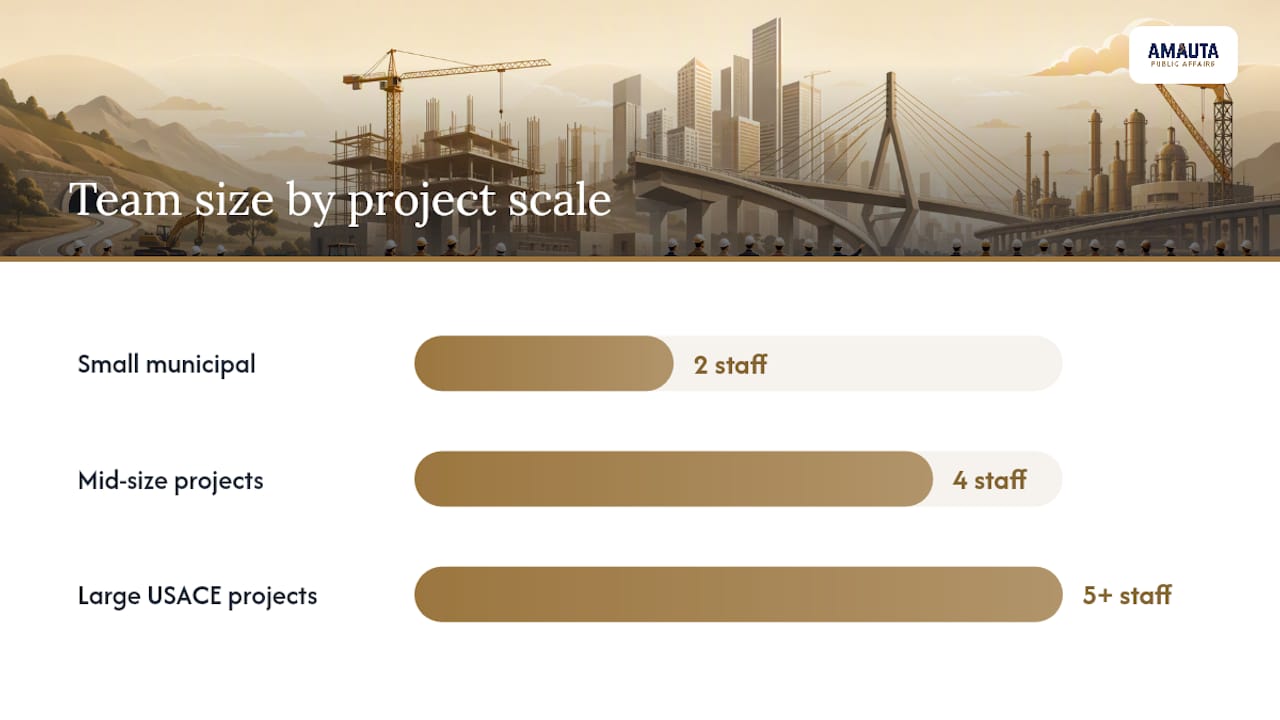
Budget ranges scale with project complexity. Small municipal projects typically require a lead strategist and one community manager. Mid-size commercial or infrastructure projects add a media lead and a data analyst. Large regional or multi-jurisdictional USACE projects often require a full team of five or more, including dedicated digital and government relations staff.
State technical assistance programs and flexible federal formula funds can materially offset staffing and budget gaps for local sponsors, particularly nonprofits and public agencies. Building this into your advocacy strategy early can free budget for community engagement that would otherwise be unfunded.
How should firms measure and report campaign outcomes?
Metrics and reporting requirements belong in the scope of work, not as an afterthought. Practical metrics to require:
Number of meaningful stakeholder meetings (with attendance logs)
Quality-verified public comments (not just raw counts)
Documented shifts in media and social sentiment
Decision-maker briefings completed
Letters of support secured
Documented instances where community input changed a project element
Timeline impacts: days shortened or regulatory risks mitigated
A complete campaign report should include an executive summary, a current stakeholder map, meeting summaries, comment analysis, a risk register, and a section showing specifically how community input was incorporated into project products. To validate claimed outcomes, request raw meeting notes, redacted contact logs, and original letters of support. Transparent communication practices and documented deliverables are the baseline for any credible engagement program.
What do successful campaigns look like in practice?
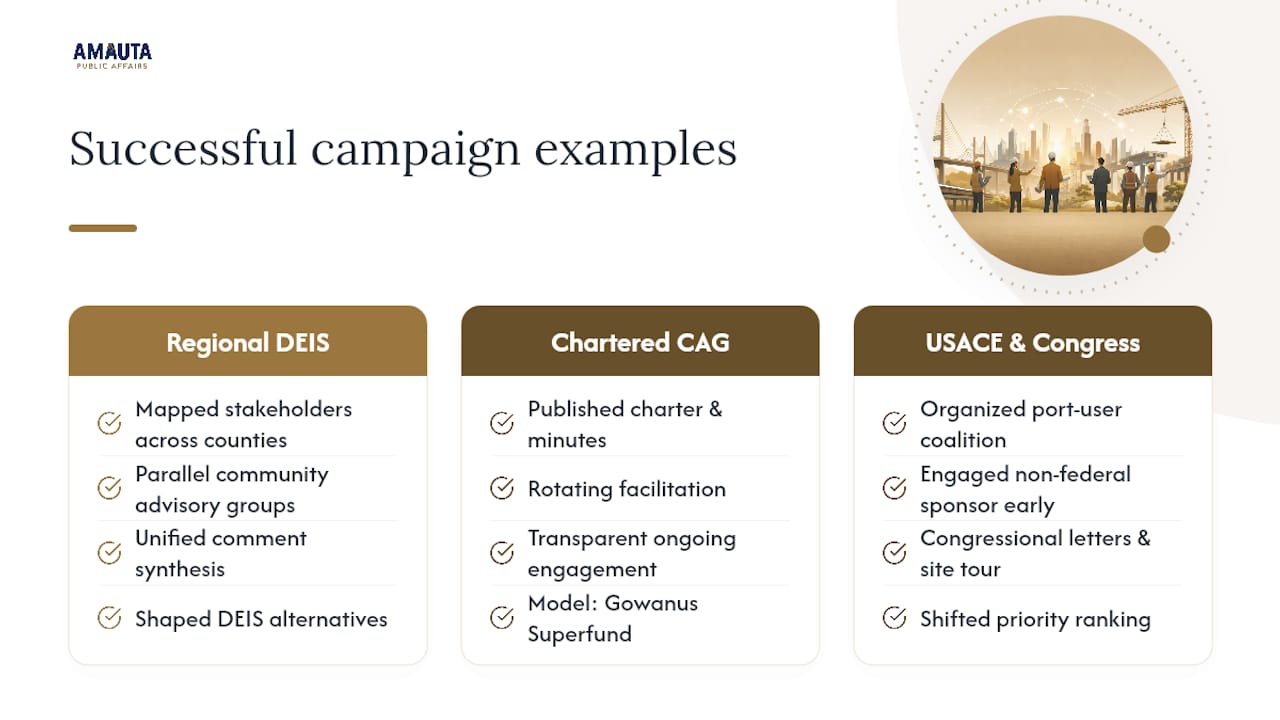
A. Multi-jurisdictional DEIS coordination. A regional infrastructure project spanning three counties required coordinated public outreach across separate NEPA scoping processes. The campaign team mapped stakeholders across all three jurisdictions, ran parallel community advisory groups, and produced a unified comment synthesis that the lead agency used to structure the DEIS alternatives analysis. The result: a consolidated public record that reduced duplicative objections and shortened the comment resolution phase.
B. Community advisory group for contaminated-site remediation. A brownfield redevelopment project faced deep community distrust rooted in prior environmental violations. The sponsor chartered a formal community advisory group with a published charter, rotating facilitation, and documented minutes. The Gowanus Canal Superfund process offers a comparable model, where chartered stakeholder structures influenced remediation decisions through transparent, ongoing engagement. The lesson: a chartered group with documented authority converts skeptics into participants with a stake in the outcome.
C. USACE project with congressional engagement. A harbor improvement project stalled in the USACE civil works pipeline until the non-federal sponsor organized a coalition of port users, labor, and local elected officials. Targeting non-federal sponsors early and engaging congressional partners are documented high-leverage tactics for influencing USACE project direction. Congressional letters and a targeted site tour for key appropriations staff shifted the project’s priority ranking. The lesson: quiet advocacy outside formal USACE processes often moves projects faster than formal comment submissions alone.
A coordinated strategy combining government relations, coalition outreach, and site tours secured sequential approvals for a controversial transit project by neutralizing opposition and aligning elected officials through targeted engagement. The single transferable lesson: map your political and community stakeholders before the first public notice, not after.
What does a recommended campaign-style approach include?
The procurement model that consistently produces approvable records follows a defined sequence. Stakeholder communication strategies for land-use projects align each phase with permitting milestones rather than treating outreach as a parallel track.
Process steps:
Discovery: Internal alignment on project scope, permitting timeline, and community risk profile
Stakeholder mapping: GIS-assisted identification of all affected parties, tribal governments, and political stakeholders
Coalition building: Recruitment and activation of credible third-party voices
Targeted outreach and communications: One-on-ones, community meetings, digital content, and earned media
Hearings support: Testimony coordination, comment mobilization, and real-time response
Post-decision monitoring: Input integration documentation and ongoing relationship management
Deliverables that belong in every SOW: stakeholder map, engagement plan, meeting summaries, comment synthesis, media plan, digital mobilization plan, and monthly progress dashboards. The differentiating factor is integration: public affairs staff working alongside permitting counsel and technical leads, with a named staffing plan and documented local relationships.
What practitioners have learned running permit approval campaigns
The gap between a well-designed engagement plan and a successful approval often comes down to two variables: timing and integration. Early one-on-ones before any public filing convert potential opponents into informed participants who feel heard, even when the project does not change. That shift in posture matters enormously at a public hearing.
Digital organizing has compressed the window for pre-filing outreach. Neighborhood apps and private social groups can generate organized opposition within 48 hours of a project becoming visible online. Sponsors who wait for the formal comment period to open are already responding to a mobilized opposition rather than shaping the conversation.
The second variable is synchronization. On one project, a pre-filing engagement effort turned a high-opposition scenario into a managed negotiation by aligning every community commitment with what permitting counsel had confirmed was legally and financially feasible. No promises were made that the project could not keep. That discipline preserved credibility through two contested hearings and a subsequent appeal. The land-use communication strategy that works is one where public affairs, legal, and finance speak with one voice from day one.
Amautapublicaffairs brings campaign-style engagement to your project
Projects that reach approval do so because the community and political conditions were built deliberately, not because opposition stayed quiet. Amautapublicaffairs delivers the full campaign stack: stakeholder mapping, coalition building, tribal consultation support, earned media, digital advocacy, and documented evidence of input integration, all coordinated with your permitting counsel and technical team.
The immediate next step is a 30–45 minute scoping call. From that conversation, Amautapublicaffairs produces a discovery scope of work covering stakeholder mapping, opposition risk assessment, and a recommended engagement timeline tied to your permitting milestones. Staff resumes, conflict-of-interest disclosures, and client references are available on request. Review the full service offering and schedule your scoping call to move from planning to campaign-ready.
Sources
The sources below are credible primary references for internal briefings, scoping memos, and RFP background sections.
Principles for Effective Stakeholder Engagement in Infrastructure Permitting and Review Processes
Common Sense Guide to Working with the U.S. Army Corps of Engineers - 2025
Act Locally: Investment guide for infrastructure funding (NRDC)
The value of early engagement in planning (Scottish Land Commission)
Recommended
Comments