
Launch Coalitions Fast: 6 Step Coalition Building for Practitioners

The strongest coalition building strategy rests on four early decisions: a focused set of a few points of unity, a small convening core, clear governance from day one, and a short public coalition letter. Skip the debate about perfect structure. Your first move is to assemble two or three anchor partners and draft that letter before you recruit anyone else.
TL;DR:
Building a coalition requires anchoring with two or three core partners and drafting a short, focused letter before full recruitment begins.
Effective coalitions choose the right type based on their goal, with campaign coalitions for singular decisions and long-term or policy table coalitions for ongoing issues.
Timing is critical, with coalitions forming best during policy windows, grant opportunities, or crises, and only after confirming clear goals and committed initial partners.
Structuring governance with a small steering committee and clear decision-making models accelerates action and prevents organizational drift.
Maintaining momentum involves celebrating wins, documenting lessons, and limiting member asks to foster long-term engagement.
Table of Contents
What Counts as a Coalition, and Which Type Fits Your Goal?
A coalition is a formal alliance of organizations or individuals who pool resources and credibility toward a shared objective, distinct from a one-off partnership or a single organization’s own campaign. The word gets used loosely. Getting the definition right matters because it determines how much structure you actually need.
Three common forms show up across land use, health, and advocacy work:
Campaign coalitions, built around a single decision point (a permit vote, a ballot measure, a budget cycle) and designed to dissolve once that decision is made.
Long-term coalitions, formed to hold a policy space over years, often around recurring funding cycles or ongoing enforcement issues.
Policy table coalitions, standing bodies that convene stakeholders regularly to negotiate shared positions on an evolving issue area, such as regional infrastructure or land use planning.
The objective you’re chasing should dictate the type, not the other way around. A campaign coalition can run lean, with an informal steering group and a hard end date everyone agrees to upfront. A long-term coalition needs bylaws, a membership process, and a plan for turnover, because it will outlast the people who founded it. Guidance from the Community Tool Box at the University of Kansas makes a useful point here: even well-planned coalitions should expect a non-linear process and revisit their own structure as circumstances shift.
Membership implications follow directly from type. Campaign coalitions can accept almost anyone willing to sign a letter, since the ask is narrow and the exit is built in. Long-term coalitions need tighter admission criteria, because a bad-fit member is harder to remove once trust and shared infrastructure are in place.
Why Build a Coalition: The Real Payoff and the Real Cost
A coalition multiplies your reach without multiplying your headcount. When a land use fight involves a school board, a small business association, and a tenants’ group all sending the same letter under one banner, the decision maker on the other side reads that as a broader mandate than any single group could claim alone.
The tactical benefits break down into three categories:
Reach and credibility. A coalition letter signed by multiple organizations lands differently than one signed by your group alone, especially with elected officials who track constituent breadth.
Pooled expertise and resources. A tenants’ rights group brings legal knowledge; a faith congregation brings meeting space and volunteer hours; a business association brings access to local media. No single partner has to fund all of it.
Channel diversity. Different partners have relationships with different decision makers. A coalition gives you simultaneous access to a city council member, a state legislator, and a regulatory agency staffer through three separate doors.
Coalitions succeed most often when they limit their public-facing principles to one to three clear points of unity. Broader, less controversial positions attract larger and more diverse memberships, according to the Commons Library’s coalition framework. That’s a strategic trade-off worth naming: the narrower your ask, the wider your tent.
A coalition is not always the right tool. If your issue is highly technical and only two or three organizations have real expertise, a coalition adds coordination overhead without adding leverage. If your timeline is short, building a coalition from scratch usually costs you more time than it buys, and a rapid-response letter with a handful of trusted allies gets you further faster.
When Should You Actually Start Building One?
Timing determines whether a coalition has teeth or just becomes a mailing list nobody reads. Three triggers usually signal it’s time to move: an open policy window (a comment period, a hearing date, a legislative session), a grant opportunity that rewards demonstrated community support, or a crisis that suddenly puts multiple stakeholders in the same room with the same urgency.
Before convening anyone, run a short readiness check:
Do you have one clear, articulable goal that a stranger could repeat back to you in one sentence?
Does someone have at least five to ten hours a week to dedicate to coordination for the next two months?
Have you already confirmed two or three organizations willing to co-convene, not just express interest?
Move too early, without a defined goal or initial supporters, and you’ll spend your first three meetings arguing about purpose instead of executing. Move too late, after the policy window has narrowed or the grant deadline is a week out, and you’ll never build the credibility a coalition needs to matter. The window for effective coalition building is almost always narrower than organizers expect.
Who Belongs at the Table: Mapping and Prioritizing Partners
Stakeholder mapping starts with listing every sector that touches your issue, then testing which sectors actually add leverage versus which just add meeting attendees. For a land use fight, a reasonable sector map includes neighborhood associations, small businesses, faith congregations, labor unions, environmental groups, tenant organizations, local media contacts, healthcare institutions, school districts, chambers of commerce, legal aid societies, and elected officials’ constituent offices. A dozen sectors is a common benchmark in coalition literature because it forces you past your existing network and into genuinely unfamiliar territory.
Diversity across sectors matters because it signals to decision makers that the issue transcends any single interest group. A council member can dismiss a coalition of environmental groups as predictable. It’s harder to dismiss the same environmental groups standing next to a small business association and a faith coalition.
Once you have your map, score each potential partner on three axes:
Influence. Do they have a direct relationship with the decision maker you’re targeting?
Audience. Do they reach a constituency you don’t currently reach?
Credibility. Would their endorsement change how a skeptical outsider views your position?
Recruit in order of highest combined score, not order of who returns your email fastest.
Skeptical or unusual partners, the business owner who’s never engaged in advocacy, the congregation leader wary of politics, often respond better to tangible incentives than to appeals to solidarity. Coalition builders have historically shaped participation by offering concrete benefits (shared media exposure, technical support, access to other partners’ networks) or by making the cost of staying out visible, a dynamic well documented in coalition research going back to large historical alliances like the 2003 coalition-building efforts around the Iraq War. You don’t need anything that dramatic. Offering a skeptical small business owner a seat on a subcommittee that directly affects their block, rather than a generic invitation to “join the coalition,” often converts faster.
Pro Tip: Call the hardest recruit first, not last. If your riskiest potential partner says yes early, every subsequent recruitment conversation gets easier because you can reference that name.
How to Launch a Coalition in Six Steps
Building a coalition from zero to functioning body follows a sequence you can actually copy. Frameworks like the eight-step process from County Health Rankings & Roadmaps cover initiation, recruitment, objectives, convening, resources, structure, maintenance, and evaluation as a baseline. Here’s a compressed six-step version built for speed.
Form a core convening team of three to five organizations. These are your anchor partners, the ones who will co-sign the first letter and absorb the early coordination workload. Assign one person as the point of contact, one as the note-taker and document keeper, and one as the outreach lead who handles new partner recruitment.
Draft one to three points of unity. Keep the public language narrow and uncontroversial enough that a wide range of partners can sign without internal debate. A useful practice is keeping the public principles on one page while maintaining a separate internal document that tracks tactical differences among partners, a method recommended in EFA/EFF’s coalition-building resources. That separation lets the coalition present a unified public front while accommodating real disagreement behind the scenes.
Write the coalition letter. Keep it to one page: the shared goal, a few points of unity, a clear ask directed at a specific decision maker, and a sign-on line. Structure sign-ons so organizations sign first and individuals sign second as an optional addition; this keeps the letter’s institutional weight visible while still allowing grassroots support to show. A common template across multiple toolkits confirms this two-tier sign-on approach accelerates both recruitment and public credibility.
Set an outreach cadence with soft and hard deadlines. Email your target list with a soft deadline for a first response (typically five to seven business days) and a hard deadline for signing on (typically two to three weeks out). Large organizations move slower than small ones. When recruiting a big institutional partner, contact the actual decision maker early, not a communications staffer, and expect a longer review cycle; partner introductions from an existing signer often cut that timeline significantly, according to EFA/EFF’s toolkit guidance.
Follow up twice before writing someone off. A first follow-up at the soft deadline, a second at the hard deadline. Silence after two follow-ups usually means no, and chasing further burns goodwill you’ll want later.
Run the first full meeting with a tight agenda. Cover four items only: confirm the shared goal, walk through the points of unity, assign initial working groups, and set the date for the next check-in. End every first meeting with each attendee leaving with one specific task and one specific deadline. A first meeting that ends without individual assignments almost always produces a second meeting with the same conversation.
Immediate follow-up after that first meeting should include a written recap sent within 48 hours, a shared document listing every member organization and their designated contact, and a calendar invite for the next meeting locked before anyone leaves the room.
Governance That Keeps a Coalition Moving
Coalitions fail more often from structural drift than from disagreement over goals. The fix is deciding governance before conflict forces the issue.
Two broad governance options exist. Informal governance works for short campaign coalitions: a rotating chair, decisions made by rough consensus in a single monthly call, and no formal bylaws. Formal governance suits long-term coalitions: a written charter, defined membership tiers, and a steering committee with actual decision-making authority separate from the full membership.
A small steering committee, drawn from the founding organizations, tends to expedite tactical decisions while preserving broader representation through rotating seats or working-group leads reporting back to it. This structure avoids the trap of forcing every operational decision through a twenty-organization vote, which grinds momentum to a halt.
Decision-making models generally fall into three camps:
Consensus, where major decisions require no strong objection from any member; slow but preserves buy-in.
Majority vote, faster but risks alienating minority-position members on contentious calls.
Steering committee delegation, where day-to-day tactical calls sit with a small group and only major strategic shifts return to the full membership.
Most effective coalitions blend the third model with periodic full-membership check-ins, reserving true consensus for decisions about the points of unity themselves.
Suggested role descriptions worth assigning explicitly: a coordinator (five to ten hours weekly, manages logistics and communications), a documentation lead (two to three hours weekly, keeps meeting notes and the membership roster current), and working-group chairs (variable time, own a specific tactical lane like media, fundraising, or direct outreach). Naming these roles out loud, even informally, prevents the common failure where one person quietly absorbs all the coordination work and burns out within three months.
Keeping Members Engaged Long After the First Meeting
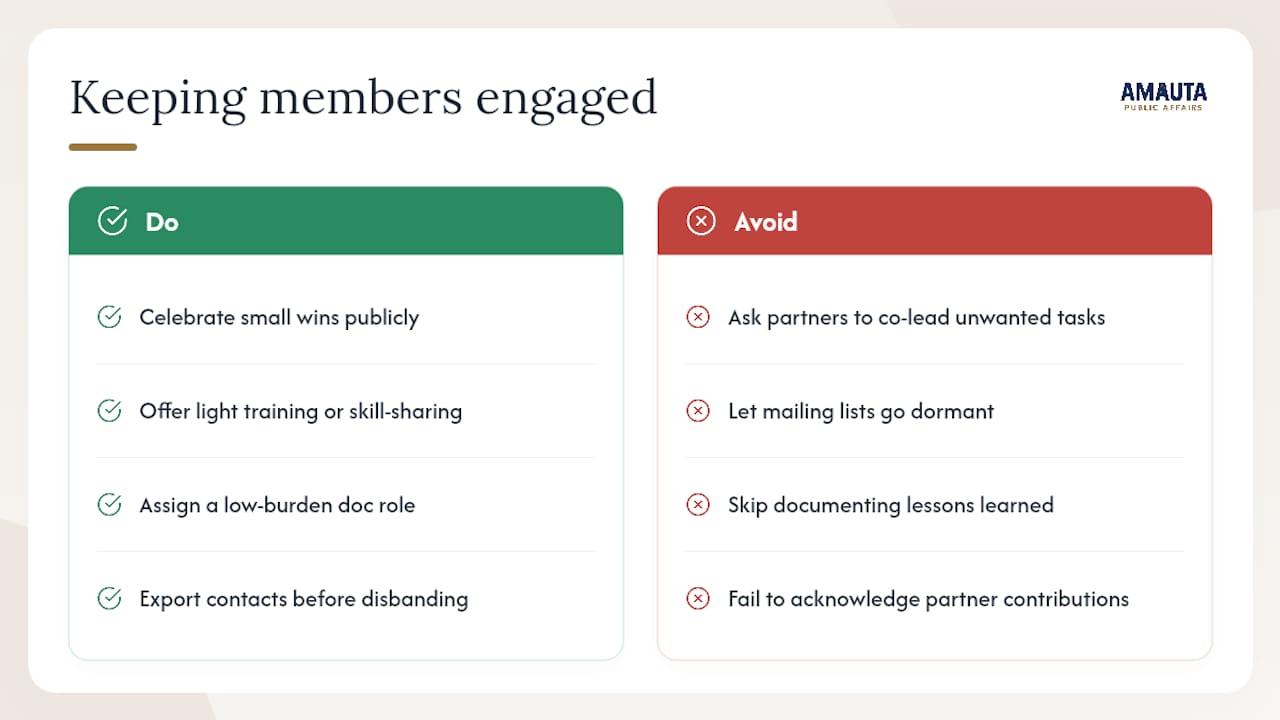
Coalitions lose momentum the same way relationships do: through unreturned effort. A member who shows up to three meetings without a task, or whose contribution never gets acknowledged publicly, stops showing up to the fourth.
Three tactics counter this reliably. First, celebrate small wins publicly and specifically, naming the partner organization whose outreach or connection made a difference, not just the coalition as a whole. Second, offer light training or skill-sharing sessions, a media training run by your most media-savvy member, for instance, so participation feels like it builds something for each partner beyond the immediate campaign. Third, keep individual asks manageable. A partner asked to show up once a month with a five-minute update stays longer than one asked to co-lead a subcommittee they never wanted.
Institutional memory disappears fast once a campaign ends, and rebuilding a coalition from scratch for the next fight is far less efficient than transitioning an existing network forward. Practitioner guidance from the Electronic Frontier Foundation’s coalition resources recommends keeping mailing lists and partner contacts active between campaigns rather than letting them go dormant. A low-burden documentation role, someone responsible for storing meeting notes, the membership roster, and media clips in one shared folder, preserves that memory without requiring a dedicated staff position.
Pro Tip: Before disbanding or going dormant, hold one closing meeting specifically to document lessons learned and export your contact list into a format the next organizer can actually use. Skipping this step is the single most common reason coalitions have to rebuild from zero.
Intergenerational leadership matters here too. Pairing newer, younger organizers with veteran advocates who’ve run coalitions before balances fresh energy against institutional know-how, a combination the Population Action International coalition toolkit points to as a real driver of long-term sustainability. When it’s time to pivot, scale down, or disband, that same intergenerational pairing usually produces the clearest read on whether the coalition still has a job to do.
Building the Communication Rhythm That Prevents Chaos
Communication overhead kills more coalitions than external opposition does. The fix is a minimal toolset, used consistently, rather than a sprawling stack of apps nobody checks.
A workable baseline: one shared email list for coalition-wide announcements, one shared document folder for meeting notes and the membership roster, and one messaging channel (a group text thread or a simple Slack workspace) for the steering committee’s faster-moving decisions. Resist the urge to add a new platform every time someone suggests one.
Meeting cadence should separate two levels. Full-coalition meetings work best monthly or at key decision points, kept to under an hour and focused on strategic alignment. Working groups, by contrast, should meet on whatever cadence their specific task demands, weekly during an active campaign push, biweekly during quieter stretches, without requiring the full membership’s attendance. Keeping the main meeting strategic and pushing task execution into working groups avoids the common failure where a coalition slowly turns into a standing association that meets often but decides little.
A useful first-meeting agenda template covers four items: a five-minute goal recap, a fifteen-minute working-group report-back, a fifteen-minute discussion of the next decision point, and a five-minute assignment of action items with names and dates attached. For public-facing moments, a brief press checklist helps: confirm a single spokesperson per event, circulate approved talking points 24 hours ahead, and designate one person to field media follow-up so reporters aren’t calling five different partner organizations for five different answers.
What to Measure and How Often to Check It
A coalition that never measures its own progress drifts without noticing. The fix isn’t elaborate reporting, it’s a short list of metrics tracked consistently enough to catch problems early.
Four categories cover most coalition needs:
Engagement, meeting attendance and working-group participation over time.
Actions taken, letters sent, meetings held with officials, events staffed.
Policy outcomes, whether the specific decision you targeted moved in your direction.
Media reach, coverage secured and audience size where trackable.
Assign one person, usually the documentation lead or coordinator, to compile these into a short update at every full-coalition meeting rather than a separate reporting exercise. A one-page summary read aloud in five minutes does more for accountability than a detailed spreadsheet nobody opens between meetings.
The real value of measurement isn’t the numbers themselves, it’s what they trigger. If engagement is dropping across three consecutive meetings, that’s a signal to change meeting format or check whether the ask has grown too heavy. If policy outcomes stall despite high engagement, that’s a signal your channel diversity isn’t reaching the right decision maker, and it may be time to recruit a new sector into the coalition rather than push harder through existing partners.
Common Coalition Problems and How to Fix Them
Most coalition conflict falls into three recognizable patterns, and each has a governance fix rather than a personality fix.
Founder syndrome shows up when the original convening organization keeps making unilateral decisions long after the coalition has grown beyond its founding core. The fix is structural: formalize the steering committee with rotating seats, so authority visibly shifts away from any single founding voice.
Mission drift happens when a coalition formed around one to three narrow points of unity slowly starts taking positions on adjacent issues that weren’t part of the original agreement. The fix is a hard rule: any new public position requires the same sign-off process as the original points of unity, no exceptions for urgency.
Uneven resource contributions create resentment when one or two organizations quietly absorb most of the coordination labor while others show up only for meetings. Naming this directly in a steering committee conversation, rather than letting resentment build silently, usually resolves it faster than most organizers expect.
A simple conflict script helps: name the specific behavior, not the person’s character; state the impact on the coalition’s shared goal; and propose one concrete change. Escalate to the full steering committee only when a direct one-on-one conversation has already failed twice. Red flags that signal a need for real structural change, not just a better conversation, include a founding organization refusing to discuss rotating leadership, a working group that hasn’t met in two full cycles, or a member organization publicly contradicting the agreed points of unity without prior discussion.
How campaign discipline applies to coalition work
Land use fights compress coalition timelines into weeks, not years, which is why coalition building benefits from treatment like political campaign field organizing: tight sequencing, real deadlines, and constant recalibration based on what’s actually happening on the ground rather than what a plan predicted six weeks earlier.
This campaign-style approach often shows up in how community benefits agreements are structured, using a six-step framework that keeps agreements enforceable long after the initial excitement of a signing ceremony fades. The same discipline applies to leadership structure: pairing newer community voices with longtime civic figures who already have standing with decision makers, so a coalition doesn’t lose its institutional credibility when founding members eventually step back.
The throughline across every engagement is the same: assess the specific community landscape first, then build the coalition structure the actual fight requires, rather than forcing a generic template onto a land use challenge that rarely resembles the last one.
What Most Coalition Advice Gets Wrong
Most coalition guides treat structure and unity as competing priorities, as if a tightly governed coalition must sacrifice breadth, or a broad coalition must accept chaos. The evidence points the other way. The coalitions that last are narrow in their public principles and disciplined in their governance at the same time. Those two things reinforce each other rather than trading off.
The conventional advice oversells consensus decision-making as the default virtuous model. In practice, consensus works for deciding what the coalition stands for, but it paralyzes coalitions trying to move fast on tactics. A small steering committee making tactical calls, with consensus reserved for the points of unity themselves, produces both speed and legitimacy. Most organizers discover this the hard way, after a campaign coalition burns three meetings debating a press release wording that a five-person steering group could have resolved in an email thread.
If you take one thing from this: sequence matters more than perfection. Get two or three anchor partners and a one-page letter out the door before your structure is fully settled. A coalition with imperfect governance and real momentum beats a perfectly governed coalition that launches too late to matter.
— Ignacio
Supporting coalitions that need outside capacity
Consultancies exist for the moment your coalition has the right partners but not the staff hours to run recruitment, drafting, and press outreach at the pace a land use decision demands. Where a traditional agency sells a fixed retainer regardless of your campaign’s actual phase, some firms build engagements around your specific community landscape, priorities, and timeline.
A typical first engagement starts with a landscape assessment: mapping the sectors and decision makers relevant to your specific fight, then building out the coalition-building and stakeholder relations services that fit your timeline, whether that’s drafting a coalition letter, running targeted outreach, or managing media relations once your coalition goes public. Community relations and digital advocacy support round out the full range of offerings available depending on where your effort stands. If your core convening team is assembled and you need help turning that group into a functioning coalition fast, get connected with AMAUTA to talk through your specific timeline.
Where to Go for Deeper Coalition Templates
A handful of free resources cover ground this article only summarizes. The Community Tool Box coalition-building chapter from the University of Kansas offers the most practical how-to walkthrough available for free online. The County Health Rankings eight-step guide works well as a checklist to run alongside your own planning.
The Population Action International coalition-building toolkit for leadership and sustainability frameworks.
The EFA/EFF coalition-building toolkit for sample letters and sign-on structures.
The Commons Library’s five principles guide for a deeper dive on points of unity.
Bookmark these before your first meeting, not after your third.
Sources
FAQ
What Is a Real-World Example of a Coalition?
A neighborhood group, a small business association, and a faith congregation joining forces to oppose or shape a specific development permit is a common land use coalition example, each bringing different access and credibility to the same narrow goal.
What Are the Sectors Typically Represented in a Broad Coalition?
Coalition mapping frameworks commonly reference around twelve sectors, including neighborhood associations, businesses, faith groups, labor, environmental organizations, schools, healthcare institutions, media contacts, and elected officials’ offices, though the right mix depends on the specific issue.
What Does Coalition Building Actually Mean?
Coalition building means forming a deliberate alliance among organizations or individuals who share a narrow set of goals, agree on shared points of unity, and coordinate action toward a common decision maker or outcome.
How Many Points of Unity Should a Coalition Have?
Most successful coalitions limit their public points of unity to one to three, since a narrower, less controversial set of shared principles tends to attract a wider and more diverse membership.
Does Amautapublicaffairs Help With Coalition Building Specifically?
Yes. Coalition building is one of Amautapublicaffairs’s core services, alongside stakeholder relations and community engagement support, tailored to land use, energy, and infrastructure projects; current details are available on its services page.
Recommended
Comments