
7 States' Sunshine Law Differences for Public Meetings and a Checklist
Sunshine laws require that meetings of public bodies stay open to the public, with advance notice, except for a narrow list of statutory exceptions covering matters like litigation or personnel. Every state has some version of this rule, though the specific mechanics differ widely: California’s Brown Act, the Pennsylvania Sunshine Act, and the Texas Open Meetings Act each set their own notice periods, remote-access standards, and enforcement paths. If you’re organizing a meeting or trying to attend one, the details of your state’s statute are what actually matter.
TL;DR:
Most sunshine laws consider any gathering of a quorum where members discuss or act on public matters as an official meeting requiring open access and notice.
Notice deadlines and methods vary by state, with California requiring 72 hours before regular meetings and Hawaii necessitating up to six days in advance, depending on the situation.
Public participation, including attending, commenting, and recording, is generally allowed unless conduct disrupts proceedings or threatens safety, with remote access rules being particularly complex.
Closed sessions are narrowly defined for specific issues like litigation, personnel, or negotiations, and must follow strict procedural rules, including a public vote and stated purpose.
Posting accurate, timely minutes and maintaining records is critical, with most states requiring public availability within days of the meeting to ensure transparency and accountability.
Table of Contents
What Sunshine and Open-Meetings Laws Actually Cover
A “meeting” under most sunshine laws isn’t limited to formally gaveled sessions. It includes any gathering of a quorum of a public body where members deliberate or take action on matters within their jurisdiction. A city council, a planning commission, a board of county commissioners, a school board, a water district board: all of these count as public bodies whose deliberations trigger open-meeting requirements, not just their final votes.
Quorum is the trigger. Once enough members are present to legally act, the law generally treats their conversation as a meeting, whether it happens in a hearing room or in a parking lot after a site visit. That’s why practitioners advise treating any gathering of a quorum as covered unless a narrow exception clearly applies. Common edge cases include:
Site inspections where members discuss a project informally
Workshops or study sessions billed as “informational only”
Subcommittee gatherings that happen to include a full quorum of the parent body
Multi-location teleconferences where consensus forms across sites
The Wex legal definition of sunshine laws from Cornell’s Legal Information Institute captures the underlying principle well: these statutes exist to make government deliberation, not just government decisions, visible to the public. Texas’s Open Meetings Act Handbook reinforces this by directing that the statute be construed liberally in favor of openness, a standard most states apply in some form.
Public Notice and Agenda Requirements
Notice rules are where state laws diverge most sharply, and getting them wrong is the single most common way agencies end up in litigation. Nearly every statute requires the same basic notice elements: date, time, location, and a description of topics to be discussed. Where states differ is timing and posting method.
California’s Brown Act requires agencies to post the agenda at least 72 hours before a regular meeting, typically at a physical location and on the agency’s website. Pennsylvania’s Sunshine Act generally calls for advance public notice of regular meetings, with a shorter 24-hour window for special meetings. Michigan’s Open Meetings Act sets its own timelines that shift depending on whether the meeting is a regular session or a rescheduled one.
State | Regular meeting notice | Special/emergency notice | Notable posting detail |
California | 72 hours before meeting | 24 hours, limited topics | Agenda posted at each teleconference location |
Pennsylvania | Advance public notice required | 24 hours for special meetings | Notice via newspaper or posted at meeting place |
Michigan | Timelines vary by meeting type | Shorter window for rescheduled sessions | Posted at agency’s principal office |
Hawaii | Six calendar days in most cases | Shortened for genuine emergencies | Filed with Lieutenant Governor or county clerk |
Emergency meetings almost always get a carve-out, but that carve-out is narrow. It typically applies only to genuine emergencies threatening public health or safety, not to convenience. Some states add extra requirements for budget-related items, like posting supporting financial documents alongside the agenda. The safest posting practice for any agency: post to the website, the physical bulletin board, and any electronic filing system simultaneously, and keep a dated record of when each posting went live. That paper trail is what protects you if a resident later disputes whether notice was adequate.
Public Access, Comment, and Remote Participation
Members of the public generally have the right to attend open meetings, and in most states, to record or broadcast them. Agencies can limit that right only in specific circumstances, typically when someone disrupts the meeting or threatens a breach of the peace, not simply because recording makes officials uncomfortable.
Public comment periods are a near-universal feature, though how they’re structured varies. Some agendas separate comment on agenda items from general public comment on unrelated matters; others fold everything into one period. What matters practically is that the agenda tells attendees when and how they can speak.
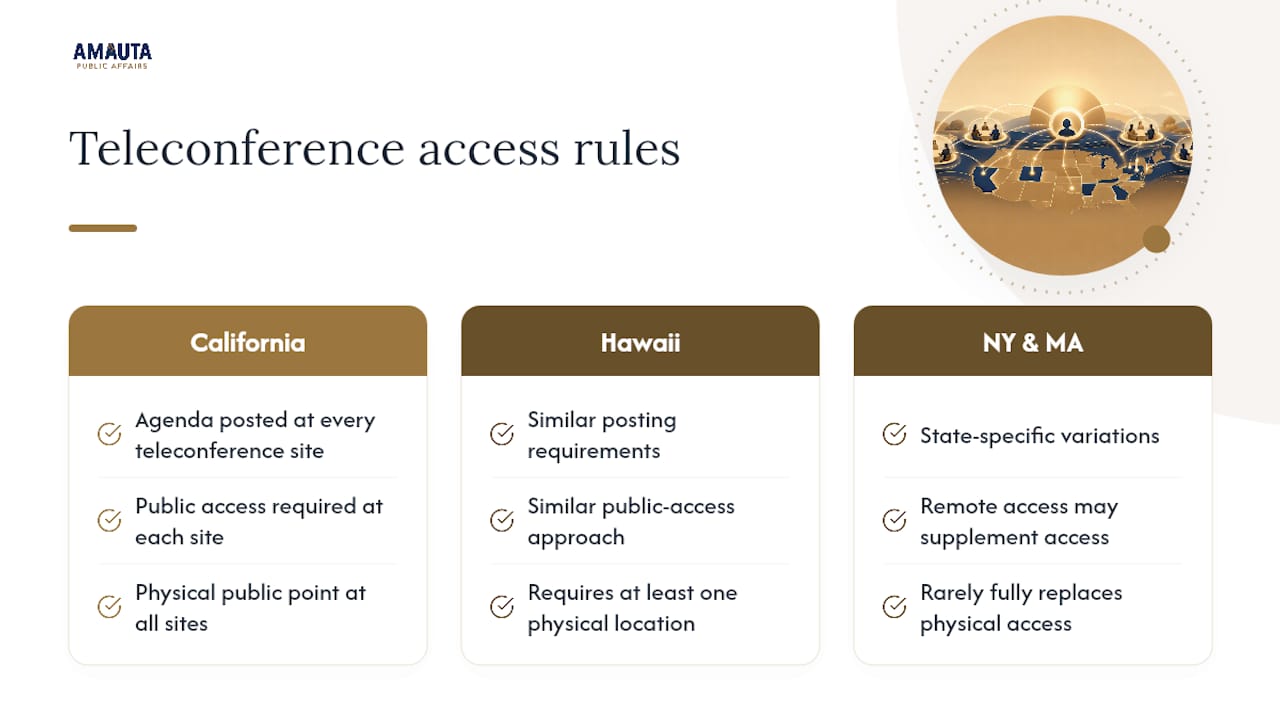
Remote participation is where the rules get genuinely complicated. The Brown Act imposes detailed teleconferencing requirements, including posting the agenda at every teleconference location and ensuring public access at each site a member calls in from. Hawaii’s Sunshine Law takes a similar approach, requiring at least one physical public location even when the meeting is otherwise conducted remotely. New York and Massachusetts have their own variations on the same theme: remote access can supplement, but rarely fully replace, a physical point of public entry.
Accessibility matters too. Notices should be available in formats compatible with ADA requirements, and agencies that stream meetings should test captioning and audio quality before, not during, a contentious vote. For readers who want a fuller walkthrough of what to expect when showing up to speak, how public meeting participation works breaks down the practical steps.
Pro Tip: If you’re planning to attend remotely, call the agency clerk the day before to confirm the dial-in or login details are still active. Teleconference links get changed more often than agendas get updated.
Closed Sessions and What Can Legally Happen Behind Closed Doors
Closed sessions are the exception, not the rule, and every statute lists them narrowly. The most common categories that qualify are:
Pending or anticipated litigation
Personnel matters, including performance evaluations and discipline
Attorney-client privileged communications
Certain real estate negotiations before terms are finalized
Some collective bargaining discussions
Entering a closed session isn’t a matter of officials simply deciding to leave the room. Most statutes require a public motion, a roll-call vote, and a stated purpose citing the specific statutory exception before members can go behind closed doors. Michigan’s Open Meetings Act Handbook is explicit that closed sessions serve narrow purposes and that a body can’t use one as a shortcut around public deliberation.
The rule that trips up the most agencies: any substantive decision discussed in closed session still has to be formally approved through a vote taken in open session afterward. A closed session is for discussion, not for finalizing outcomes. New York’s Open Meetings Law follows the same logic, treating closed-door exceptions as limited carve-outs rather than a general permission to conduct business privately.
Minutes, Records, and What Happens After the Gavel Drops
Minutes aren’t optional paperwork. Most statutes require them to capture the date, time, and place of the meeting; which members were present or absent; a summary of matters discussed; and, critically, a record of roll-call votes on formal actions. That last detail matters because it’s what lets a resident later verify exactly how their representative voted on a specific measure.
Posting timelines for minutes vary by state, but the trend across most handbooks, including Michigan’s, is to post minutes and make them publicly available within days, not weeks, of the meeting. Agencies should maintain minutes as part of a permanent, searchable public archive rather than a folder buried on a subpage.
If an omission surfaces later, such as a missing roll-call vote, the correct fix is a formal correction adopted at a subsequent meeting, not a quiet edit to the old record. That keeps the public archive trustworthy.
How Violations Get Challenged and What Penalties Look Like
Enforcement generally runs through two channels: a complaint to the state attorney general’s office, or a lawsuit filed directly by an affected resident or organization. Most statutes are written to give ordinary citizens standing to sue, which is part of what makes these laws different from typical administrative rules.
If you believe a meeting violated the law, here’s the practical sequence:
Document everything. Save the posted agenda, note when and where it appeared, and record what was and wasn’t discussed publicly.
Request the record. File a formal request for minutes, recordings, or the closed-session motion language under your state’s public-records law.
Contact the enforcing authority. Many states route complaints through the attorney general’s office; Texas’s Open Meetings Act Handbook outlines this process in detail.
Consider litigation if the violation is clear. Courts can void actions taken in violation of notice or closed-session rules, issue injunctions, and in some states award attorney’s fees to a prevailing plaintiff.
Some statutes, including versions of the Texas and Michigan laws, carry the possibility of civil or even criminal penalties for officials who knowingly violate notice or closed-session rules, though prosecutions are rare compared to civil remedies like voided votes.
Notice Rules and Standout Requirements by State
The seven statutes below cover the states readers encounter most often when researching sunshine law compliance. Timing and standout rules differ enough that copying one state’s practice into another jurisdiction is a common and avoidable mistake.
State | Statute | Regular notice timing | Standout requirement |
California | Ralph M. Brown Act | 72 hours | Agenda posted at every teleconference location |
Pennsylvania | Pennsylvania Sunshine Act | Advance public notice | 24-hour notice for special meetings |
Texas | Open Meetings Act (Gov’t Code ch. 551) | Notice of date, time, place, subject | Liberal construction favoring openness |
Florida | Sunshine Law (Ch. 286) | “Reasonable” notice | Attorney-client sessions require a court reporter and stenographic record |
Michigan | Open Meetings Act (OMA) | Varies by meeting type | Decisions must be finalized in open session |
Hawaii | Sunshine Law | Six calendar days | At least one physical public location required |
New York | Open Meetings Law | Reasonable advance notice | Narrow, strictly construed closed-session exceptions |
Florida’s statute is worth flagging separately: Florida Statutes chapter 286 requires a “reasonable” notice standard rather than a fixed hour count, but it compensates with unusually strict procedural rules around attorney-client sessions, including a requirement for a certified court reporter.
A Practical Compliance Checklist for Agencies and Attendees
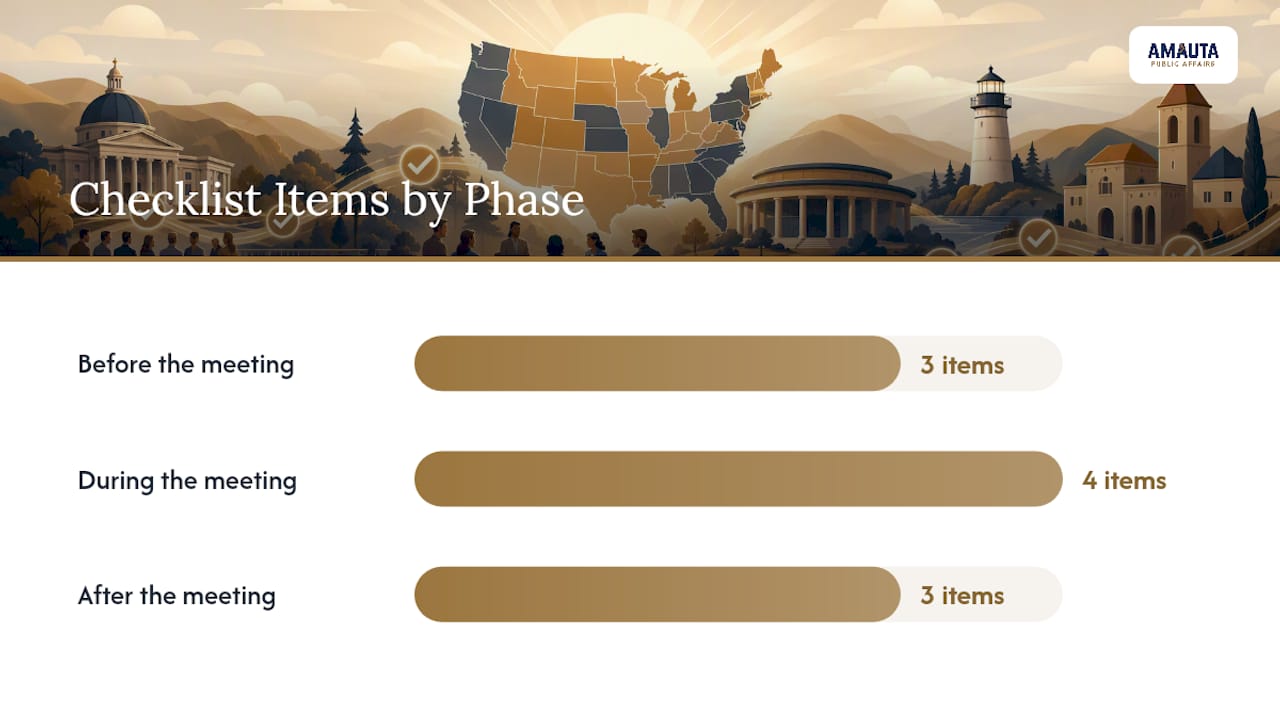
Compliance breaks down into three phases, and most violations trace back to a gap in one of them.
Before the meeting:
Publish an annual meeting schedule so the public can plan around it
Post agendas with remote-access details (dial-in numbers, streaming links) well before the statutory deadline, not right at it
Attach supporting documents for budget or contract items when required
During the meeting:
Confirm quorum on the record before taking any action
Open the floor for public comment at the point specified on the agenda
Record roll-call votes explicitly, not just a general “motion carried”
Follow closed-session procedure exactly: motion, roll call, stated statutory purpose
After the meeting:
Publish minutes promptly and archive agendas and recordings in one accessible location
Respond to records requests within statutory deadlines
Track a running log of any procedural near-misses to fix before they become disputes
Pro Tip: Draft agendas in plain language rather than bureaucratic shorthand. “Discussion of Resolution 2026-14 regarding the Elm Street rezoning application” tells a resident far more than “Old Business Item 3,” and it heads off complaints that notice was technically adequate but practically useless.
Transparency as Prevention, Not Just Compliance
The agencies that get sued over notice technicalities are rarely the ones acting in bad faith. They’re the ones treating sunshine law compliance as a checkbox instead of a relationship. When a community can see how a decision got made, weeks before a vote, the fight moves from “why weren’t we told” to the actual merits of the project. That’s a better fight for everyone involved, including developers and agencies trying to move projects forward without a last-minute revolt at the podium.
Proactive transparency, posting accessible agendas, testing remote-access tools ahead of time, sharing background materials early, does more than reduce legal exposure. It shortens the distance between a proposal and a decision, because half the opposition energy at contentious meetings comes from residents who feel ambushed rather than informed. Clear notice is cheap. Litigation and delayed permits are not.
— Ignacio
Where Amautapublicaffairs Fits Into Meeting Design and Community Trust
Sunshine law compliance is the floor, not the strategy. Getting a notice posted on time keeps you legal; it doesn’t tell you how to run a meeting that actually builds support for a project instead of hardening opposition to it. That gap between “technically compliant” and “genuinely trusted” is where Amautapublicaffairs works.
This agency approaches land use and infrastructure projects the way a campaign approaches a contested race: assess the community landscape, set priorities, and adjust messaging as real feedback comes in. That means helping clients design meeting agendas that are clear rather than bureaucratic, coordinating stakeholder relations and permitting support so agencies and applicants aren’t caught off guard by procedural disputes, and building community relations and digital advocacy strategies that get accurate information in front of residents before a contentious vote, not after. If your project is headed toward a public hearing and you want the meeting itself to build trust instead of triggering a fight, get connected with the AMAUTA team for a consultation.
This article is general information, not a substitute for advice from a qualified lawyer. Consult a qualified legal professional about your own circumstances before acting on anything here.
Sources
FAQ
What states have a sunshine law?
Every state has some form of open-meetings or sunshine law, though the names and specifics differ. California calls its version the Ralph M. Brown Act, Pennsylvania has the Pennsylvania Sunshine Act, Texas uses the Open Meetings Act under Government Code chapter 551, and Florida, Michigan, Hawaii, and New York each have their own statutes covering the same basic ground.
What does Florida’s Sunshine Law say about public meetings?
Florida Statute chapter 286 requires that meetings of boards and commissions be open to the public with reasonable notice given in advance. It also sets specific procedural rules for attorney-client sessions, including a requirement for a court reporter to keep a stenographic record.
What are the requirements for public meetings under state sunshine laws generally?
Most state statutes require advance public notice of the date, time, place, and subject matter of a meeting, along with an opportunity for the public to attend and often to comment. Notice periods range from 24 hours for special meetings in some states to six calendar days under Hawaii’s Sunshine Law, so the exact rule depends on the state and meeting type.
What is the US Sunshine Law?
There isn’t one single federal “Sunshine Law” covering all public meetings. The federal Government in the Sunshine Act applies specifically to multi-member federal agencies, while most meetings that affect everyday residents, city councils, school boards, planning commissions, fall under state-level statutes like the Brown Act or the Texas Open Meetings Act.
Can I record or livestream a public meeting?
In most states, yes. Attendees generally have the right to record or broadcast an open meeting, and agencies can restrict that right only in narrow circumstances, such as an actual disruption or threat to public safety, not simply discomfort with being filmed.
Recommended
Comments