
6 Steps to Form a Community Advisory Committee for Land Use Projects

A community advisory committee is a formal group of residents, stakeholders, and subject matter experts that gives ongoing, structured input to an organization, agency, or research team on a specific project or policy. These bodies show up most often in public health, urban planning, transit authorities, and government agency oversight, where they act as a standing bridge between decision makers and the people affected by those decisions. The rest of this guide covers how they’re structured, how they operate day to day, and how to charter one that produces real influence rather than symbolic participation.
TL;DR:
Community advisory committees typically influence project design and outreach strategies but lack final decision-making authority, requiring formal documentation to ensure influence.
Effective membership reflects diverse community experience, partner organizations, and technical experts, with staggered term lengths and inclusive recruitment to ensure real community representation.
Meetings usually occur quarterly for 60 to 90 minutes, with agendas sent in advance, clear follow-up steps, and expense stipends or reimbursements to maximize participation of lower-income members.
A well-structured charter defines purpose, scope, membership criteria, operating rules, and evaluation checkpoints, with outside facilitation recommended for land-use or public project committees.
Preventing committee failure relies on balancing influence, providing feedback transparency, limiting staff dominance, and maintaining member recognition through staggered terms and ongoing charter reviews.
Table of Contents
What Does a Community Advisory Committee Do?
A community advisory committee holds an advisory role, not a governance one. It recommends, critiques, and flags concerns, but the sponsoring organization retains final decision authority. That distinction shapes everything about how the committee should be designed and managed.
These bodies show up in strikingly different settings, though the underlying function stays consistent: translating community perspective into project design. Common contexts include:
Public health research, where community advisory boards help researchers design culturally relevant studies and recruitment strategies
Urban planning and land-use projects, where committees weigh in on site design, traffic impact, and neighborhood character
Transit agencies, which use rider advisory groups to shape route changes and accessibility upgrades
Government agency oversight, where standing committees review policy proposals before public comment periods
A CAC often operates alongside other engagement structures, like steering committees or short-lived task forces. The difference is duration and scope: a task force dissolves after a specific deliverable, while a well-designed advisory committee persists across the life of a program or agency mandate.
How Are Community Advisory Committees Structured?
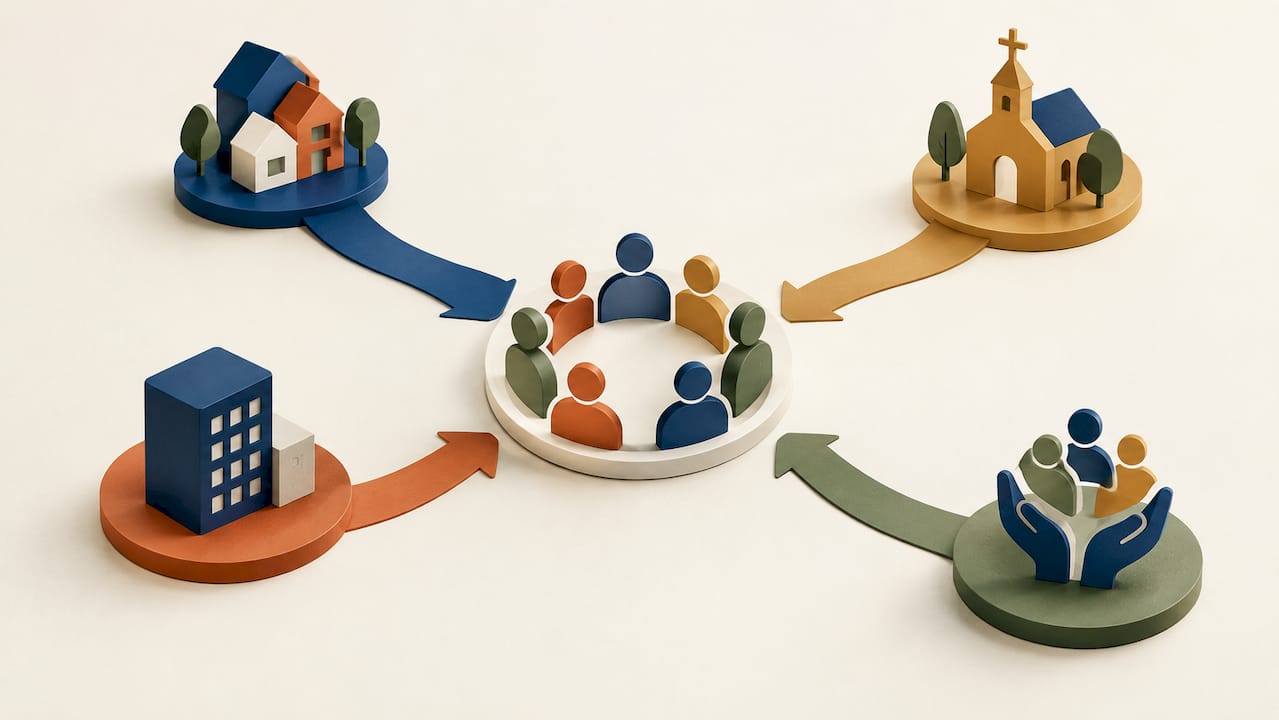
Membership composition determines whether a committee produces genuine insight or a rubber-stamp exercise. Most effective committees mix several types of participants rather than relying on a single voice.
A representative structure typically includes:
Community members with direct lived experience of the issue at hand
Representatives from partner organizations, nonprofits, or neighborhood associations
Subject matter experts who can translate technical proposals into plain language
Staff liaisons who facilitate but don’t dominate discussion
Leadership models vary by sector, but co-chair arrangements, pairing a community member with a staff or agency representative, tend to distribute authority more evenly than a single appointed chair. Term lengths commonly run one to three years, staggered so the entire roster doesn’t turn over at once.
Recruitment matters as much as structure. Reaching beyond an organization’s existing contact list, through neighborhood associations, faith communities, and local employers, produces a membership that actually reflects the community rather than the loudest existing stakeholders. Partnering with organizations focused on inclusive recruitment, such as groups working in diversity, equity, inclusion, and belonging, can widen that pool meaningfully.
What Decisions Can an Advisory Committee Actually Influence?
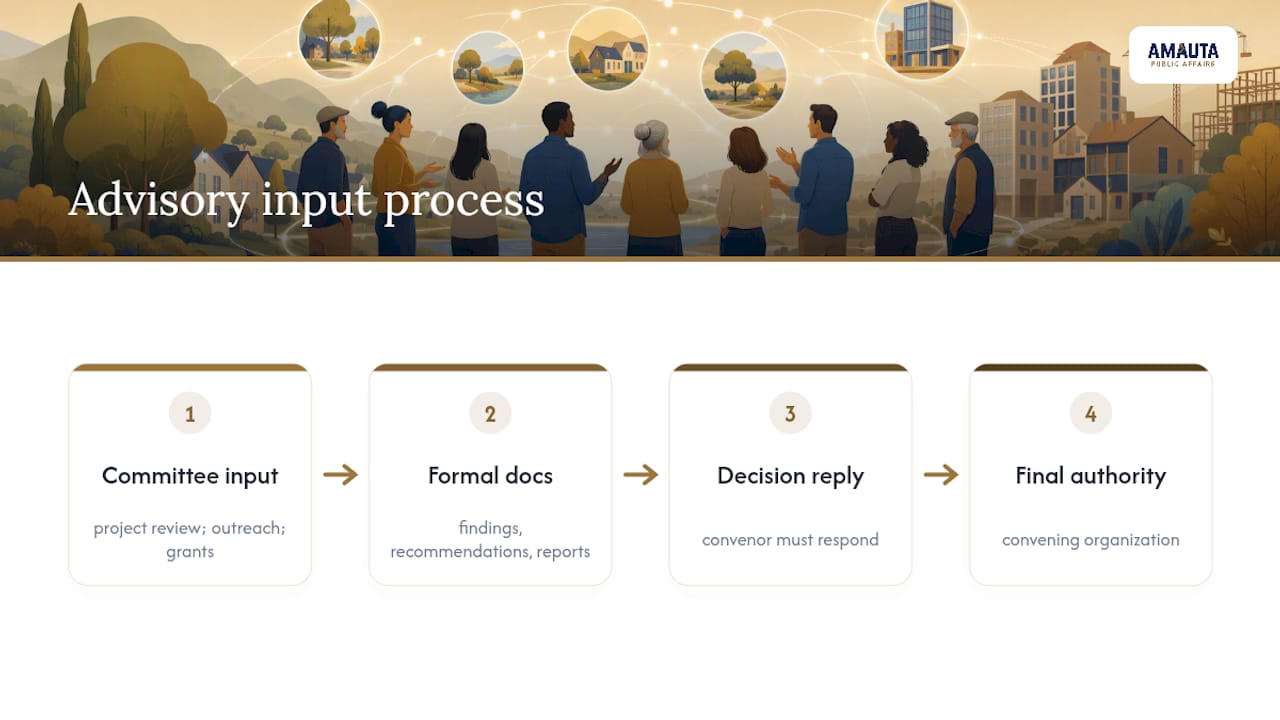
Committees typically advise on a defined set of matters: reviewing project proposals before public release, shaping outreach and messaging strategy, and sometimes scoring grant applications or prioritizing funding requests. None of that constitutes binding authority. The organization convening the committee makes the final call.
What makes advisory input actually count is documentation. Committees that produce formal findings, written recommendations, or meeting reports create a paper trail that decision makers must respond to, even if they don’t adopt every suggestion. A committee whose feedback disappears into an internal email thread will stop attracting engaged members within a year.
Setting scope honestly at the outset prevents the most common source of frustration: members who join expecting decision-making power and discover they only have advisory standing. Naming that boundary in the charter, before recruitment begins, saves the relationship later.
How Often Do Committees Meet, and What Do They Cover?
Meeting rhythm varies by sector, but quarterly meetings running 60 to 90 minutes are common practice, according to documented CAC operations at Wake Forest, where leadership positions are held by community members themselves rather than institutional staff.
A workable operating rhythm looks like this:
Send agendas and background materials at least one week ahead, giving members time to review technical content
Open with a brief recap of how prior recommendations were used or declined
Reserve the bulk of the meeting for substantive discussion, not staff presentations
Close with clear next steps and assigned owners
Publish minutes promptly, especially for committees tied to public agencies subject to open-meeting laws
Compensation practices differ widely. Some conveners pay stipends, others don’t, and toolkit examples show figures like $300 per quarterly meeting as one workable benchmark from the Community Advisory Board Toolkit. Budget for travel reimbursement and childcare support too. These costs are often the deciding factor in whether lower-income or working members can participate at all.
Pro Tip: Budget stipends and travel reimbursement into your project’s engagement line item from day one. Retrofitting compensation after members have already volunteered unpaid signals that their time wasn’t valued from the start.
How Do You Form and Charter a Community Advisory Committee?
Forming a committee that lasts starts with clarity, not enthusiasm. Skipping the groundwork is the most common reason committees stall out within a year.
Define the purpose and scope. Write down exactly what the committee will and won’t decide before recruiting a single member.
Draft the charter. Cover mission, membership criteria, term lengths, meeting frequency, and how recommendations get recorded and reported back.
Set membership criteria and build a recruitment plan. Identify the representation gaps in your current stakeholder list and target outreach accordingly.
Onboard new members thoroughly. Co-education, walking members and staff through both the technical project details and the community context together, builds the shared understanding that makes advice useful, a practice emphasized in guidelines tested with tribal partners.
Establish operating rules. Decide how decisions get made within the committee itself: consensus, majority vote, or chair discretion.
Build an evaluation plan. Set check-in points, at six months and annually, to assess whether the committee is producing real influence or just meeting for its own sake.
A charter should also spell out:
How vacancies get filled
What happens if a member misses multiple consecutive meetings
How the charter itself gets reviewed and updated
Pairing this process with a broader community engagement strategy keeps the committee aligned with the project’s overall public-facing goals rather than operating in isolation.
Why Do Advisory Committees Fail, and How Do You Prevent It?
The most common failure mode is a committee that exists on paper but has no real influence. Members notice fast when their recommendations vanish without explanation, and disengagement follows within a couple of meeting cycles.
Power-sharing tactics address this directly:
Limit how much airtime staff and institutional representatives take during meetings
Use a co-chair model or rotate agenda-setting duties to community members
Consider splitting agendas so part of each meeting runs without staff present, preserving unfiltered community discussion
Build visible feedback loops that show members exactly how their input changed, or didn’t change, a final decision
Sustained engagement also depends on reasonable workload and recognition. Practical sustainability tactics include staggered terms so institutional memory doesn’t disappear all at once, a small steering group to handle logistics between full meetings, and periodic charter reviews that keep the committee’s mandate current as the project evolves.
Designing Committees for Land-Use and Public Projects
Campaign-style engagement, where outreach tactics get recalibrated as community feedback comes in, changes how a committee should function. It works best when the committee’s charter allows for adjustment rather than locking every procedure in place before the first meeting.
External facilitation earns its cost in three specific spots: structuring onboarding so technical and community knowledge transfer both directions, mediating disagreements before they harden into factions, and keeping meeting logistics running so staff can focus on substance. Before forming a committee, organizers should ask three questions: What decision will this committee actually influence? Who is missing from the room that the project can’t succeed without? And what happens to their feedback after the meeting ends?
— Ignacio
How Amautapublicaffairs Supports Committee Formation
Some firms offer an alternative to building a community advisory committee from scratch with no outside support and hoping it holds together. Organizers juggling permitting deadlines rarely have bandwidth left to draft a charter, recruit representative members, and mediate the disagreements that surface in month three.
Amautapublicaffairs offers community relations, coalition building, and stakeholder relations built around the campaign-style approach described above: assessing the community landscape, setting priorities, and adjusting tactics as real feedback comes in rather than running a fixed script. That includes facilitation support during formation, conflict mediation once a committee is running, and messaging strategy that keeps a project’s permitting support and public engagement moving in the same direction. If you’re weighing whether to form a committee for an upcoming land-use or infrastructure project, get connected to talk through what your specific project needs before you draft a charter.
Toolkits and Guidelines Worth Consulting
The Community Advisory Board Toolkit supplies sample charter language and stipend schedules. The tribal partner guidelines offer modular worksheets for formation and evaluation. Organizers building a companion outreach plan can pair either with a 90-day community engagement starter.
Sources
FAQ
What Is the Role of an Advisory Committee?
An advisory committee’s role is to review proposals, offer recommendations, and represent community or stakeholder perspective to the organization that convened it. It does not hold binding decision authority. The sponsoring body decides whether to adopt, modify, or decline the committee’s advice.
Are Community Advisory Committee Members Paid?
Compensation practices vary by sponsoring organization. Some committees pay stipends, such as the $300 per quarterly meeting example found in toolkit guidance, while others operate on a volunteer basis with travel reimbursement only.
What Is the Role of a Community Advisory Board?
A community advisory board functions much like a community advisory committee: it gives structured, ongoing input to guide research, policy, or program design, most commonly in public health settings. Boards often hold quarterly meetings with leadership positions filled by community members themselves rather than institutional staff.
What Are Some Examples of Advisory Committees?
Examples include community advisory boards related to HIV prevention research, transit agency rider advisory committees, neighborhood planning advisory groups tied to land-use projects, and public health center advisory boards required under federal funding rules. Each shares the same core structure: a defined charter, representative membership, and a documented feedback channel to the sponsoring organization.
How Do I Get Professional Help Setting Up a Committee?
Organizations that need support designing, chartering, or facilitating a community advisory committee for a land-use or infrastructure project can review Amautapublicaffairs’s community engagement and stakeholder relations services. Pricing depends on project scope and is available by contacting the team directly.
Recommended
Comments