
Community Outreach Before Project Launch: A 2026 Guide

Community outreach before project launch is a structured, early-stage engagement process that determines whether a project earns public trust or faces organized opposition. The industry term for this practice is pre-decisional community engagement, and it encompasses every deliberate step taken to involve stakeholders before final plans are set. Projects that skip this phase routinely encounter delays, legal challenges, and redesign costs that dwarf the investment of early consultation. This guide gives local government officials, developers, and community organizers a practical framework for designing outreach that generates real collaboration, not just compliance.
What are the prerequisites for successful community outreach before project launch?
Effective pre-launch community engagement begins with a documented strategy, not a phone call or a single public notice. GOV.UK guidance directs project teams to define purpose, target audience, and measurable objectives inside a Project Initiation Document before any public-facing activity begins. This document becomes the internal contract that keeps communications, planning, and IT teams aligned throughout the process.
Stakeholder and demographic analysis is the second prerequisite. You need to know who lives near the project, who has legal standing to comment, and which groups are historically underrepresented in public processes. Indigenous communities, renters, non-English speakers, and people with disabilities each require tailored outreach pathways, and identifying them early prevents last-minute scrambles that produce thin participation numbers.

Timeline planning is the third prerequisite, and it is where most teams underestimate the complexity. Consultation timelines require backward planning from decision deadlines, factoring in minimum consultation lengths, translation, accessibility formatting, and feedback processing. GOV.UK mandates a minimum 21-day scoping consultation before Gateway 1 self-assessment, and the U.S. National Environmental Policy Act (NEPA) imposes its own strict scoping deadlines for environmental review. These are floors, not targets.
Key prerequisites to document before outreach begins:
Project Initiation Document covering purpose, audience segments, objectives, and success metrics
Stakeholder map identifying primary, secondary, and hard-to-reach groups with contact pathways for each
Consultation calendar built backward from regulatory decision dates, with buffer time for translation and accessibility formatting
Internal team coordination across planning, communications, and IT to address platform security, data contracts, and accessible design
Budget allocation for both digital tools and in-person facilitation, including translation services
Pro Tip: Publish your engagement strategy openly before the first consultation event. GOV.UK guidance identifies this transparency as a direct trust-building signal, and it reduces accusations of a predetermined outcome.
How to select and combine outreach channels for maximum reach
No single communication channel reaches every community member, and treating digital platforms as a complete solution is the most common structural error in modern outreach programs. Digital platforms work best when combined with in-person events and printed materials, and early promotion that explains how feedback will be used measurably increases participation rates. This finding from GOV.UK pilot programs across multiple councils confirms what experienced practitioners already know: channel diversity is not optional for inclusive engagement.
The NSW Government’s Regional Communities Consultation Guide (2026) recommends diverse channels with four weeks’ notice as the minimum standard for reaching regional and remote populations. Four weeks allows time for community radio announcements, printed flyers distributed through local businesses, and social media posts to compound their reach before the consultation window opens.
Channel | Best use case | Key limitation |
Online engagement platforms | Broad geographic reach, asynchronous input | Excludes residents without reliable internet access |
In-person town halls | Deep dialogue, trust-building with skeptical groups | High logistical cost, limited geographic coverage |
Printed materials and mail | Reaching older residents and low-digital communities | Slow feedback loop, no real-time data |
Community radio and local press | Regional and rural audiences, trusted local voices | Limited interactivity, one-way communication |
Targeted social media | Younger demographics, rapid awareness building | Algorithm-dependent reach, potential misinformation |
Accessibility is a non-negotiable design criterion, not an afterthought. The NSW Consultation Guide calls for tailored, culturally aware consultations that account for local context, timing sensitivities, and language barriers. For projects in multilingual communities, translated materials and bilingual facilitators are prerequisites for meaningful participation.
Pro Tip: Coordinate with local trusted intermediaries, such as neighborhood associations, faith organizations, and school networks, to promote consultations. These networks carry credibility that a government or developer website cannot replicate.
What are the step-by-step execution strategies for pre-launch engagement?
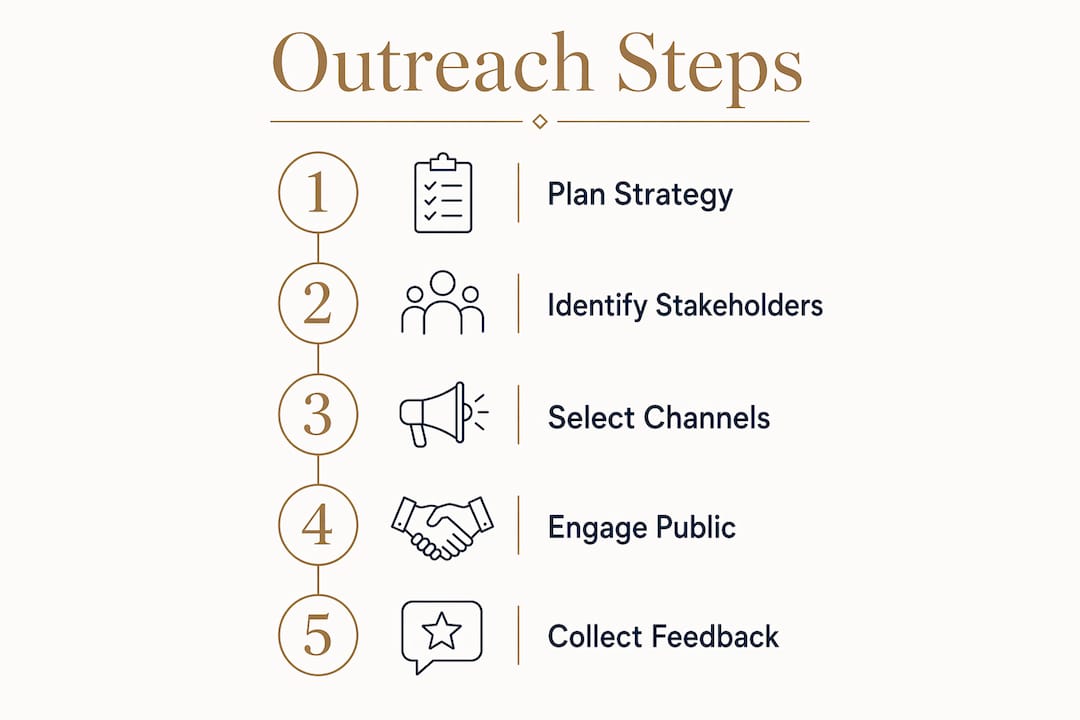
Execution follows a staged logic that mirrors the project’s own development phases. Each stage has a defined purpose, a specific set of tools, and a clear output that feeds into the next phase.
Launch a scoping consultation. Before any design work is finalized, publish a notice of intent that describes the project’s purpose, geographic scope, and the questions you are asking the public to address. Under NEPA, this notice triggers a formal comment period. Under GOV.UK frameworks, it initiates the pre-Gateway engagement phase. Either way, this step establishes the public record.
Map and segment your stakeholder groups. Use census data, land registry records, and local government databases to identify every affected party. Segment by proximity, legal standing, and demographic profile. Assign a specific outreach tactic to each segment rather than sending identical communications to everyone.
Design consultation activities around participation barriers. Schedule events outside working hours. Provide childcare at in-person meetings. Offer online and phone-based submission options alongside in-person attendance. The City of Burlington’s Civic Square Renewal project engaged broadly across residents and stakeholders, including voting on design concepts, and the resulting feedback directly shaped project priorities.
Collect and categorize feedback systematically. Use standardized input formats across digital and offline channels so that responses can be aggregated and analyzed without manual reclassification. Coordinating with IT early on data contracts and security protocols prevents the platform failures that erode public confidence mid-consultation.
Publish a feedback summary before the next project milestone. Closing the loop is the step most teams skip, and it is the step that determines whether future consultations attract genuine participation or cynical disengagement. Publish what you heard, what it changed, and what it did not change, with clear reasoning for each decision.
Iterate based on participation data. Track response rates by channel and demographic segment. If a particular group is underrepresented after the first phase, adjust the outreach tactic for that segment before the next consultation window opens.
What challenges and common mistakes undermine pre-launch outreach?
The most damaging mistake in community involvement in projects is treating outreach as a single event. Engagement designed as a one-off produces thin participation, generates accusations of tokenism, and leaves project teams without the granular community insight needed to anticipate opposition. Staged consultations aligned with project milestones produce better data and stronger public trust.
Common pitfalls to avoid:
Failing to close the feedback loop. If communities do not see how their input influenced decisions, they disengage from future consultations and become active opponents.
Scheduling consultations during sensitive periods. Avoid major holidays, harvest seasons in agricultural communities, and periods of local crisis. The NSW Consultation Guide specifically flags timing sensitivity as a participation determinant.
Underestimating platform complexity. Selecting and deploying a digital engagement platform involves planning its data contract, coordinating with IT for security and accessibility, standardizing input formats, and integrating offline feedback. Teams that skip this coordination face mid-consultation data failures.
Ignoring consultation fatigue. Communities that have been consulted repeatedly on similar issues without visible outcomes become resistant to new engagement requests. Acknowledge prior consultations explicitly and demonstrate what changed as a result.
Relying on self-selected participation. Online surveys and open comment forms attract the most motivated voices, which are often the most opposed. Proactive outreach to neutral and supportive community members produces a more representative dataset.
How do real projects demonstrate the value of early and sustained outreach?
Two projects illustrate what systematic, early engagement produces in practice.
The City of Burlington’s Civic Square Renewal engaged residents, Indigenous communities, and local stakeholders through multiple rounds of consultation, including concept voting and design feedback sessions. The process produced a project design that reflected community priorities rather than defaulting to the original municipal proposal. The engagement model demonstrates that inclusive feedback shapes project design in ways that reduce opposition and accelerate approval timelines.
The Arunachal Pradesh Siang Upper Multipurpose hydropower project in India offers a different scale of evidence. Through detailed, sustained deliberations with the Komkar village community, the project team achieved over 95% community consensus before pre-feasibility studies began. That level of informed consent is the direct product of early, transparent engagement rather than post-announcement damage control.
Project | Engagement method | Outcome |
City of Burlington Civic Square Renewal | Multi-round consultation, concept voting, Indigenous inclusion | Community feedback reshaped design priorities |
Arunachal Pradesh Siang hydropower | Sustained village deliberations, informed consent process | Over 95% community consensus before feasibility studies |
Both cases share a structural feature: engagement began before project parameters were fixed. That timing is the variable that separates projects with community support from projects with community resistance. When stakeholder outreach methods are applied after designs are finalized, communities correctly perceive the process as performative.
Key takeaways
Effective community outreach before project launch requires a documented strategy, staged consultations, and transparent feedback publication to build durable public trust.
Point | Details |
Start with a documented strategy | Define purpose, audience, and objectives in a Project Initiation Document before any public engagement begins. |
Combine digital and in-person channels | No single channel reaches all community members; mix platforms, events, and printed materials for inclusive coverage. |
Respect minimum consultation timelines | Plan backward from decision deadlines, accounting for translation, accessibility, and the 21-day minimum scoping period. |
Close the feedback loop publicly | Publish what you heard and what changed before the next project milestone to sustain participation and trust. |
Treat engagement as a staged system | One-off consultations produce thin data and community skepticism; align engagement phases with project milestones. |
Why early outreach is the most undervalued project investment
From my experience working across land use, infrastructure, and energy projects, the teams that treat pre-launch community engagement as a regulatory checkbox consistently pay for that decision later. Opposition that crystallizes after a project announcement is structurally harder to address than concerns raised during the design phase, because by the time the public hears about a finalized plan, the community’s posture has already shifted from inquiry to resistance.
What I find most instructive about the Burlington and Arunachal Pradesh cases is not the outcomes themselves but the timing. Both teams engaged before they had answers to defend. That posture, entering a community with questions rather than presentations, changes the entire dynamic of the relationship. It signals that the project can still be shaped, which is the only condition under which communities invest genuine effort in participation.
The balance between digital and in-person methods deserves more honest attention than it typically receives. Digital platforms are efficient and scalable, but they systematically underrepresent older residents, low-income households, and communities with limited internet infrastructure. Projects that rely primarily on online engagement tools are not conducting inclusive outreach. They are conducting convenient outreach and calling it inclusive. The NSW Consultation Guide’s insistence on multiple channels and four weeks’ advance notice reflects a hard-won understanding of how participation actually works in diverse communities.
The organizations that get this right treat community engagement as a continuous cycle with defined inputs, outputs, and feedback mechanisms, not a phase that ends when the comment period closes.
— Ignacio
How Amautapublicaffairs supports your outreach strategy
Amautapublicaffairs brings a campaign-style approach to pre-launch engagement that goes beyond standard public notice requirements. The team designs community outreach strategies tailored to the specific stakeholder landscape of each project, combining strategic messaging, digital advocacy, and field coordination to build genuine public support before a single permit is filed.
Whether your project involves land management, commercial development, or environmental permitting, Amautapublicaffairs evaluates the community context, identifies key stakeholders, and designs engagement programs that produce measurable results. The firm’s results-driven tactics are continuously refined based on real-time feedback, so your outreach investment compounds rather than stalls. Connect with the team to discuss how a structured engagement strategy can accelerate your project timeline and reduce opposition risk.
FAQ
What is community outreach before project launch?
Community outreach before project launch is a structured engagement process that involves affected stakeholders before project designs are finalized. It encompasses scoping consultations, feedback collection, and transparent communication about how public input shapes project decisions.
How early should outreach begin?
GOV.UK guidance directs teams to start engagement as early as possible, ideally at the project initiation stage before any design parameters are fixed. Early engagement produces better feedback quality and reduces the risk of opposition forming around a finalized plan.
What is the minimum consultation period required?
GOV.UK mandates a minimum 21-day scoping consultation before Gateway 1 self-assessment, while NEPA in the United States imposes its own formal comment periods for environmental review. These are regulatory floors, and most effective engagement programs run considerably longer.
How do you reach underserved or hard-to-reach communities?
The NSW Regional Communities Consultation Guide recommends combining digital platforms with in-person events, printed materials, and community radio, with at least four weeks’ advance notice. Partnering with local trusted intermediaries such as neighborhood associations and faith organizations significantly improves participation from underrepresented groups.
What happens if community feedback is ignored?
Projects that collect feedback without visibly acting on it face consultation fatigue and active opposition in subsequent phases. Publishing a clear summary of what changed and what did not, with reasoning, is the mechanism that sustains community trust across multiple engagement rounds.
Recommended
Comments