
Land Use Teams: Digital Advocacy Strategy, Legal Checks and Templates

A digital advocacy strategy is a coordinated plan that uses email, text, social media, petitions, and virtual events to move a defined audience toward a specific action that influences policy or a decision-maker. The critical components are measurable goals, a segmented audience, a tested core message, a channel mix, and a KPI framework that tracks actions, not just impressions. Done right, it converts scattered supporter interest into targeted pressure on the people who can actually say yes.
TL;DR:
Digital advocacy campaigns should prioritize clear, measurable goals focused on direct actions such as contacts made or signatures gathered.
Supporter segmentation and tailored messaging across channels significantly increase the likelihood of converting digital engagement into tangible influence.
Ensuring compliance with legal rules like TCPA, CAN-SPAM, and IRS lobbying limits is essential to maintain campaign integrity and prevent liabilities.
Using a coordinated campaign approach that integrates digital tactics with in-person efforts boosts overall effectiveness and responsiveness.
Tracking specific actions, conversion rates, and office responses provides the most reliable indicators of campaign success rather than impressions or follower counts.
Table of Contents
What Is Digital Advocacy, and Why Does It Matter Now?
Digital advocacy uses internet-based tools to mobilize supporters and apply pressure where decisions get made. That includes email campaigns, SMS outreach, social media, petitions, and virtual events, all aimed at a specific ask directed at a council member, agency official, or legislator.
Speed is the real advantage over offline organizing. A council vote scheduled for Thursday doesn’t leave time for a mailed postcard campaign, but it leaves plenty of room for a text alert that hits 3,000 supporters in an hour and routes them to a pre-filled email to the district office.
Digital-first works best for time-boxed decisions: a zoning hearing, a permit comment period, a budget vote. Integrated approaches, pairing digital with door-knocking, town halls, or earned media, tend to fit longer fights where trust-building matters as much as volume. AMAUTA’s land use and infrastructure work almost always runs integrated, since community engagement and advocacy communications have to move together with digital tactics rather than substitute for them.
Common digital advocacy formats include:
Email action alerts with one-click messages to officials
SMS and peer-to-peer texting for time-sensitive mobilization
Social media posts designed to be shared, not just viewed
Online petitions tied to a specific vote or hearing
Virtual town halls or public comment sessions
How Do You Build a Digital Advocacy Strategy From Scratch?
The sequence matters more than any single tactic. Skip a step and the campaign either burns out fast or never converts clicks into real pressure on a decision-maker.
1. Set goals tied to a policy outcome, not a vanity metric. “Get 500 signatures” is not a goal. “Generate 500 constituent contacts to the Planning Commission before the March 12 hearing” is. Every digital KPI, opens, shares, actions taken, should trace back to that outcome.
2. Separate your target from your audience. The target is the decision-maker: a commissioner, a state representative, a zoning board. The audience is who you’re activating to reach that target: residents, business owners, grasstops leaders. Segment your list by geography, prior engagement, and relationship to the issue, since a homeowner three blocks from a proposed rezoning needs a different message than a regional trade association.
3. Write one core message, then adapt it per channel. Draft a single, tight argument and build pre-approved templates from it: a 40-word email, a 20-word text, a social caption, a 10-second video script. Consistency across channels reinforces the ask; templates cut down on last-minute errors when volunteers are sending on your behalf.
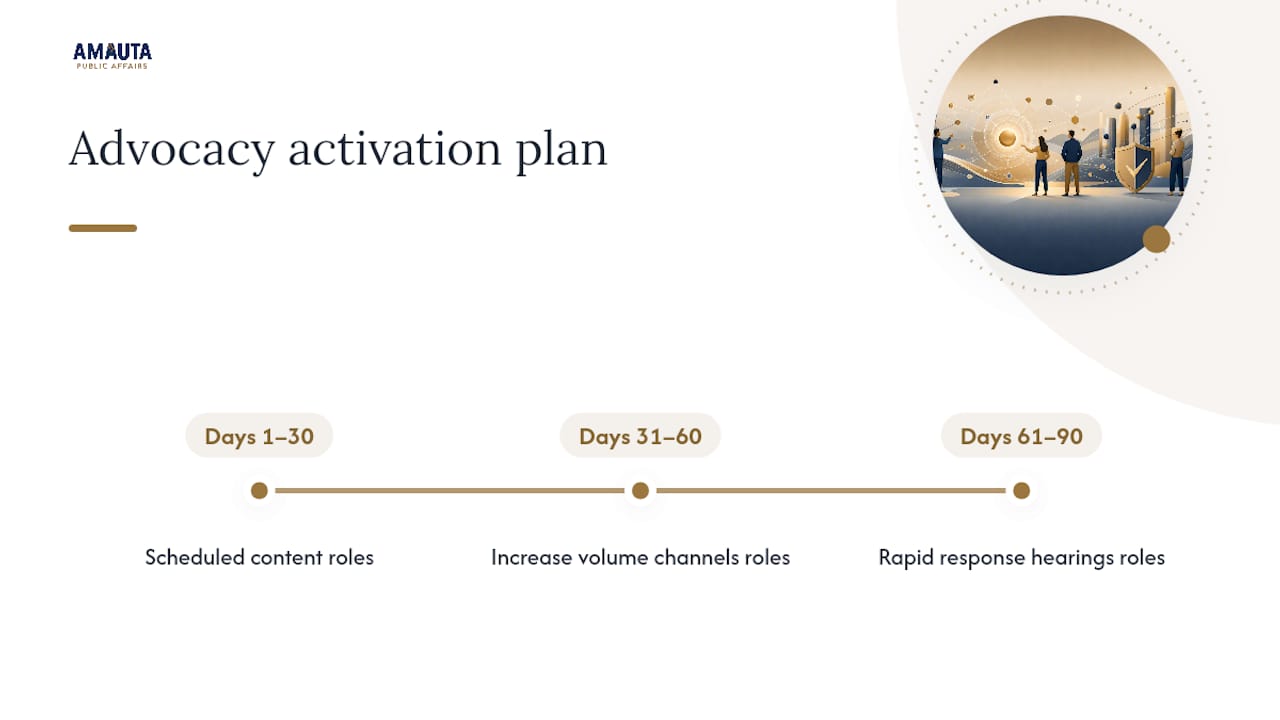
4. Map a 30/60/90 activation plan. The proactive and reactive organizing model works well here: build scheduled content for the first 30 days, escalate volume and channel count in days 31 to 60, and reserve days 61 to 90 for rapid response tied to actual legislative or hearing dates. Assign clear roles up front, who drafts, who approves, who sends, so a same-day rapid response doesn’t stall waiting on sign-off.
5. Choose a minimum viable toolkit before you choose features. You need a CRM to track supporter history, an email platform with automation, a peer-to-peer texting tool with two-way capability, and a landing page builder. Advocacy platforms with campaign customization and real-time reporting reduce manual tracking, but the toolkit should match your campaign size. A neighborhood coalition doesn’t need enterprise software; a statewide infrastructure fight probably does.
Pro Tip: Build your templates and approval workflow before you need them. The campaigns that lose momentum are almost always the ones scrambling to draft a rapid-response email the same night as a surprise vote.
Integrating supporter data into a CRM and routing high-value responses to staff for direct follow-up is what separates mass mobilization from targeted persuasion. A thousand identical emails to a council member reads as noise. Fifty personalized calls from constituents in the affected district reads as a mandate.
Which Channels and Tactics Actually Drive Action?
Every channel has its own mechanics, and treating them identically is the fastest way to underperform across all of them.
Email needs segmentation and automation to work at scale. Split your list by engagement level and geography, test subject lines on a sample before full send, and always give recipients a one-click action, a pre-filled message to an official beats a blank contact form every time.
SMS and peer-to-peer texting require documented consent and work best as two-way conversations, not blasts. Timing matters: a text sent the morning of a hearing outperforms one sent a week ahead, since urgency drives completion rates. Peer-to-peer platforms that let a live volunteer send from their own number, rather than an automated blast, tend to get higher response rates because recipients can reply and get an actual answer.
Social media splits into two jobs: organic content builds awareness, paid content drives reach into audiences you don’t already have. User-generated content, a resident’s photo with a handwritten sign, a short video testimonial, consistently outperforms polished graphics because it reads as authentic rather than manufactured.
Petitions and click-to-call tools convert best when the landing page does the thinking for the visitor. Pre-fill the message, show the target’s name and photo, and keep the form to two fields. Track every submission with a timestamp and source tag so you can measure which channel actually drove the action.
Virtual events live or die on the registration funnel. A confirmation email with a calendar link and a reminder text 30 minutes before start time cuts no-show rates significantly. Align every CTA during the event, chat prompts, verbal asks, on-screen graphics, to the same single action, and follow up within 24 hours while attention is still warm.
A majority of advocacy traffic now arrives on a phone, which means every landing page, petition form, and email needs mobile testing before launch, not after a volunteer reports a broken button mid-campaign.
Test every template on a phone screen before it goes live
Tag every action with source and timestamp for later analysis
Never send a peer-to-peer text without documented opt-in
Pair every social push with a landing page, not a bare link
Which KPIs Actually Prove Your Campaign Is Working?
Impressions and follower counts feel good and prove almost nothing. The KPIs that matter track how many people completed the actual ask.
Core metrics to watch:
Actions taken: emails sent to officials, petition signatures, calls placed
Conversion rate: percentage of people who saw the ask versus those who completed it
Reach: unique people exposed to the message across channels
Email open and click rates: benchmarked against your own list history, not industry averages
Replies from offices: direct responses from a legislator’s or agency’s staff
Set benchmarks from your own first campaign, then build a simple real-time dashboard tracking daily actions against your target number. If you need 500 constituent contacts by a hearing date and you’re at 80 with five days left, that’s the signal to shift budget toward paid social or add a second text push.
Triage every incoming response into support, neutral, or opposed categories as it arrives. Categorizing office responses in real time lets your team prioritize follow-up calls to neutral offices instead of spending staff time re-convincing supporters who already agreed. Automating that triage with tags and routing rules means a high-value lead, a swing vote’s office replying “undecided,” reaches a staffer within a defined window instead of sitting in an inbox.
Run a short post-campaign review after every effort: what channel drove the most conversions, which message variant won, where did drop-off happen in the funnel. Feed that into the next campaign’s KPI framework instead of starting from zero each time.
What Legal Rules Apply to Digital Advocacy Campaigns?
Compliance failures can shut a campaign down mid-flight or expose an organization to real liability, so run this checklist before launch, not after a complaint arrives.
Check TCPA requirements for every text. The Telephone Consumer Protection Act requires documented consent before sending automated or peer-to-peer texts, and violations carry real financial exposure. Keep opt-in records for every number on your list.
Review CAN-SPAM obligations for mixed-purpose emails. Any email that includes commercial content alongside advocacy messaging may trigger CAN-SPAM rules, which require a working unsubscribe link and accurate sender information.
Confirm IRS lobbying limits if you’re a nonprofit. 501©(3) organizations face expenditure tests on lobbying activity, and crossing certain thresholds may require filing Form 5768 or consulting counsel before scaling a campaign.
Keep an audit trail for every outreach action. Log who was messaged, which template was used, the timestamp, and the response received. That documentation habit protects you if a compliance question ever comes up and makes post-campaign reporting far faster to assemble.
Pro Tip: Loop in counsel before your first mass text send, not after a complaint. A five-minute compliance review costs far less than a TCPA dispute.
What Templates and Sample Calendar Can You Copy Today?
A one-click email template needs three parts: a subject line naming the decision, a two-sentence argument, and a pre-filled message the sender can edit before submitting. A phone script should open with the caller’s connection to the issue, state the ask in one sentence, and thank the staffer regardless of response.
For social, pair a short caption naming the target and the deadline with a single campaign hashtag and a photo of a real supporter, not a stock graphic. Training advocates with ready-made templates measurably increases participation because it removes the guesswork volunteers face when asked to write their own message from scratch.
Two mini campaign outlines show how objective connects to tactic:
Objective | Primary tactic | Expected metric |
Generate emails before a zoning hearing | Email blast + landing page | Conversion rate on send |
Fill a virtual town hall with attendees | SMS reminder + social event page | Registration to attendance rate |
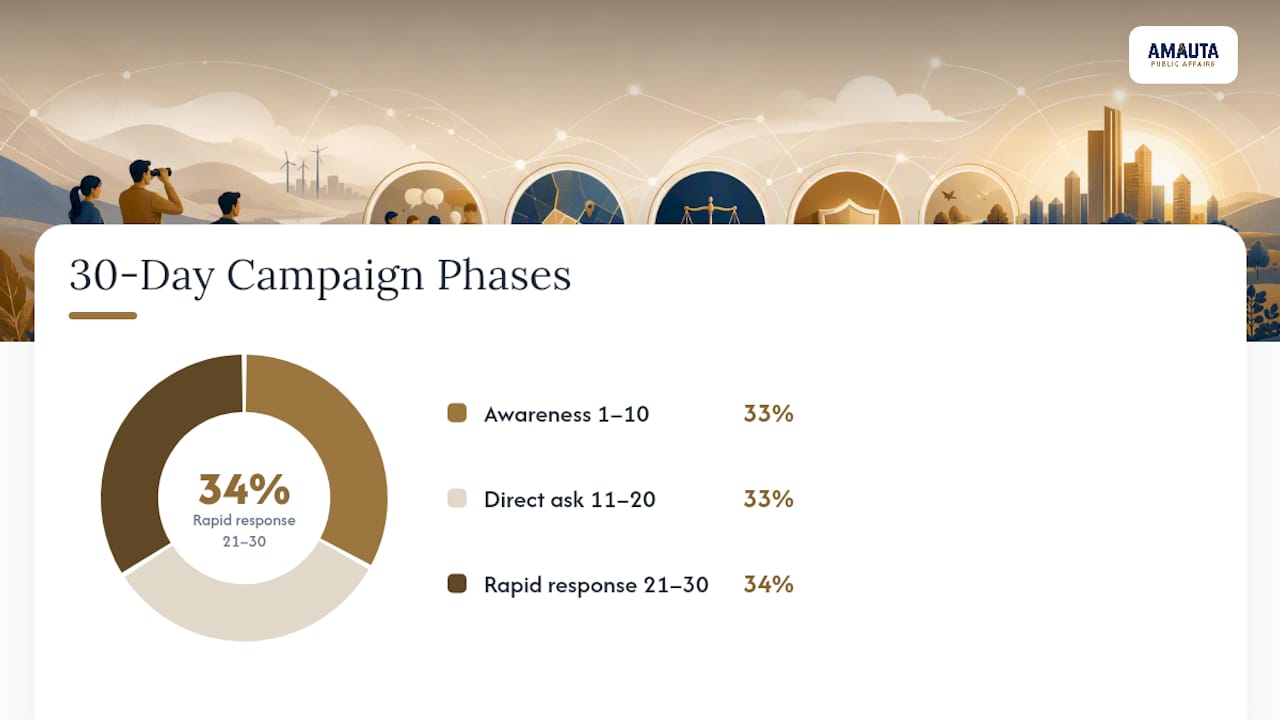
Build a 30-day calendar around three phases: days 1 to 10 for awareness content, days 11 to 20 for direct-ask emails and texts, and days 21 to 30 for rapid-response content tied to the actual hearing or vote date. Full tactical examples can help you adapt this cadence to your own timeline.
How Does a Campaign-Style Approach Change Digital Advocacy Outcomes?
A campaign-style approach treats digital advocacy as one coordinated system rather than a set of separate tactics run in parallel. Community engagement findings inform which message tests best; media relations timing dictates when a digital push should crest; digital advocacy tools then execute the ask at scale. That integration is the difference between a scattershot social push and a campaign that actually shows up in a hearing room as organized constituent pressure.
Iterative evaluation matters as much as initial planning. Messaging that tests well in week one often needs adjustment by week three, once real response data shows which argument actually resonates with a specific council district or agency audience. Refining outreach based on that live feedback loop, rather than sticking rigidly to the original plan, is what keeps a campaign’s ROI climbing instead of flattening out.
What Do Most Organizers Get Wrong About Digital Advocacy?
Most conventional advice treats digital advocacy as a volume problem: more emails, more followers, more impressions. That framing is backwards. A decision-maker’s office doesn’t count your social reach; it counts how many verified constituents contacted them and what they actually said.
The advice that gets underweighted is the compliance and documentation work, TCPA consent, audit trails, IRS lobbying thresholds. Organizers treat it as an afterthought because it doesn’t feel like campaign work. It is campaign work. A single TCPA complaint can freeze a mobilization effort at the exact moment a vote is scheduled, which defeats the entire point of building speed into your digital strategy in the first place.
If you prioritize one thing before scaling any tactic, prioritize the target-audience split and the message test. Everything downstream, channel selection, cadence, toolkit, works only if the core ask is aimed at the right decision-maker and phrased in language that audience actually responds to. Volume without that foundation just produces noise that’s easy for an office to ignore.
— Ignacio
How AMAUTA Public Affairs Turns a Digital Plan Into a Managed Campaign
Some organizations face challenges piecing together their own advocacy stack from disconnected tools and guesswork. Where a DIY approach means juggling a CRM, an email platform, and a texting tool with no one connecting the dots, AMAUTA runs community engagement, media relations, and digital advocacy as one integrated campaign, built around your specific decision-maker timeline rather than a generic template.
Organizations typically seek integrated support when a land use, energy, or infrastructure project needs organized public support fast, such as for a rezoning hearing, a permit fight, or a contested siting decision. A common outcome sought is a documented, defensible record of community support that holds up when the vote happens.
If you’re facing a hearing date and need a strategy built around it rather than adapted to it, review AMAUTA’s services and request a consult to scope your campaign timeline.
Sources
For legal detail and tactical templates referenced throughout this guide, consult LegalClarity’s advocacy compliance overview, the state digital organizing plan template, and Quorum’s digital advocacy guide. For a deeper look at legislative campaign coordination, see The PSC Group’s legislative advocacy strategies.
This article is general information, not a substitute for advice from a qualified lawyer. Consult a qualified legal professional about your own circumstances before acting on anything here.
FAQ
What Is Digital Advocacy?
Digital advocacy is the use of online tools, email, SMS, social media, petitions, and virtual events, to mobilize supporters and influence a specific policy decision or decision-maker.
What Are Some Examples of Digital Advocacy?
Examples include an email action alert asking constituents to contact a council member before a vote, a peer-to-peer text campaign urging turnout at a public hearing, a shareable social graphic tied to a hashtag, and an online petition addressed to a specific agency official.
What Are Some Examples of Advocacy Strategies?
Common strategies include coalition building with aligned stakeholders, media relations to shape public narrative, direct constituent mobilization through digital channels, and campaign-style community engagement that pairs in-person outreach with online action, an approach AMAUTA applies to land use and infrastructure projects.
What Are the 7 Pillars of Advocacy?
Definitions of advocacy pillars vary by organization and sector; there’s no single universally agreed list, so it’s worth checking the specific framework a given campaign or funder is using rather than assuming a fixed standard.
How Do You Measure Whether a Digital Advocacy Campaign Worked?
Track actions taken, conversion rate, reach, and replies from targeted offices, then benchmark future campaigns against your own historical data rather than industry averages.
Recommended
Comments