
Land Use Teams: 5 Research Backed Steps to Earn Social License
A social license to operate is the ongoing, informal approval a community and its affected stakeholders grant an organization, separate from any government permit. Definitions vary across the literature, but the consensus is clear: it rests on trust, credibility, and demonstrated ethical conduct, not paperwork. Losing it drives up permitting friction, invites reputational damage, and slows projects that already cleared every legal hurdle. Building it deliberately, using stakeholder mapping and structured community engagement, is the subject of the sections below.
TL;DR:
Only organizations that build genuine trust and credibility with the community can sustain strong social license over the project’s lifespan.
Active stakeholder mapping and culturally sensitive engagement are necessary before any meetings to ensure effective relationship-building and trust.
Regular, transparent communication coupled with visible follow-through on commitments prevents support erosion and reduces risks of opposition.
Silence from residents often masks disengagement, making proactive efforts to identify and address signs of declining support vital.
Power-sharing requires real leadership investment, including dedicated staff and governance structures, to avoid superficial community involvement that damages trust.
Table of Contents
What Does a Social License to Operate Actually Mean?
Scholars have not settled on one definition of the social license to operate, and that ambiguity has practical consequences for anyone trying to manage it. The YaleGlobal analysis of business legitimacy frames it plainly: government approval is not enough, because SLO is the community’s informal, ongoing acceptance, distinct from the legal permit sitting in a filing cabinet.
Peer-reviewed work breaks the concept into competing framings. One school treats SLO as social acceptance, a measurable state of tolerance among nearby residents. Another treats it as a set of drivers, the specific conditions (jobs, environmental safeguards, cultural respect) that produce acceptance. A third treats it as overall moral legitimacy, judging the organization’s right to operate at all. A fourth, moral authority, asks whether the organization has earned standing to speak on the issue in the first place. The ScienceDirect conceptual review warns that conflating these framings misdirects strategy: a team chasing “acceptance” metrics while the real deficit is moral authority will keep missing the target. Some researchers go further, proposing SLO as an institution with its own governance logic rather than a static yes-or-no condition.
Why Social License to Operate Matters for Your Bottom Line
Organizations with a durable social license move faster: fewer appeals, fewer late-stage design changes, and partnerships that survive a change in local leadership. Without it, the risks compound in predictable ways:
Permitting delays as officials respond to organized opposition
Reputational damage that outlasts the project itself and follows the organization to its next site
Heightened regulatory scrutiny once a project becomes politically visible
Coalition fractures, where former allies quietly withdraw support under pressure
The dangerous failure mode is “uncoupling,” where a project’s technical performance stays fine while community perception deteriorates unnoticed. Practitioners consistently observe that teams mistake the absence of vocal opposition for genuine acceptance, when silence is often just disengagement waiting to surface at the worst possible moment, usually during a public hearing.
What Are the Core Drivers Behind a Strong Social License?
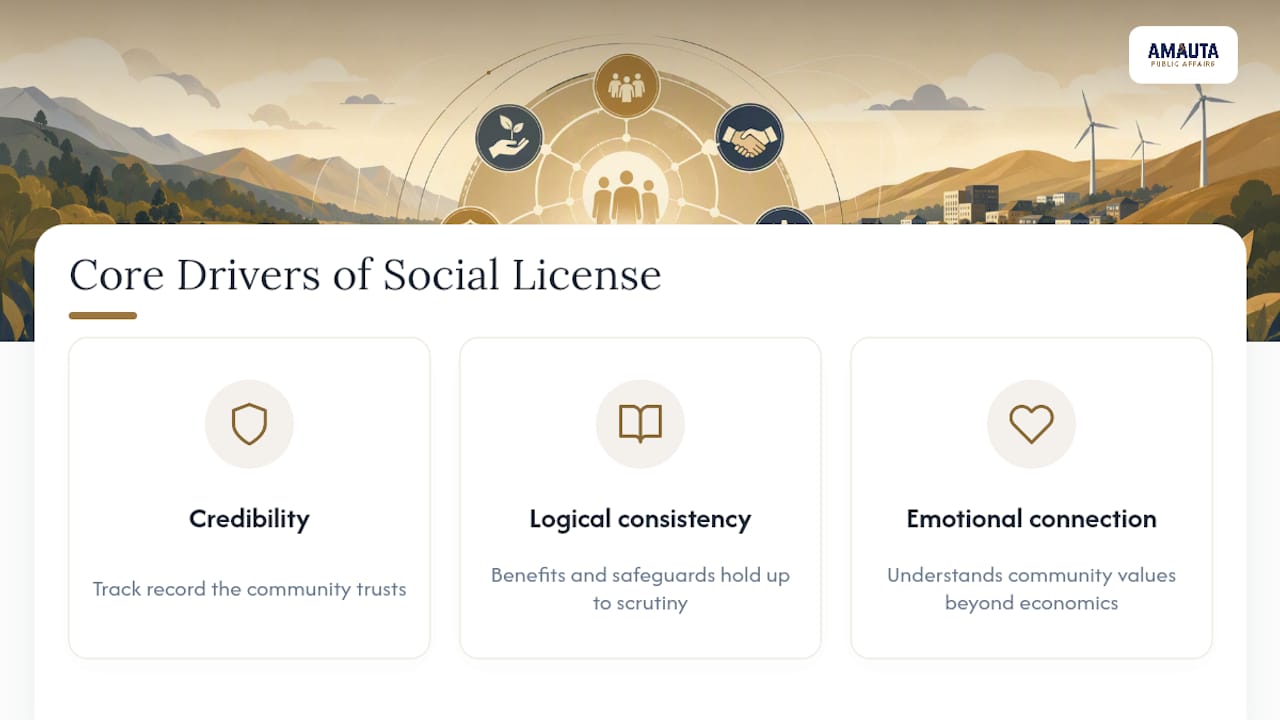
Three evaluation axes, borrowed from classical rhetoric, give practitioners a workable diagnostic. Credibility (ethos) asks whether the organization has a track record the community trusts. Logical consistency (logos) asks whether the project’s stated benefits and safeguards hold up under scrutiny. Emotional connection (pathos) asks whether the organization understands what the community actually values, beyond the project’s economic case. Together, these three predict how durable an SLO will be over the life of a project, not just at the ribbon-cutting.
Not every stakeholder carries equal weight, especially in contexts that require sensitive engagement with Indigenous groups as described in tribal relations. Some actors hold moral authority disproportionate to their formal power, a tribal council, a longtime neighborhood association, a respected local pastor, and dismissing them because they lack a legal veto is a common and costly mistake. A quick qualitative check works well here: Who do residents actually trust to tell them the truth about this project? Whose absence from a meeting would other residents notice? Those names deserve outsized attention regardless of their title.
How Do You Build and Sustain a Social License to Operate?
Building an SLO is sequential work, not a single town hall. Skipping steps to save time almost always costs more time later.
Map stakeholders and power. Identify who is affected, who influences opinion, and who holds informal moral authority, not just who sits on a permitting board.
Align objectives before engaging. Decide what kind of input you’re actually seeking, information, consultation, or shared decision-making, since promising one and delivering another destroys trust fast. The Principles of Community Engagement frame this alignment as the foundation of any sustainable relationship.
Design equitable, culturally sensitive engagement. This means genuine power-sharing, not information sessions dressed up as dialogue. NAM/CDC commentary is direct on this point: decision-makers must be willing to defer to community preferences on how and when engagement happens, not just where.
Communicate transparently and act visibly. Trust builds through demonstrated follow-through, not press releases. Transparent communication practices matter more once a commitment is made publicly, because that’s when residents start watching for whether it happened.
Institutionalize monitoring and feedback. Build governance structures, community advisory committees, published response timelines, that make responsiveness routine rather than reactive.
Pro Tip: Co-created monitoring committees with limited, clearly documented decision authority (not full veto power) tend to build trust fastest while avoiding the paralysis that comes from unbounded community control over every project decision.
Community engagement itself is both a science and a craft, requiring dedicated staff time and budget, not a volunteer side project bolted onto a communications intern’s job description.
What Warning Signs Suggest You’re Losing Community Support?
The clearest mistake teams make is equating silence with consent. A quiet public meeting can mean satisfaction, or it can mean residents already believe the outcome is fixed and stopped bothering to show up.
Watch for these signals:
Sudden negative coverage in local media after a period of calm
New grassroots organizing or petition activity that didn’t exist six months earlier
Declining attendance at official forums paired with rising activity on neighborhood social media pages
Former allies going quiet on public statements of support
Tokenistic consultation, where feedback is collected but never visibly acted on, produces exactly this pattern. When these signs appear, common trust-building missteps usually trace back to one root cause: engagement stopped being reciprocal. Reopening dialogue, sometimes with an independent third-party facilitator, and revising governance to give residents real input, is the standard remediation.
A Practitioner’s Checklist for Applying This Framework
A public affairs consultancy approaches land use, energy, and infrastructure projects with a campaign-style method that treats each community as its own distinct landscape rather than a template to repeat. That means assessing opportunities and setting priorities specific to the project’s actual terrain before a single meeting is scheduled.
The sequence collapses into five stages:
Assess: Map stakeholders, moral authority, and existing sentiment.
Plan: Set engagement objectives and choose the right mechanism, information, consultation, or shared authority.
Engage: Run culturally sensitive, power-sharing dialogue, not one-way presentations.
Act: Deliver visible follow-through on commitments made in the room.
Institutionalize: Build monitoring and governance so responsiveness outlives any single campaign.
Amautapublicaffairs applies this through community engagement, media relations, and digital advocacy, refining tactics against real-time feedback rather than a fixed script. Related tactical guidance lives in the stakeholder communication strategies for land use projects resource.
What Practitioners Get Wrong About Power and Patience
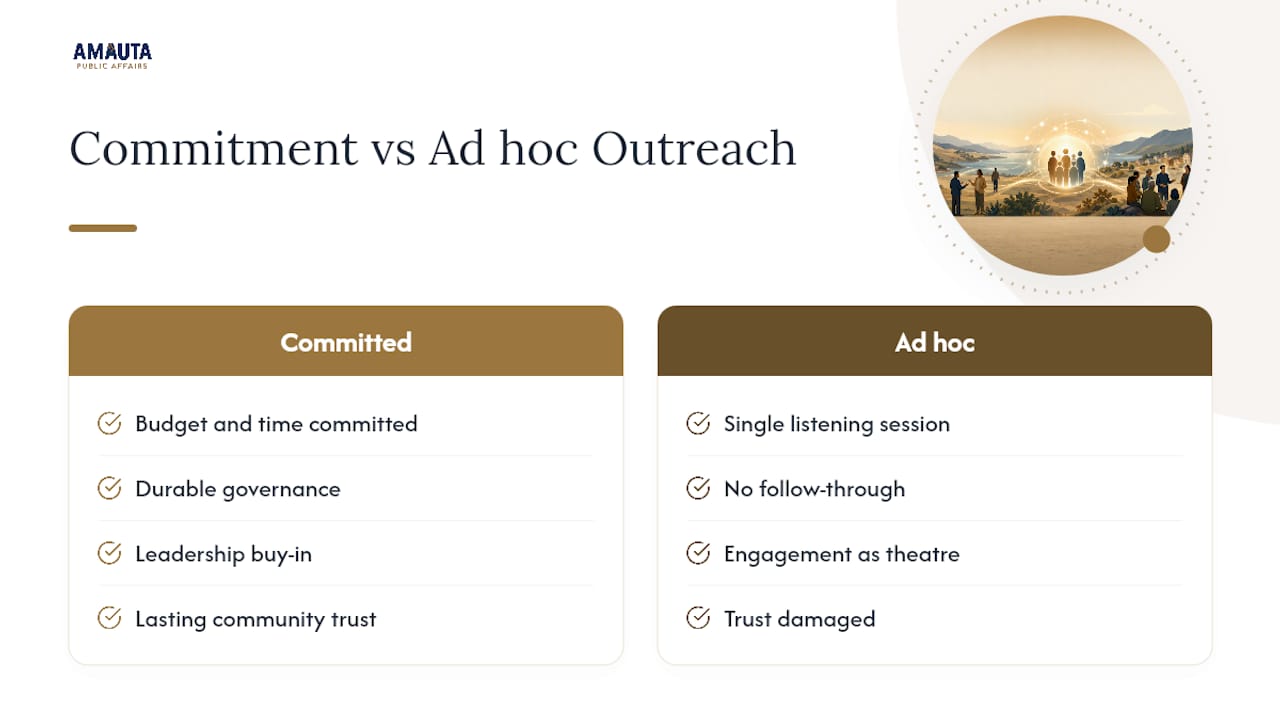
The lesson that keeps surfacing across this work is simple: power-sharing only counts when leadership has actually committed the budget and time to honor it. A single listening session backed by no follow-through does more damage than no session at all, because it teaches a community that engagement is theater.
Leadership buy-in and durable governance beat ad hoc outreach every time, since residents remember whether commitments outlasted the news cycle. Getting this right is less about charisma in the room and more about the structural commitment behind it, which is exactly where an experienced partner earns its keep.
— Ignacio
Let Amautapublicaffairs Run Your Community Engagement Campaign
Building a durable social license to operate is not a task most internal teams can run alongside their regular workload, and generic outreach templates rarely survive contact with a specific, skeptical community. Some consultancies provide campaign-style services that assess a project’s actual stakeholder landscape before recommending tactics, rather than applying the same playbook to diverse project types.
Community engagement, media relations, digital advocacy, and permitting support all work together in Amautapublicaffairs’s service lineup, refined continuously against real-time feedback instead of a fixed six-month plan. Projects tied to land use specifically benefit from the firm’s land management experience, where permitting timelines and neighborhood sentiment are especially tightly linked. If your project is facing a permitting deadline, organized opposition, or simply a community you haven’t fully mapped yet, start with a discovery call to assess where your current social license actually stands before the next public hearing.
Sources
FAQ
What Does a Social License to Operate Mean?
It’s the informal, ongoing approval a community grants an organization to operate, built on trust and credibility rather than any government permit.
How Do You Build a Social License to Operate?
Start with stakeholder mapping, align on genuine engagement goals, share decision-making power where appropriate, communicate transparently, and institutionalize monitoring so feedback triggers real governance responses.
What Is the Purpose of a Social License, and Why Does It Matter?
It reduces operational risk, smooths permitting, and protects reputation. Without it, organizations face delays, public opposition, and regulatory scrutiny even when every formal permit is in order.
Can a Project Lose Its Social License After Construction Begins?
Yes. SLO is dynamic, and uncoupling between perception and actual project performance can erode support well after a permit is granted.
Does Cultural Sensitivity Really Affect Social License Outcomes?
It’s central. Engagement that ignores local values or fails to recognize actors with moral authority, including tribal councils and community elders, consistently produces weaker, less durable support.
Recommended
Comments