
How Advocacy Communications Work for Civic Leaders

Advocacy communications is the practice of using strategic messaging and coordinated tactics to influence public policy, shift stakeholder behavior, and mobilize defined audiences toward specific, measurable actions. The field draws on disciplines including political communication, public relations, and behavioral science, though practitioners most often call it strategic advocacy communication or public affairs communication in professional contexts. Understanding how advocacy communications work is not a theoretical exercise. It is the prerequisite for any campaign that intends to move a decision-maker, build community trust, or translate public momentum into policy outcomes.
How advocacy communications work: core components
The Berkeley Media Studies Group defines advocacy campaign communication as operating across four distinct but interconnected layers: overall strategy, message strategy, media strategy, and access strategy. Each layer depends on the others. A campaign with a compelling message but no access strategy never reaches the decision-maker. A campaign with media coverage but no clear ask produces awareness without action.
Overall strategy sets the foundation. This layer defines the policy goal, identifies the key decision-makers who hold the authority to act, and maps the influencers who shape those decision-makers’ thinking. Without this clarity, every subsequent tactic risks misalignment.

Message strategy translates the policy goal into language that resonates with each audience segment. Effective advocacy messaging combines human stories with supporting data, because stories create emotional connection while data establishes scale and urgency. The message must also include a concrete, specific ask. Vague calls for “change” do not move decision-makers.
Media and access strategies determine how messages reach their intended audiences. These include:
Earned media: press coverage secured through newsworthy angles and prepared spokespeople
Paid media: targeted digital or print advertising to reach specific geographic or demographic segments
Owned media: the campaign’s own channels, including websites, email lists, and social accounts
Shared media: coalition partners and community organizations amplifying the message through their own networks
Pro Tip: Plan your media and access strategies simultaneously. Aligning spokespeople and timing with newsworthiness dramatically increases the likelihood of media pickup.
Measurement closes the loop. Trackable behavior outcomes are the only reliable indicators of campaign effectiveness. Metrics like media impressions or social shares are useful signals, but observable actions, such as constituent calls to a legislator’s office or sign-ons to a formal comment letter, confirm that communication translated into real-world engagement.
How do advocacy communications bridge awareness and action?
Awareness without action stalls advocacy campaigns. This is the most common failure mode in public affairs communication, and it stems from a fundamental misunderstanding of what communication is supposed to accomplish. Visibility is not the goal. Behavior change is.
The gap between awareness and action exists because knowing about an issue does not automatically produce the capability, opportunity, or motivation to respond. Cuttlefish Communications frames this as a prerequisite problem: audiences must have all three conditions present before they will act. A constituent who supports a policy but does not know how to contact their representative lacks capability. A supporter who wants to attend a public hearing but cannot take time off work lacks opportunity. A community member who agrees with the cause but feels their voice does not matter lacks motivation.
Effective advocacy campaign communication addresses all three conditions simultaneously. The sequence matters:
Reduce cognitive load. Present one clear, specific ask per communication. Asking audiences to call their senator, share a post, attend a meeting, and sign a petition in the same message fragments attention and reduces completion rates for all four.
Lower participation barriers. Provide direct links, pre-written scripts, and specific dates and times. Every additional step an audience member must take on their own is a dropout point.
Connect emotionally before asking logically. Human stories that validate data and close with a concrete ask follow the sequence that decision-makers and general audiences both respond to most reliably.
Offer multiple action levels. Not every supporter can attend a rally or testify at a hearing. Providing a spectrum of actions, from signing a digital petition to writing a personal letter, captures engagement across different capability and availability levels.
Reinforce with follow-up. A single message rarely produces action. Campaigns that communicate consistently across multiple touchpoints, and that report back on progress, sustain motivation over the longer arc of a policy campaign.
Pro Tip: Community Catalyst’s research shows that framing messages around voice and agency, rather than crisis or threat, reduces audience defensiveness and increases willingness to act across politically diverse groups.
What strategic frameworks do effective advocates use?
Two frameworks stand out for practitioners who want a repeatable structure for advocacy communications: the Berkeley Media Studies Group’s Layers of Strategy and GovCentre’s three-part messaging sequence.
Framework | Core Structure | Best Used For |
Berkeley Media Studies Group Layers of Strategy | Overall strategy → message strategy → media strategy → access strategy | Full campaign planning from goal-setting through deployment |
GovCentre Messaging Sequence | Lead with lived experience → validate with data → close with a concrete ask | Individual meetings, testimony, and written advocacy materials |
CDC Clear Communication Index | Plain language standards for public-facing materials | Reviewing and improving advocacy documents for accessibility |
Community Catalyst Voice and Agency Frame | Non-polarizing language → multiple action options → emotional grounding | Health-justice and equity-focused advocacy across diverse audiences |
The GovCentre sequence deserves particular attention because it directly addresses cognitive load for decision-makers. A legislator or agency official who receives a briefing that opens with a constituent’s lived experience, confirms the scale of the problem with credible data, and then presents a single, specific policy ask is far more likely to act than one who receives a data-heavy report with no human context and a list of ten recommendations.
Framing also shapes reception in ways that advocates frequently underestimate. The same policy position framed as a fiscal responsibility argument lands differently than the same position framed as a public health argument, even when the underlying facts are identical. Matching the frame to the audience’s existing values, rather than the advocate’s preferred framing, is a discipline that separates high-impact campaigns from well-intentioned ones.
Media readiness and timing are the operational expression of the access strategy layer. A spokesperson who cannot explain the campaign’s core ask in two sentences under pressure, or a story pitch that arrives the day after a competing news cycle dominates coverage, loses the window entirely.
How does integrating inside and outside advocacy multiply impact?
Coordination between lobby and communications teams multiplies impact beyond what either function produces alone. This is the inside-outside model of advocacy, and it is the structural difference between campaigns that shift policy and campaigns that generate awareness without outcomes.
Inside advocacy refers to direct legislative engagement: meetings with legislators and their staff, testimony at hearings, participation in regulatory comment processes, and coalition-building among policy stakeholders. Outside advocacy refers to the public-facing communication campaign that builds the political environment in which those inside conversations occur.
The two functions reinforce each other in specific, tactical ways:
Hyperlocal media outreach places constituent stories in district-level news outlets, giving legislators evidence that their own voters care about the issue before a lobby meeting occurs.
Digital advertising targeted to specific legislative districts creates visible public pressure that correlates with the timing of key votes or regulatory decisions.
Coalition toolkit distribution equips partner organizations with pre-approved messaging, graphics, and call-to-action templates, so the campaign speaks with a consistent voice across multiple channels simultaneously.
Earned media coordination times press releases and op-eds to coincide with legislative milestones, keeping the issue in public view during the periods when decision-makers are most attentive.
The WHO Europe’s 2026 operational guide on risk communication and community engagement frames this integration as a prerequisite for public health advocacy, noting that community trust built through consistent outside communication directly enables the credibility of inside policy engagement. The principle applies equally to land use, energy, and infrastructure advocacy. For advocates working on community engagement before a project launch, the 2026 community outreach guide from Amautapublicaffairs offers a practical framework for sequencing these efforts.
Flexibility is a non-negotiable feature of effective integrated campaigns. Political dynamics shift. A legislative champion loses a committee seat. A competing bill absorbs media attention. Campaigns that build in regular review cycles, and that maintain the capacity to redirect tactics without abandoning the overall strategy, sustain momentum through these disruptions.
What best practices build clarity and trust in advocacy messaging?
The Federal Plain Writing Act and the CDC’s Clear Communication Index establish a measurable standard for public-facing advocacy materials: language should be accessible to the broadest possible audience without sacrificing accuracy. Plain language is not simplistic language. It is precise language stripped of unnecessary complexity.
Transparency and trust are directly linked in advocacy communications, particularly when campaigns ask audiences to share personal stories, provide contact information, or take public positions. Audiences who understand who is asking, why, and how their participation will be used are significantly more likely to engage and to remain engaged over time.
Several practices consistently improve both clarity and trust:
Avoid polarizing language that signals tribal affiliation. Messaging that reads as partisan narrows the audience and triggers defensive responses in persuadable stakeholders.
Ground emotional appeals in specific, verifiable experiences rather than generalized claims. “Maria, a farmworker in Fresno, lost two weeks of income because of this policy” is more credible and more motivating than “workers across the state are suffering.”
Offer multiple ways to engage, calibrated to different levels of capacity and commitment. This respects audience diversity and captures participation that a single-action ask would miss.
Build iterative measurement into the campaign from the start. Advocacy communications function as a measurement problem disguised as a storytelling challenge. Campaigns that track observable behaviors, not just reach, learn what is working and adjust before resources are exhausted.
For advocates managing nonprofit media relations, these principles translate directly into how you pitch stories, frame spokespeople, and structure press materials for maximum credibility with journalists and editors.
Key takeaways
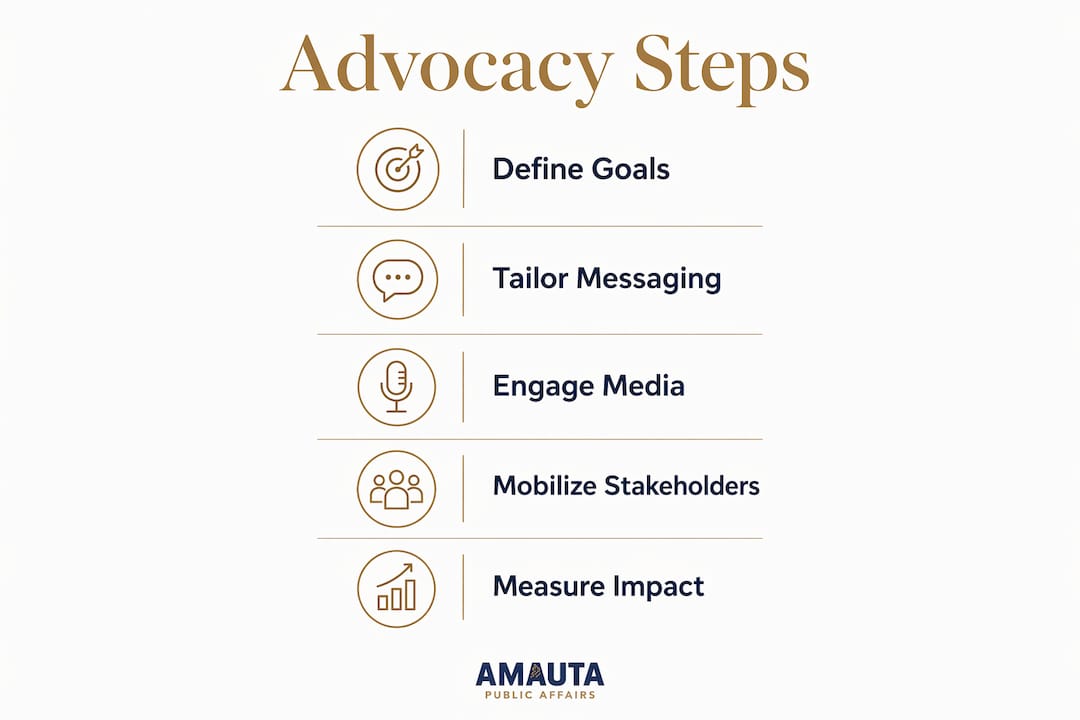
Effective advocacy communications require integrating clear goal-setting, tailored messaging, coordinated inside-outside tactics, and trackable behavior outcomes to move audiences from awareness to policy-relevant action.
Point | Details |
Define goals before messaging | Set specific, observable behavior targets before drafting any communication materials. |
Use the three-part message sequence | Lead with lived experience, validate with data, and close with a single concrete ask. |
Coordinate inside and outside advocacy | Align lobby engagement with public communication campaigns to multiply political impact. |
Apply plain language standards | Use CDC Clear Communication Index criteria to improve accessibility and audience trust. |
Measure behavior, not just reach | Track observable actions like constituent contacts and sign-ons, not only impressions or shares. |
Why most advocacy campaigns underdeliver on their own ambitions
The most consistent pattern I observe in advocacy campaigns that fall short is not a messaging problem. It is a coordination problem. The communications team is producing strong content while the lobby team is having entirely different conversations with decision-makers, and neither function knows what the other is saying in real time. Decision-makers notice the disconnect immediately. It signals that the campaign lacks internal coherence, which undermines credibility at exactly the moment you need it most.
The second pattern is substituting communication volume for policy specificity. A campaign that generates significant media coverage but presents decision-makers with a vague or multi-part ask has spent its political capital without producing a clear pathway to a decision. Specificity is not a constraint on ambition. It is the mechanism through which ambition becomes achievable.
The media environment in 2026 rewards campaigns that can operate across hyperlocal digital channels, earned media, and coalition networks simultaneously. The tools for this kind of multi-channel amplification are more accessible than they have ever been. But tools do not replace the discipline of clear goal-setting, honest audience analysis, and the willingness to measure what is actually happening rather than what you hoped would happen. Iterative learning is not a sign of a campaign in trouble. It is the sign of a campaign that intends to win.
— Ignacio
How Amautapublicaffairs supports your advocacy communications
Amautapublicaffairs brings a campaign-style approach to advocacy communications that integrates community engagement, media relations, and digital advocacy into a single, coordinated strategy. The team evaluates the community landscape before any tactic is deployed, identifies the key decision-makers and influencers who shape outcomes, and builds messaging frameworks that align inside policy engagement with outside public momentum.
Whether you are preparing for a land use hearing, building support for an energy project, or managing a multi-stakeholder public affairs campaign, Amautapublicaffairs designs the communication architecture that connects your policy goals to the audiences who can make them real. Explore the full range of advocacy communication services or connect with the team to discuss your campaign’s specific needs.
FAQ
What is the definition of advocacy communications?
Advocacy communications is the practice of using strategic messaging and coordinated tactics to influence public policy and motivate specific, measurable actions from defined audiences. It differs from general public relations in its explicit focus on behavior change and policy outcomes.
How do you measure the success of an advocacy campaign?
Success is measured through observable, trackable behaviors such as constituent contacts, public comment submissions, or legislative sign-ons, not through reach or impressions alone. The University of Florida’s UFCJC frames advocacy measurement as the discipline of distinguishing real-world impact from storytelling output.
What is the most effective advocacy messaging structure?
GovCentre recommends leading with a constituent’s lived experience, validating the scale of the problem with credible data, and closing with a single concrete policy ask. This sequence reduces cognitive load for decision-makers and increases the likelihood of a specific, actionable response.
How does plain language improve advocacy communications?
Plain language removes unnecessary complexity from advocacy materials, making them accessible to broader audiences and more credible to journalists and decision-makers. The CDC’s Clear Communication Index provides a practical scoring tool for evaluating and improving public-facing advocacy documents.
Why does coordinating inside and outside advocacy matter?
Coordination between lobby teams and communications teams multiplies political impact because public momentum created through outside communication directly strengthens the credibility of inside legislative engagement. GroundFloor Media’s advocacy communications framework identifies this integration as one of the six core steps for amplifying legislative efforts.
Recommended
Comments