
How Campaign-Style Advocacy Works: 2026 Guide

Campaign-style advocacy is a structured, coordinated method that mobilizes people, messaging, and resources to achieve specific policy or social objectives. Unlike one-time lobbying efforts, this approach relies on sustained multi-year engagement to shift decisions at the institutional level. The industry term for this practice is public affairs campaigning, and it draws on grassroots organizing, digital automation, paid content creators, and earned media to build pressure over time. Organizations from environmental nonprofits to land use developers use it to move decision-makers from awareness to action. Amautapublicaffairs applies exactly this model to complex land use and community engagement challenges, combining data-driven tactics with authentic stakeholder relationships.
How campaign-style advocacy works: core components
Understanding the advocacy campaign process starts with recognizing that every effective campaign is built on five interdependent elements. Miss one, and the whole structure weakens.
Set a concrete, specific objective. Vague goals like “raise awareness” produce vague results. A well-defined ask sounds like: “Secure a yes vote from three county commissioners by October 15.” Specificity gives every tactic a measurable target.
Map your decision-makers and influence pathways. Identify who holds the power to grant your objective, who influences those people, and what motivates each of them. A county commissioner responds differently than a federal agency director. Mapping these relationships before you communicate saves months of misdirected effort.
Develop behavior-focused messaging. Behavior change, not awareness, is the primary goal of any advocacy campaign. This means your messaging must address three factors: capability (does your audience know how to act?), opportunity (do they have access to act?), and motivation (do they want to act?). Messaging that only informs without removing barriers fails to move people.
Coordinate across multiple channels. Grassroots outreach, digital media, traditional press, and direct meetings with officials must reinforce the same narrative. Siloed channels create contradictory signals that confuse both supporters and decision-makers.
Deploy specific calls to action. Petitions, scripted phone calls to legislators, in-person testimony, and social media shares each serve a different function. Petitions demonstrate volume. Calls demonstrate intensity. Testimony demonstrates credibility. A complete campaign uses all three at the right moments.
Pro Tip: Write your primary ask on a single index card before you build any materials. If you cannot state it in two sentences, it is not specific enough to campaign around.
For a deeper look at how consulting firms structure these efforts, the policy advocacy campaign guide from Amautapublicaffairs walks through the full framework.

How do digital tools and automation enhance advocacy?
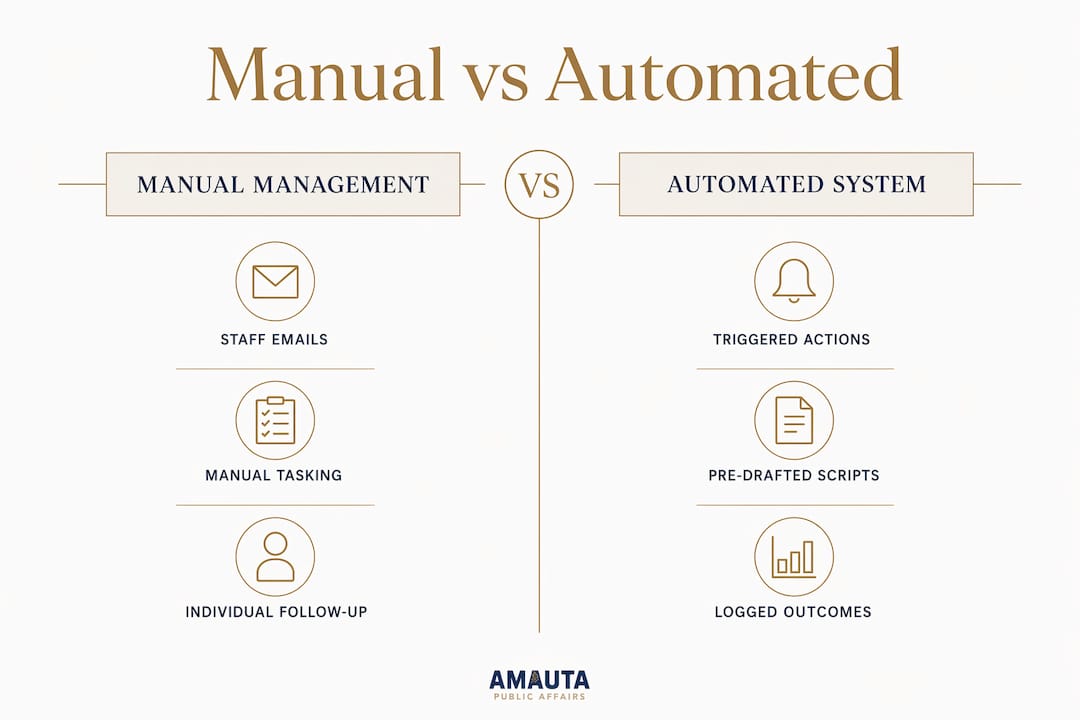
Digital automation transforms a campaign from a manually managed operation into a self-reinforcing system. The technology does not replace human judgment. It scales the actions that human judgment has already validated.
Here is how automation functions inside a modern advocacy campaign:
Threshold-based triggers: When a petition reaches 50 signatures, an automation platform can automatically notify the relevant legislative office and log the outcome in a CRM. That removes a manual step that often gets delayed or forgotten.
Sequenced supporter workflows: A supporter who signs a petition receives an automated follow-up asking them to call their representative. The system schedules the reminder, delivers the script, and records whether the call was completed.
Confirmation micro-actions: After a supporter completes a call, the system sends a brief prompt asking them to confirm. Confirmation micro-actions improve tracking accuracy and trigger the next step in the workflow automatically.
Pre-drafted call scripts: Providing supporters with a specific script raises legislator call completion rates by 3.4 times compared to general prompts. That is not a marginal improvement. It is the difference between a campaign that generates legislative contact and one that generates good intentions.
The table below compares manual campaign management against an automated approach across four operational dimensions.
Dimension | Manual Management | Automated System |
Supporter follow-up | Staff sends emails individually | CRM triggers follow-up based on action status |
Legislative notification | Staff compiles signatures and calls office | System notifies office at preset threshold |
Call completion tracking | Self-reported, often inaccurate | Confirmation micro-action updates CRM in real time |
Campaign reporting | Weekly manual summary | Real-time dashboard with action counts and outcomes |
Pro Tip: Before selecting an automation platform, map your supporter journey on paper first. Automation amplifies whatever process you already have. A broken manual process becomes a broken automated one at scale.
For organizations exploring digital advocacy campaigns that convert supporters into actors, Amautapublicaffairs has published practical guidance on triggering and tracking supporter actions effectively.
Paid creators vs. volunteer advocates: what is the difference?
The role of paid digital advocacy inside a campaign is frequently misunderstood. Paid creators and volunteer advocates serve different functions, and conflating them produces both strategic errors and compliance risks.
Influencer marketing is contract-driven, with paid deliverables and defined performance metrics. Advocacy programs, by contrast, are system-driven. They rely on volunteer or incentivized participation for long-term sustainability. The distinction matters because a campaign built entirely on paid content collapses the moment the budget runs out.
Recent political campaigns have tested hybrid models. The Tom Steyer campaign paid content creators roughly $10 per unique video plus performance bonuses tied to viewership goals. That payment model amplifies reach quickly but requires careful disclosure to maintain credibility with regulators and audiences.
The table below clarifies the structural differences between these two participant types.
Dimension | Paid Content Creators | Volunteer or Incentivized Advocates |
Motivation | Contract and payment | Belief in the cause, community identity |
Sustainability | Ends when budget ends | Continues with proper relationship management |
Disclosure requirement | Required by FTC guidelines | Varies by incentive level |
Best use | Rapid reach and narrative framing | Sustained pressure and authentic testimony |
A well-designed campaign uses paid creators to establish narrative reach early, then transitions to volunteer advocates for the sustained pressure phase. Paid media sets the frame. Grassroots mobilization applies the force.
What strategies make advocacy campaigns more effective?
Effective advocacy strategies share one characteristic: they prioritize relationships over transactions. A decision-maker who trusts you will take your call. One who views you as a pressure tactic will not.
Advocates who remain honest and acknowledge complexity become genuinely useful to decision-makers. That reputation spreads quickly in policy circles. A single advocate known for straight-talking engagement can open doors that a well-funded campaign cannot.
The most durable campaigns combine three media types into a single cohesive model:
Paid media frames the narrative and reaches audiences who have no prior connection to the issue.
Earned media provides third-party credibility that paid content cannot manufacture.
Grassroots mobilization creates the direct constituent pressure that decision-makers cannot ignore.
Managing these channels cohesively is critical because regulators and journalists scrutinize advocacy campaigns closely. A message that contradicts itself across channels destroys credibility faster than any opposition campaign can.
Storytelling combined with data is the most persuasive format for policy audiences. Data establishes the scale of a problem. A specific story from a named constituent makes that scale feel real. Neither works as well alone.
“The most influential advocates are those who become genuinely useful to decision-makers by remaining honest and willing to acknowledge complexity.” — An Advocate’s Guide to Influence Policy and Decision Makers
Measurement closes the loop. Every campaign should track not just outputs (signatures, calls, media placements) but outcomes (votes changed, policies amended, permits approved). Without outcome tracking, you cannot distinguish a busy campaign from an effective one. For a detailed look at how public affairs strategy connects these elements for policy professionals, Amautapublicaffairs covers the full framework.
Key takeaways
Campaign-style advocacy works because it combines specific objectives, sustained engagement, digital automation, and blended media channels into a single coordinated system that moves decision-makers from awareness to action.
Point | Details |
Specificity drives results | Define your ask in two sentences before building any campaign materials. |
Automation scales human judgment | Pre-drafted scripts raise call completion rates by 3.4 times compared to general prompts. |
Paid and volunteer roles differ | Use paid creators for rapid reach, then transition to volunteer advocates for sustained pressure. |
Honest relationships outlast tactics | Advocates known for straight-talking engagement build influence that money cannot replicate. |
Blended media creates cohesion | Paid, earned, and grassroots channels must reinforce the same narrative to withstand scrutiny. |
What i have learned running campaign-style advocacy
After years of working on land use and community engagement campaigns, the single most common mistake I see is treating advocacy like a sprint. Organizations invest heavily in a launch moment, generate a burst of activity, and then go quiet. Decision-makers notice the silence. It signals that the pressure was temporary, and temporary pressure rarely changes policy.
The second mistake is confusing digital reach with influence. A petition with 10,000 signatures from people outside a decision-maker’s district carries less weight than 50 calls from constituents who live in it. Automation tools are genuinely powerful, but only when they are pointed at the right audience. I have seen campaigns spend months building a large supporter list that had almost no geographic overlap with the officials they were trying to move.
The third mistake is underestimating the value of being useful. The advocates I have watched build lasting influence are not the loudest ones. They are the ones who show up consistently, acknowledge when the data is complicated, and offer decision-makers something they actually need: clarity. That is a harder discipline than running a social media campaign, but it compounds over time in ways that paid media cannot.
My practical advice: build your campaign around a three-year timeline, not a three-month one. Identify two or three decision-makers you want to develop genuine relationships with, and invest in those relationships before you need anything from them. Use digital tools to scale your supporter engagement, but never let automation replace the personal contact that actually moves people.
— Ignacio
How Amautapublicaffairs can support your advocacy campaign
Amautapublicaffairs brings a campaign-style approach to the complex challenges of land use, community engagement, and public affairs strategy. Every client engagement starts with a thorough evaluation of the community context, followed by tailored messaging and coordinated outreach across grassroots, digital, and media channels.
If you are ready to move from understanding how advocacy campaigns work to actually running one, Amautapublicaffairs offers the full range of support your effort needs. From initial strategy development to real-time campaign refinement, the team builds programs designed for measurable outcomes. Visit the services page to explore what a tailored engagement looks like, or get connected directly to start a conversation about your specific objectives.
FAQ
What is campaign-style advocacy?
Campaign-style advocacy is a coordinated, multi-channel effort to influence policy or social outcomes through sustained engagement, specific calls to action, and targeted messaging directed at decision-makers and their influencers.
How long does an advocacy campaign take to produce results?
Major policy shifts happen only after years of consistent engagement, not single events. Most effective campaigns operate on a three-year minimum timeline to build the relationships and pressure needed to move institutional decisions.
What is the role of paid digital advocacy in a campaign?
Paid digital advocacy establishes narrative reach early in a campaign, using content creators to frame the issue for broad audiences. It works best when paired with volunteer advocates who provide the sustained grassroots pressure that decision-makers respond to over time.
How do automation tools improve advocacy campaigns?
Automation platforms trigger supporter actions at preset thresholds, deliver pre-drafted call scripts, and log outcomes in a CRM. Scripted call prompts raise legislator contact completion rates by 3.4 times compared to general instructions.
What makes an advocacy campaign credible to decision-makers?
Credibility comes from honest, consistent engagement over time. Advocates who acknowledge complexity and provide decision-makers with genuinely useful information build reputations that open doors no amount of paid media can replicate.
Recommended
Comments