
How Local Media Relations Work for Organizations

Local media relations is the proactive process of building lasting, reciprocal relationships with local journalists to share relevant, newsworthy information that serves both the organization and the community. For government officials, developers, and civic organizations, understanding how local media relations work is not optional. It is the foundation of credible public communication. This discipline, formally known in public affairs as earned media strategy, operates on the principle that journalists need compelling, community-relevant stories and organizations need trusted channels to reach residents. When both sides of that exchange are served well, the result is coverage that shapes public perception with far more authority than paid advertising.
How local media relations work: the core framework
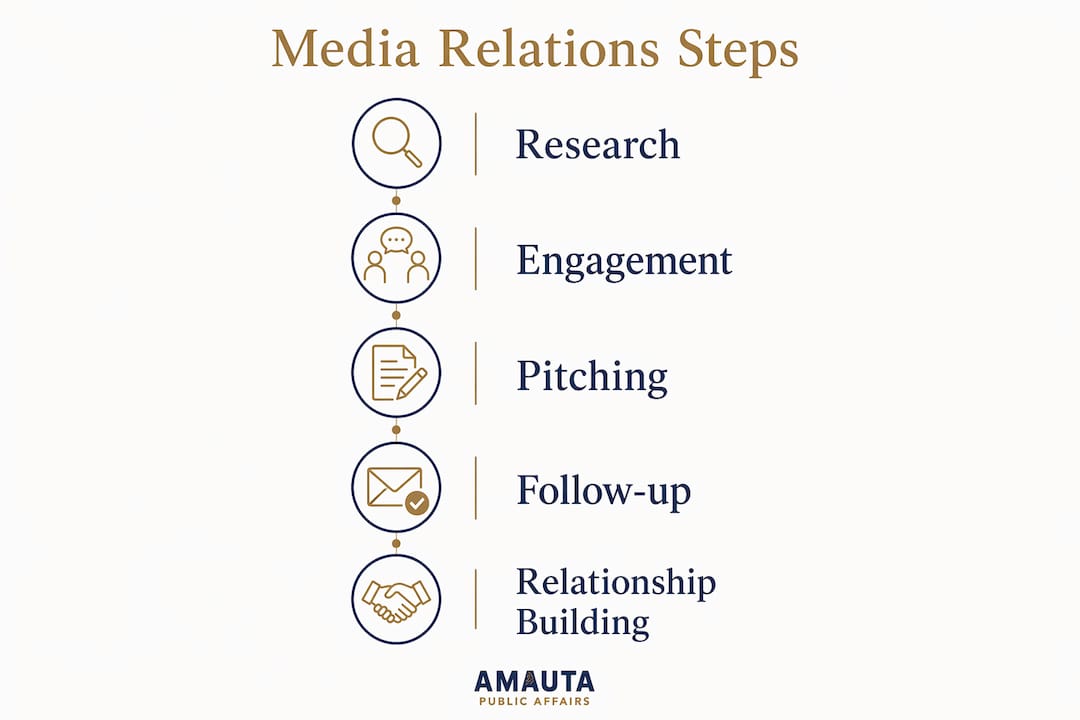
Earned media strategy is defined by three interlocking elements: research, personalized engagement, and sustained relationship management. Organizations that treat any one of these as optional consistently underperform in local press coverage.
The research phase is where most organizations fail before they even send a pitch. Effective local media pitching involves identifying 20 to 50 targeted local reporters, sending brief three to four sentence personalized pitches, and following up once, one week later. That number matters because it forces specificity. You are not blasting a list. You are selecting reporters whose beats, audiences, and recent coverage align with your story.

Personalized engagement means reading a journalist’s last five articles before writing a single word of your pitch. Reference their work. Explain why your story fits their beat. A city council member pitching a housing development to a reporter who covers education is a wasted email and a damaged relationship.
The follow-up discipline is equally precise. If no response follows a single follow-up, wait several months before approaching the same contact with a new angle. Persistence without patience destroys credibility faster than a weak story.
Build a targeted media list of 20 to 50 local journalists segmented by beat, outlet type, and audience geography.
Craft pitches of three to four sentences that lead with the community impact, not the organizational announcement.
Follow up once, one week after the initial pitch. After that, pause and reassess the angle.
Use wire services selectively. PR Newswire and Business Wire distribute press releases for $400 to over $1,500 depending on geographic scope. Wire distribution supplements direct outreach but does not replace it.
Monitor local coverage consistently using Google Alerts, Meltwater, or Cision to track journalists’ current interests and identify timely entry points.
Pro Tip: Set up a simple spreadsheet tracking each journalist’s name, beat, last three story topics, and your last point of contact. This prevents duplicate outreach and surfaces patterns in what each reporter actually covers.
How do you craft story angles that local newsrooms actually want?
Local newsrooms seek community-centric stories that connect organizational activities to tangible resident outcomes like job creation or neighborhood revitalization. Editors want a clear “why should readers care” answer embedded in the pitch itself, not buried in paragraph four of a press release.
The most common failure is generic corporate language. Announcing that an organization has “completed Phase 1 of a multi-year infrastructure initiative” tells a journalist nothing. Saying that 47 permanent jobs will open in the Eastside neighborhood by Q3, with 60% of positions requiring no college degree, gives a reporter a story their readers will click.
A GEO-relevant hook transforms generic corporate releases into localized, newsworthy content by including neighborhood names, concrete numbers, and community outcomes. This technique, drawn from Generative Engine Optimization practices, also improves how AI-driven search tools surface your content. Specificity serves both journalists and algorithms.
The table below illustrates the difference between weak and strong story angles for a development project announcement:
Weak angle | Strong angle |
“Company announces new mixed-use development” | “120 affordable units coming to Riverside District by 2027, cutting commute times for 400 families” |
“Organization completes environmental review” | “Wetlands preserved along Mill Creek corridor as part of approved Northgate project” |
“Project receives city approval” | “City approves transit-oriented development that adds bike lanes on three blocks of Central Ave” |
“Firm expands operations locally” | “Expansion adds 85 jobs in Southeast Portland, with apprenticeship slots for recent graduates” |
Pro Tip: Before writing a press release, write one sentence that answers: “What changes in a resident’s daily life because of this?” If you cannot answer that in one sentence, your story angle needs more work.
What are best practices for building long-term media relationships?
Media relations is not transactional. It is a long-term exchange where organizations provide journalists with helpful, non-promotional information, and journalists reward reliable sources with access and fair coverage. Organizations that understand this distinction become go-to sources. Those that do not remain one-time pitch senders.
Building relationships before needing coverage is the prerequisite most organizations skip. Share a reporter’s article on your organization’s social channels. Send a brief note when their coverage of a community issue was particularly thorough. Offer background data on a topic they are already investigating, with no ask attached. These actions accumulate into trust.
Concrete practices that sustain long-term media relationships include:
Become a reliable expert source. Offer commentary on local trends, zoning changes, or community data even when you have nothing to announce. Journalists remember sources who deliver value without an agenda.
Respect editorial independence. Never ask a reporter to soften a story or delay publication. Requests like these permanently damage relationships.
Leverage coverage across owned channels. Media coverage amplified on social media, newsletters, and websites maximizes SEO benefits and signals to journalists that their work reaches a wider audience through your network.
Complete the digital hand-off. After publication, verify that your website is linked in the story. A polite follow-up for backlinks secures SEO value that is otherwise lost. Most organizations never make this request.
Avoid mass pitching. Sending identical releases to 200 reporters signals that you have not done the work to understand any of them. Targeted outreach to 20 well-researched contacts outperforms mass distribution every time.
For government officials and developers specifically, the media relations strategy for professionals requires an additional layer of transparency. Public-sector communicators carry institutional credibility that can be lost quickly if journalists perceive spin over substance.
How do local media relations fit into broader community engagement?
Local media relations is a foundational component of community trust-building, not a standalone tactic. Coverage in a trusted local outlet carries social proof that no organizational website or social media post can replicate. When the Sacramento Bee or a neighborhood news site like Berkeleyside covers a project favorably, that credibility transfers to the organization behind it.
The integration of media coverage into broader engagement channels multiplies its impact. A single article in a local paper becomes a newsletter feature, a social media post, a website testimonial, and a reference point in public meetings. Organizations that treat coverage as an end goal rather than a foundational asset leave most of its value on the table.
Challenges in this space are real and require preparation:
Misinformation spreads faster than corrections. Strong, pre-existing relationships with local journalists give organizations a direct channel to provide accurate context before a false narrative solidifies.
Negative coverage is not the end. A reporter who trusts you will call for comment before publishing. That call is an opportunity. Organizations without relationships get no call.
Authentic communication is non-negotiable. Residents and journalists alike detect when an organization is managing perception rather than sharing genuine information. Transparent messaging, even when the news is difficult, builds more durable trust than polished spin.
For organizations preparing for project launches, the community outreach guide for 2026 outlines how media relations fits within a pre-launch engagement sequence that reduces opposition and builds early public support. The UK government’s recognition of local media’s civic role, reflected in its £12 million investment in local news infrastructure under the ‘Amplify’ Local Media Strategy, confirms that local journalism is a public good worth protecting and engaging strategically.
Key takeaways
Effective local media relations requires targeted research, community-centric story angles, and sustained relationship investment to generate coverage that builds organizational credibility and public trust.
Point | Details |
Research before outreach | Build a targeted list of 20 to 50 journalists segmented by beat and geography before sending any pitch. |
Lead with community impact | Replace corporate language with specific resident outcomes: jobs created, neighborhoods affected, timelines confirmed. |
Relationships precede coverage | Engage journalists with value before you need anything. Sources who give without asking get called first. |
Leverage every placement | Amplify coverage across social media, newsletters, and websites, and follow up to secure backlinks for SEO. |
Integrate with broader engagement | Media coverage is most powerful when it feeds into a larger community outreach and public communication strategy. |
Why relationship-first thinking changes everything in local media
I have watched organizations spend significant budgets on wire distribution and press release formatting while ignoring the single most important variable: whether the reporter on the other end of the pitch knows who they are. The technical mechanics of media outreach, the pitch length, the subject line, the timing, matter far less than the trust already in the room when that email arrives.
What I have found in practice is that the organizations generating consistent local press coverage are not the ones with the best press releases. They are the ones whose communications staff reads local journalism every morning, shares reporters’ work without being asked, and shows up at community meetings not to pitch but to listen. That posture, repeated over months, creates a relationship where a journalist thinks of you when they need an expert source, not the other way around.
The growing demand for hyperlocal, data-driven stories in local newsrooms in 2026 creates a genuine opening for organizations willing to do this work. Reporters at understaffed local outlets are actively looking for credible sources who can provide granular, neighborhood-level data and clear community context. If your organization holds that data and can communicate it without jargon, you are not just a pitch sender. You are a resource.
The mistake I see most often is treating a press release as the product. The press release is a tool. The relationship is the product. Build the relationship first, and the coverage follows with far less friction.
— Ignacio
How Amautapublicaffairs supports your media relations strategy
Amautapublicaffairs brings a campaign-style approach to local media relations that goes beyond press release distribution. For government officials, developers, and civic organizations, the firm designs tailored outreach strategies that assess the community landscape, identify the journalists and outlets that matter most, and craft messaging that connects organizational goals to resident outcomes.
Whether you are managing public perception ahead of a land use decision or building long-term credibility with local press, Amautapublicaffairs provides the strategic framework and hands-on execution to make coverage work for you. Explore the firm’s media relations services or take the first step by visiting the Get Connected page to discuss your specific engagement goals.
FAQ
What is the definition of local media relations?
Local media relations is the strategic, ongoing process of building reciprocal relationships with local journalists and outlets to share newsworthy, community-relevant information. It is a core component of earned media strategy and public affairs communication.
How many journalists should you target in a local media outreach campaign?
Effective local media pitching targets 20 to 50 relevant local reporters, selected by beat and audience alignment. Targeting fewer contacts with personalized pitches consistently outperforms mass distribution to larger lists.
How do you make a story angle compelling for local newsrooms?
Local editors prioritize stories with a clear community impact, such as job creation numbers, neighborhood-specific outcomes, or resident quality-of-life changes. Including geographic specifics, concrete metrics, and a direct answer to “why should residents care” significantly increases pickup rates.
How often should you follow up after a media pitch?
Follow up once, approximately one week after the initial pitch. If there is no response, wait several months before approaching the same journalist with a new angle. Repeated follow-ups without a response damage the relationship.
How does media coverage support SEO for organizations?
Coverage in local outlets generates backlinks to your website, which improves search engine rankings. After publication, organizations should verify that their website is linked in the story and make a polite request for a backlink if one is missing, securing SEO value that would otherwise be lost.
Recommended
Comments